


Dear Jomrade,
Today we’ve published:
- “Singapore This Week”, by Jom
- “Syncretic sorcery: how Singaporean spiritualists are making healing their own” by Tsen-Waye Tay
Eat more durians. Ride the Circle Line. Watch a bit of football.
That’s my to-do list this weekend.
Like other durian aficionados, I’ve lamented the spike in prices over the past decade, driven by the boom in consumption in Mainland China. Why couldn’t rich Chinese be content with truffles and wine, why did they have to develop a taste for our “stinky” fruit, boo. There is no doubt much to admire about their market’s sophistication and their durian entrepreneurs’ zeal.
Still, high prices (and an ageing gut) have forced me to curb my consumption, so I was thrilled to read this week about Malaysia’s “durian tsunami”, which has caused prices of Mao Shan Wang in KL to plunge from RM60 (S$19) per kg two years ago to RM10 (S$3) today. What?!? Time to whack. Perhaps there is virtue in living in harmony with the Malayan land’s bounty, consumption in sync with relative abundance and scarcity. Sorry, microbiome, and HPB. “Not more than four seeds per sitting”? Right.
And good luck to those who bump into me on the Circle Line right after. When I watched the video of the Austrian man who had flown halfway across the world just to experience the loop’s completion, I felt like that child unappreciative of their family’s achievements, who awakens only upon external validation.
One of my favourite activities when exploring cities overseas is to choose a subway line that criss-crosses income and ethnic divides, and just travel its extent, observing the churn of fellow humans. I think of the District Line in London, Shanghai’s Line 2, or, my favourite, the 7 train in New York City, which starts in the Hudson Yards on the West Side, passes through Times Square as it cuts east across Manhattan, and ends on Main Street in Flushing, Queens. You enter in the funk of New York and exit in what seems like the Pearl River Delta.
Sure, Singapore’s approach to multiculturalism precludes the formation of “ethnic ghettos”, so riding the MRT will never yield such urban diversity. Still, the journey from Raffles Place to Pasir Ris, where I live, is transformative in its own way (suits -> athleisure). The updated Circle Line map shows new connectivity from Marina Bay through to Harbour Front—an area that, anecdotally, seems to be attracting more well-heeled young professionals and the monied elderly looking to downsize. Will more of them now ditch their cars for the train? Pair that with Sundays at Paya Lebar, a riot of colours and sounds with our beautiful migrants, and maybe it’s now time to feel SG’s shifting social milieu on the Circle.
And yes, finally, there’s the World Cup Final on early Monday morning. (Free on Ch 5, on terrestrial or through mewatch.) The last final was watched by about 1.5bn people, or almost one in five humans—there are few other things that connect us as much. A couple of months ago, Abhishek and I co-authored a commentary about why Singaporeans should boycott most of it (to stem the flow of funds to the corrupt, venal FIFA). True to our word, we’ve each watched fewer than five matches this time.
Even for non-football fans this tournament has been fascinating, crystallising so many contemporary global themes, including: Trump’s political machinations; pro-Palestinian activism by the Egyptian coach; racism and xenophobia as a right-wing, nativist Paraguayan politician derides France’s immigration openness (after their team beat hers); and the commercial and marketing juggernaut that is Brand Beckham.
So, well, gulp. As much to my colleagues, dear reader, as to you: I may not be very responsive on Monday morning.
- Why the conclusion of Shan and Tan versus Bloomberg is worrying
- Are robots the answer to our construction labour woes?
- How content creators are turning homes into monetisable spaces
- “Charged”, the critically acclaimed play exploring racial tensions gets a rerun next week
- Obituary of artist Chua Mia Tee
Above are the issues we chose to explore in more depth.
Other news this week included: Tharman extols Malayan brotherhood on first state visit to Malaysia; RSIS’s Ariel Tan analyses last week’s Johor state election; economic growth eases in Q2; Singapore contributes S$2.5m to support Ebola outbreak response in Congo and Uganda; the Auditor-General’s annual report finds lapses and irregularities across the government, including 120 people entering casinos despite exclusion orders; IRAS nabs 279 high-income earners over sham tax arrangements; more seniors living alone; the tragedy of Abdul Rani, the caregiver who snapped; a Singapore international school provokes nativist backlash in Sapporo; Sheng Siong’s new S$520m facility; FairPrice to remove vegetables from at least three local farms; SCMP on how scammers are using AI-generated visuals of leaders’ faces to con you; CNA analysis of AI-generated women spreading disinformation about Singapore on TikTok; three in five PMETs not confident in identifying AI-generated misinformation; ketamine therapy at IMH for hard-to-treat depression; ST obituary of Jeffrey Low, sports journalist who coined the Kallang Roar; the Circle Line completed; some 25 ha of forest to be cleared for housing “designed around nature” in Gillman Barracks and at Sunset Way, sparking environmental concerns; and Malaysian durian parties as prices crash.
Join 1,700 members keeping Jom independent. From S$10/month—full access, no compromises.
“Syncretic sorcery: how Singaporean spiritualists are making healing their own” by Tsen-Waye Tay
Waye, one of Jom’s co-founders, doesn’t write as much as I wish she would. But then again, that’s because her method involves months of patient research and deliberation, often spent with vulnerable or disenfranchised communities.
Long-time Jom readers may remember her first piece, a meditation on mental health told through her own struggles. Another one on generational shifts in caregiving from 2023 portends many contemporary discussions, while the one titled “Who deserves healthcare?”, about those afflicted by spinal muscular atrophy (SMA), was the first Jom essay to be assigned in our university classrooms.
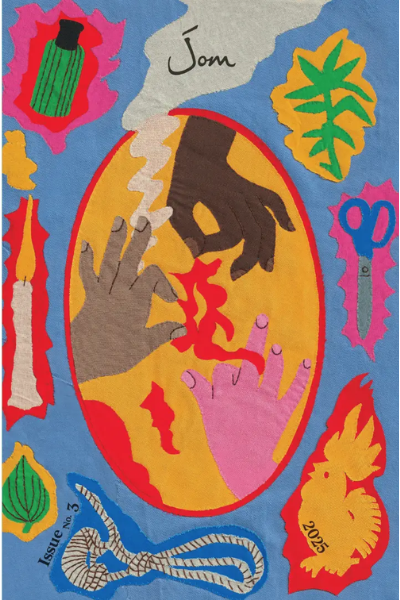
For today’s piece, which was first published last year in print issue No. 3, she steps into the magical and macabre. Even for somebody fairly enthusiastic about the astrological and new age leanings of a certain set—I’ve lost count of my Millenial/Gen Z tarot card reading friends—there was so much in Waye’s piece, from bomohs to Wicca and witchcraft, that had me gasping. All this in Singapore? Here’s a bit from her opening:
“Little Luna had the ‘gift of sight’. She could glimpse what others in the material world were oblivious to: a parallel dimension filled with spirits, deities, angels, djinns, and nebulous energies. To her, this ability to glance between realms felt less a blessing than a curse—a split screen of horrors that haunted her childhood. Luna was so disturbed by these encounters that at 26 years old she still recalls them vividly.
Like the first time she came face-to-face with an otherworldly entity. A sinister-looking silhouette outside her bedroom, its frightful features framed by the moonlight. All pointy ears, glowing white eyes, and sharp teeth. She was just four.
‘What the hell do you want?’ it snapped in Malay.
‘A glass of water,’ she said.
‘Take it yourself.’
‘No, I’m scared.’
‘What of?’
‘…you.’
‘Come here,’ it coaxed, beckoning her to follow it to the kitchen.
Who knows what might have happened if she had. Instead, she woke her mother. The lights revealed nothing. A rustling in the storeroom proved equally empty.
Later, from her parents’ bed, she watched a ball of fire float outside the window, a lupine face at its centre. A fiery spectacle that only she could see.
…Raised Muslim, Luna felt abandoned by her religion from an early age. Despite her pleas, Luna’s God seemed unable to shield her from the paranormal. Faced with a crisis of faith, she sought spiritual support and guidance online, where a playground for Western esotericism and its practitioners was spreading…”
Jom fikir
Sudhir Vadaketh
Editor-in-chief, Jom
Behind Jom’s art with Charmaine Poh
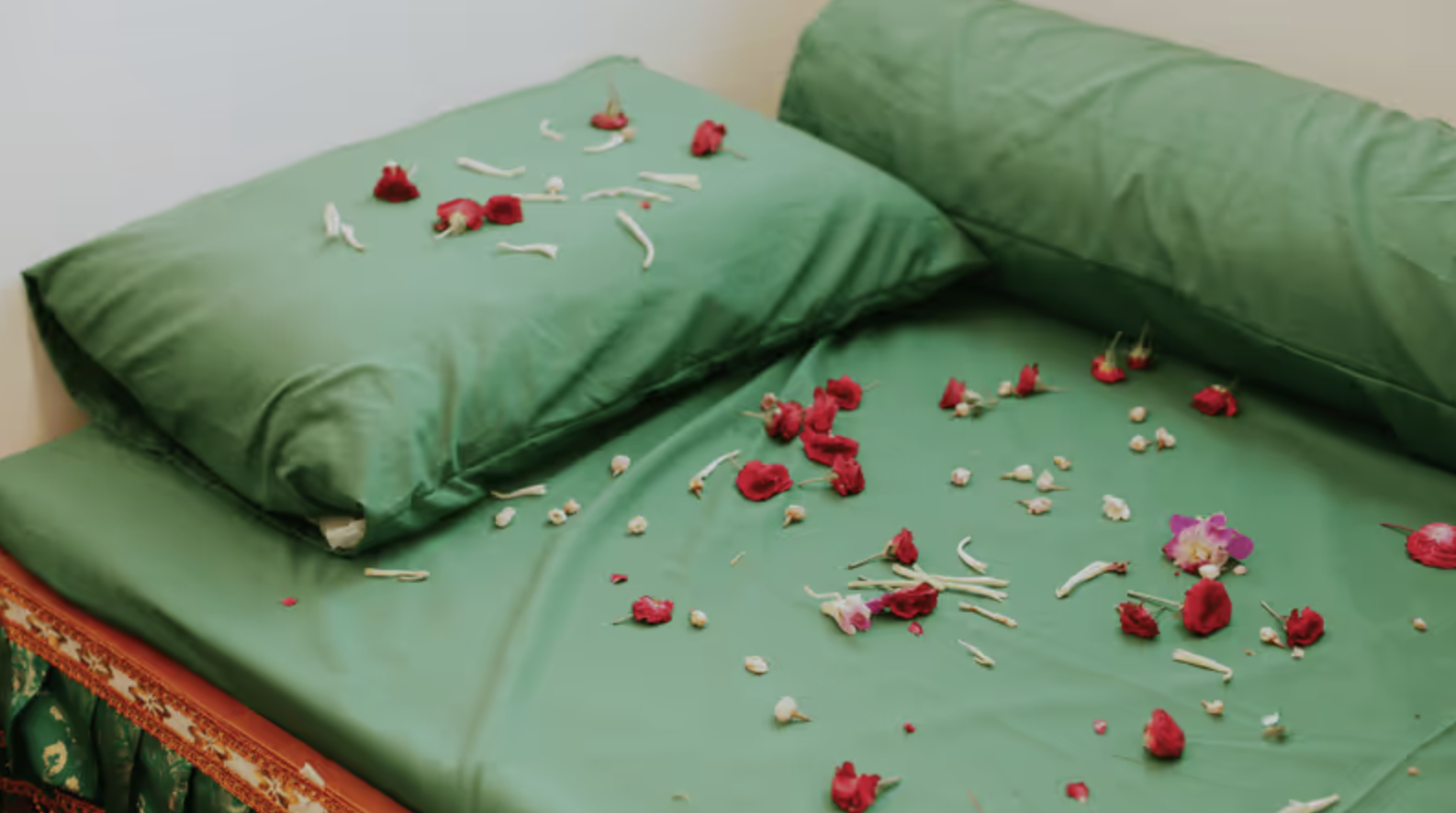
Longtime photographic contributor Kathy-Anne Lim carefully documents the spiritual practices mentioned in the essay, focusing on portraiture, objects, and textures. Her intriguing header image of flowers on a bed draws the viewer in, yet withholds explicitness in favour of subtlety. It's a befitting companion to Waye’s in-depth, detailed exploration of the occult, which resists oversimplification and stereotypes. Kathy-Anne’s portrait of Luna, one of the essay’s protagonists, does something similar: with the focus on the smoke wafting from the incense stick, we are guided to pay attention to the intangible elements in the photograph, a nod to the mysteries beyond our grasp.
Jom on soul searching
 Marissa Lee
 Toh Ee Ming
 Damien Thow Xin Wei
 Faizah Zakaria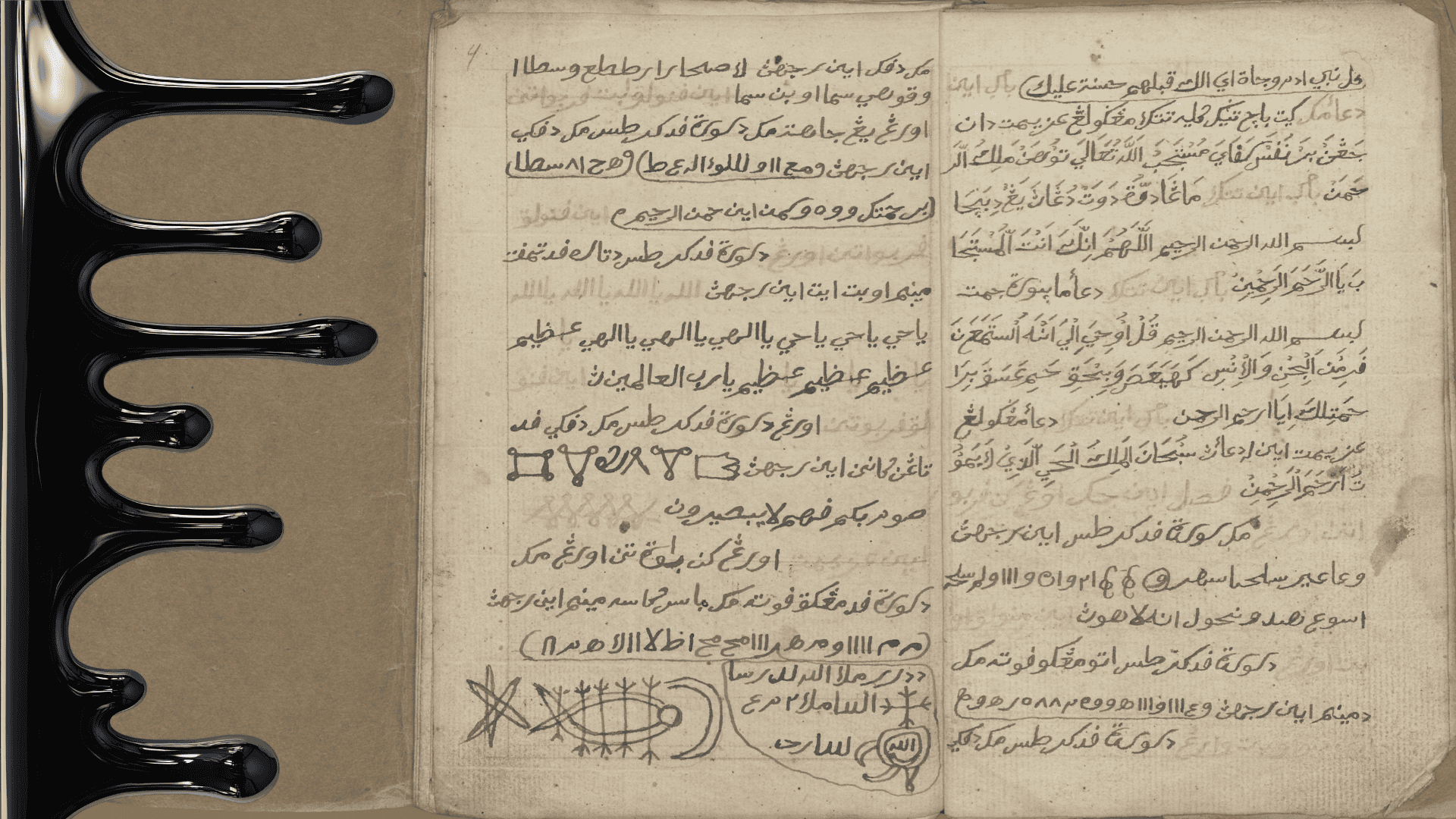
Singapore This Week
Society: Poor ministers defamed

Few public figures are as polarising as K Shanmugam, Singapore’s fearsome home affairs minister. For over three years, his housing has been under scrutiny. First were revelations that he’s been renting from the government a palatial colonial bungalow on Ridout Road; and subsequently that he sold a good class bungalow (GCB) on Astrid Hill for S$88m, or almost 150 times the value of a median resale flat. With the former, he emerged unscathed from a ministerial review. And this week saw the dénouement of the latter saga, when a court found that Bloomberg and its reporter Low De Wei had defamed him (and manpower minister Tan See Leng) in an article, “Singapore Mansion Deals Are Increasingly Shrouded in Secrecy”.
Though the accuracy of Bloomberg’s reporting on both ministers’ respective GCB transactions was not disputed in court, in her judgement Audrey Lim, high court judge, mentioned “material falsehoods” and repeatedly referenced the “impression” that was being conveyed to the reader, concluding that “the natural and ordinary meaning of the Article is that the claimants took advantage of the absence of checks and balances or disclosure requirements to conduct their property transactions in a non-transparent manner, and that they did so in order to hide their transactions and avoid scrutiny that might extend to the possibility of money laundering.”
Bloomberg’s editor, while respecting the ruling, said “we continue to believe that the ministers have imposed an extremely strained meaning on what was a solid story.” This too is our view. We worry that such interpretations by the subjects of stories will have a chilling effect on all journalists. It’s notable that while the mainstream media regularly reports on property transactions by the rich, it appears to shy away from the political elite. Put another way, such public interest journalism is not being performed by our taxpayer-funded behemoths. Sure, not all in this country would agree with this purpose. “[T]here isn’t any legal recognition or political acceptance of the media as a Fourth Estate,” SMU’s Eugene Tan told The New York Times.
But maybe there should be. This is a world where wealth and power are increasingly concentrated in the hands of plutocrats. The wealth gap between Singapore’s senior politicians and ordinary citizens appears to be widening by the day, whether through property dealings or otherwise. Unlike many other democracies, Singapore doesn’t require public asset declarations by its politicians. How might personal investments in, say, Singapore landed property, Chinese firms, or AI bias one’s policy decisions? Even if we accept that our current politicians are squeaky clean, will it always be so?
These weren’t Bloomberg’s lines of inquiry, but we worry about the judgement’s broader impact on such interrogations. In his response, Shanmugam said that he chose to “bring defamation proceedings” because if “irresponsible outlets like Bloomberg get away with publishing lies and falsehoods about public officers, it will set a new norm” that might eventually deter others from seeking public office. It’s a puzzling assertion. None of these property “scandals” appear to have affected Shanmugam’s popularity—his team romped home with 73.81 percent of the vote at GE2025. And the ruling People’s Action Party (PAP) has such a robust pipeline that it was able to introduce a whopping 32 new faces last year, nudging five MPs out after just one term.
On the contrary, beset by digital disruption and other forces, the media industry globally is staring into the abyss. The vulnerable group in Singapore is not PAP politicians but journalists. Any suggestion of victimhood by the former effectively functions as a sophisticated exercise of power. What Singaporeans should actually worry about is that one day we’ll be left only with neutered, sycophantic media outlets and lots of AI slop. Which perhaps is what some prefer.
Some further reading: Lim’s entire judgement, particularly her discussion of the Reynolds privilege, a development of the common law defence of qualified privilege in England, which the defence had argued they can rely on (she disagreed), and which touches on the balance between constitutional free speech and protection of reputation. She ordered Bloomberg to retract its original article but a copy remains visible at the bottom of the judgement.
Other stuff we like
“Who Knows Where The Bird Goes” Dana Lam: Six Decades of Practice. Gender equality advocate, writer, visual artist, and grandmother. Lam’s sprawling solo exhibition brings together writing, drawing, animation and performance—exploring themes of renewal, gender, grief, memory and the more-than-human. Presented by T:>Works, this showcase inaugurates The AGEncy Fest, dedicated to artmakers aged 60 and up. From July 22nd.
Zarna Garg in Singapore on Aug 1st. The New York-based “Indian immigrant mum” comedian is known for her two specials—“One in a Billion” and “Practical People Win—and “The Zarna Garg Family Show”, a podcast alongside her three kids and husband. And, of course, her standup, which she'll be performing for the first time in Singapore, with her new show, “Million Dollar Excuses”.
Comics about comics. Chinese-Filipino writer Scott Lee Chua (also Jom’s tech lead) grapples with family and national histories alike in Between Panels, a graphic memoir. It’s illustrated by Pulitzer-nominated artist Ren2x Galeno, and was one of the many South-east Asian comics that debuted at last weekend’s Philippine International Comics Festival.
A flavour of Jom. Occasionally, Jom publishes essays outside the paywall. These are on issues we think are in the public interest, and deserve a wider airing. In the past two years, we have published nearly 50 such pieces. Read some of these if you’d like to see samples of our work. We hope they’ll convince you to subscribe. And even if you’re here with no intention of doing so, we hope you’ll enjoy these offerings and consider it time well spent!