



Dear Jomrade,
Today we’ve published:
- “Singapore This Week”, by Jom
- “Saving Singapore football”, by Robert Jeffery
In a few hours, SpaceX, rocket and satellite maker, will go public and become the world’s most valuable company. And Elon Musk, its founder, may become the world’s first trillionaire. SpaceX’s achievements are remarkable: reusable rockets that have dramatically reduced satellite launch costs; a launch cadence that most countries can’t match; and the ability to bring internet access to remote and war-torn places through its Starlink network. It’s a testament not just to Musk’s vision but to the talent and tenacity of the thousands of SpaceX employees—many of whom will become millionaires as soon as SPCX, the company’s ticker, appears on trading platforms.
But Musk’s growing power and influence should worry us all. His time at Tesla, another trillion-dollar company he founded, has shown that accountability to shareholders does little to curb him. SpaceX operates in critical domains. When Ukraine was cut off from much of the world following Russia’s 2022 invasion, it turned to Musk for Starlink access. He helped. Yet, later, he inexplicably ordered SpaceX engineers to restrict coverage in certain areas, causing panic among Ukrainian forces using Starlink to track Russian movements. Access was later restored, but the episode underscored how dependent a sovereign nation has become on one man’s whims.
When researching all this, I was reminded of an anecdote about Marcus Crassus, considered the richest man in ancient Rome. Crassus created Rome’s first firefighting force in response to the city’s frequent blazes. His 500-man strong team brigade would arrive at the scene but begin working only after Crassus forced owners to sell their burning properties to him at ruinous prices. Musk has not sunk to such depths yet. But it’s a reminder of how dangerous concentrated power can be.
Besides, all should be alarmed at the frequency with which he spreads misinformation on X—another influential company he controls—and more repulsively, the gnomic glee with which he gutted USAID.
“We have run out of words to describe the depths of suffering we have witnessed after President Trump [and Musk] took a sledgehammer to U.S. humanitarian assistance…we are seeing years of progress unravel, and more children suffer and die preventable deaths because of these cuts,” said Abby Maxman, CEO and President of Oxfam America, an NGO.
Are those buying SpaceX shares morally compromised? Should we separate the man from his machines? Or do we make a crass calculation—the lives saved on Ukrainian battlefields versus those lost elsewhere? I don’t know. What’s certain is that Musk’s shadow touches the hundreds of millions who participate in the global economy, whether by buying broad-based ETFs, or through pensions and savings invested on their behalf. Moments like these bring home the limits of individual ethical agency in an interconnected world.
Even if Musk weren’t morally stained, many on the left would find the spectacle grotesque. News of his potential trillions comes at the same time as deepening fears about the impact of AI alongside rising inequality and living costs, and growing anxieties among the young. In Singapore, recent manifestations include more retrenched white-collar workers approaching unions and trade associations for help than ever before.
And so it goes…
- Cockroach Janata Party, the newest Gen Z movement rocking a government, this time in India
- Foreign propaganda targeting Indians in Singapore launches a thousand convos
- Laurence Lien, the only Singaporean on TIME’s 100 Philanthropy 2026 list
- Singapore’s jaywalking elderly
- Political drama, current and historical, in Malaysia’s Negeri Sembilan
- Valentine Willie, art titan, dies
- Marcus Pang, public power washing art, and “simi sai call police”
Above are the issues we chose to explore in more depth.
Other news this week included: CDC lai liao!; Lawrence Wong on boosting fertility, AI-enabled disinformation, and a potential Cabinet reshuffle; Justice for Myanmar says 13 Singaporean arms-trading firms still active; Bombardier’s expansion; Shopee’s retrenchment; local interest in SpaceX’s IPO; the (limited) ways unions here have been helping retrenched white-collar workers; the ongoing debate about food, rental and other cost pressures for hawkers; CapitaLand helps delivery riders with parking; conditions suitable here for underground storage of nuclear waste; a new AI supercomputer for climate and health research; century-old “King of Bedok” bungalow up for conservation; CNA commentary on the risks with Ozempic and other weight-loss drugs; ST multimedia story on “unseen” abused husbands; “Don’t just stare, give us a smile,” says mother of son with autism; commentary by NUS’s Simon Chesterman on the need for better privacy rules to deal with AI companions; NParks employee among those investigated for alleged illegal handling of snake in the wild; a dead dugong at Bedok Jetty, a rare dead whale (discovered last year) in our waters, and “Into The Ocean: Journey Beneath”, the new exhibition at ArtScience Museum; and ST’s suggestions on eating and sleeping well, and avoiding excessive screen time, during the month-long World Cup that starts next week. (Better still, as Jom has argued, just boycott most of it.)
Join 1,700 members keeping Jom independent. From S$10/month—full access, no compromises.
“Saving Singapore football”, by Robert Jeffery
Anyone who wants to avoid Singapore’s madding crowds should head to a local football game, I remember thinking to myself. That was more than a decade ago, when I was covering S.League games as a rookie football journalist. The memories are still vivid: a smattering of die-hard middle-aged fans, the occasional uncle who may or may not have wandered in mistakenly, players’ shouts bouncing off desolate stands to echo around cavernous stadiums. Woodlands, Toa Payoh, Bishan, Jalan Besar, Queenstown, Clementi. A carnival longing for an audience that never quite showed.
Today’s essay by Robert Jeffery, veteran football writer and first time Jom contributor, begins by telling us that, sadly, nothing much has changed. The stadiums remain as empty, and prospects for sustained success as remote. Many who’ve followed local football for a while may have made peace with its comatose reality. Robert, a recent arrival to our shores, is driven to uncover the reasons for himself. “Almost everyone I have spoken to on the topic marvels how a country that overachieves in any field it sets its mind to has allowed its football to become so second rate,” he writes. How indeed? He combines insights from coaches, former players, and veteran observers with gleanings of Singapore’s football history and its societal idiosyncrasies to enrich his, and our, understanding.
Some of you may find the timing of Robert’s essay puzzling. Singapore football is having a rare moment—a billionaire benefactor in Forrest Li, a talented coach in Gavin Lee, and a maiden merit-based appearance at the Asian Cup round the corner. And some of you may be reading this bleary-eyed, basking in the ineffable warmth the start of every football World Cup brings (you can read Jom’s rather sober stance on that here). But this is precisely the time to ask: why isn’t Majulah Singapura being sung across North American stadiums? Can Li’s billions help us gain entry into a future edition if the very substrate on which our sporting edifice rests stays unchanged?
Read Robert’s essay to find out.
Jom fikir,
Abhishek Mehrotra, head of content
Jom
Jom on homegrown talent
 Sudhir Vadaketh
 Jonathan Chan
 Kanwaljit Soin
 Sudhir Vadaketh
Singapore This Week
International: India’s turn
Surya Kant, India’s chief justice, seems to harbour a peculiar aversion to his nation’s youth. In the past, he has called them “oversmart”—a uniquely Indian term for someone who speaks out of turn, especially in the presence of those older—while boasting that he knows “how to deal with them.” Last month, hearing a case that prima facie was about something else entirely, India’s chief unc labelled youngsters “cockroaches, who don’t get any employment…Some of them become media, some of them become social media…”
It came at a time when Indian youth have been brutalised by an unforgiving education system. In May, it was announced that the 2.27 million aspirants who had just taken the NEET exam—a funnel to roughly 130,000 undergrad medical school places (and upward mobility)—would have to sit for it again because the paper had been “leaked”. A spate of suicides followed news of the cancellation. On the heels of this controversy came another: nearly 1.8 million Class 12 students affected by a flawed, new online evaluation method, implemented by a software firm that won an allegedly corrupt tender process.
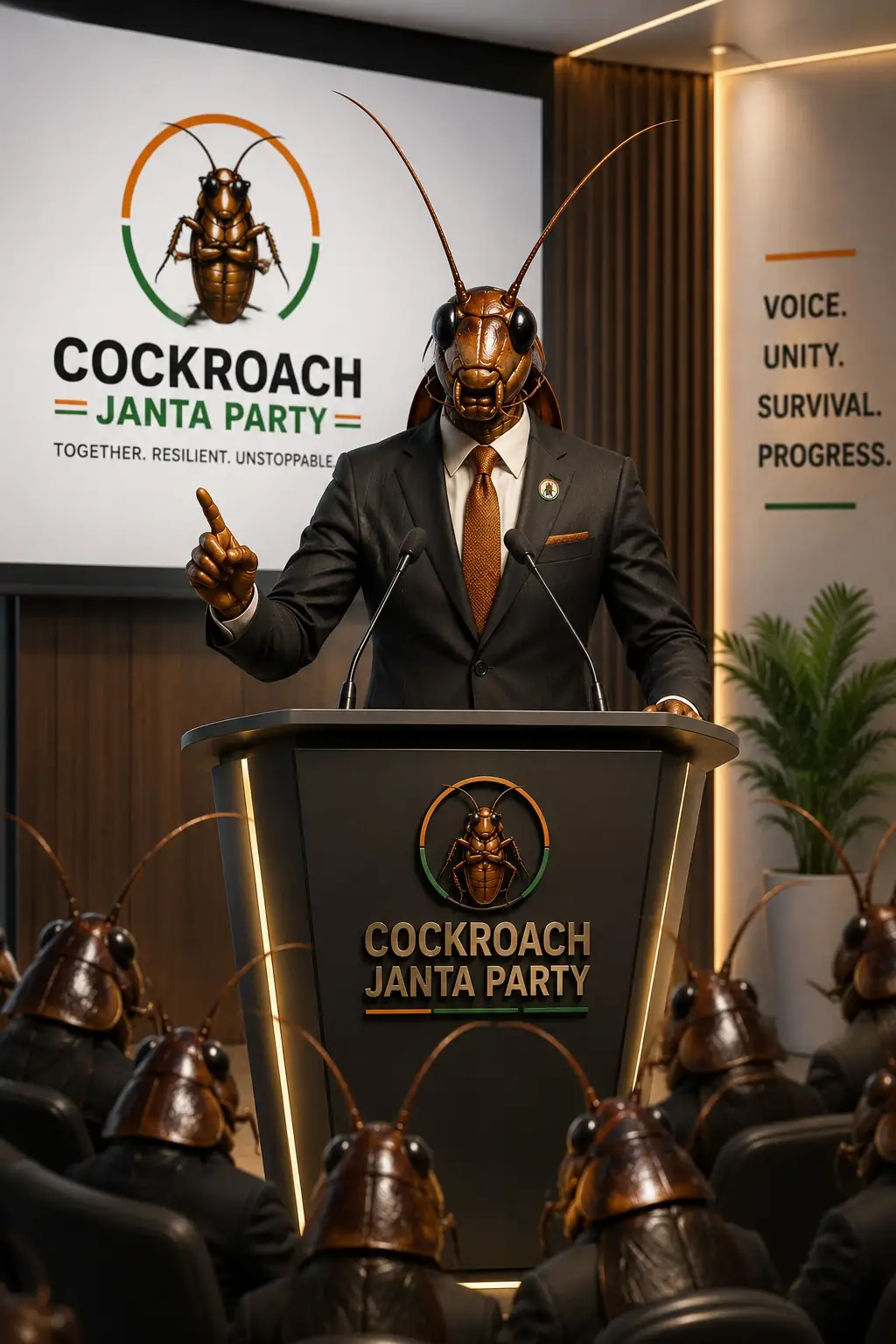
Amidst all this, Surya Kant’s remarks fell like a spark on dry kindling. (His clarifications the next day were too late.) Riffing off the ruling Bharatiya Janata Party (BJP), an Indian student at Boston University launched the satirical Cockroach Janata Party (CJP)—the “Voice of the Lazy and Unemployed”. Being “chronically online” and capable of ranting professionally were the other membership prerequisites. Tens of thousands signed up through a Google form; and within days, CJP’s Instagram account amassed 23 million followers, 10 million more than the BJP (which has harvested bushels of political fruit from seeding disharmony and misinformation on social media).
CJP has demanded the resignation of the education minister. Failing that, its founder, currently in India, has threatened to launch nationwide physical protests in addition to the one held last week in New Delhi, the capital. “It is high time,” said an attendee. “We are grappling with numerous problems and challenges, yet the youth are being channelled towards the IPL [a hugely popular cricket tournament], films, and religious issues. This protest seeks to foreground discussions on education and freedom of speech.”
The movement has drawn inevitable comparisons with recent Gen Z-led movements in neighbouring Nepal and Bangladesh. But there are fundamental differences. Despite its name, the CJP is not a registered political party yet, nor is the BJP nearly as unpopular as the governments those movements toppled. Indeed, it’s currently on a high, having just come to power in West Bengal, a state long considered immune to its virulent Hindu nationalism. What may give the party pause though is an astonishing result in Tamil Nadu where twin Gen Z waves of excitement and resentment washed away interests, including BJP allies, that had ruled for decades.
Its reaction to the “cockroaches” reflects this uncertainty. As the movement spread with astonishing speed, the party instinctively reached for its authoritarian toolkit—blocking the CJP website and X accounts on “security” grounds, hacking other social platforms and rolling out ministers to incant the familiar litany of libel and lies: anti-national conspiracies funded by foreign actors seeking to destroy India. Lately though, it has softened its tone: “It’s part of democracy. Such things happen in democracies,” one senior leader said of the New Delhi protest.
They do. But as Jo Teo argued in their recent essay for Jom, the experience and practice of democracy itself is being transformed in Gen Z’s device-wielding hands. Geriatric elites ignore this at their own peril.
Other stuff we like
“The Day I Lost My Son To Suicide”. In this OGS video, a father remembers the day eight years ago, and discusses coping with grief, guilt, and the absence left behind.
“Wang Gungwu interviewed by Viswa Sadasivan”. The former NMP speaks to the acclaimed historian, whose lucidity at 96 is reminiscent of those decades younger.
“Can the World Cup Transcend Donald Trump?” Ishan Tharoor, who made his name at the Washington Post and is now regularly contributing to The New Yorker, offers an optimistic view of the tournament that just begun.

A flavour of Jom. Occasionally, Jom publishes essays outside the paywall. These are on issues we think are in the public interest, and deserve a wider airing. In the past two years, we have published nearly 50 such pieces. Read some of these if you’d like to see samples of our work. We hope they’ll convince you to subscribe. And even if you’re here with no intention of doing so, we hope you’ll enjoy these offerings and consider it time well spent!