
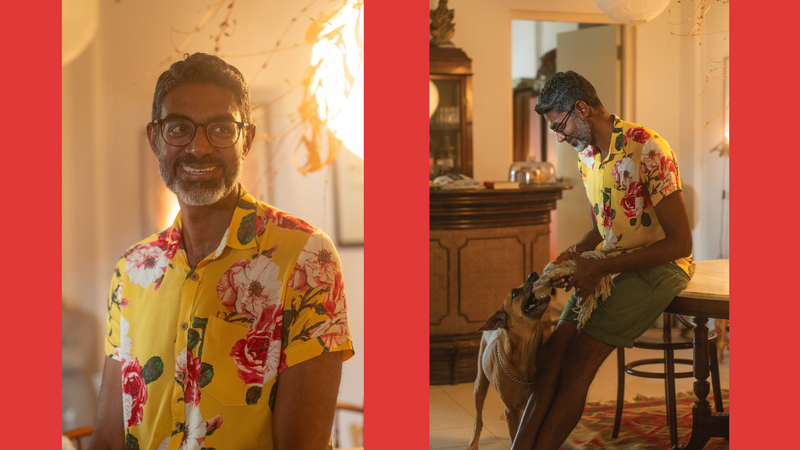
Prashant Somosundram needed a break. It was 2018, and at 39, his major entrepreneurial achievement was having founded Artistry, a gallery, cafe and community space on the edge of Kampong Glam. From its inception in 2012, Artistry was beloved by artists, activists and writers, and hosted a melange of activities weekly, from spoken word performances showcasing unheralded poets, to out-of-classroom jams for Kazakh Masters students at the Lee Kuan Yew School of Public Policy.
Prashant had also started double-hatting as event organiser and food operator at The Projector, an indie cinema in Golden Mile Tower. Only four years old, its old-world seats, dramatic inclines and arthouse-offbeat curation had earned it a cult following among silver screen romantics and those whose cultural palates were allergic to Marvel. Karen and Sharon Tan, the sisters who founded The Projector (along with Blaise Trigg-Smith), had seen Prashant’s work at Artistry, and asked if he’d like to operate the Golden Bar (later Intermission Bar) as a tenant. Karen described him to me as “...a kindred spirit that actually knows how to get shit done.”
But with the burden of two jobs, and Artistry more loved than busy, Prashant decided to close the café. The break he had planned was a journey from China to Iran that would have been more mid-life reset and exploration than recuperation. Before he could leave, however, The Projector acquired the Intermission Bar, forcing him to delay his trip. Then Sharon asked if he wanted to replace her as general manager (GM). “I never got to go on that trip…she went on her own trip instead.”
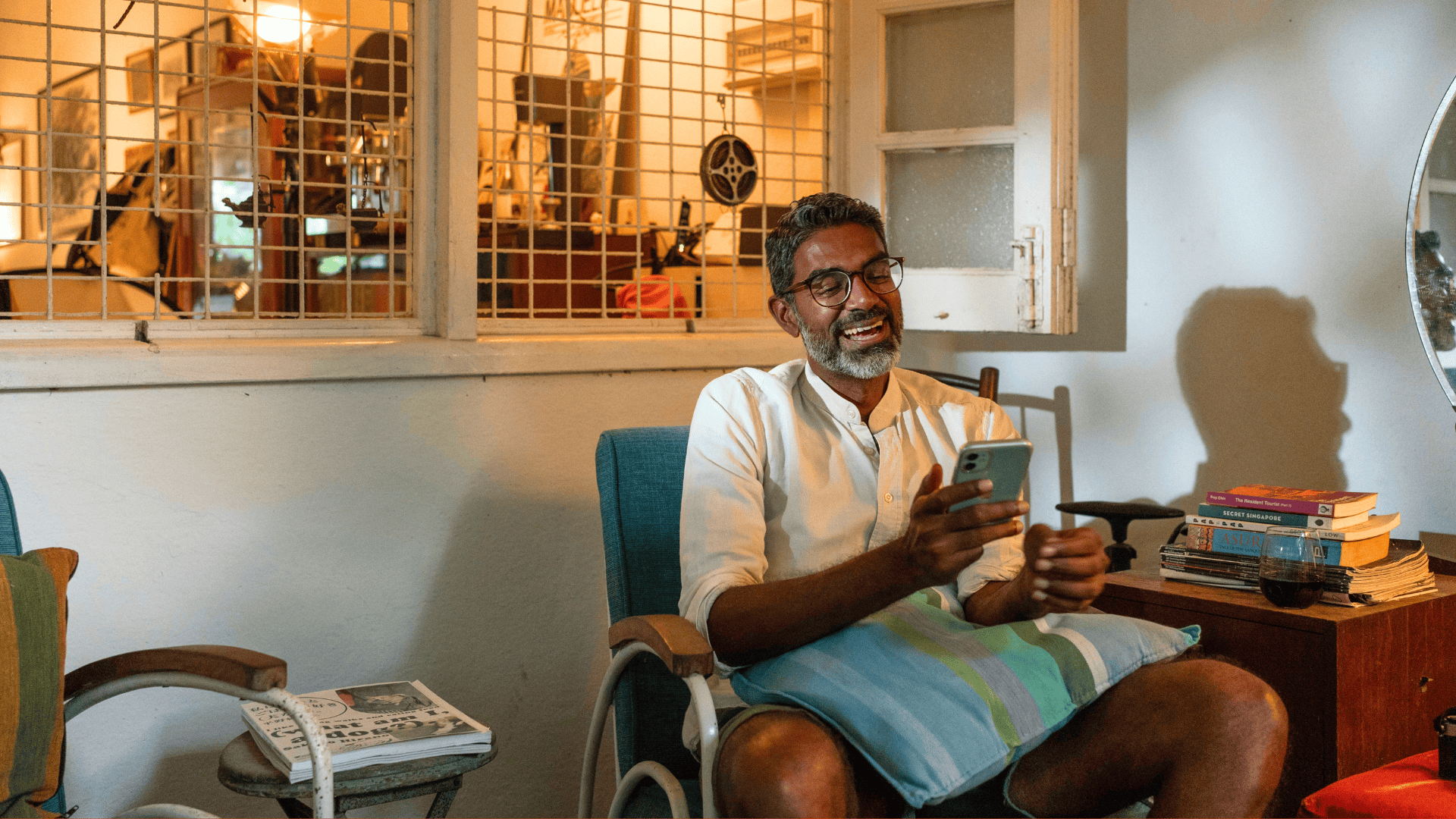
Prashant and Sharon laughed as he narrated this story to me at the Bullion Kopitiam over whisky highballs and pork satay. Prashant was sitting on a ledge facing the road, his Nikes dangling at the end of his dark-denim-covered legs. He pairs a deep, thoughtful gaze with an ability to lose himself in laughter, sometimes turning away, his gaze off in the distance, when reliving memories. People who know the Prashant of today—six-foot, salt-and-pepper bearded, and whose WhatsApp profile pic reads “Smokin’ hot meat” in neon—are shocked to see old photos of a chubby Prashant with skinny arms, described by a former physical education teacher as “feathers attached to the body of an elephant.”
The two trade stories of Prashant’s early culinary achievements. Sharon first met Prashant at Artistry after her dad had ordered a peanut-butter-and-jelly sandwich with a huge scoop of vanilla ice-cream. “If only you knew how much butter went into that,” Prashant deadpanned.
Another story involved innovation at Red Baron, a place he co-founded after Artistry with Tham Wai Hon, the person who would later become his partner. The kitchen came up with a “fried quinoa”, a seemingly refined version of Singaporean fried rice. “It was not very healthy, but you’d get these women coming in after yoga, eating it, and then posting photos with the hashtag ‘healthyliving’,” he said. “Coconut oil. That’s how we sold it.”
These stories bookmark early ventures, yet surely the accumulated experiences helped feed his confidence in assuming the GM role. By juggling the different arms of the business—events, F&B, and film—revenues grew. January 2020 was The Projector’s best-ever month.
And then the world changed. “We had one good year before Covid came. It’s been a struggle ever since.” By June 2023, long after the last pandemic-related restrictions had been lifted in Singapore, The Projector’s film revenues (at two outlets) were still 25 percent lower than in the pre-Covid days (at one outlet). This overall decline, Prashant said, is broadly in line with the industry at large. He’s tried hard to diversify its revenue streams, including by renting out its centrally located and funky event spaces. On any given week The Projector might host everything from government agency events and corporate movie nights to queer parties and migrant worker art exhibits.
Yet this hodgepodge points to a basic question: what exactly is The Projector? A cynic might argue that The Projector’s offering is confused, its core proposition ill-defined. In a post-Covid world where cinemas globally have been battered by streaming and other forms of home entertainment, The Projector is perhaps a project on borrowed time.
Prashant’s four grandparents migrated to Singapore from Jaffna, in the north of Ceylon (present day Sri Lanka). They were part of one of the most significant migratory patterns of the 19th-20th centuries for Malaya at large. British administrators, especially those who’d previously worked in the Ceylon Civil Service, appreciated the Jaffna Tamils’ English-language skills and maths proficiency, and also considered them hardworking, loyal and honest, according to historian Ranjit Singh Malhi.
Unlike many other South Asian migrants to Malaya—who did low-wage work—Jaffna Tamils slotted into mid-level roles in the colonial civil service: bureaucrats, clerks, surveyors, medical workers, railway station masters and engineers. By 1919, they formed 46 percent of the Federated Malay States Clerical Service, writes Rajakrishnan Ramasamy in Sojourners to Citizens: Sri Lankan Tamils in Malaysia 1885-1965.
These were the roots for the emergence of what today might be termed a “privileged minority” group. Notable Jaffna Tamils in Singapore include S. S. Ratnam, obstetrician gynaecologist and pioneer of in-vitro fertilisation; S. Rajaratnam, first foreign minister and one of Singapore’s “founding fathers”; Joshua Benjamin Jeyaretnam (JBJ), opposition politician; Eugene Thuraisingam, lawyer; Jacintha Abisheganaden, singer; and Tharman Shanmugaratnam, president.
The late JBJ unknowingly influenced Prashant. In 1981, he broke the 14-year stranglehold of the People’s Action Party (PAP) over Parliament. He was subsequently a fixture in Kampong Bahru, where Prashant went to kindergarten. “I would always see JBJ in the coffee shop, holding court, hanging out with people. It was like ‘oh, wow, someone who is standing up to the PAP and all that.’” Prashant’s family sparked the four-year-old’s political awareness. “I was in awe at that time.”
Jaffna Tamil camaraderie, efficiency and folklore were apparent in Prashant’s Singapore-born parents’ matrimonial journey. Their respective parents came from different villages in Jaffna. In Singapore, they decided on an arranged marriage for Prashant’s parents. But they wanted it as part of a two-couple package deal: Prashant’s mum’s elder brother would also simultaneously marry Prashant’s dad’s niece (his eldest sister’s daughter, of a similar age to him).
So in 1976, this Jaffna Tamil matrimonial spectacle—Prashant’s mum x Prashant’s dad; Prashant’s maternal uncle x Prashant’s paternal cousin—occurred in Singapore. Unfortunately, the latter marriage broke down. When that happened, some in the family and community demanded that Prashant’s parents also separate—into love together, and out of love together, they believed. His parents resisted.
Prashant attended the academically demanding Raffles Institution (RI), which he has fond memories of. It wasn’t then the citadel of privilege that it appears to have become, he said. Prashant and two other RI boys who lived in public housing in Clementi carpooled to school every morning in the taxi driven by one of the student’s fathers. “Most of the people I knew were on bursaries.” At RI, he picked up photography, dabbled in the Boys Brigade, though Bible study and drills soon turned him off. “Of course, there’s [also] always TLDS…the Tamil language and drama society. That’s a default,” Prashant, or பிரஷாந்த் (Piraṣānt), said.
After Raffles Junior College came National Service. In between basic military training (“BMT”, Singapore’s boot camp), Prashant found time to sneak into the National University of Singapore with the help of female buddies who were already enrolled. He realised then that he had to leave Singapore. “I couldn’t learn from a lecturer standing over an OHP [overhead projector] and just reading out stuff, expecting us to listen.” To fund his university education, he had two options: either a teaching or an Air Force scholarship. Since he “can’t deal with kids”, the feathered elephant who once had trouble doing a single pull-up, signed on as a regular in the Republic of Singapore Air Force (RSAF). Having completed his basic air defence training (“looking at the radar”), he reached New York University (NYU) in August 2001.
As when he later became GM of The Projector, it was a new chapter in his life that would be indelibly shaped by a global calamity. On the morning of September 11th, Prashant and the other students heard that “something had happened” but still went to class. News soon filtered through that the Pentagon and The World Trade Center had been hit by something. Students left class and gathered at the nearby Washington Square Park, as chess fiends abandoned games to watch, in horror, as both towers collapsed. They were over two kilometres away and yet people turned and started running in fear, he said. “It was like ‘Independence Day’.”
With handphone connections cut, Prashant had to e-mail a friend to call his parents in Singapore. Shave, came the message from his dad, they’ll think you’re a Muslim. “I told him people are more enlightened here.” In NYU’s liberal bubble, Prashant was insulated from the antagonism and bigotry that gripped many parts of the US, and the world, in the wake of 9/11. He believes that it was the perfect place and time to be studying political science, and the complex conversations they had in the classroom stood in sharp contrast to the simplistic narratives propagated elsewhere around the world. Bertell Ollman, a professor of politics, left a deep impression in a class on socialist theory. “The only deliverable was a journal at the end of the semester,” Prashant told me, cooing about his liberal American education. No lecturer over an OHP, then, but a student still moored to his Singaporeanness: “I crammed that journal like, you know, three days before it was due.”
Outside of NYU, Prashant got into organising at the LGBT Experimental Film Festival, skills he later parlayed into work for civil society organisations in Singapore—such as Action for AIDS (AfA), Migrant Voices and Pink Dot—following his return from the US in 2004. Describing Migrant Voices, which started forum theatre projects with migrant workers staged in public spaces, Prashant noted: “When you bring arts into a communal space or a liminal space, people then feel that they can engage with it, rather than if it’s in a gallery or something.”
NYU was also where Prashant grew more comfortable with his queer brown identity. Previously, in RI, Prashant had started to pop into IRC chat rooms like #gayteens@sg and #sgboy. “Very soon, I found out that my brown name would cockblock any potential meetups,” he wrote in “Curry Corner”, a chapter in Brown is Redacted, an anthology about minority race experiences in Singapore. “My response, as a 14-year-old seeking validation and acceptance from this community that I felt I belonged to, was to try as much as possible to suppress my Tamil identity. Prashant became Shane…I hated being brown. I felt like I needed to choose between my queer or Tamil identity; that these were mutually exclusive spaces. But I could not wash away my brownness.”
Prashant felt the liberation of exploring queer spaces in New York City (its own racism notwithstanding). It was then that he also first spoke up about the racism that a queer Indian faces in Singapore, on SiGNeL (Singapore gay news list), a queer listserv. The early internet allowed a queer brown Singaporean male in New York City to engage with his community back home, to reimagine what it means to be diasporic, 15,000km away. Upon Prashant’s return to Singapore—“armed with disposable income and fresh self-confidence”—he shed his old insecurities, reclaimed “Prashant”, embraced complex realities, and found community. “I was determined to make space in these [queer] bars [along Neil Road]. I had seen an alternate reality and knew it was possible.” He’d soon be inspired to create space among broader circles and networks for an artistic community experiencing a fresh bout of anomie.

Singapore’s post-independence era was marked by underinvestment in the arts, as conservative trepidation about “Western culture”—no long hair for guys, please—fused with a technocratic state’s desire to quickly grow its manufacturing and trade base. Emphasis was placed on “pragmatic” subjects and skills; the “arts have never been seen as a ‘basic need’,” said Koh Tai Ann, English professor, in 1989. (No surprise, then, that during Covid-19, even as art was therapeutic for many globally, Singaporeans rated “artist” as the most “non-essential” occupation.)
The 1990s presaged a new problem. Government enthusiasm for the arts grew, but its market-driven impulse—cultural production for economic gain; “the arts” to attract foreign talent—prioritised global champions over local. Esplanade was the physical manifestation of this drive: less a site for artistic practitioners than a symbol of “power and glory”, wrote Janadas Devan in 1995, a journalist then and the current head of the Institute of Policy Studies. George Yeo, then arts minister, was its champion. In a 1992 speech, he said: “Nothing is more inimical to the development of the arts than a false nationalism which tries to protect a market under the guise of safeguarding some misconceived national essence.”
This was also the period when the government ramped up immigration as part of its growth-at-all-costs drive to turn Singapore into a premier “global city”. The ironies are obvious. Having underinvested in the arts for decades, the government’s about-turn was to splash on foreign art; and having dissuaded Singaporeans from procreating for over a decade—including through eugenics policies—the government’s about-turn was to attract as much talent as it could. The instrumentalisation of the former in service of the latter reflected the state’s clinical, capitalist worldview of humans as units of production.
Bulwarks against this economic hegemony included The Substation, co-founded in 1990 by Kuo Pao Kun, and whose second artistic director, T Sasitharan, argued that Singapore should be creating cultural spaces as much “for eloquent failures as for resounding successes”. Another was Post-Museum, set up in 2007 by artists (and partners) Jennifer Teo and Woon Tien Wei. “Singapore’s Renaissance may have elevated the position of the arts, but it has been limited in its reach,” they told On Curating in 2019. “Post-Museum became a place to ‘hunt’ for a network of cultural practitioners, from students to academics, artists to activists. That confluence of people and their practices allowed us to see how diverse practices could convene and learn from one other…”
Post-Museum, which closed in 2011, and other “community-centric venues” such as Pigeonhole, a book cafe and arts space, inspired Prashant, then in his early 30s. Together with his experiences in New York City, they were important influences in how he conceptualised Artistry and later Red Baron—including the need to be “a bit more sustainable financially.” From our conversations, a few pillars of The Projector’s business strategy became clear.
The first is the conversion of disused or low-rent city spaces into higher-value ones. Karen, Sharon and Blaise had identified a 1970s cinema at Golden Mile Tower for the original Projector, crowdfunding it partly through Kickstarter. The precarity remains, as there’s always the risk that a new building owner might demolish it, or boot out The Projector. (Neighbouring Golden Mile Complex has been conserved, but the Tower has not.)
To mitigate this, one of Karen’s primary roles, she told me, is to look for underused or undervalued spaces in the city centre, and then try to cut deals with landlords to get them at decent rents. This includes The Projector’s recent pop-ups at Clarke Quay and The Picturehouse, and the new collaboration with Golden Village at Cineleisure.
In choosing potential spaces, Karen said, she first has to envision how it might look for The Projector. “I handle creating the physical space, the look and feel. I get it to a point where Prash comes in and takes over, and then it’s like the ops side of things. Then he gets it all running with the team.”
Blaise, who effectively performs the CFO’s role, is, according to Karen, the “third member in this triangle that makes The Projector work.” The two of them keep a close eye on The Projector’s financials, including its cash flow. They send early warning signs to Prashant. “Hey, we’re a bit close to the edge, man,” Karen told me, mimicking a conversation they might have. “And he’s like, ‘Well, fuck, you know, maybe we’ll do some promos now.’”
Conversely, Prashant might tell them that one pop-up is about to close, and they have to figure out what to do with all the material and equipment that went into it. The “really great dynamic” between the three of them—Blaise, Karen and Prashant—underpins The Projector’s ability to balance the books even while renting space in the centre of one of the world’s costliest cities.
One way of doing that is by raising the average patron’s F&B spend. This is what drove Prashant’s kitchen experimentation, including the quinoa fried rice at Red Baron and “kale and eggs and what not” at Artistry. That in turn fed menu design at The Projector, which serves unique drinks like “Haram Teh”, a Thai milk tea spiked with Baileys and rum, and sour plum shots. The food offerings range from snacks to full meals, including kacang puteh, popcorn, “cock-tail” nuts, nachos, hot dogs, grilled cheese, classic pizzas, poutine fries, sticky Korean fried chicken popcorn and a five spice steak rice bowl. Every time I watch a movie there, I spend far more than I do at other cinemas—it’s a treat in Singapore to drink alcohol in front of the big screen.
Some of The Projector’s early supporters will invariably be dismayed by this commercialisation. “In the arts and in the creative space, people almost, you know, pussyfoot around the fact that you’ve got to actually make a profit,” Karen said. “It’s almost a bit of a taboo, it feels like you’re selling out.”
We’re also rarely at The Projector just for the movie. “Eventising” around films, as Prashant calls it, is a key part of programming. In September 2023, I watched “Moonage Daydream”, a trippy, time-travelling homage to David Bowie. Its blend of the artist’s work, philosophies and life journey seemed tailor-made for The Projector’s crowd. Following the movie was an exclusive live video Q&A with director Brett Morgen. More elaborate eventising occurred with “The Glory Hoes present THAT PINK MOVIE”, a screening of “Barbie” hosted by Becca D’Bus, who calls herself “Singapore’s biggest drag queen”. This was followed by “The Hoe Down Dance”, an afterparty featuring drag and DJ performances. (The Glory Hoes are Becca, Prashant, and Bobby Luo.)
The last film shown at Projector X: Picturehouse, a pop-up in the old Cathay cinema, was “The Room”. The so-bad-it’s-good 2003 film has developed a cult following among fans of The Projector, who engage in the same participatory rituals as devotees elsewhere, including throwing plastic spoons in the air when images of spoons come on screen. Almost 600 people showed up, Prashant told me, of the sure-fire hit that The Projector has screened 10 times since 2015. On that final weekend The Projector also hosted a 12-hour party, with numerous DJ sets, alongside a sneaker, clothing and art market, where a S$1,700 pair of pink-hued Nikes shared space with cannabis-inspired t-shirts by local merchant BluntXIII. “My manager told me that we’ve been doing too many activist and civil society events,” Prashant said, half-joking. “He organised all this.”
Another pillar is managing the inevitable tension between global and local film—itself a microcosm of the larger global-local arts debate. “One pet peeve is like how people expect The Projector to show all local movies. Which sometimes puts us in a difficult position because not all content is worthy of an audience…and that’s an opportunity cost for us.” The Projector is not supported by the National Arts Council or the Infocomm Media Development Authority (IMDA), Prashant said, so there can’t be any obligation to blindly promote local, though interested parties can always arrange private screenings. For him, the loyalty of The Projector’s fans is vital. “There’s a trust that we’re building with our audience. Like they trust that when we curate a film, there’s a certain level of quality. And we don’t want to jeopardise that by ‘just support local’—no boundaries, nothing.”
There are related commercial tensions around mainstream versus arthouse, and English versus other languages. Cinema-goers don’t associate mainstream films with The Projector, so tend to watch them elsewhere. For foreign-language films, there’s the pressure to programme more commercially popular ones, for instance Korean over Tamil cinema, which Prashant still watches and understands despite his faltering literacy: “After I went to New York, I kind of lost touch and now it’s a bit hard to get back into speaking and reading Tamil.”
Staying onside of the law, and more generally maintaining good relations with the government, is also an imperative. “We [The Projector] are always in constant dialogue with IMDA so that we’re still playing by the book. Because ultimately, we are a business. I have, you know, 35 people to feed. I can’t risk things so we’ll just find ways to make it work.” Pushing boundaries while staying ever-vigilant of rules is a philosophy he extends to events—no foreign speakers, for instance, on socio-political issues. (Among other risks is the government accusing them of interference in domestic affairs.)
That doesn’t mean kowtowing to the establishment. “I wouldn’t shy away from things that may be potentially controversial,” he argued, citing the “Tak Boleh Tahan!” town halls in early 2023, which were on the rising cost of living and were directly linked with the opposition Singapore Democratic Party. “I think a lot of venues tend to fear repercussions [from the government]. When actually, legally, it’s fine.” Unless the organisation or event is unethical, illegal, or its values don’t align with theirs, Prashant said, The Projector rarely declines a request to book its spaces. “A lot of people don’t exercise the independence of their spaces as much as we would like them to...we want to create a space that’s conducive to counterculture.”
This also speaks to his belief in offering people different entry points to social issues. “I admire everything that Jolovan [Wham] and Kokila [Annamalai] are doing,” he said, of the activists involved in, among numerous other things, the Transformative Justice Collective, which seeks reform of the criminal justice system. “But for me, I’m more comfortable [with] that kind of softer approach. Because I think that’s a different way to reach out to people whose immediate reaction from seeing all the direct action stuff is, ‘This is a waste of time.’”
He places a premium on spontaneity and chance. “We have all these different people coming to watch other films that may not be even interested in these topics, but then they get forced to see it. I’m all for putting people that you don’t expect to be together in a space and then seeing what comes out of it…I find that it stems from us not being too precious about the space. We are comfortable with a bit of messiness and chaos…we kind of feed on that chaotic energy sometimes.”
In Prashant and The Projector’s work, one can also trace, then, the lineage of all the artists who’ve resisted the state’s gilded commercial vision of “the arts”, those who’ve recognised the inherent transformative power of art, and who’ve through their daily practice actualised the liberation it promises. “Art satisfies the highest human needs after the satisfaction of our material needs,” Sasitharan said in 2022. “After we’ve acquired the Mercedes-Benz and the magic beans, what kicks in is a need to make meaning of our lives, to tell stories that will build communities—communities that will save our children.”
Some Saturday evening, November 2023. I was in a plush oversized chair in Projector X: Picturehouse’s main room, empty wine bottle to my right, Charmaine Poh (my Jom co-founder who photographed Prashant for this piece) to my left, as the audience erupted in laughter at “Triangle of Sadness”, the latest black comedy from Ruben Östlund, a Swedish filmmaker. As we left the hall I smiled at friends from a past corporate life, but couldn’t see Prashant, who had checked tickets on the way in. We had wanted to say goodbye before going home.
Once outside, we found ourselves in a quiet corridor, where the black walls were hung with bright art—Dysphoria/Euphoria, an exhibition organised by Rainbow Families, a pride collective. Cut off from the rest of The Projector, the silence immersed us, as the anxiety, the struggle, and the ecstasy of lived experiences emerged from multi-hued, mixed media pieces.
We walked out of solitude into a booming club. The foyer had been converted for “Intervention”, a queer dance party “for everyone to be whoever they want to be.” Charmaine and I looked at each other. There’s a party? But we’re not dressed?!? Fuck it. We saw Wai Hon freeing himself from the clasp of social butterfly Prashant. The three of us sat in a corner—bottle number three—and watched.
Downstairs after a cigarette I saw Kokila surrounded by a clique of activists. Back upstairs I saw somebody in a flowing silver gown, and make-up and glitter on his face, as if David Bowie had manifested as a young Chinese Singaporean man. He looked as fabulous as I, in my jeans and a college-era pullover, looked drab. We neared each other, then bounced back in recognition—he was somebody I had only just met the week before in a corporate Zoom call. And as I left the building, I marvelled at the freedom of expression, of movement, of speech, and also at the constellation of connections buzzing around me, each individual with their own star map, the belonging to space fostering the belonging to beings: today’s feathered elephant, tomorrow’s JBJ, and this century’s Jaffna Tamils.
The Projector’s openness and vibrancy is the product of a whole team’s work, though it’s also easy to feel Prashant’s imprint. I wonder if the different influences in his life—from the history and superstition of the Jaffna Tamil community in Singapore to the intensity and urgency of a post-9/11 New York City—as well as the knotty journeys of self-discovery he’s been on—body image, queer brown identity, Tamilness—have together helped his instinctive ability to create a welcoming space for all. “He’s someone who has that ability to kind of imagine and take risks and say it’s a crazy idea, but let’s go for it. He’s got that element to him,” said Karen “But at the same time, he’s also incredibly grounded and pragmatic.”
When I told her about my experience that Saturday last November, she said: “You can have as many fucking avatars as you like in the metaverse but you still need real faces and real interactions. At The Projector, our payday is when we come in and there’s a palpable energy in the space.”
How should we think about the contemporary impact, then, of The Projector, with its evolving randomness and messiness of shared space? One could look to theorists of placemaking, as Post-Museum’s Teo and Woon once had: “We create places so that our projects can take place, and that the activity of placemaking is, as [the geographer] Robert David Sack would say, how we help make the world or conjure a reality.”
Quite different people feel like they belong to The Projector’s space, Prashant told me. “Like the punks are totally comfortable doing events and gigs in the space. And likewise, even NAC, government agencies…that whole broad spectrum of different people who feel that they can identify with the space.”
In a recent “On Being” podcast, Vivek Murthy, the US surgeon-general, talked about the worry, anxiety and pessimism that many around the world are feeling. He pointed to several possible causative trends, including the extraordinary pace of change that we are living through, an information environment that’s often negative, our inability to communicate adequately with each other, and chronic loneliness. In order to address this, he called for new social infrastructure, “...that consists of the programmes, policies, and structures that foster healthy relationships.”
In Singapore, there are numerous sites for social interaction, from community centres, where ordinary citizens mingle, to posh clubs like Mandala and 1880, where the local and foreign jet-setting classes hob-nob. Yet they are each limiting in their own way: the former irrepressibly watched over by Big Brother, and the latter nauseating to many in their exclusivity. In the organic, often sporadic way it organises itself, and with its lack of pretentiousness, it seems like The Projector is also an example of the “social infrastructure” Murthy advocated for: a site of healing and therapy for many.
The Projector’s fate will likely remain uncertain for some time. Its business is vulnerable to numerous global risks, including relentless competition from alternative entertainment options, as well as local ones such as the unceasing need to secure an affordable, central location, amid a red-hot property market. While many hope for its success, few would be shocked if The Projector ultimately goes the way of Post-Museum, Artistry, and Red Baron. Yet, even if that happens, its legacy will be the accretive knowledge for whoever next wants to try and create what Karen captured in an interview with CNA: “A participatory space that’s open, inclusive and organic, which allows people to contribute to and shape it in ways that they would like.”
The first time Prashant and I met, this publication did not yet exist. We had a name, Jom, but little else. We had reached out to several people we wanted to profile for our yet-to-be-launched magazine. They understandably had many questions, from the source of our funding to whether we expected the government to crack down on independent media outlets.
Prashant was curious to know whom else we’d be profiling. After I told him the names of a few people, he paused. “Oh great,” he said, looking away as a smile started to break on his face. “An artist, a Marxist, and a [former] drug addict.”
It was the sort of gathering, of community, that the space creator had simply come to expect.
If you enjoy Jom’s work, do get a paid subscription today to support independent journalism in Singapore. This is the only way for us to achieve sustainability.
This piece was first published last November in Jom’s first print issue. We’ve made minor edits to this version. Additionally, Prashant has recently announced that he will, finally, be taking that break.
Sudhir Vadaketh is Jom’s editor-in-chief. For this piece he’s also indebted to Charmaine Poh and Lin Yanqin.
Letters in response to this piece can be sent to sudhir@jom.media. All will be considered for publication on our “Letters to the editor” page.