

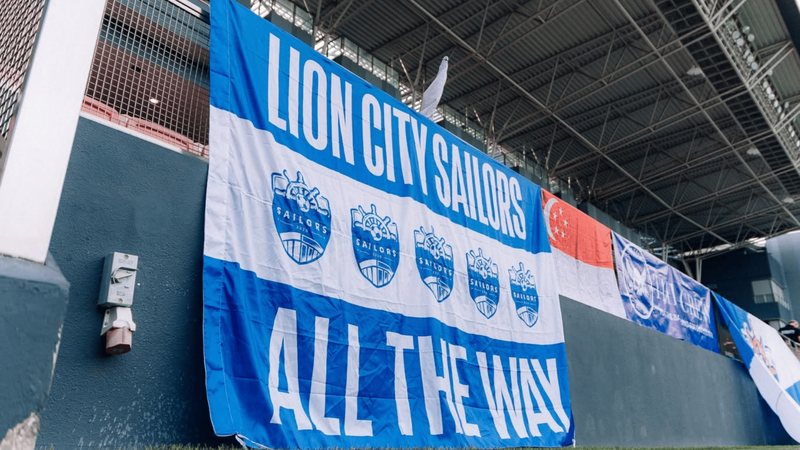
The silence as dusk falls in Bishan Stadium is broken only by trains clattering into the depot in the distance, a small hubbub at the kopi stand, and the booting of the ball in the foreground. But soon, the chorus rises again, a few strained voices at first, then several dozen joining heartily, and eventually a drum accompaniment: “We all hate Sailors, da-da-dum. We all hate Sailors, da-da-dum”. On the pitch, the unfazed Sailors are already two goals up against Hougang United, and will go on to win 5-1. But the noise will resurface throughout the 90 minutes, accompanied by the occasional middle finger from a small, discordant knot of green-shirted home fans sitting in the front rows.
The Sailors in question are the Lion City Sailors (LCS), Singapore’s first and only private football club and, depending on your viewpoint, either a malevolent symbol of capitalist excess or a brave attempt to resuscitate the sport’s barely twitching corpse here. Enmity towards the club, funded by the millions of Forrest Li—founder of Shopee parent Sea Ltd—is a sport in itself among rival supporters. At various times this season, the Sailors have been told through the medium of chant that they are worthless, “full of shit” and, borrowing from a song beloved of British football fans, that they deserve to be defecated on from height by a winged bird bearing the “arse of a cow”.
It’s been a similar story ever since the Sailors burst onto the scene six years ago in a confetti of cash. After taking over and rebranding Home United, once the club of the Singapore Police Force, they did not hold back. Brazilian Diego Lopes was signed for almost S$3mn, breaking the previous league transfer record by a factor of 60. Belgian forward Maxime Lestienne earned a reputed S$1mn per season until his departure last year, riches previously unheard of in the domestic game. Today, the Sailors boast Bart Ramselaar, a 29-year-old Dutch winger capped seven times for the Netherlands, a Rolls-Royce of a footballer capable of bending the ball and himself around corners while others think only in straight lines. To attract such players shows enviable daring; to have them run out to a specially commissioned soft rock theme tune (“From Southeast Asia to the world/Club and nation’s flag unfurl”) takes another level of chutzpah.
The Sailors’ S$10mn Mattar Road training ground—ironically, a stone’s throw from Farrer Park, once the cradle of local football—bears comparison with those of top European clubs. It boasts five pitches, an ultra-modern gym, physiotherapy facilities, and video analysis rooms. The results have followed: in 2021, within a year of debuting, they became the first native winners of the Singapore Premier League (SPL) in seven years, and repeated the trick in 2025, adding three Singapore Cups along the way. They have landed the league by a comfortable margin again this season.
Outside of diehard rival fans, objection to the Sailors has largely emerged along two lines. Some are queasy about the sheer profligacy on display. Others feel that such overwhelming domination has made SPL matches even less of a spectacle. The Sailors lost just once last season, and when they won, they did so by an average of three goals. They dominate youth competition even more. And while they may be bringing in some younger fans and pumping out high-octane social media clips, fewer than 2,000 people attend most of their matches.
And yet, to any dispassionate observer, the Sailors are the only game in town, a last throw of the dice for a sport surviving on sepia-tinged memories of distant glories. No other country has been able to so effectively centralise its societal-level planning or so decisively lubricate the road to free market prosperity. But Singapore’s national sport is counter-intuitively sclerotic in nature, unloved and regarded, despite the patronage of many establishment figures over the decades, as a drain on resources rather than something worth nurturing and cherishing. Almost everyone I have spoken to on the topic marvels how a country that overachieves in any field it sets its mind to has allowed its football to become so second rate. Only Li, a formerly reclusive entrepreneur of unclear intentions, seems to have the cash and the will to help the game off life support.
Vikram Jayakumar, a local football agent and blogger, speaks for many when he praises the Sailors for “putting Singapore on the map” by reaching the AFC Champions League Two final in 2025, creating pathways for young players and even attempting to overcome longstanding concerns over the effects of national service by having promising talents undertake it earlier than their peers. The club has also embarked on a programme of scholarships and community outreach that suggests it wants to be a lot more than just a men’s first team. There’s a sincerity with which these upstarts are going about things that’s difficult to deny.
Neil Humphreys, journalist, broadcaster, and well-known commentator on local football, points to the Sailors and Johor Darul Ta’zim (who have dominated the Malaysian league with a similar blueprint) as evidence that a “rising tide lifts all boats…If those are the two clubs that put south east Asian football on a better footing, I’m all for it”.
In March, club owner Li deepened his commitment to local football when he announced a S$50m cash injection from Sea to improve the game, the most conspicuous private intervention ever made in football here. In 2025, he assumed the presidency of the Football Association of Singapore (FAS), a not uncontroversial move given his involvement with the Sailors but to many a genuine ray of light, as only outside capital is likely to change local football’s fortunes.
For the first time in years, there is also a positive buzz around the national team. Under Gavin Lee, a local coach who has served his apprenticeship in public and speaks with an endearing honesty and humility about his own learning curve, the Lions have at last qualified for the Asian Cup, to be held in 2027 (in 1984, as hosts, participation was guaranteed).
And yet, it may take more to bring about a genuine revolution, for the week-in, week-out experience of football occurs neither at gleaming training grounds nor at the underrated National Stadium.
John Duerden, in his instructive history Lions and Tigers, writes that few nations talk about their sporting past more. The story of Singapore football is often told by those for whom its Malaysia Cup heyday has achieved near mythic status. The 1950s and 1960s—when the tournament was still known as the Malaya Cup—were the high-water mark of Singaporean triumphs on the peninsula even though post-separation nationalism and occasional on-pitch successes ensured the rivalry remained intense until the 1990s. Crowds for Malaysia Cup matches here regularly numbered 40,000; more than 10,000 often made the trips for the return legs. When Singapore withdrew from Malaysian tournaments in 1995, it did so as the second most successful Malaysia Cup team in the competition’s history, a position it still occupies.
The immediate reason for the withdrawal was a disagreement with the Malaysian authorities over gate receipts. But there had long been a yearning, among the corridors of power if not the supporters, for a domestic league beyond the semi-professional competition populated by the likes of Geylang International and Tiong Bahru. The S-League (as it was known until 2018) was launched with eight teams in 1996, following a template set four years earlier by the English Premier League. Humphreys saw his first S-League fixture in its inaugural season, weeks after he arrived from London. “It was Balestier Central at Toa Payoh Stadium. [The league] still had a Malaysia Cup spillover. They had to put in extra seating around the running track. You’d get 3-4,000 fans in there easily. I would compare the football then to [English] League Two. It was a good standard.”
But the comparisons didn’t last long. Corporate sponsors who had shelled out S$600,000 to S$1m per team pulled back during the Asian financial crisis, and players across the league were forced into 20 percent pay cuts to keep it afloat. Four of the eight clubs that competed in the first season no longer exist. They were replaced by a variety of marketing gambits: Sporting Afrique, a team of African players which collapsed amid accusations of underpaid wages; Etoile FC, French imports who won the league in 2010 before withdrawing; and more recently Brunei DPMM, full of that country’s national players. The number of teams in the league has yo-yoed between eight and 12, accompanied by other frequent shifts—the number of foreign players each club can sign has changed five times in a decade (it now stands at nine, with seven on the pitch at any one time) alongside numerous tweaks to the number of younger and older players in squads. Amid it all, there was also a bid to rekindle the causeway romance when the newly-formed, elite LionsXII outfit joined the Malaysia Super League in 2011 but they left after four years. All these changes confuse, disorient, and disappoint fans, thwarting the kind of emotional investment so vital for the grassroots growth of the game.
Most damningly, the league has struggled to shake off the shadow of match-fixing. Seven players from Chinese guest S-League side Liaoning Guangyuan were jailed for match-fixing offences in 2008 and a separate case in 2012 saw two convictions for attempting to bribe S-League players in the 2011 season. The cases that gained most attention internationally involved Singaporean gamblers affecting games outside the country, but the ensuing stench clings to local competition in parts of the public imagination.
Aside from the questionable optics, the sheer organisational chaos of the league can’t help the quality. To give just one metric: today the ball is in play for an average of around 40 minutes in the SPL versus 57 minutes in the English top flight. It can be fun and some matches are highly competitive, but as a sporting spectacle it is patchy at best.
Through it all, crowds at domestic games have shrunk dramatically. The 30,000 who watched Geylang United win the first S-League championship decider are a distant memory. While the Sailors attracted 9,000 to Bishan for the AFC Two final (they lost to the UAE’s Sharjah), average attendances across the SPL were last recorded at the 700-odd mark. It isn’t uncommon to see just a couple of hundred people at some fixtures. The only time football has come close to filling the National Stadium in recent years is for pre-season games involving British teams. The Straits Times devotes more regular coverage to Spain’s La Liga than the domestic top flight.
It doesn’t help that eight years after the S-league rebrand which was supposed to make it “professional in every sense”, most SPL clubs don’t have websites. They share just four stadiums, often miles from their nominal roots. Fixtures are announced late or, as in the 2024-25 season, rearranged en masse at short notice. It may be why expats like me make up a disproportionate share of the crowd, at least at non-Sailors games: in the league’s endearingly ramshackle nature and triumph of spirit over sheer incompetence, we see something of our un-Singapore-like homelands. But it will take more than that to prop up the game.
Pickings have been slim at the national level too. Singapore’s last trophy of note was the 2012 AFF Championship, the fourth of a fruitful era that began in 1998 with R Sasikumar’s “Blade of God” goal, in what was then called the Tiger Cup. Within a few years of the 2012 triumph, the Lions sank into the 170s in world rankings, and are now 148th. The women’s game has also failed to take off (the national team withdrew from the 2025 ASEAN Cup, citing “readiness” issues) despite Tokyo-based Danelle Tan being arguably the country’s most successful current footballing export.
Daniel Bennett, part of the 2012 AFF winning team, wants to be positive. But when Singapore’s second most-capped player, who moved from the UK to Singapore when he was two and is now 48, says he could hold his own in the SPL today—“although maybe not lasting the 90 minutes”—he isn’t being boastful.
As a talented 17-year-old trainee, Bennett was fast-tracked on an FAS scheme to make his debut with Tiong Bahru. Twice he returned to the UK with Wrexham—now the heavily documented plaything of Hollywood stars, then an unloved lower league side—but despite the crowds and cash on offer, preferred to return home, not least to stay close to the national team. But the culture today in Singapore, says Bennett, “doesn’t support football…you’re banging your head against a brick wall”.
The attraction of the ultra-slick English Premier League is often cited as a major factor in domestic football’s plight. As Humphreys puts it: “Singapore ending their reign in the Malaysia Cup [in 1994] coincided with the rise of the internet and cable television. For the first time ever, you had an unfair comparison between what you’re watching on TV coming out of England and what you’re watching coming out of Bishan.” A 2023 Yahoo study found that people were three times more inclined to actively watch EPL matches than venture to an SPL game.
But whether lack of interest in the local league has led to lower on-field standards, or vice versa, is moot. Hunger is a word that comes up frequently in this discussion. Duerden quotes former national team coach Vincent Subramaniam lamenting in 2003: “Our youngsters put football only third on their priority list, after studies and social activities.” Little has changed. “There is a reason a lot of players here have taken up degrees,” says Jayakumar, the agent. “The mindset is, a degree will get you a job. There are players in the league who have degrees from NUS or NTU, in maths or business for example.” While this is a source of pride on one level, it means that “subconsciously”, football is not an all-or-nothing pursuit for them, he adds.
Kids in Singapore feel intense academic pressure around the same time their interest in sport is blossoming. Many coaches say PSLE stress leads to a massive disengagement among talented youngsters, with those from Chinese families most likely to walk away from the game. This reveals an ethnic dimension which can be uncomfortable to confront. There have at times been only or two members of the national squad from non-Malay backgrounds. This isn’t new—Malay players dominated the post-war domestic football scene—but it is uniquely Singaporean.
“I still haven't found a single nation anywhere else in the Fifa rankings that often doesn’t have its majority race represented in its first XI,” says Humphreys “Even Qatar do. If 70 percent of your potential talent pool isn’t playing the game, you’re not going anywhere. [The national team] is predominantly Malay and Indian and occasionally we get one or two Chinese guys come through. I feel sorry for them—they can’t just be a good player, they have to be the great Chinese hope. It must be such a burden for a kid that just wants to play football.”
But he adds: “If I was your average Chinese parent and my son came to me at 12 or 13 and said ‘I want to pursue professional football for a living’ I’d say ‘Really? You’d probably earn more working as a Grab driver’”.
Professional football is a demonstrably unattractive career path here, thanks to a combination of available, relatively well-paid employment for local nationals and an anaemic level of revenue that keeps wages depressed. This is a phenomenon seen only in Singapore and perhaps parts of the US; even in well-developed European economies, many youngsters recognise the game as their best route to riches. But the average wage in the SPL is said by sources in the game to be around S$2,000. Many players have second jobs, which further diminishes the quality of imports willing and able to play here.
Meanwhile, in the absence of much commercial income, most clubs are reliant on annual government subvention to survive. In contrast, while Malaysia and Japan have largely privatised their leagues and even Indonesia is getting there, Singapore is more comparable to Laos and Myanmar in handing out grants just to keep the floodlights on.
Lou Apolinario Antolihao, senior lecturer in sociology and anthropology at NUS who specialises in sports studies, thinks there is something deeper going on. Football, he says, has come to be seen in the Singaporean establishment as slightly distasteful and unworthy of investment. This has not been helped by the case of Ben Davis, the Singapore-educated player who having seen his appeal to defer national service rejected, skipped it altogether and is now part of the Thai national team.
But that is just one in a number of reasons, says Antolihao, why the sport compares unfavourably in many people’s eyes to swimming and other, more genteel, pursuits: “Football is seen as a personal goal. It’s about your career, playing in Europe and becoming famous—[it’s] all about you. Swimming is about bringing glory to the nation.” Indeed, this was one of the reasons MINDEF gave for refusing Davis’ request for NS deferment; in contrast, national swimmers Quah Zheng Wen and Joseph Schooling were both granted deferments, for six and seven years respectively. Antolihao might have added that Singapore can conceivably succeed at swimming with less emotional investment, fewer foreigners, and not as much money.
Of course, cash of the sort that Li is throwing around creates its own hard choices between obtaining glory the “right” way or simply buying it . There are plenty who fear the game will become disconnected from communities and will alienate the next generation of fans when naked transactionalism becomes its primary—perhaps only—currency. I would count myself among them. As a Wimbledon FC supporter since childhood, I watched my south London team (one of them, Vinnie Jones, was still a bricklayer when he joined the club) literally kick their way into the professional ranks until they famously defeated Liverpool in the 1988 FA Cup Final, an upset that still astonishes.
But fairytales today are bought, not made. Wrexham, who created history by winning three consecutive promotions in the UK (they only narrowly missed qualifying for the English Premier League this season), are cited as a dream come true but rely on the patronage of megastars and a Netflix series. AFC Wimbledon—the club re-formed by supporters after the Wimbledon entity was moved to a different part of the country—punches above its weight in the English third tier but fans, myself included, have now voted to accept external investment in order to stem its losses. The average wage in the English first tier was roughly double that of the third tier in 1984; in 2024, it was 30 times greater. It means access to capital now determines footballing destiny since the bill facing teams who want to climb the leagues is simply insurmountable. But in Singapore, even money may not be enough.
In Woodleigh, with the Upper Serangoon Viaduct casting the slightest of shadows over the astroturf, Christophe Aprile is preparing for a training session at Gaulois SC. Gaulois is one of dozens of semi-professional teams operating in a pyramid system under the auspices of the FAS, most of them getting by on the determination of volunteers and playing for sheer enjoyment. Aprile became club president by default more than 20 years ago—its forerunner, Olympique Gaulois, needed fresh blood and he was the only volunteer. “We finished last that year. We got two draws and one of them was rescinded for not submitting the match report.” Today, Gaulois has almost 1,000 members—the majority are still French expats—and Aprile juggles his day job running a timber company with administering a growing academy of 200 young players, promoting “structured, competitive football but also with a structured mindset”.
For a “hobby” that started with a desire to keep the post-match beers flowing, Gaulois has become a serious undertaking. Its men’s first team competes in the expat-heavy Cosmoleague and next year will launch in the SFL2, three rungs below the SPL. It has attracted former national team players as coaches (“They have knowledge, they have fire but there’s no opportunities for them…”) and operates a thriving women’s section.
Gaulois should be just one cog in an ecosystem of grassroots football. Instead, it is a rare beacon of hope amid a national crisis in access to playing fields. When the Turf City complex in Bukit Timah closed the doors on its four in-demand pitches in 2023, it was disastrous for the local game; Aprile says private schools now charge an average of S$600 to book pitches for a 90-minute match, three times more than just a few years ago, and his club survives only because it has secured a long-term lease on its site. These disparities can only serve to make the game more remote to most Singaporeans and further shrink the national pool of available talent, as organised football becomes increasingly concentrated in elite organisations rather than around HDBs and in public parks, where it should flourish.
Bennett is saddened by the sight of amateur players carrying equipment from park to park looking for a pitch: “If you want to play with your son or daughter, it’s hard to find a corner of grass. In Malaysia, you’ll find it. Even London has huge parks. Space is the biggest problem, and that goes from kickarounds to organised teams.”
Local coaches emphasise that FAS can do relatively little to address systemic issues around pitch access, and feel the governing body is becoming more receptive to their challenges. But there is an entrenched belief that semi-professional teams are nothing more than “Sunday League” when in fact they maintain standards that are crucial to the development of a thriving pyramid, offering promising youngsters a first taste of adult competition and if encouraged, could generate a groundswell of interest in the sport nationally.
Sport, said Lee Kuan Yew, “militates toward a noncommunal, multireligious, multilingual approach to life”. But Singapore seems, to an outsider, often unwilling to value the intangible, to acknowledge the cultural glue that binds nations. When the much-loved cinema The Projector closed, it was described by one user as “a cracked open window where self-expression could breathe”. Though many arts lovers would find the suggestion almost sacreligious, there is plenty of evidence football can have the same effect on a far larger scale and act as a “third space” that makes neighbourhoods and nations more than the sum of their parts.
You can see it in Hamburg at the Millerntor-Stadion, where St Pauli rallied a multi-racial, partially anarchist community behind an unloved team and took it into the Bundesliga, the top-tier of German football. The viral popularity of China’s Jiangsu Football City League, where amateur players are celebrated like superstars for their very ordinariness, is a deliberate, ground-up reaction to a sanitised professional game. But you can sense it too in the Little Red Dot, dormant beneath a studied indifference. “When Singapore won their first Tiger Cup, I heard a roar go up in my HDB block when we scored our winning goal,” said Humphreys. “I’ve only ever heard that since when Man United or Liverpool play. But it is there.”
It may be too weighty a task to change entrenched attitudes towards football, but there remains a lot of hope and goodwill out there. And there are some absurdly easy fixes too for the domestic game. Promotion and relegation between the SPL and semi-pro leagues, to any degree, would be “fantastic” and would offer clubs something to play for, says Bennett. As would more widespread privatisation, if other companies and millionaires are willing to follow Li.
Dismantling entrenched bureaucracies, being rigorous about coaching standards, and rebuilding the network of academies that produced the likes of Fandi Ahmad in the 1970s would be tougher. But we could reopen neighbourhood stadiums and reconstruct the connection between fans and clubs, which would also boost cohesion and reinvigorate old rivalries that added spice to the local game. Antolihao of NUS says too many areas “aren’t neighbourhoods in terms of community relations, they’re new towns and people don’t identify with the place”, something football could go a long way to solving.
Li and the Sailors alone cannot be the answer, though if his S$50m is a catalyst he will deserve his own statue at Kallang. Change must be systemic and organic, and needs to start on the ground floor outside HDB blocks and on school playing fields. This summer, Curaçao, an island nation of 150,000 people, will compete at the World Cup. Singapore’s multiple top-down initiatives to reach the greatest sporting stage have spanned four decades and have long since descended beyond parody. It is unlikely that the country will reach those heights even when today’s young academy graduates are nearing retirement. But it would, at least, be something to say it had tried.
Robert Jeffery is a Singapore-based journalist and editor, who writes about business strategy, markets, HR and technology, among other topics. He is a lifelong football fan and a former staff writer on the pioneering British football magazine FourFourTwo, and is the author of two books on the history of English football.
Letters in response to this piece can be sent to sudhir@jom.media. All will be considered for publication on our “Letters to the editor” page.