
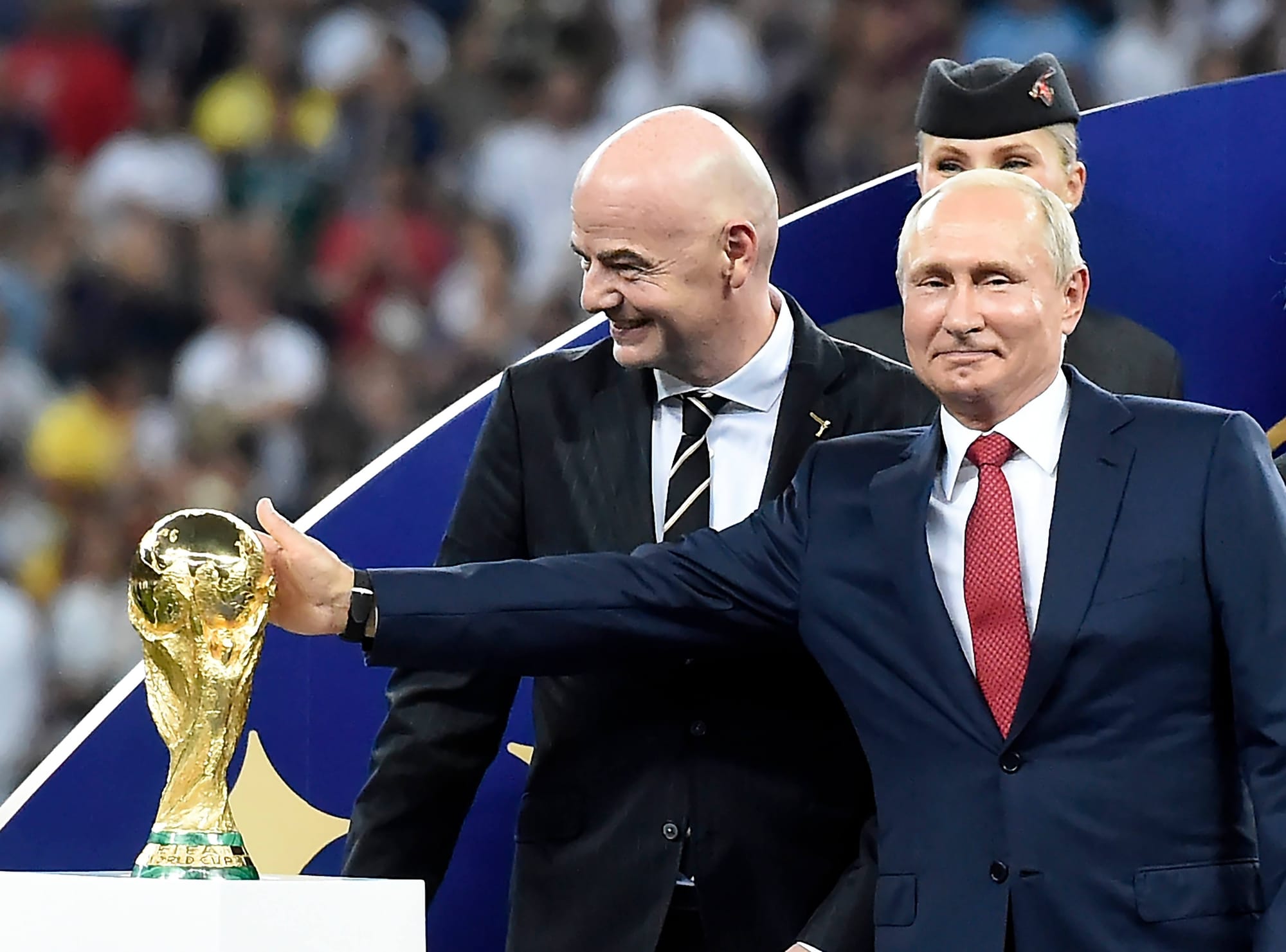
We watched in 2018, as Vladimir Putin, having consolidated his grip over Crimea and just years from invading Ukraine, inaugurated the world’s biggest sporting extravaganza in Moscow. We watched again in 2022, as Qatar became the first monarchical, petro-state to play hosts. Our televisions beamed images of the 800-odd players who tussled in stadiums, but not the thousands of migrant workers who perished in their construction. Their blood trickled through the sand upon which later airflown grass would sprout, far below the suits and sheiks running the show. Perhaps never before has a single event so encapsulated global injustices, the hierarchy of the jungle washed in the desert.
For jaded football fans, the decision made by FIFA—the sport’s governing body—in 2024 to award the 2034 World Cup to Saudi Arabia caused further consternation. Should we worry about the kingdom’s human rights record or cheer “progress”? Is MBS a great reformer or killer of journalists? How many more South Asians is the world willing to sacrifice for sport? The only solace at the time was, well, time: another ten years before we had to unpick our messy tangle of feelings. With the 2026 World Cup scheduled for North America (Canada, Mexico, and the US) and the 2030 World Cup for the western Mediterranean (Morocco, Portugal, and Spain), it felt as if FIFA had offered the faithful a moral interlude, a chance to renew our sporting vows at the altars of more salubrious temples.
Then came Trump version 2.0. The US president is (unsurprisingly) adept at the glad-handing of superstars with immense global reach. In recent months he separately hosted Argentine Leo Messi and Portuguese Cristiano Ronaldo, icons even at the tail end of their careers, at the White House. But away from the glamorous facade of sporting affinity lies a harsher reality of prejudice, brutality, and the upending of a rules-based order. Greenland, Venezuela, and ICE caused consternation among many. But two recent incidents stand out. There was the overt bigotry of the video that portrayed the Obamas as apes, roundly denounced by a footballing world still struggling to stamp out racism. And then the illegal war against Iran, whose team is due to compete this summer. The World Cup’s host has attacked one of its guests, in other words, and banned its fans (and others) from attending. And now, it wants to ban the Iranian team itself from competing. The notion that sports should float above politics today sounds ignorant and grotesque.
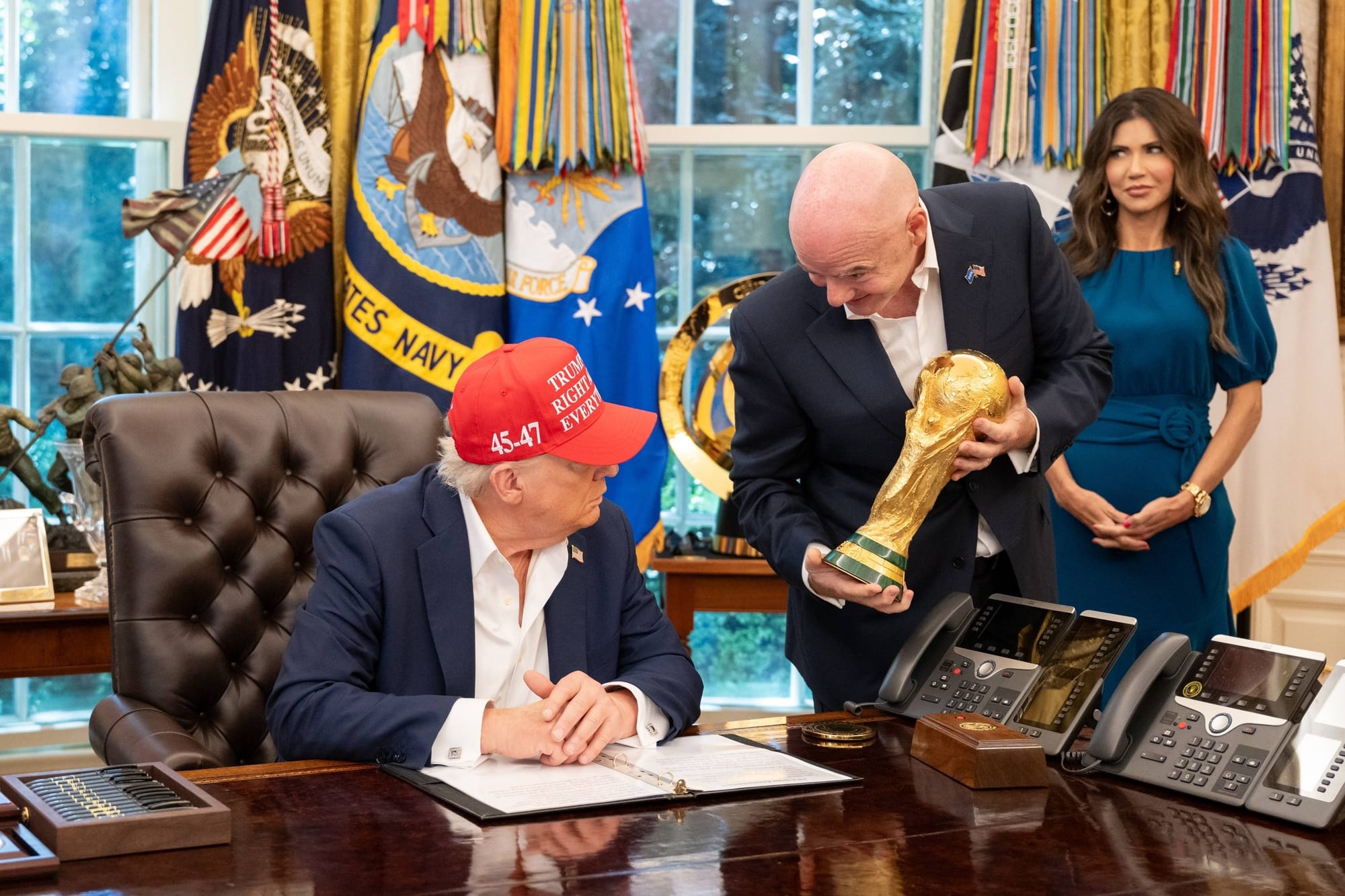
And yet it isn’t Trump, democratically elected and without sufficient international opposition to his militaristic adventurism, who should be the main target of the football fan’s ire. Instead it’s FIFA and its president, Gianni Infantino, who has enabled him through his “willingness to act as a fluffer, ally and de facto propaganda mouthpiece”, according to The Guardian’s Barney Ronay. Having lobbied for Trump’s [failed] bid to win the Nobel Peace Prize, Infantino simply created a new FIFA Peace Prize at the end of last year, and awarded the inaugural one to Trump. Having eschewed the UN and all other sensible multilateral forums, Trump, on his part, surely appreciates the PR value of cosying up to FIFA, with more member associations than the UN. And by pricing the games at astronomical levels—opaquely and likely deceitfully—Infantino has helped Trump ensure that if immigration can’t keep out the hoi polloi, the market will.
Every fan and football federation is implicated in these absurdities. It may seem misguided to call for the boycott of a World Cup co-hosted by three feisty democracies—after having tolerated two in autocracies. Yet this is not an indictment of their societies, but an overdue protest against FIFA—for its long-running corruption, cronyism, and manipulation of the world’s biggest sport in service of narrow, elite interests.
Sport has been a means to odious ends for as long as it’s been organised. Roman emperors hosted gladiatorial circuses to mollify public pique; for decades, our benevolent benefactors, the British, held an annual New Year’s Sports Day at the Padang to keep the natives happy and entertained; and Hitler’s 1936 Berlin Olympics were a paean to Nazi fascism. Hitler’s spirit animal, Mussolini, had used the football World Cup for similar ends just two years earlier.
The politicisation of the game happened despite the “best intentions of FIFA and its sincere, gentlemanly, progressive liberalism,” wrote David Goldblatt in The Ball is Round, a masterful history of football. For others, rumours of political intrigue and bribery that accompanied the award of the tournament to Fascist Italy were enough to conclude that FIFA’s foundations rest on deeply illiberal soil. The role of Jules Rimet—then president, the man who conceived the World Cup, and after whom the winners’ trophy is named—in the whole episode remains contested.
With football’s growing popularity through the 1960s-70s, FIFA’s influence grew. So did its complicity in enabling dictators, populists, and shitty regimes across the developing world. So devoted was its sixth president, Stanley Rous, to the game, that he insisted apartheid-era South Africa be welcomed back into its fold, racism be damned. In 1973, a FIFA fact-finding team gave a clean chit to Augusto Pinochet’s regime after visiting the Estadio Nacional complex, in which thousands of alleged communists had been brutally tortured weeks earlier and where many were still being held. (A gruesome detail: imprisoned guitarists were forced to perform after their fingers were broken, Beatles’ songs blasted from megaphones drowning out their screams).
FIFA passed the stadium for use by Chile, to host their World Cup qualifier against the USSR (read: a red-crushing, right-wing government’s team versus the one repping the Marxist motherland). The Soviets refused to show up, Chile qualified for the 1974 tourney in West Germany. “It is hard to determine the exact proportions of the duplicity, complicity and sheer naivety that informed the glib and sanitized response of FIFA’s inquisitors,” wrote Goldblatt.
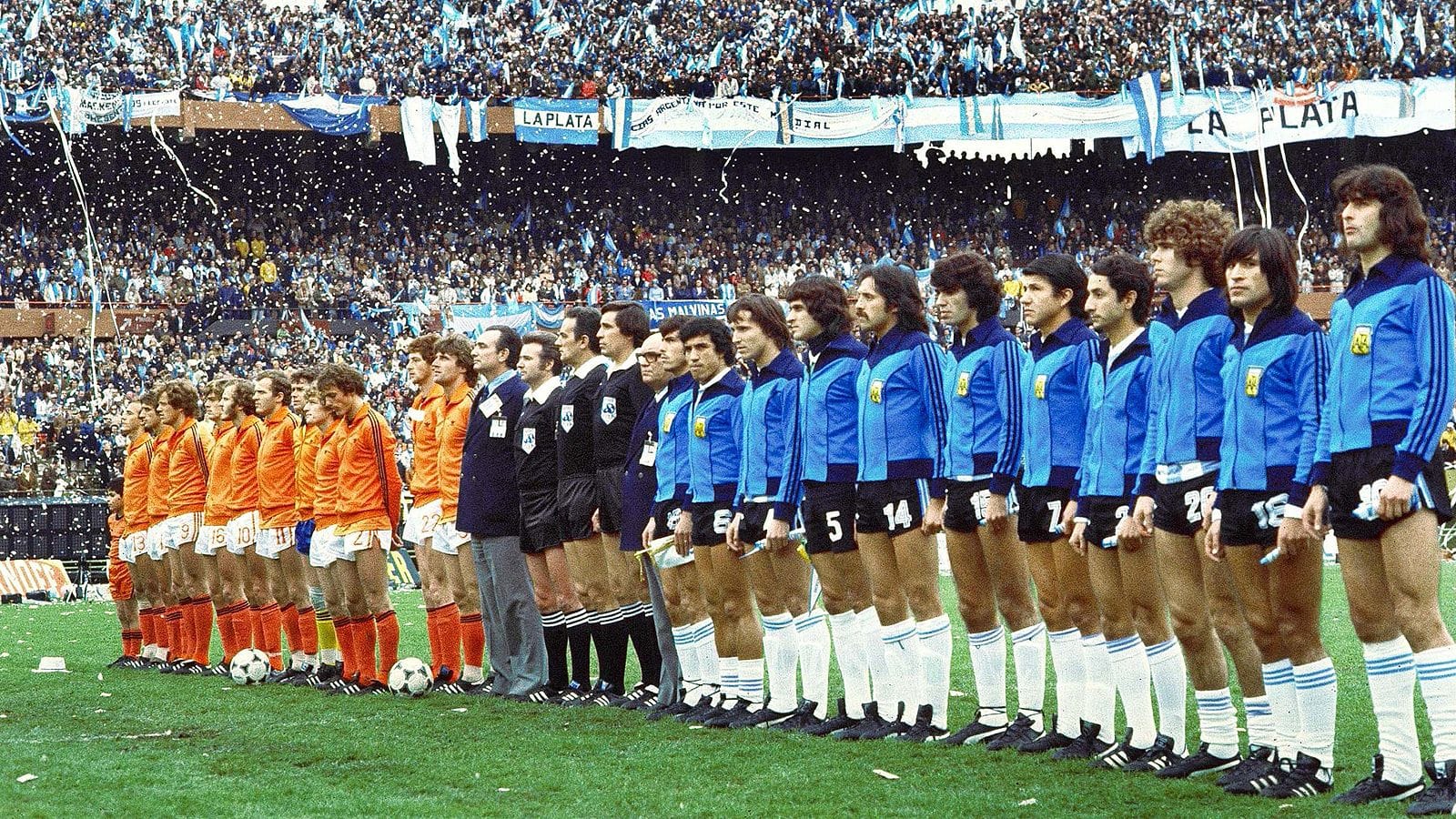
The same indeterminate collusion shrouds FIFA’s decision to go ahead with the 1978 World Cup in junta-ruled Argentina; and its cheerful declaration that all was well with Iraqi football after a gutless 1997 inquiry into allegations that Uday Hussein, Saddam’s sadist son and head of the country’s football association, tortured players. Sharar Haydar, one of Iraq’s best, was among those who later confirmed that Uday regularly had members of the national team whipped with electric cables, dunked in sewage water, and confined in inhumane conditions.
By then, FIFA was a gargoyle bloated on television revenues milked from billions of fans, and on sponsorships from behemoths like Adidas and Coca Cola. And so desperate were national football bodies to bring the World Cup cash machine to their shores that Switzerland nominated the Brazilian Joao Havelange, FIFA president, for the Nobel Peace Prize so they could win the 1998 hosting rights. (Obviously the fetish is neither new nor restricted to Infantino-Trump.) The prize went to Irishmen John Hume and David Trimble, for their role in ending The Troubles, while the tournament rights went to France, leaving the Swiss only with the stench of amoral transactionalism.
Havelange retired that year after a quarter-century reign, an unlovely administrator who rarely evinced any affection for the game. “[T]he players, the countries and hundreds of millions of fans to whom the game brings such joy seemed but parts of his money-spinning masterplan,” went his obituary in The Guardian. The financial corruption under Havelange was breathtaking; under his slimy successor Sepp Blatter—female players should wear “tighter shorts,” he once said—it acquired a deeper moral dimension too.
In 2010, Blatter’s FIFA awarded the 2018 World Cup to Vladimir Putin’s Russia and the 2022 edition to Qatar. A lawyer hired to investigate claims that both World Cups had been bought resigned, saying that FIFA had distorted his findings to exonerate itself. Blatter himself resigned in 2015, not because his devotion to dictators had become untenable but because some bribery allegations had attracted the FBI’s attention. The US attorney general at the time called FIFA a “mafia-like racketeering organisation.”
Football fans hoping for a new FIFA dawn were fresh out of luck. Infantino, a humdrum Blatter factotum for years, was anointed with the ashes of his erstwhile boss’ career and brought with him a promise to oust those using FIFA as a gravy train stretching from Zurich to the Caymans. Within a month he was named in the Panama Papers, within a year he was subject of an inquiry relating to personal mattresses and exercise machines charged to FIFA; within two, questions arose about private jet travels to Russia and Qatar; and within five, US federal investigators were investigating him for “indications of criminal conduct.” He was cleared of all wrongdoing.
Throughout it all, he heroically clung on to FIFA’s century-old tradition of being on the wrong side of history—fawning over Putin, defending Qatar’s human rights record (somewhere along the line he became a resident of the country), and then holding up a giant Fuck You neon sign to all critics by awarding the 2034 edition to Saudi Arabia. Both Middle Eastern nations have qualified for the upcoming tournament on the back of favourable playing conditions supposedly enabled by FIFA. Handing Trump a bauble to caress his ego borders on the benign in this larger context. Within FIFA, Infantino has gutted independent committees, used technicalities to extend his reign, and deepened the money-for-votes culture to wrangle support from cash-strapped national bodies. No surprise they get along.
Given all this, someone who’s never followed football might wonder why anyone would. Mostly because people are not initiated into football, or any sport, through policy papers or screeds like these. They hear stories from their parents, they see siblings in void decks and on fields, they swap stories with school friends, they want to crack the DSA track (we kid), they read books and comics, and latterly of course, they watch YouTube, Insta, TikTok, and the rest. They try out a few sports. And from the billion pleasing cues these glorious diversions of the field offer—a shuttle’s flutter; a squash court’s geometry; running’s solitude; cricket’s impossibility; basketball’s dynamism; golf’s self-denial; tennis’ monasticism—one feels just right. Football, which Pelé started playing with only an orange, feels just right for 3.5 billion.
For fans in Singapore, the World Cup is a once-in-four-years opportunity for communal gatherings of family and friends. Parties are planned, bets are placed, and journeys are embarked on together, as fans follow their teams. Signature spaces in our little red dot are abuzz with life, from community centres and HDB kopitiams to swish downtown bars. And through it all is the undercurrent of hope about our dream delayed, that one day our very own Lions will represent us at the highest stage. (Incidentally Curaçao, with a population of 156,000, qualified this year, the smallest country ever to do so.)
Amidst all this joy and goodwill and hope; the culture, the community and the memories, to be confronted with the fact that the whole enterprise is rotten from within elicits varying reactions. Some simply shut out the off-field shenanigans. Others sit uncomfortably with the cognitive dissonance until it dissolves into background noise. And yes, many simply do not care. The gravitational pull of the game is too strong and its largest spectacle too hypnotic; the suffering and the corruption too far removed. No one is broadcasting migrants dying while building stadiums in the desert. They’re all lies, anyway, spread by racist liberal Western media; I’d rather believe my local broadsheet (and forget that it’s part of the gravy train, juiced up by local broadcasters’ ad dollars).
FIFA counts on our apathy. It counts on our Faustian bargains. It counts on us finding ways to wipe away any guilt, the culpability of one pair of eyes among 3.5 billion too small. All approaches to making peace with FIFA’s chicanery—and that includes pleading ignorance to it—rest on an assertion taken to be self-evident. Football is only a sport, not a vehicle for activism. And it’s in the moral gaps created by these negotiations that it burrows itself. The imagery may seem odd for an organisation so crass, so loud, and so full of self-serving platitudes. But that’s precisely why FIFA is sui generis. Its superpower, as one commentator said, is its “shamlessness.” It can be both insidious and brazen—knowing our love of the game will blind us to both its and our own hypocrisies.
Yet look we must, for as Goldblatt puts it, “football, the game the world plays, offers a metaphor for the dilemmas that sit at the very centre of any moral framework or political programme that takes the reformation rather than the abolition of modernity as its starting point.” In other words, football is as much a window into larger struggles with labour exploitation, elite connivance, and unfettered capitalism as it is a way to appreciate our common humanity and our need to be with one another.
On these shores, disenchanted social justice advocates further feel that nobody cares about Singaporeans’ views because we’re too small. That may have once been true. But it’s also become clear in recent years, from Davos to Gaza, that amidst a great disruption to the prevailing world order, our perspectives have become more salient and valued.
Meanwhile, Singaporean football fans are, per capita, perhaps the most lucrative cogs in the global soccer machine, forced to pay exorbitant prices to watch international football on TV. Immensely rich, powerful, and averse to change as FIFA is, reform will take years, if not decades. But even the tiniest disruption to the order will send a necessary signal.
Still, there is a reason this commentary’s title has a fudge in parentheses, “(most of)”. The history of progressive social change is littered with instances of sanctimonious overreach by the extreme left. For instance, it’s better if omnivores (especially in the rich world) eat less meat—for their health, for animals, for the planet. But draconian demands to, say, immediately discard all leather and animal-based products in the household, as we’ve witnessed, reveal an insufficient level of care and empathy about tradition and the human condition.
Radical action is also possibly counter-productive to the larger cause: veganism, for instance, is sometimes at odds with locavorism, and the quest for nutritional purity can come at the cost of food miles—fly in the greens from afar rather than eat the animal product down the road. With any social change, people need not just convincing through reason but pathways to change that honour the multitude of competing tensions in their lives.
Yes, there are areas that demand a greater urgency of action. They’re usually those where there is imminent harm to other humans. Two examples we can think of are the death penalty and racism. It’d be folly to allow that auntie to keep calling her Indian friend keling kia because—reasons we’ve heard given—“last time can what”, “just joking” or “it’s a term of endearment, they don’t mind”.
From our perspective, the FIFA World Cup isn’t nearly so urgent. Why? It is long-term systemic change that we want to spark, even though the short-term impact of any boycott is limited. The coming World Cups will, barring some drastic turns of events, proceed as planned. But might pressure on FIFA force it to maybe clamour for better migrant worker protections in Saudi Arabia ahead of 2034? One can hope.
So what do we mean by “boycott (most of) the World Cup”? Do what you can. Baby steps. Maybe just limit yourself to the 28 free-to-air games. That’s plenty. (Your eyeballs will still be monetised by advertisers, feeding the great FIFA machine, but little else.) If you absolutely have to buy a package from Mediacorp/Singtel/Starhub, maybe share it with a group of friends—for example, rather than five homes having subscriptions, all can occasionally gather at one. Circumstances differ between groups and individuals. You need to figure out what works for you, always aware of the imperative of ethical consumption. One way could be to use some of your precious time and money on supporting local sport instead of FIFA.
To change nothing at all, to simply continue adhering to the FIFA machine, would be to effectively condone everything Infantino is doing and what FIFA has done throughout its history. In the same way that the neoliberal capitalist order sucks you in to a materialist life through sweet lullabies about progress and development elsewhere, so does FIFA’s messaging about sporting camaraderie and the livelihoods of aspiring footballers in poorer parts of the world.
All those things can still be achieved without FIFA’s corruption and venality. We must do something now.
Abhishek Mehrotra is Jom’s head of content and Sudhir Vadaketh is Jom’s editor-in-chief. Abhishek first watched the World Cup in 1990; Sudhir in 1986. They’re debating whether to watch one, three, or seven of this year’s matches.
Letters in response to this piece can be sent to sudhir@jom.media. All will be considered for publication on our “Letters to the editor” page.