

News this week included: Ong Ye Kung on balancing technological surveillance with privacy concerns; Vivian Balakrishnan on keeping the Malacca Straits open; Singapore and Malaysia emphasise diplomacy and energy resilience amid Middle East conflict; “No room for reactive governance”, says Chan Heng Kee, new civil service head; SGX proposes stricter KPI and executive pay disclosure rules; good summary of that Bloomberg trial’s hearing by TOC; Singapore executed a man for trafficking weed; the UN’s human rights chief expresses concern about the continuing spike in executions for drug-related offences here; one in three new lawyers may quit within three years due to workload, workplace culture, and mentorship gap; activist Kokila Annamalai responds to her POFMA charge; a 40-year-old jailed after assaulting his 74-year-old father and repeatedly locking him out of their flat; JC student suspended after allegedly trying to film females in a women’s toilet on campus; longer waits for driving lessons and tests; more women in their 40s giving birth; CNA feature on Singaporeans who left the corporate world to become farmers in Johor; the Singaporean temple going viral amongst Thais looking for love; open-concept massage establishments will no longer be exempt from licensing; and two cockerels chasing each other across a busy road narrowly avoid a passing car.
Below are the issues we chose to explore in more depth.
Our picks
Society: Slopaganda
“Wake up, America, open your eyes to the devil’s design,” goes a rap song about Israel’s apparent ultimate ambition: to nuke the US. Its music video begins with an Iranian MC dressed in fatigues in a war-room and ends with a shot of Americans in chains in front of a burning Golden Gate bridge. The words are spit relentlessly: Israeli deception; American destruction from Indonesia to Panama; and elite protection and privilege, starring Jared Kushner, Jeffrey Epstein, and others. All told through cutesy Lego characters, and all the product of generative AI (GAI). “The subject matter is deathly serious—international war, unfolding in real time, killing thousands—yet the visual vocabulary is preposterously trivializing,” said The New Yorker. (Its creators told the magazine they’re Iranian students.)
In case you missed it, the ongoing slopaganda war is perhaps as important, and certainly more entertaining, than the actual one. (Slop is a subset of GAI.) For those who like voluptuous blondes in tight uniforms, enter Jessica Foster. She accumulated over a million followers on Instagram through photos of herself in proximity to weapons and their masters, including in the Oval Office. She’s “the apotheosis of what MAGA fantasizes about, all packed into one channel, but it’s obviously AI”, an interviewee told The Washington Post. Meta removed her account, though she’s just one of many AI-generated sexy female soldiers—American, Iranian, you name it—fuelling the war machine and grotesque manosphere fantasies.
Indeed, the intersection of war, feminism, and sex appeal is perhaps the most troubling form of slopaganda. In “The New Era of War Propaganda”, Alice Cappelle proposes three evolutionary stages: the feminist push for military inclusion; the military’s “girlbossification” (in the 2010s); and today’s “female war-influencers in a post-truth world”. In the last two decades, feminism has been reduced by politicians, Cappelle says, to “a buzzword to manufacture consent for more and more interventions, more and more death of women, but also destruction of their homes, their universities, their schools, their hospitals, and workplaces.” Foster was ultimately tied to an Only Fans account. Notions around online entrepreneurial autonomy and farce complicate the issue. “And that's precisely what makes this form of gendered war propaganda so powerful. It escapes criticism because it constantly flirts with irony, with the possibility that it is not something to be taken seriously,” said Cappelle.
Wonks who worry that the zone is being flooded with brain rot should be more concerned that their talking heads will one day be replaced by GAI. USA TV Digital, a relatively small “digital creator” with 12,000 Facebook followers, wants to appeal to a leftist literati with the patience to sit through 20-minute audio diatribes. Welcome to political pontification with AI Bill Clinton. In “Most people DON’T REALIZE Trump’s Ceasefire is WORSE Than You Think!”, a single, static visual of the 42nd US president accompanies his signature, ArkLaTex Southern drawl. The machines have even replicated his signature self-regard, as he pats himself on the back for his negotiation nous during the Dayton Accords, before asserting: “An open-ended ceasefire, with no clear terms, gives the other side exactly what they need most: time.” Leon Perera, former MP, told Jom he “found the analysis fascinating as an example of applied IR theory. I watched to the end (I rarely do).”
Jo Teo, physicist and commentator, said that: “2025 was the year of TikTok protests, 2026 is shaping up to be the year of AI slop warfare”. Ahead of GE 2025, the government banned “deepfakes of candidates during elections”. Given that AI offers a leg up to under-resourced adversaries, should we expect even more sophisticated laws by 2030?
Some further reading: “Slopaganda: The interaction between propaganda and generative AI” by three media scholars. “In summary, slopaganda has unique features (targeting), unique magnitudes of features (scale, scope, speed), and unique qualitative improvements (persuasiveness) that together make it distinct from any prior form of group influence strategy…By its effects on individuals, slopaganda poses challenges at a group level, which can only be addressed by new solutions and not those that may have worked with earlier manifestations of political rhetoric and propaganda.”
Society: Four times the power
The Labour Day Rally 2023, the first to be organised by advocacy group Workers Make Possible (WMP), was unique for a few reasons. It was not fronted by any political party but was a genuine ground-up, activist-driven event. It championed the rights of all workers, regardless of nationality (some previous events involved worrying xenophobia amid calls for job protection). “The People’s 15 Demands for Labour Day” included stopping the GST hike while implementing a 2 percent wealth tax on Singapore’s richest 1 percent; a minimum wage for all; and ensuring all workers have enough rest. A nurse, community worker and researcher, F&B worker, and food delivery rider shared their stories with Jom.
The second edition in 2024 saw the crowd double to about 600. Its theme was safety, given that workers here endure some of the longest hours in the world, and are one of the most sleep deprived, with the chronic overwork partly to blame for 36 deaths the year prior, the overwhelming majority being migrant workers in the construction sector. The 2025 edition was famously delayed because of GE2025. On May 25th, about 700 people gathered for what was, for many, a mix of revelry and rehabilitation: the recent devastating electoral victory by the pro-business PAP was perceived as a setback for workers’ rights. The SDP’s Ariffin Sha, TikToker Jay Ish’haq Rajoo, and artist Bani Haykal led an impressive lineup of speakers. Jom filmed an interview with Jaya Anil Kumar of the Humanitarian Organisation for Migration Economics (HOME).
Next Friday, from 3-7pm at Hong Lim Park, we’ll see the first joint rally by WMP and SG Climate Rally (SGCR). Their unified message: people and the planet are being sacrificed for the pursuit of profit. Among other contradictions, they highlight: workers are told to reduce their personal carbon footprint while large MNCs continue polluting with government subsidies and invest in AI-driven data centres that consume vast resources. This year’s demands include an eight-hour workday and a maximum five-day work week for all workers; and the assertion that Singapore’s green transition cannot come at the cost of others—all overseas projects should be done with free, prior, and informed consent of local communities. Expect speeches by workers, dances, a skit, stand-up comedy, and a choir, as well as partner booths featuring over 30 local ground-up community groups, a record for the park.
What might have once been seen as a leftie bonfire has evolved to an important event in the calendar for academics, activists, artists, journalists, politicians, students and anybody, really, keen on understanding labour resistance in one of the world’s capitalist temples. See you there.
Some further reading: “Singapore is not an island”, by SGCR
Society: Spare the rod…
Always, the victims first. Some 15 percent of girls and 26 percent of boys in Singapore are bullied a few times every month—mocked and abused by peers, shunned, and in the worst cases, physically assaulted. The effects of bullying on children are well known but bear repeating: anxiety, poor self-esteem, lower academic achievement, sleeping problems, and difficulties maintaining relationships in adulthood. The effects on parents whose children are bullied are less studied but easy to grasp: sorrow, frustration, and a frantic helplessness.
Outrage over the rising incidence of bullying in primary schools, including a series of recent high-profile cases, has prompted MOE to respond with a slew of measures that all public schools must adopt by 2027. One is a stricter disciplinary framework. A first-time offender deemed to have participated in verbal, physical, or cyber bullying can be given three days detention, suspended, or slapped with a lower conduct grade. Boys in upper primary can be caned once, with the number of strokes rising for each subsequent offence, to a maximum of three.
EveryChild.SG, an education NGO, raised concerns about this provision. It argued that a substantial body of evidence shows that corporal punishment can cause long-term developmental and physiological harm while leaving the underlying problem untouched. It is “associated with low moral internalization, reduced empathy…and was found to be a factor in”—here’s the kicker—“behaviours such as bullying…”, reported WHO just last year. Besides, our own Ministry of Social and Family Development encourages parents to adopt “less harmful alternatives” over physically disciplining their children.
EveryChild.SG has instead called for greater emphasis on “restorative practice”: cool-down periods, mediation, counselling, and reintegration. Formal frameworks exist—most notably KiVa—developed and piloted in Finland, and now adopted elsewhere too. KiVa has significantly reduced the incidences of bullying in both trials and real-world settings. Far from showing misplaced solicitude to the perpetrators at the victims’ expense, such approaches make far more emotional, relational, and cognitive demands of the former. But crucially, said EveryChild.SG, they change the lens from “‘what punishment is required?’ to ‘how do we repair the harm, and ensure it does not happen again?’”
To be clear, caning is just one plank in MOE’s broader framework. Others range from more manpower for schools to a more intentional nurturing of a kind and respectful student culture. But when physically punitive measures sit alongside more considered ones, “students are likely to prioritise compliance and avoidance of punishment, over genuine reflection and making amends.” (By restricting caning to boys, the MOE itself is implicitly acknowledging that there are ways to tackle bullying without reaching for the rod. This, by the way, should not be read as a call to start caning girls too.)
Caning appeals. For traumatised victims and parents, it’s swift and visceral retribution. For harried teachers, it’s a simple, readily available recourse. For policymakers, it acknowledges the former’s pain and empowers the latter. Yet, as EveryChild.SG put it: “A system cannot reliably teach non-violence while retaining violence as one of its tools.”
Some further reading: In “Discipline and punish”, Singapore This Week guest contributor Tracey Toh reviews “Rotan Rattan: Meditations”, an exhibition by Yanyun Chen and Dave Lim on the role of corporal punishment in disciplining children.
Earth: The straw that breaks the planet’s back
Starbucks customers who want a straw will now have to request it at the counter instead of just plucking one from the condiment bar. The purported Earth Day initiative has been criticised as another greenwashing move to cut costs under the guise of saving the environment. The Starbucks Singapore Instagram post had over 3,000 comments, including one: “We’re worried about straws when we have billionaires flying all over the place. Priorities”. Indeed, Starbucks CEO Brian Niccol uses the company’s aircraft for travel from his home in Newport Beach, California to its headquarters in Seattle, Washington. An X user wrote, “rules for the little people but not for the kings in society”. What’s more, Starbucks recently removed climate goals from its executive bonus structures, a strategy considered necessary to nudge senior leaders into taking environmental goals seriously. (UBS and HSBC have rolled back similar incentives.)
But let’s assume Starbucks’ latest move is in good faith. Even at the height of anti-straw campaigns, plastic straws formed a tiny fraction of global plastic waste. By contrast, takeaway packaging—especially single-use cups—is a far more significant and persistent source of waste. A CBS News investigation traced 36 cups placed in in-store recycling bins across a number of US cities. Only four went to recovering facilities; the rest went to transfer stations, incinerators, or landfills.
The same dynamic is evident in Singapore. The nation runs on coffee; nearly 55 percent of the respondents in a 2022 Statista survey said they’d bought coffee in the week prior. In addition to the specialty coffee joints and neighbourhood coffee shops, we have 140 Starbucks outlets, some 60 Coffee Bean stores, and new entrants such as China’s Luckin Coffee, Indonesia’s Kenangan Coffee and Fore Coffee, Canada’s Tim Hortons, and Taiwan’s Louisa Coffee. The takeaway cups and bags from these contribute far more than straws to the alarming amount of plastic waste we generate, estimated at one million tonnes in 2022.
Only six percent of this was recycled, with the remaining 944,000 tonnes, comprising single-use and reusable plastics, disposed of. Further, the efficacy of recycling here is also reduced by a commingled system—where plastic, glass, and paper are deposited in a single blue bin—making contamination more likely. Food residue and non-recyclables frequently enter the stream, and once a single bin is contaminated, entire truckloads can be rendered unsuitable for recycling.
These patterns point to a broader tension between corporate initiatives and government action in addressing the climate crisis, and raises questions about where responsibility for environmental change is expected to reside. “The ESG trend perpetuated, or even amplified, the fiction that corporations are the most effective driver of societal change”, wrote Diane Coyle, a British economist, in Foreign Affairs. Amidst all this, banning straws won’t rise beyond vague hand gesturing at best, and greenwashing at worst. It offers a sense of participation without requiring much in the way of change, allowing larger systems of production, consumption, and disposal remain largely undisturbed.
Culture: A growing circle of influence
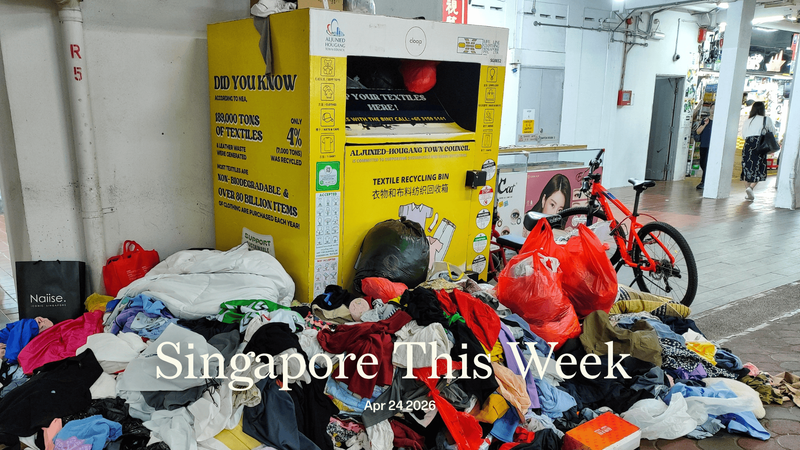
We reach for the same 20 percent of our clothes about 80 percent of the time. But how is it that we always end up with overstuffed wardrobes, our rails heavy with chemical-coated Shein impulse buys, and the backs of our shelves becoming warrens for multiplying dust bunnies? It might be time for your one-way closet to go circular: giving back instead of just taking things in. Various attempts to get Singapore away from a pattern of disposability and on board the fashion circular economy have been chugging along for some years now. More local labels are leaning into well-made, long-lasting capsule offerings, and more consumers want to avoid waste. A 2024 YouGov survey showed that over one in three Singapore consumers had made at least a single sustainable fashion purchase. “I’ve noticed a real mindset shift, especially among Gen Z and younger millennials. They’re less impressed by flashy ‘eco’ labels and more drawn to longevity and intention,” Moushumi Khara, a Singapore-based stylist, recently wrote in The Peak. “Rather than chase trends, they ask: ‘How many ways can I wear this? Can I rewear or remix it?’” But we’re still lagging behind; as of 2023, Singaporeans discarded an average of nine pieces of clothing a year, Singapore as a whole generated an eye-watering 211,000 tonnes of leather and textile waste—roughly double the weight of our entire MRT train fleet—recycling a meagre two percent of it.
There’s been a lot more traction in other countries. It’s almost expected in Finland, for instance, that you’ll source for something pre-loved rather than splurging on something brand-new. UFF, a ubiquitous high-street second-hand chain, stocks well-curated seasonal clothing and has a regular countdown of “equal money days”, where you can get any item starting at €8 (S$12) on day one, and a grab bag of anything for €1 (S$1.50) apiece when the stores are about to clear their racks for the new season. And if you head into higher-end boutiques like Relove or Urbaani Legenda, you’ll find everything from vintage Levi’s with button flies to buttery Dolce & Gabbana motorcycle jackets for a fraction of the price. (Even their flagship fashion and jewellery labels, Marimekko and Kalevala, boast a wide-ranging preloved selection in their online stores.) These thrift stores and flea markets, usually neighbourhood staples, will also help to sell your well-looked-after clothing with all-inclusive packages that end up benefiting the store, the seller, and the buyer who gives it a new home. The Nordic country is proud of its circular economy, which newcomers quickly get inducted into: why burn money when you can get a robust winter wardrobe of coats, thermals and boots for cents on the dollar?
Singapore is getting there. This week marks our first-ever Circular Fashion Week. It’s organised by The Fashion Pulpit, the social enterprise that specialises in clothes swapping and is committed to minimising textile waste. You can learn to mend your own clothes at a sewing workshop; learn from tastemakers themselves at panels and talks; or hit the runway showing off textile scraps and pre-loved clothes upcycled into dramatic new silhouettes—even discarded flour sacks sourced from Philippine bakeries and sewn into stylish genderless clothing. Happening at the same time is the advocacy platform Fashion Revolution’s third edition of the Eco Fashion Weekend, which is hosting an awards and fashion showcase for brands advocating sustainability. Part of the delight of thrifting and swapping is the thrill of a one-of-a-kind discovery: who knows what treasures someone your size might bring in that day, from a sturdy basic to a statement piece. Instead of chasing fashion trends, you get to set your own: when to retire a look and when to embrace a makeover, tailored to the seasons of your own body and ever-evolving identity.
Abhishek Mehrotra, Sakinah Safiee, Corrie Tan, and Sudhir Vadaketh wrote this week’s issue.
Letters in response to any blurb can be sent to sudhir@jom.media. All will be considered for publication on our “Letters to the editor” page.
If you enjoy Jom’s work, do get a paid subscription today to support independent journalism in Singapore.