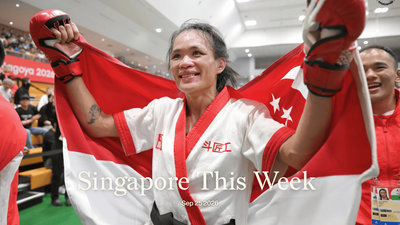



News this week included: a survey of South-east Asians finds Singapore to be a regional leader on issues and rates “US leadership under President Trump” as the top geopolitical concern; FairPrice supermarkets freeze prices of 100 essentials for over a month; the first wholly-government-owned worker dormitory opens; Sar-El Volunteer Corps, the Israeli outfit where two Singaporeans volunteered, but have been cleared of wrongdoing; a new surgical procedure trialled at Changi General shown to improve symptoms associated with Alzheimer’s; the number of kids sexually assaulted, and the number attacked by family members, both rose in 2025; a 38-year-old Indian national (and Singapore PR) faces two careless driving charges after killing a 6-year-old Indonesian child; Amos Yee returns, and our minister for home affairs wishes “the Americans had kept him”; as “irritating as incessant drilling”, says a man in Clementi after he stands in the middle of a pickleball court to stop a game; Aloysius Yapp wins a surprise 8-ball world title in US (and here’s Jom’s earlier profile of him); the “Singapore Pokedex”, a free online wildlife library, launches; the Singapore Art Book Fair gracefully walks back a controversial idea for its 2026 edition following online criticism; and our very own MacGyver, as a 39-year-old man is charged after weapons, including firearms and homemade crossbows, were found in his Potong Pasir flat.
Below are the issues we explore in depth.
International: The wages of war
The modern world order is built on free trade, much of it underpinned by the United Nations Convention on the Law of the Sea (UNCLOS). UNCLOS parcels out swathes of the oceans to coastal nations: full sovereignty over 12 nautical miles, another 200 nautical miles for activities like fishing and mining. It designates most waters as global commons. It guarantees safe passage on the high seas and through key navigation routes for ships of all flags (save the Jolly Roger). Vivian Balakrishnan, foreign affairs minister, told Parliament that if Singapore were to negotiate with Iran for passage through the Strait of Hormuz, it would upend the logic of UNCLOS—a right enjoyed by all countries turned into a privilege granted (and withdrawn) by one. A principled stand; self-interested too in that such negotiations could invite similar gamesmanship in the Straits of Malacca, sovereign waters belonging to Indonesia, Malaysia, and Singapore but open to all under UNCLOS. (Some Malaysian politicians have criticised us for choosing “disengagement” over “dialogue”.)
Balakrishnan’s remarks coincided with reports that Iran had allowed a Malaysian vessel to sail through Hormuz, and as prices at petrol stations, in power tariffs, and down the chain at kopi stalls began to bite. To assuage the pain, the government has reached for its favoured VCR toolkit—bringing forward CDC vouchers issuance, and announcing higher cash transfers alongside more corporate tax and utility rebates. Ride-hailing and taxi drivers, among the most severely affected, welcomed the S$200 one-time payout while calling for more sustained support. A few countries have cut fuel levies but Jeffrey Siow, acting transport minister and senior minister of state for finance, ruled out a similar move here, calling it “regressive” and “blunt”. Siow’s stance was backed by Ho Ching. “Cutting taxes and increasing subsidies are both bad options for all govts. They addict [sic] people and economy to cheap oil,” wrote Facebook Singapore’s resident oracle (and former boss of Temasek). To be fair, their opposition isn’t misplaced—the benefits of such cuts tend to accrue disproportionately to wealthier households, which consume more fuel.
The G’s announcements came amid heightened tensions, as Donald Trump, US president, declared “a whole civilisation will die tonight” before announcing a two-week ceasefire. A day in, the fragile peace is already showing signs of fraying, thanks in no small part to Israel carrying out its largest attack on Lebanon since the war began. Iran claims this was a violation of ceasefire terms; the US disagrees. Even if the peace holds, and Iran allows shipping through Hormuz immediately—neither a given—the ructions are going to be felt for a while yet. The backlog of some 2,000 vessels stranded in the region will take days to clear; oil supply disruptions caused by extensive damage to the Middle East’s energy infrastructure will take months to resolve. “It’s not a case of you just flick a switch and everything’s back up again,” an oil executive told the New York Times.
The contagion of higher prices is likely to spread, including to food. “[W]e import everything,” K Shanmugam, minister and head of the recently convened Homefront Crisis Ministerial Committee, said. “Fertiliser prices have to go up. And the cost of bringing those food products, transportation to Singapore, that will go up.” (Read Jom’s essay on Singapore’s food security.)
If there’s a silver lining in the carnage, it’s that individual suffering may catalyse systemic change. The war has laid bare the urgency of cultivating indigenous energy sources. Land constraints limit Singapore’s solar potential, so experts are pushing for nuclear power: clean, reliable, and better insulated from geopolitical shocks. But this will take time. For now, we must bear the costs of one man wielding power he neither understands nor deserves.
Society: Go overseas to work or play?
Andrea, a recent graduate of the National University of Singapore, went viral for her “six-step” process of putting on the Chulalongkorn University uniform in 2024. “No exchange student studies on exchange okay?!” she quipped at the start of another video, this time cramming for an exam during her Bangkok stint. Andrea is one of a growing number of Singaporean students signing up for overseas programmes in ASEAN-China-India (ACI).
A quick search on Lemon8, a Singaporean social media platform owned by ByteDance, throws up a thriving depository of student-made guides on navigating ACI study or work experiences: from recommending databases of overseas opportunities like the Singapore-China Youth Interns Exchange Scheme (YES), to reflecting on mistakes. In the past, language barriers, unfamiliar work cultures, or simply not knowing where to begin would intimidate many from considering studying or interning in non-Western countries. Today, social media is filling the gap in a way official university brochures often cannot.
While European countries remain popular, more Gen Zs are opening themselves to nearby emerging markets that can provide meaningful overseas work experience. This trend reflects the generation’s appetite to travel independently and prioritise immersive, experience-led itineraries—moving away from mainstream cities in a bid to discover “hidden gems”.
It’s also a symptom of today’s job market, with fewer graduates securing employment within a year of graduation compared to last year. As opportunities dwindle, “stacking” internships may not feel enough, nudging students into seeking global exposure. The chance to study and/or work in neighboring countries provides a more financially accessible option for those not on “parents’ scholarship”.
That accessibility matters. For students without the means to pursue expensive exchanges in Anglophone countries, it provides international exposure that is not only more affordable, but also geographically and culturally closer. Still, this growing ease of regional mobility should not be romanticised uncritically. On TikTok, you’ll see students sharing house tours of their “affordable”, S$600-a-month condominiums in Bangkok. On Reddit, the internet’s Debbie Downer, commenters are less charmed—pointing instead to the wealth inequality such lifestyles underscore for locals, and scoffing that for Singaporean students, “it’s an internship not a career, pay money go there play for six months”.
As more affluent Singaporeans move through neighbouring cities they should be aware of how their presence can contribute to rising costs and gentrification in the very places they seek out for opportunity, advancement, or “authenticity”.
Society: Joyful three-dimensional doodling
As ever, science fiction led the way. “It makes drawings in the air following drawings it scans with photo-cells. But plastic comes out of the end of the drawing arm and hardens as it comes ... following drawings only,” wrote Murray Leinster in Things Pass By, a 1945 short story. Raymond Jones would refer to it as “molecular spray” in his 1950 story, Tools of the trade. It was only in the 1970s that innovators understood the resonance with human endeavours millenia old. “As used herein the term printing is not intended in a limited sense but includes writing or other symbols, character or pattern formation with an ink,” stated the 1971 patent for a Liquid Metal Recorder. “...The preferred ink is of a hot melt type.”
Corporate America’s dry legalese was elevated in 1974 by British scientist David EH Jones. In his regular column Ariadne in New Scientist, he exuded a child’s wonder upon discovery. “By proper settings of the mirrors [to direct lasers] anything from a Brillo-pad to a vest can be made: and with no moving parts at all!...This effortless optical sculpture would revolutionise the plastic arts in all senses. Designers would be liberated from heavy, expensive steel moulds, and could try out their fancies at will in the laser bath…The whole process is in fact a sort of joyful three-dimensional doodling.” Chuck Hull’s invention in 1983 of stereolithography—ultraviolet lasers working on photopolymer resins—is considered the birth of 3D printing. And if human evolution is partly a story of the words we use to depict our condition, then our engineers are still grasping for the truth. Is it “3D printing” or “additive manufacturing”? One seeming reason is that it’s the former for the consumer market and the latter for industrial applications.
Layers of meaning for the process of layering. Akin to inkjet printing, modern 3D printers take their raw materials, which may include plastics, metal powders, and binding solutions, and squeeze out, ala glue gun, the printing material—commonly a plastic filament—in thin layers, often 0.1mm thick. Layer by layer, a human’s ingenious computer-aided-design (CAD) dreams are realised. To what ends? What began as way to replace tools, spare parts, and other knicks and knacks was later used extensively for functional prototyping in manufacturing, and then supercharged in the 2010-2020s: automotive parts, including for fighter jets; shoes, dresses, necklaces and spectacles; firearms; edible designs in “food printing”; and countless applications across other industries, notably healthcare, including prosthetics and dental implants. In Singapore, doctors at Tan Tock Seng Hospital have replaced a youth’s severed finger with a 3D printed one, and researchers have made progress on developing 3D-printed organs.
The technology’s benefits are numerous, including fostering design freedom, individualisation, and the decentralisation of manufacturing. Victoria Yoong of the (now-defunct) Atlas Aquaculture in Tengah told Jom how husband and business partner Kane Mcguinn would make their HDB flat reverberate as he prototyped new parts. The resource advantages also seem clear. Consider that traditional construction involves subtractive manufacturing, say chiselling stone or cutting wood into shape. Additive manufacturing reduces waste dramatically. (And confers other environmental benefits.)
Which brings us to its use in houses, entire communities, and urban infrastructure. In 2021, Amsterdam opened the world’s first 3D printed bridge, a 12m long stainless steel one across a canal in its red light district. And this week Singapore announced its first one due by 2028, a 10m by 5m concrete bridge for pedestrians and cyclists. “In labour-scarce Singapore, this has the potential to save manpower and time by reducing temporary structures and manual labour required to carry out construction works,” LTA said. Shame, our fertility wonks might cry, that we can’t yet print humans.
Sports: HYROX is everyone, everywhere, all at once
You step into the National Stadium, and for a moment it feels like complete chaos. There’s a horde of grunting people trying to lob weighted balls (the size of a globe) at a target (the size of a fist) about 3m overhead. Then there’s another line of folks speedwalking with clanking kettlebells in each chalked hand. You’ll get lapped by a stampede of bronzed men with abs you could grate garlic on; then shortly after by a pair of sisters in colour-coordinated outfits and ribbons in their braided hair, who look like they’re taking a casual morning jog down a Bali beach; and then perhaps a little later, two grandmas in neon dancercise leggings who are singlehandedly hauling a sled that’s double their bodyweight. And if you’ve come to support a friend, you might feel like you’re in the race yourself, because you’re in the trenches with them, dodging flocks of competitors and a regular spray of sweat. And wait: Was that former minister of state Teo Ser Luck? Oh, that’s definitely Singapore Idol Taufik Batisah. And up on the podium, a more planetary kind of star power: K-pop idol Minho and Netflix reality celeb Hong Beom-seok. Welcome to HYROX, one of Singapore’s latest obsessions, the functional fitness race that’s derived its success from pushing itself as the race for anybody, and any body.
HYROX might just outstrip the multiplying pilates studios and padel courts as one of the fastest-growing fitness fads not just in Singapore—where over 14,000 enthusiasts competed over the weekend—but in the world. This year, some 1.5m athletes have signed up to hoist sandbags on shoulders, barrel through burpee-broad jumps, and run a total of 8km, one between each gruelling workout station. There’s no cutoff time, no qualification to enter; at this year’s Singapore race, the youngest registrant was 16 and the oldest, 74. You can go the entire race alone or you can share the pain with a friend, or even a group of friends, and decide how you want to divvy up your approach to each station.
It’s this community aspect that’s won the race its diehard fans. There’s Carolyn Soemarjono, a 57-year-old cancer survivor who discovered the race through her neighbourhood gym in Tanglin. She told The Straits Times: “There’s that mental image that people have of people in their 50s and I’m happy to try and redefine that, like I can be a grandmother and super fit, I can develop muscles, I can be strong, I’m lifting heavier weights now than I’ve ever lifted in my whole life.” She finished the race in just under three hours, close to the top of her age group. Or the mother-daughter team who decided they’d do the race together for a bit of family bonding: the 73-year-old is part of a gym catering to seniors, many of whom came down to support her, complete with decorated cardboard posters. This may be a competition, but it isn’t the usual rat race. One of the rules for the popular doubles category requires that teammates be close enough in stride or risk being disqualified. Each station is a collaboration, where one person makes up for what the other lacks. You watch couples, best friends, siblings, athlete-coach duos lap the arena together, regardless of their asymmetries in speed or strength. The way they’ve paced each other for months, years, or perhaps even decades, in the long-distance race of life. In the end, we’re all really walking—or in this case, running—each other home.
Culture: Those who can, do. Those who can’t...generate?
We journalists know the drill. A blockbuster drops on a streaming platform or the silver screen, and its stars orbit the globe in a relentless press circuit that privileges media outlets with credibility, or with cool. If a global celebrity palms off an interview and passes on your platform, well, it’s par for the course.
Netflix released the second season of the live-action fantasy-pirate-adventure “One Piece” last month; it’s one of the rare adaptations of a seminal manga series that’s received the approval of fans both on the page and the screen. One of the show’s swashbuckling protagonists is Mackenyu Maeda, who comes from a rarefied cinematic lineage—he’s the son of legendary martial artist Sonny Chiba. Esquire Singapore swiped right on an interview with the coiffed and chiselled Japanese-American actor. He sent over some artful pictures for the cover and then...he ghosted them. What the glossy did next was a little bit like building its own AI companion off a Tinder chat with a real-life crush. It fed all of his previous interviews into generative AI platforms Claude and Copilot, and created a ghostly echo of Mackenyu. “Harnessing our creative license”, it said. “We have to be inventive,” it said. Its AI-Mackenyu is a walking dispenser of the enigmatic axioms and easy aphorisms we now recognise as AI slop. “Pressure can crush you, but weight can ground you.” “Fatherhood has no script. No second take.”
If Esquire Singapore was gunning for the Streisand Effect, it’s done pretty well. The backlash was immediate, and the hot takes and hit pieces have been excoriating. AV Club, the TV and pop culture mainstay, barely masked its incredulity: “Today, in ‘Kill it with fire’ news: The editors of Esquire Singapore recently adopted a novel approach to the admittedly daunting problem of having a profile...scheduled to run on...Mackenyu, but no actual access to the man himself: They made the whole fucking thing up.” The popular gaming site Kotaku ran with this headline: “Esquire AI-Generated A Fake Interview With Live-Action One Piece Actor Mackenyu Because He Was Busy”. Esquire Singapore decided it wouldn’t mind dying on this hill. In a statement sent to Marketing-Interactive, it argued that the use of AI was “a ‘deliberate creative decision’, intended to reflect the theme exploring the ‘echo of a persona in the digital age in the absence of the physical subject’”, which is a fancy way of saying: if you can’t get the guy, you can make him up.
For all the editors and journalists out there who’ve been angsting about precarious careers in an AI era, and the disappearing craft of interviewing, documenting and verifying, we might have a new hope. Divika Jethmal of media analysis company CARMA told Marketing-Interactive: “The severity of this language suggests the incident may set a precedent for what AI use is categorically unacceptable in journalism. The backlash sends a message: the craft of journalism remains fundamentally human, and AI-generated interviews cross an ethical line that transparency cannot erase.” No backlash yet from Singapore’s AI-philic establishment. The next time a minister says no to an interview, well, you know what to do...
Some further reading: In “Sam Altman May Control Our Future—Can He Be Trusted?”, The New Yorker generated its lead visual using AI, for a story written by humans, an example of journalistic application that’s generally respected today.
Abhishek Mehrotra, Sakinah Safiee, Corrie Tan, and Sudhir Vadaketh wrote this week’s issue.
Letters in response to any blurb can be sent to sudhir@jom.media. All will be considered for publication on our “Letters to the editor” page.
If you enjoy Jom’s work, do get a paid subscription today to support independent journalism in Singapore.