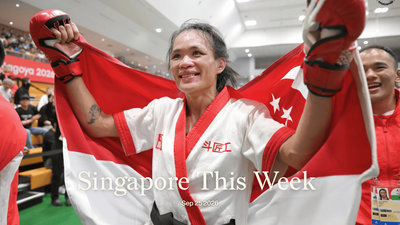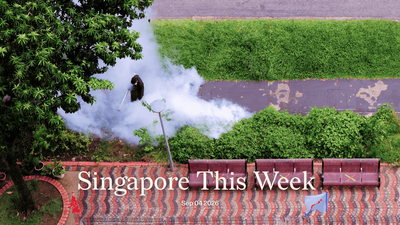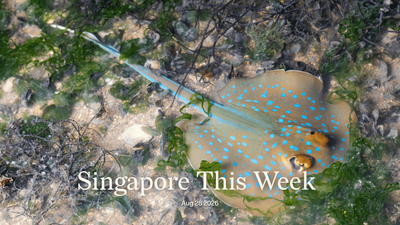



News this week included: Lawrence Wong meets Vladimir Putin; Lazada the latest firm to cut jobs; soaring AI course enrolment; some 400 workers claim unpaid wages from air-con firms; a foreign worker housing ban in a Geylang condo; TAFEP investigates an alleged “Malaysian only” job ad by Micron; UN concludes that Israel deliberately targeted children and committed genocide in Gaza; two Singaporeans issued orders under the Internal Security Act for Gaza-related extremism; more families to receive support from the Chinese Development Assistance Council after the income threshold is raised; a LawSoc study finds that lawyer attrition is driven by a toxic culture, bullying, and court pressures; petrol prices down; greater transparency on property firms’ and agents’ disciplinary records; the success of “siu dai by default” is prompting the Health Promotion Board’s new “low sodium by default”; Sheikh Haikel and Anna Belle Francis share their struggles building their halal Hainanese food group; the challenges with overseas adoptions; ST multimedia piece on Changi Airport’s rough sleepers; CNA on a mum’s awkward first period talk with her daughter; muted coral spawning in our waters this year; a new species of scarab beetle discovered in Pulau Ubin; and holidaymakers celebrate 11 public holidays and five long weekends in 2027.
Below are the issues we explore in depth:
Our picks
Society: A rank affair
Silly season is upon us—the time when universities tremulously scour global rankings to see where they stand, much like students sweating on their finals scores. Among the most prominent self-ordained evaluators is Quacquarelli Symonds (QS), a London-headquartered firm that also provides a raft of consulting services to some of the very universities it judges. A 2021 Berkeley study found that such “conflicts of interest may produce significant distortions in global university rankings.” Last year, a non-profit that combats research fraud in India questioned QS’s partnership with Elsevier, one of the world’s largest academic publishers. QS uses a “papers per faculty” metric in its regional (though not global) rankings. Whether or not that partnership influences methodology, there’s a certain smell to it.
Even without these malodorous suspicions, the very idea that any one ranking can capture so many universities, so staggeringly varied in scale, resources, and mission, invites ridicule. One of the most heavily weighted metrics QS uses is “academic reputation”. Faculty are asked to list other institutions that they think are making meaningful contributions in their fields. Nearly 15 years ago—rankings have plagued higher education for a while—the writer Malcolm Gladwell wondered how any one person could reasonably assess thousands of universities. (QS doesn’t reveal survey questions, just their broad thrust.) Confronted by this impossible task, many likely fall back on the usual suspects: the Ivies, Oxbridge, and others with decades and centuries of accumulated prestige. Some, Gladwell suggested, may simply consult previous editions of the very rankings they’re now helping determine. A second reputational measure asks employers similar questions and suffers from the same limitations. Rankings therefore reinforce age-old dominance, conferring the visibility and legitimacy that draws students and scholars from around the world. The result is a feedback loop that strengthens legacy institutions and deprives others of talent—further restricting the sites and kinds of knowledge production.
Some argue that the rise of institutions around Asia rebukes such criticism. Of the 20 “top” universities in the latest QS rankings, two are Singaporean, two Chinese, and two from Hong Kong (all between 11-20). But geographical diversity alone won’t exonerate QS. Another of its metrics is “citations per faculty”—which rewards research output and the frequency with which others refer to it. This too privileges certain kinds of scholarship. STEM disciplines naturally produce more papers and attract more citations than the humanities. Researchers are also incentivised to publish in elite journals, the majority of which are American or European, and favour work that either speaks directly to their societies, or has universal relevance. Research rooted in places like Singapore suffers. “Since critical scholarship on Singapore is neither valued by…industry, nor…state, why bother?” said Cherian George, formerly of these shores and now with the Hong Kong Baptist University. Conversations about academia here tend to focus on political restrictions, but the structural conditions created by global rankings are just as consequential.
The allure of rankings is understandable. For universities, it’s an easy differentiator; for students, a decision enabler. Estimates suggest there are around 30,000 universities globally. QS itself claims to evaluate 7,000 before ranking around 1,500. Without a heuristic, students may feel lost. Still, a heuristic is useful only if it has significant inferential value. Among suggestions for ranking agencies to improve their own research outputs are greater survey transparency, limiting comparisons to similar universities, and interactivity that allows readers to assign their own weights to various metrics based on their own priorities. These may not solve all underlying issues, but at least rankings’ utility will be enhanced. Until then, like the man in the old fable searching for his lost ring underneath the lamppost simply because that’s where the light is, they merely dress up convenience as truth.
Society: The workforce generation gap
The inaugural Singapore Workplace Report 2026 has found that only 10 percent of young Singapore workers are engaged at work, six points lower than those above 35. The report defines engagement as workers feeling emotionally connected to and enthusiastic about their work and workplace.
Federico Magni, assistant professor at Nanyang Technological University, felt that this may reflect “a deliberate effort to redraw boundaries and preserve energy, and a more pragmatic stance towards work”. Particularly for Singapore—an always-on, digitally mediated economy—the low engagement levels may not be apathy or dysfunction, but rather a recalibration of how people here relate to work. Indeed, in an increasingly turbulent job market—mass layoffs, degree-holders being asked to re-think traditional notions of job stability, and AI taking over entry level roles—a detachment from work identity could be beneficial for self-preservation. But that doesn’t mean that Gen Z is suddenly “Gen Zen.” Fewer younger workers feel they’re “thriving”; more are stressed, angry, and sad compared to their older counterparts.
We’re in an era where established social contracts are crumbling. Stability and career advancement in exchange for hard work and loyalty is slowly being replaced by a more transactional, short-term approach to work for both employees and employers. Workplace norms are in flux too. Those in senior positions who grew up in a different era consider things like staying late to finish a project or regularly putting in 40-hours at the office non-negotiables. Gen Zs, who entered the workforce at the height of pandemic-era work-from-home restrictions, don’t feel the need.
The divide was visible in the range of reactions to a clip of CNA intern Ang Jie Chun for saying he would, in principle, not answer his manager’s call at 8pm since he’s only paid from 9am to 6pm. “That’s why he’s still an intern,” jibed one commenter before telling someone who called him out: “don’t cry about fresh grads not getting jobs pls.” (In the full podcast, Ang added: “But if I have a very good working relationship with my manager or I understand the value of my work, and the meaning behind the things I do, then I’m more likely to pick up.”) Another said: “The toxicity of boomer and Gen Y is amazing.”
A generation gap deepened by huge societal change cannot be addressed by unhelpful labels and generalisations—whether it’s the supposedly fragile “strawberry generation” or the change-averse, blindly loyal “boomers.” As the report notes, younger colleagues expect “productive and protective” relationships with managers based on direct communication, guidance, and some insulation from workplace friction. And older ones would appreciate a bit more flexibility, and an understanding that sometimes, just sometimes, there’s a need to go beyond fixed working days and hours.
Food: Suckers for blood
South-east Asians love blood. Coagulated, tofu-like chunks of pig’s or duck’s blood float up in all manner of Thai soups, often gobbled up first thing in the morning. Laotian larb is perhaps the pinnacle of the caveman’s diet, with raw meats and fresh blood sometimes tossed with bile, to make their signature “salad”. Lawar plek, similarly, is Bali’s pork equivalent of steak tartare—with dollops of pig’s blood—and further proof, if the more common babi guling wasn’t enough, of a Hindu’s diverse diet in the world’s largest Muslim country. And the best way to invoke nostomania in your Pinoy buddy is to whisper “dinuguan”, its black, vinegary porkiness camouflaging the essential ingredient.
Vietnam’s tiết canh is perhaps the bloodiest of all, as fish sauce and broth are dripped to moderate coagulation, producing a sheet-pan red pudding then decorated with chopped offal, peanuts, and herbs—as if Dracula had been consulted on haute cuisine. Those who prefer streetside hip might tuck into duck blood curry mee in Penang, a whitish, laksa-ey broth whose textural play—coagulated cubes swimming next to tau pok, julienned ginger and chunks of siew yok—helped earn it a Michelin Bib Gourmand. And why do we all savour our blood? Reasons include Chinese influence in the region; nose-to-tail zero wastage; and nutrition, of course, with blood dense in protein, heme iron, and vitamins.
Many Singaporeans grew up with coagulated blood, found everywhere from the grittier kway chap to the gentler yong tau foo. Then in March 1999, just as the Singaporean economy was rocketing back from the depths of the Asian Financial Crisis, a 47-year-old abattoir worker showed up at SGH with, as researchers described in The Lancet, “fever, headache, and confusion. His level of consciousness deteriorated rapidly over the next 12 h, and he died from what appeared to be [sic] a viral encephalitis.” Only he died, but 10 other abattoir workers were found to have antibodies of the same virus detected the year before among Malaysia’s pig-farming community, and which resulted in some 100 deaths of over 300 infected. Though Malaya has seen no new outbreaks since, the zoonotic virus whose natural host is the fruit bat, and which was later named Nipah, is still periodically reported in South Asia.
Singapore’s quick closure of all abattoirs that March—and attendant banning of blood supply from locally slaughtered pigs—helped contain the outbreak, and by the end of April pig imports from an accredited farm in Indonesia had resumed. That blood itself was never again permitted has been a sore point for foodies, although if one considers the regular warnings from Vietnamese authorities about bacterial infection with tiết canh, perhaps in this case some conservatism was warranted.
Still, our thirst for blood cannot be quenched. Following industry pressure, in 2018 the Singapore Food Authority started assessing blood as an ingredient again. This April it announced that it had approved the import of heat-treated pork blood products from an accredited establishment (Thailand’s Bangkhla Pig Slaughterhouse). Since early June, 400g packs of “Pig Blood Curd” from CP Foods (S$6.95) have been flying off the shelves at supermarkets, while restaurant chains like Crystal Jade and Haidilao have added it to their menus.
During this bloody interregnum, the Singaporean palate has grown far more adventurous, broadened by everything from regional budget flights to boundary-breaking influencers like Anthony Bourdain. Hopefully, with the vim of creatures returning from a parched desert, our chefs now allow their creative South-east Asian juices to flow. “I like the night. Without the dark, we'd never see the stars,” said the most famous animal-blood-drinking vampire ever, Twilight’s Bella.
History weekly by Faris Joraimi
Sometime in 1910-11, Khatijah Terung, a commoner married to a prominent kadi (judge) of the sultanate of Riau-Lingga, composed a manual of sex entitled Perhimpunan Gunawan Bagi Laki-laki dan Perempuan (Compendium of Charms for Men and Women). Despite the title, its sensuous verses seem addressed to women only, who are guided to command the desire of their husbands through dominant methods of foreplay and spells promoting male libidio, stamina, and subservience. It is as much a map, along warm, moist, and pulsing roads to the peaks of bedroom pleasure, as it is an Islamic theology of the body. The spells call on Biblical and Qur’anic figures to lend their qualities: Zulaikha (Potiphar’s wife in Exodus) for her beauty, Daud (David) for his alluring voice, and Yusuf (Joseph) for his attractive figure, before affirming the oneness of the Abrahamic God and his Messenger, the prophet Muhammad, through whose intercession these words work their magic. No bourgeois Protestant pearl-clutching distinction between the sacred and profane here. “Dirty talk,” as some adults still know, can work like a redemptive charm: transmuting our bodies from the source of our greatest fears and shame, into potent instruments of gratification.
But the Muslim context of this document has unsurprisingly attracted interest from scholars, intrigued by a woman’s rare, “defiant” voice from what we now consider a patriarchal, conservative society. The sultanate of Riau-Lingga ruled the islands of Batam and Bintan until 1911, and its aristocratic centre, the island of Penyengat—where Khatijah Terung lived—emerged as a major node of Islamic-Malay scholarship in the nineteenth century. A significant and well-documented circle of noblewomen were part of this literate community, producing ballads of adventure called syair. Men, however, wrote what was then considered the more prestigious genres: books of history, law, theology, and government. Raja Ali Haji, the most famous of the Penyengat scholars, is frequently compared with Khatijah Terung for his Malay dictionary featuring anecdotal descriptions of sex and genitalia in everyday life: sailors patronising the brothels of Tanjung Pinang, or kampung gossip of illicit liaisons. But these entries still differentiate between polite words and rude ones, a public body and a private one.
Another male-authored text from the same period, the Kitab Jimak (Book of Coitus), is a legal manual laying down regulations for what forms of intimate activity are permitted or not. It’s too easy to fall back on the old stereotypes about an institutional, patriarchal, scripture-based Islam repressing a mystical South-east Asian one that’s more benevolent to women. But did they necessarily work at cross purposes? It seems as if both Khatijah Terung and the male jurists took bodily pleasure seriously. Both the book of spells and the book of rules are invested in sexual success as something to be cultivated, like a discipline; neither saw pleasure itself as inherently wrong or shameful. Given that Khatijah Terung’s book was also addressed to wives, it still operated within the framework of permissible sex validated by Islamic law. That focus on conjugal pleasure as a condition of a moral marriage hasn’t gone away with increased religious “fundamentalism”: in Muslim shops selling religious paraphernalia, I still occasionally see guides for wives to enhance conjugal relations, hawked alongside prayer beads and Qur’an cassette tapes. It may not resemble the kind of female sexual agency envisioned by secular liberal politics, but a women’s art and science of desire, no less? Sadly P7:1SMA, the ingenious interpreters of Khatijah’s work today (see next blurb) were met with reductive portrayals by the Plan Bs of the world, for whom there seems to be little room for contradiction and ambiguity.
Arts: A charmed life
A couple circles one another. There’s a sweet awkwardness to their flirty overtures: a swinging of the arms, a swaying of the hips, the tapping of a heel and a toe. They draw close, then pull apart. But soon enough, they’re in buoyant step with each other, knotting brightly coloured handkerchiefs together as a symbol of their inseparability. “Serampang Dua Belas”, a charming uptempo dance from Sumatra, speeds through a couple’s courtship from first glance to final vows in 12 movements over about four minutes. Norhaizad Adam and Hasyimah Harith, classically trained in Malay dance, have performed “Serampang Dua Belas”—and they’ve lived it. The dancer-choreographers and long-married couple are parents to a five-year-old and a 10-month-old, and co-founded their dance company, P7:1SMA (pronounced “prisma”), a decade ago. Norhaizad was bestowed the Young Artist Award by the National Arts Council in 2021, a gratifying stateside acknowledgement of their sensual body of work, one that has consistently occupied that rich but challenging intersection of traditional dance, sexuality and social codes.
For years, their artistry took different shapes. The invisible labouring body has threaded through much of Norhaizad’s work. In “The Wrong Geng”, he deconstructed the mechanics of the ronggeng form, but also what’s extracted from the body of the dancer, stripping down to his underwear while begging for alms from the audience; in the site-specific “Loading/Unloading”, he dismantled the hyperefficient, hyperaccelerated shipping system of the Singapore port, where dancers disassembled and reassembled modular metal structures and dangled from their rungs. Hasyimah’s work relishes the pleasures of femininity and the power of the erotic. “Nak Dara” revelled in collective female desire, in the heaving, sweat-slicked bodies of dancers, batik knotted around their chests and waists. “Daging”, performed just before the birth of her first child, saw her pounding meat with a mortar and pestle, slabs of raw beef shimmering against the swell of her pregnant belly.
P7:1SMA emerged from the shock of the pandemic seemingly at the height of its creative powers. The company was raking in commissions by major arts organisations, including Esplanade and the Singapore Art Museum, and touring their critically acclaimed work around the region. Dance artists fell in love with both the couple’s artistic ethos and their ethics of care; each production felt like a joyful potluck, where they’d have participants present a signature dish, while also getting a seat at the table. Hasyimah was pregnant with their second child; they were looking forward to welcoming her into the world. Then their little girl died, suddenly, before she was born. “Serampang Dua Belas” ends in raptures at the altar. It didn’t prepare them for a subsequent devastating, totalising grief.
For years, Norhaizad and Hasyimah wondered: what happens after the dance’s last act? How might a husband and wife, riven by pain, repair their relationship in the wake of unthinkable loss? For the first time, they began to make work together—not just as romantic partners, but as creative partners. “Berahi: Holy Unions” was the gift that grew from this grief. The work begins with “Serampang Dua Belas”, then embarks on a passionate, playful exploration of arousal in married life. The couple found their answers in the work of 19th-century Riau writer Khatijah Terung and her compendium of charms (see previous blurb), where desire is devotion and sex is divine. “Ini azimat baik memeliharakan kasih sayang antara laki isteri supaya jangan berbantah sepanjang hidup keduanya,” so goes the sixth azimat, or charm, in her collection, which you can find in the digital annals of the British Library. “This amulet is good for maintaining love and affection between husband and wife so that they do not quarrel throughout their lives.” It’s a fierce affection that’s still visible beneath their sequinned masks and gauzy, iridescent veils and baju, beneath every flick of the wrist and bend of the elbow. And you can watch Norhaizad and Hasyimah perform this work for the first time in Singapore this weekend. Their work continues to be misrepresented by conservative agendas. But no matter. These azimat don’t just heal the lovesick, as historian Faizah Zakaria wrote in this essay for Jom. They can heal the married, too.
Arts: Speak Teochew Campaign
Your grandfather flees Southern China in the 1940s to dodge a civil war conscription. He finds refuge in Thailand where, like many other migrants seeking their fortunes in South-east Asia, he sends qiaopi (番批), or remittance letters, to the wife and family he’s been forced to leave behind. Back in her Shantou village, your grandmother receives both money and tracts of poetry that would crack the coldest heart: 江海万里,心中念你,便不觉遥远 (jiang hai wan li, xin zhong nian ni, bian bu jue yao yuan). “The rivers and oceans may span thousands of miles, but with you in my heart, this sprawl feels small.” It’s a love story for the ages, and one lost in translation the moment it washed up on Singapore’s shores. “Dear You”, the multi-generation sleeper hit moving (or perhaps manipulating) millions across the Sinophone world to tears, was filmed almost entirely in Teochew, then dubbed into Mandarin for its general release here. An initial run of 4,800 tickets in the original language—allowed with special permission from the authorities—were snapped up; when cinema operator Golden Village released an additional eight screenings, those sold out in one and a half hours. Singaporeans are crossing the border into Johor Bahru just so they can watch the un-dubbed show, and they’re also calling on the authorities to loosen restrictions on Chinese dialects in film, television and radio.
The dialect restriction on broadcast media is an old chestnut, one dating back to the 1979 Speak Mandarin Campaign, so effective it wiped out the use of Chinese dialects in a single generation. Part of Lee Kuan Yew’s mission to maintain cohesion across a linguistically diverse ethnic community, the movement essentially pared its lush polycrop down to a manicured monocrop, slashing the percentage of households deploying dialects as a primary language from 76 percent in 1980 to under nine percent in 2020. The Workers’ Party, built on a Teochew stronghold, was quick to recognise the recent saga’s political potential. Kenneth Tiong, one of its Aljunied MPs, wrote: “Mandarin is not under threat from Teochew. If anything it is Teochew and other dialects that are fading.” Dennis Tan, Hougang MP, took the opportunity to resurface previous parliamentary questions on dialect preservation, and champion his clan connections. The Ministry of Digital Development and Information and the Infocomm Media Development Authority have since made some concessions, promising an openness to “facilitating and supporting” more Teochew screenings, and “a more flexible approach” towards dialect films; and following that up by approving 50 additional screenings. But piecemeal tradeoffs may not be enough to buttress what has already been quietly eroding for decades, with kin cleft by language and lineages lost to time—by a policy founded on the flimsy belief that exposure to Chinese dialects impedes the learning of Mandarin.
The Teochew phrase 家己人 (ka ki nang)—meaning “our own people” or “one of our own”—is one of the dialect group’s most recognisable aphorisms, a pithy badge of pride for its fierce sense of community. But can you belong to a community without speaking its language? Singaporean artists have long mourned this linguistic loss. In the play “Grandmother Tongue”, a young man struggles to connect with his Teochew-speaking grandmother across the chasm of language. And in his autobiographical play “Roots”, playwright-performer Oliver Chong is derided by a Cantonese-speaking Hong Kong netizen for lacking the very roots he’s searching for. “My surname is also Chong. But my ‘Chong’ is different from yours. Yours has been castrated. So why bother to find any roots? You don’t have roots any more.” Yet some hardy cultivar might persist. In one of the film’s most wrenching letters, the absent husband writes: “I have been practising my brushwork lately, and I have learnt to write your name. It is clumsy still, but a few more days and I think I will have it.” A younger generation of Singaporeans, striving to escape the CMIO identity straitjacket, has been insistent on reclaiming their grandmother tongues; it is clumsy still, but a few more years, and perhaps they will have it.
Some further reading: Chinese journalist Chu Yang offers political nuance and historical context for qiaopi in her essay “What the Letters Did Not Say”, noting how some of these remittance letters—so romanticised in “Dear You”—ended up becoming more like ransom notes that fleeced many of the Chinese diaspora and their families of their hard-won earnings.
Faris Joraimi, Abhishek Mehrotra, Sakinah Safiee, Corrie Tan, and Sudhir Vadaketh wrote this week’s issue.
Letters in response to any blurb can be sent to sudhir@jom.media. All will be considered for publication on our “Letters to the editor” page.
If you enjoy Jom’s work, do get a paid subscription today to support independent journalism in Singapore.