


News this week included: Parliament debates Gillman Barracks and Maju Forest, which unsurprisingly, “need” to be developed for housing; easier en bloc sales with proposed lowering of consent thresholds; Lee Hsien Yang’s response to Oxley acquisition; Law Ministry to review legal education and considers guide on workplace norms; arrest warrant issue for opposition politician Lim Tean after he fails to surrender for jail term; Woodlands Hospice opens; man wins forced retirement case; immigration backlash forces SG school operator out of Sapporo; the need for better traffic regulations for a super-aged society; Ivan Heng and MINDEF on paying artists fairly; obituary to Andrew Chow, Zouk DJ; ST commentary on why we need mandatory criminal history checks for those working with kids; trans youth harassed at a mamak stall; autonomous wheelchairs at Changi Airport; CNA investigates whether words like “supermum” and “girl boss” are doing women more harm than good; is it true love, or love bombing?; Massive Attack members barred from re-entering Singapore because of pro-Palestine support; student clubs joining Singapore’s anime, comics and games creator scene; ST “full-time report” on week of feats for SG athletes; the Seniors National Games; SG’s dog gym for canine fitness; and venomous blue-necked keelback snake spotted at MacRitchie.
Below are the issues we explore in depth:
Politics: Return of the wonks
Lawrence Wong, prime minister, unveiled a new cabinet two weeks ago featuring six politicians who’d spent most of their careers in the civil service or the military, and who’d only just been elected last year. This has invited criticism from bits of the establishment. This “shows that the PAP [People’s Action Party] has failed to recruit from the private sector”, said Calvin Cheng, former Nominated MP and vocal party firebrand. “[M]any if not all of them were also scholarship holders. Meaning they have been in the civil service all their lives, from the time they graduated…we have a group of Ministers with very narrow albeit exceptional career experiences.”
In a CNA commentary this week, Han Fook Kwang, a former editor of The Straits Times who’s now at RSIS, said that Wong “inherited the problem which stemmed from the last two GEs, in 2015 and 2020, when the pipeline for minister-calibre material slowed down considerably.” Han believes that Wong “had too few cards to play”, and that these seemingly limited choices point to “a stark reality facing Singapore”, also worrying about the cabinet’s lack of diversity.
The PAP has a long tradition of plumbing the civil service and military for recruits, in keeping with the supposedly unique demands of an “administrative state”. Over the past decade, as traditional politicking has arguably become more important, the PAP has actively tried to search for non-traditional candidates. The infamous Ivan Lim saga of GE2020 suggested that its screening was becoming lax. Wong clearly wasn’t enthused by that 2020 batch, last year pushing out five MPs after just one term—oh, the ignominy—to make room for his own recruits.
Three of those who left are from the private sector and another is a social entrepreneur. Meanwhile, there are several other backbenchers, including Edward Chia, Mariam Jaafar, and Vikram Nair, with distinguished private sector careers. Rather than having limited choices, as Han suggests, perhaps Wong, who was a civil servant for over a decade before entering politics, is deliberately opting to surround himself with his peeps. “And one of the keys to the PAP’s success has been a full focus on renewing our team every election,” he told the FT last year, responding to a question about the hardest part of his job. “So having to look hard at the members of the team, speak to each one of them individually and say, ‘I am sorry, I am not able to allow you to continue. I have to drop you’. That was very painful.”
Han also mocked the relative inexperience of Wong’s charges, saying that nine veterans with over 100 years of experience had been “replaced by four new ministers whose combined years in office can be counted on two hands”, calling it a “major problem that requires urgent action”. Well, we won’t shed any tears for gerontocracy’s end—an injection of youthful “inexperience” is perhaps what the cabinet needs in today’s rapidly-changing world. (The likes of Gan Kim Yong, K Shanmugam, and Lee Hsien Loong are anyhow still maintaining the cabinet’s grey-hair count.)
Perhaps, in the age of ever-sexier AI firms and philanthropic foundations, the PAP will never again be able to recruit top performers from outside government. But surely that’s a good thing for Singapore, to have talent distributed across society, not monopolised by politics. We must also keep broadening the very definition of “top performers” and “talent”. Maybe Wong should, rather than trying vainly to foster some Big Tent cabinet, instead ensure that his wonkish ministers collaborate with leaders, from the private sector to the arts and civil society, on an equal footing, not from an ivory tower. Given the PAP’s elitist history, easier said than done.
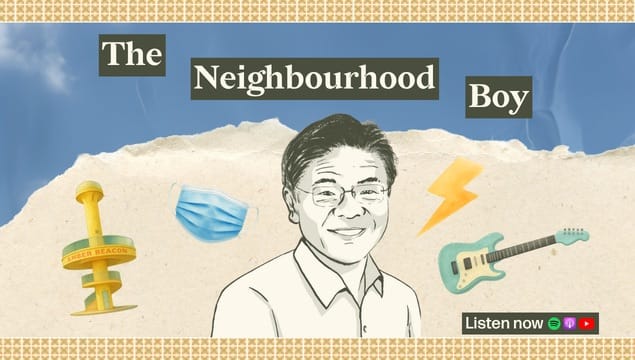
Some further listening: “The Neighbourhood Boy”, a four-episode scripted series about Lawrence Wong, and Jom’s first-ever podcast, launched today. Subscribe on Spotify, Apple Podcasts, YouTube, or wherever you get your podcasts.
Politics: Predistribution rather than redistribution
While accepting that Singapore as an “exigency” may have had to focus on growth first and redistribution later—for instance through the so-called VCR (voucher, cash, rebate) system—Kenneth Tiong, Workers’ Party MP, said “over the medium and long-term we should be building an economy where a fair distribution is produced by the growth itself, rather than repaired afterwards out of the proceeds.” He argued for “an economic engine driven by dynamic local companies, healthy domestic demand, and Singaporeans and Singaporean capital venturing abroad”.
This was the core thrust of a WP motion on Singapore’s future economy, which saw 24 MPs speaking for almost nine hours on Wednesday. “We host many large companies, but build few of them,” Tiong said, comparing Singapore’s three Fortune 500 companies (all commodity traders) with South Korea’s 13 and Taiwan’s six (semiconductors and ships). “Theirs were built by their own people, Ours came here, and can as easily go.” Jamus Lim, fellow WP MP, said that the Economic Strategy Review (ESR) “betrays an implicit bias” towards MNCs over SMEs. “We need a conscious shift away from too much fixation with tax competition, an undervalued exchange rate, and the wooing of footloose multinationals.”
To spark local innovation, one recommendation from Tiong was for a “special zone surrounding NTU where the State land is charged at cost-recovery, rather than market scarcity value”. Residential and commercial spaces, co-living, local enterprise and R&D could clump around the university, “zoned for organic messiness”, he suggested (veering close to the mocked Singaporean desire to manufacture creativity). Best of all, “this experiment is reversible,” he said. He also offered “three North Stars for the distributional aspect of growth”, part of a broader lament about insufficient “report cards and targets” with government blueprints.
Other ideas from the party included: changes to land policy to lower costs of housing and other uses; proper paid apprenticeships and other measures to ensure those under 30 transitioning from education or NS to professional life “get a fair start”; and legislating for minimum retrenchment benefits. All in all further evidence that the party has put Raeesahgate behind it, and is flexing its intellectual and policy chops in Parliament.
The PAP responded to all this by…mostly agreeing. “We all want a more inclusive economy. Stronger local companies, good jobs for Singaporeans, and growth that gives our people confidence in the future,” said Edward Chia, PAP MP and businessman. Jeffrey Siow, transport minister, said there was “considerable common ground” between the parties, but perhaps they differed in degree, with the WP believing that the “economic model is imbalanced and needs to be fundamentally reoriented. They have portrayed Singapore as a place where MNCs create wealth, and there’s some Faustian bargain where SMEs are held down…I disagree with this characterisation.” Chia proposed four amendments to WP’s motion to make “clear that these aspirations are aligned” with the ESR, and it passed, with the WP’s members unsurprisingly voting against.
Humour was proffered by Tan See Leng, manpower minister who started his own successful healthcare firm as a 27-year-old doctor (aka the one with the real battle scars). “Rocky [Balboa] is like an entrepreneur…it’s not someone who can just throw punches. But it is that person who can take the punches, get back up and keep moving forward.” The punchline actually came at the beginning: “[WP chief] Mr Pritam Singh is smiling. I presume he would have known who Rocky the character is.”
Society: The space economy
Old-timers may remember the first ever football World Cup match broadcast in Singapore: Gerd Muller collecting a cross just behind him, swivelling on a five-cent coin, and bundling the ball past the Dutch keeper to win the 1974 final for West Germany.
That memory exists thanks to the erstwhile telecom hub in Sentosa. Established in 1971, it transmitted across the island signals received from the Intelsat satellite. The Sentosa Earth Station was, ironically, Singapore’s first foray into space. Some three decades later came ST-1, a communications satellite owned by Singapore but designed overseas, and then in 2011, the X-SAT, designed locally. Since then, Singapore has finessed its satellite design nous—it currently owns three major ones—and this year established the National Space Agency of Singapore (confusingly, NSAS).
Satellites do more than broadcast football matches, though one suspects many would be happy even if they did just that. Besides drowning us in data, they help agencies estimate rainfall, track storms, manage air and sea traffic, assess damage inflicted by natural disasters, help with urban planning, and confirm that we are indeed destroying our coastlines with relentless development. Other governments too have taken notice. In the past decade alone, Australia, Indonesia, Malaysia, New Zealand, and the Philippines are among those that have established new space agencies or beefed-up existing ones.
In this, they’ve been helped by the democratisation of technology that was first inaccessible due to Cold War jealousies and later because of eye-watering costs. Countries needed not just the means to build satellites but also rockets on which to strap them and a spaceport from which to launch them. These capabilities are still necessary for a fully indigenous space programme. But the rise of companies like SpaceX, Rocket Lab, and Blue Origin alongside commercial launch services offered by established space powers has allowed countries like Singapore—with neither the acreage nor the inclination for a full-fledged programme—to focus on satellite technology. Space X’s monstrous Falcon 9 rocket, for instance, can carry dozens, even hundreds of satellites (“payloads”) for private and public customers in a single launch—a rideshare model akin to shipping containers or GrabShare. Every Singaporean satellite launched this century has hitched a ride on an Indian launch vehicle.
Our strides in space are to be applauded. But easier access has also made things rather crowded and messy up there. There are currently around 16,000 satellites in space—that shiny thing you spotted with your Daiso telescope was likely not a supernova—to say nothing of the tens of thousands of damaged satellite fragments, lost tools, and discarded rocket parts now orbiting overhead. One slammed into the moon days ago. Since the Soviet Union launched Sputnik-1 in 1957, humanity is estimated to have hurled some 17,000 tonnes of material overhead. To a particularly cantankerous ET light years away, the Earth may look less like a blue marble than an overripe fruit besieged by a swarm of flies.
Singapore has acknowledged the problem, with one of the focuses of its new satellite centre being to avoid collisions in space. A good next step would be to join hands with companies helping clean up the debris. Cleaning up the skies could perhaps wash away some of our sins here on earth.
Society: Shark-infested waters
Debt greases the global economy. Countries borrow from one another, companies issue bonds, banks borrow from some customers and lend to others. Mortgages, car financing, credit cards, personal loans—future earnings filling present needs. Inevitably, yawning inequities exist. The ultra-rich can borrow immense sums at low interest against their assets—what’s known as secured debt—to fund their lifestyles and/or investments. The poorest—Singapore’s migrant workers among them—lack the assets, often the paperwork, and the future earnings potential needed to access the formal banking system. Instead, they are reliant on employers’ largesse, community support, or small-scale moneylenders to meet immediate needs: a medical emergency, schools fees for children back home, or any of life’s million vicissitudes.
In 2019, one study found that a full third of Singapore’s Foreign Domestic Workers (FDW) were in debt; the same year, it emerged that some 53,000 foreigners were in debt to moneylenders—more than seven times the number in 2016. The government moved quickly. Foreigners earning less than S$10,000 per annum were restricted to S$500 loans, down from S$1,500; and moneylenders could not lend to more than 300 foreigners and up to S$150,000 in total loans to them. The crackdown was well-intentioned, aimed at predatory moneylending to the most vulnerable. But it reduced the supply without addressing the demand.
“[W]ith no legal avenues for the FDWs to borrow from, they resort to borrowing from unlicensed moneylenders, retail companies/shops, and handphone or jewellery shops,” said Blessed Grace, a charity.
Unlicensed moneylenders aka loan sharks aka “Ah Longs” are easily able to advertise their services via TikTok, Telegram, and other social media. They charge extortionate interest and use intimidation to enforce repayment: splashing paint on doors (a practice that’s spread elsewhere), padlocking gates, and bombarding borrowers’ homes with dozens of late-night unsolicited food deliveries. In one terrifying instance, a loan shark threatened an FDW’s employer: “You block me ok. I find you [sic] mother. I find you [sic] wife.” Often, Ah Longs use the vulnerable to harass the vulnerable – paying youngsters recruited from social media tens of dollars to do the dirty work.
In keeping with its penchant for policing and penalising, Singapore imposes severe sanctions on unlicensed moneylenders. One pair caught threatening borrowers recently could each be fined S$50,000, jailed for up to five years and caned. There have been efforts to educate FDWs about the dangers of loan sharks too “but it does not resolve their immediate need to put food on the table back home,” said Joseph Ong, whose helper was entangled in one such situation.
The unlicensed lending industry will continue to thrive unless FDWs, other migrant workers and all those unable to easily access loans have viable alternatives. Micro-finance facilities, and short-term, zero-interest loans are some solutions that observers have been suggesting for years. Surely not a stretch for this shiny, world-class, global hub of all hubs?
Arts: National Day portrayed
A silver-skinned busker gleaming under Orchard Road streetlights. A star of the Malayan silver screen from the 1950s and 60s. A gilded orchestra turns 30 and revisits its commitment to multiculturalism. How might multiple stories of a single state be told? All throughout our nation-state’s birthday month, artists, filmmakers, musicians, and writers are, directly or indirectly, shading in the highlights and shadows of our complex country, from pre-independence to the present day. Indie cinema Filmhouse has programmed a monthlong celebration of Singaporean cinema, from the wonderfully offbeat—a kaleidoscopic portrait of “Singapore’s wildest busker” Roy Payamal—to a contemporary classic—Anthony Chen’s Caméra d’Or-clinching “Ilo Ilo”, about the freighted relationship between a Singaporean boy and his Filipino caregiver. Both films crack the shiny, manicured veneer of our skyscrapers and shopping streets, turning the lens on the whimsical dreamers and marginal workers trying to carve out a space for themselves.
Then there are groups that are gesturing towards a broader regional identity of which Singapore is a small part, be this a Nanyang style or a Malayan sensibility. The Singapore Chinese Orchestra, under the baton of principal conductor Quek Ling Kiong, is putting together a touring repertoire that takes inspiration from Singaporean artists across disciplines, whether that’s the lilting tunes of xinyao pioneer Liang Wern Fook or the bulbous sculptures of the late Ng Eng Teng. Quek told ST he’s also set on pursuing more international collaborations, particularly those involving the musical traditions of South-east Asia, “which have soundscapes and colours that resonate well with the Chinese orchestral tradition”. Theatre company Wild Rice is also bringing back “Tunggu Sekejap: The P. Ramlee Suite”, its lush musical homage to the charismatic leading man (and filmmaker, musician, and composer) whose visage graced every other blockbuster in the golden age of Malay film. The hybrid lecture and musical performance, buttressed by the warm timbre of a 30-piece chamber orchestra, is set against the conjoined musical and cinematic histories of Malaysia and Singapore, with Ramlee part of this thick connective tissue.
Another, quieter, intermediary figure connecting the two countries was the late Lai Foong Moi, whose upcoming eponymous show at the National Gallery Singapore is subtitled “Crossings”. Born in Malaysia in 1931, Lai worked across portraiture, still life, and landscapes. Her body of work, perhaps now only getting the attention it deserves, was keenly attuned to labour, gender, and urbanisation in pre- and post-independence Singapore. In “Crossing (Home Coming)”, a woman in a scarlet blouse holds a stilted pose, one hand stiffly grasping the other wrist in the lap of a batik skirt. She’s glancing away from the gaze of the viewer, peering outside the frame in a moment of distraction or boredom—it isn’t quite clear. It’s these languages of the body, all slightly askew, that make Lai’s work so captivating, an oeuvre that also happens to capture a period of sociopolitical tumult and transformation. How will we remember the time we are now living through? In 2001, a young Alfian Sa’at published A History of Amnesia. These poems are a fierce, unabashed meditation on national and social memory—and the lack thereof—on everything from national service to the AIDS crisis told through incisive verse. Its epigraph declares: “The patient, born in 1965, suffers from a history of amnesia of unknown onset and duration. The prognosis is uncertain.” Ethos Books is reissuing the prolific writer’s sophomore poetry collection 25 years later. Perhaps there’s no better time, as we collectively turn 61, to take a good hard look at ourselves beyond the frame we’ve been given—both the parts of our history we’ve forgotten, and those we’d rather not remember.
Abhishek Mehrotra, Corrie Tan, and Sudhir Vadaketh wrote this week’s issue.
Letters in response to any blurb can be sent to sudhir@jom.media. All will be considered for publication on our “Letters to the editor” page.
If you enjoy Jom’s work, do get a paid subscription today to support independent journalism in Singapore.