


News this week included: Singapore Red Cross pledges S$50,000 in aid to quake-hit Colombia; Tommy Koh leaves MFA after 55 years; Lee Hsien Loong on SG’s unique approach to lawmaking and electoral schemes (and the rebuttals); WP chief Pritam Singh, a non-practising lawyer, struck off rolls over conviction for lying; cash handouts for over 2.4m citizens; AI boom boosts GDP growth forecast; AI courses compulsory for all NUS undergrads; ST investigation into Chen Zhi’s global scam syndicate; the Fun Coffee investment scam; Johor investigating firms for allegedly dumping waste from SG in Pontian; LawSoc under fire for lack of transparency over leadership failings; poly grads’ start-up makes it to Silicon Valley’s Y Combinator; more accessible healthcare—clinics within 2km—for migrant workers; Bhutanese nurses here; restaurant apologises for foraging from Changi’s inter-tidal zones; home-grown gelato Tom’s Palette shuts after 21 years; 72-year-old Singaporean kidnapped in Malaysia rescued; asteroid named after Singaporean astronomer; ST poll of young Singaporeans’ aspirations; ST commentary on autism in the workplace; CNA investigation on people who hurt their families—and then seek help; ST multimedia piece on “The designs that made Singapore”; SG’s ginger collection; and a Sunda slow loris released into the wild.
Below are the issues we explore in depth:
Society: Smells Like Tean spirit
The distance from Singapore to peninsular Malaysia, across the Johor Strait, is under a kilometre at its closest—the century-old causeway links two vastly different cities. Johor Bahru’s relationship to Singapore is akin to Tijuana’s to San Diego, or Poipet’s to Thailand. Lower costs and laxer policing foment the febrile atmosphere of the border town, at once liberating and edgy.
Fugitives fleeing Singapore have long headed north. The 1915 Sepoy Mutiny saw hundreds of Indian soldiers rebel against presumed British plans to pack them off—as they did millions from the subcontinent—to the dastardly, horrific first world war. The mutineers, having killed scores of civilians, were rounded up with the help of ragtag allies of the time—including the Japanese and Russians, as well as the Royal Johor Military Force plucking off the northward-bound. Some 15,000 people watched the public execution of 47 mutineers outside Outram Prison.
From the 1940s, the tightening grip first of the British, and then the newly-independent states of Malaysia and Singapore, saw scores of communists, real and alleged, seeking refuge to the north, many eventually being pushed all the way to Thailand. Tan Chay Wa, for instance, was a senior official at the Malayan National Liberation Army (whose roots were in the Malayan Peoples’ Anti-Japanese Army). Tan fled Singapore, was found with firearms on a vegetable farm in Johor in 1979, and executed by the Malaysians. Tan’s brother was himself later arrested by Singaporean authorities for allegedly inscribing a subversive message on Tan’s Chua Chu Kang tombstone—the plot for 2024’s “Small Hours Of The Night” (banned here).
Tan Pin Pin’s “To Singapore, With Love” (also banned), features interviews with other exiles, many spirited away to the UK in the 1970s, and for whom Johor Bahru has assumed a different geographic purpose: a sanctuary as close to home as they can get. The subaltern murmurs with excitement, and leftist luminaries amble across the causeway, when one draws near, such as Tan Wah Piow’s appearance in Johor Bahru this March.
Perhaps the marquee escapee of our times was Mas Selamat Kastari, an alleged Jemaah Islamiah militant who, unlike the aforementioned exiles, posed a clear security threat. In 2008 he jumped out of a toilet window in the Whitley Detention Centre—one of our most secure facilities—walked 5km along the highway, boarded a bus for Woodlands while wearing a pillowcase to disguise himself as a woman, and then swam across the Johor Strait using an improvised floatation device made from plastic bottles. He moved around different militant safehouses in Johor before being arrested over a year later.
Set against such mythologies, the story of Lim Tean’s abscondment this week is a damp squib. The lawyer and leader of People’s Voice was due to begin a 13-week jail term on August 3rd for practising law without a valid certificate. He didn’t show up. His own lawyer didn’t know where he was. Singapore issued an arrest warrant. And last Thursday, the Malaysians arrested him in Johor Bahru. Two others who allegedly helped him escape were charged.
Many questions might long remain unanswered. Did he not have the stomach for 13 weeks in jail? Tean has often projected the aura of a spiky, right-wing firebrand, given the way he lambasts civil servants and other politicians, and his willingness to stoke nativism and xenophobia for political gain (regularly railing against “CECA Indians”). Someone more likely to turn the jail into a pulpit than the sorry-looking, disheveled ‘unker’ filmed lumbering from a Malaysian cop car to a Singaporean one. And why did he hang around JB, teeming as it is with fellow Singaporeans, and whose state’s officialdom is so close to Singapore? Indeed, Johor Bahru today vies to be like Shenzhen, China, more up-and-coming sibling than border backwater. Perhaps this was simply the latest in a long line of misjudgements by a rather forgettable character.
Society: Becoming cyborgs
Cybernetic civilians wear neck ports carrying personal data chips, connected to neural links projecting holographic digital elements; answering phone calls simply by thinking about it. Some are decked out in superhuman cyberware. Spinal implants enable temporary acceleration; synthetic lungs enhance stamina; and even a “Midnight Lady” to allow them to have sex indefinitely. This is Night City. A fictional place in the animation series “Cyberpunk: Edgerunners” set in 2075. Could this sci-fi dystopian reality be part of our future?
In some ways, it already is. Two years ago, Elon Musk said that Neuralink, his neuroscience company, had implanted its first wireless brain chip into a human. Today, the company has over 20 clinical trial volunteers, including Noland. After being paralysed below the shoulders in a diving accident in 2016, the implant enabled him to control his computer, and even play chess and video games. The implant, still in trial, is not without glitches. At one point, it partially disconnected from Noland’s brain, stopping his ability to control his computer. The connection was repaired and improved, but remained limited in its effectiveness. The project reflects Musk’s larger belief in the necessity for technology, AI, and the human flesh to intersect so humanity isn’t “left behind”, if and when machine intelligence exceeds human intelligence. It’s not just Musk. Other tech lords, like OpenAI’s Sam Altman, are ushering in an era of transhumanism. One where “radical transformation” immortalises the human body. While cyberwear has a long way to go, AI is considered essential in enhancing and transcending the human mind and body.
We’re entering the age of longevity capitalism. Biological time is increasingly treated as an economic resource to be managed like material assets. Ageing and death are no longer natural limits but solvable problems for new financial frontiers. We’re seeing similar interest in Singapore—from national level funding for healthy longevity research, biological age tests that use Asian cohort data, to atas longevity clinics.
In a society keen to pursue longevity, we must be wary of such technocratic aspirations using capital and labour to produce a future that may not be enjoyed equally by everyone. Inequality in elderly access to healthcare services persists across social classes. Reformations to healthcare financing were made, but expenses remain mostly out-of-pocket and reliant on private insurance.
The Chinese have a saying: “钱带不进棺材”, money cannot be carried into the coffin. Where would one’s riches go without a coffin to shut? Death forces us to redistribute our wealth—either vertically through succession planning, or horizontally via charities and philanthropy. But a growing obsession in reversing ageing and immortality is justifying reasons to hoard wealth and accumulate power—behaviours that may only exacerbate societal inequalities.
Society: Pet paradise
Environmental collapse. Nuclear war. AI run amok. Among these existential threats, one often gets overlooked: the long-simmering civil war between those whose babies lack fur and those whose wards have it. For ever, the former have been the sole claimants to the martyrdom that accrues to the fact of being a “parent”. The assumed sacrifices, the caregiving, the mental and emotional labour all fusing into one glowing halo. Well, not any more. People with pets are growing in number, along with claims that they, too, deserve admission to the hallowed ranks of “parents”.
The number of licensed dogs in Singapore grew from 59,000 in 2011 to some 91,000 by 2025, while 41,000 cats have been licensed since NParks lifted the ban on cat ownership among HDB dwellers in 2024. The actual number is likely much higher. One estimate suggests that one in three Singaporeans now has a pet. Singapore isn’t unique. Across the globe, and especially in Asia, humans and animals are cohabiting more than ever before. In South Korea, the number of households with pets has doubled since Covid-19, while the urban pet population in China has increased by over a quarter over the same period.
Some of this is down to changing norms. “The younger generation…started to realise…what if this [a traditional life with children] is not the life I want?” one Chinese youngster told NBC before grinning, “You have to think about their education and their future but…my dog, as long as he’s happy, as long as his tail is wagging every day, I’m good.”
Money, obviously, matters too. With the cost of living soaring and the space for said living shrinking, many see little reason to procreate—especially if the inherent need to be needed can be fulfilled, among other ways, by fauna that isn’t going to sass you or drain your bank account. Small wonder, then, that younger adults, singles, and willingly childless couples— the SINKs, DINKs, and the rest—are among the biggest drivers of the pet boom.
Commerce follows where affection flows. Pet parents (we won’t be using that dreadful paw-pun) are now in the market not just for life’s basic necessities but for rarefied indulgences like gourmet baked goods, boutique grooming salons, and hotels offering pet packages complete with exclusive room service menus. Organic food, automatic feeders, and air purifiers are other tendrils in an ever-expanding ecosystem whose farthest reaches now include health insurance, dog gyms, and private jets, and whose size is estimated to hit half a trillion dollars in less than a decade.
The correlation between plummeting TFRs with rising pet ownership and a booming pet economy—fewer children can mean more disposable income to be splurged on other loved ones—is irresistible, although establishing causation is best left to demographers and statisticians. All of which brings us back to the great parenting wars. The whole thing has a whiff of the absurd when there are larger, more interesting questions to ponder. What does family mean? Who gets to belong to one? And if the human impulse to love, nurture, and be needed endures even as the traditional family recedes, does it really matter if the object of that affection has two legs or four?
Sports: The depths of fortitude
“The Deepest Breath”, an A24 film, begins with the tropical island breeziness of The Bahamas. A three minute shot follows Alessia Zecchini, Italian freediver, as she descends—the turquoise slowly bleeding into deep ocean black, the microphone catching her slowing heart beat amid the abyss—and then ascends. Just before she reaches the surface, disaster strikes: her hands can no longer grip the dive line; a safety diver swoops in, pushes her up by the jaw; and then pumps rescue breaths into her, as he says, “OK, look at me.” She can’t: the camera shows her aquamarine eyes ghoulishly rolled back in her head. Before the viewer can think too much about the ethics of filming, and viewing—the opening credits.
Adrenaline. Speed. Terrifying crashes. Extreme sports, such as BASE jumping and motorbike racing, typically connote sensations of reckless motion, a body propelled through this world in a manner evolutionary biology never countenanced. Freediving, by contrast, is quiet, meditative, and requires one to restrain that most basic impulse: to breathe. “By holding your breath, you get to understand a lot more about yourself,” Zecchini said. She has also described nitrogen narcosis as the “rapture of the deep”, saying, matter-of-factly, that “[t]o be drunk at one hundred metres is not the best.” It’s been called the world’s second most dangerous sport after BASE jumping (though daredevils every day popularise newer endeavours, such as free soloing).
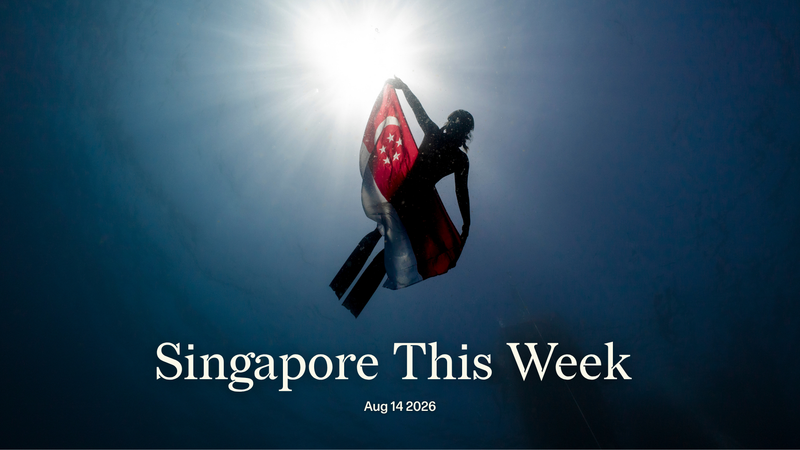
And Singaporeans are increasingly at it. On August 9th, National Day, Patricia Ong set a new national record of 85m in the constant-weight discipline (CWT) at the Manado Bay in North Sulawesi. Of the eight freediving disciplines, four are in the pool (horizontal), and four in the open. CWT involves descending and ascending by using a single large fin, mermaid-like. The 1.5m Ong, nicknamed “Pocket Rocket”, bested compatriot Michelle Ooi’s previous CWT mark, and also the men’s national record, by 2m. (Zecchini has made it to 123m.) She set 19 national records and currently holds all eight. “🇸🇬 Happy Birthday Singapore! 🇸🇬,” Ong posted, alongside a photo of her silhouette holding our flag underwater. “Really happy to have had the chance to raise the Singapore flag high in freediving competitions.”
Freediving is a sport that harks back to antiquity, as humans searched for clams and other tasty morsels. There is regional specificity too, with the Ama women of Japan and the Haenyeo women of Korea having harvested shellfish and seaweed for over a millenia; likewise, closer to home, the nomadic Bajau of maritime South-east Asia. Over time the Bajau have evolved spleens 50 percent larger than their land-based neighbours, allowing them to stay underwater longer. The BBC clip of a Bajau man calmly walking on the seabed and spearfishing his prey is mesmerising in its depiction of human ability.
Ong is pushing boundaries, and doing so safely. One of her most popular posts is titled “What giving up looks like”, featuring a rescue by a safety diver. And freediving may have relevance well beyond a tiny group of superbreathers. Ong told Jom that she’s also “working toward using the breathing (or not breathing) we do for freediving to help people overcome corporate stress in the office through short workshops.” (The Singapore Pool Freediving Open 2026 will be held September 19th-21st.)
Arts: Dynamic drama
What do the Mahabharata, a monkey’s paw, and a lizard have in common? They’re all part of Nadagamic, a brand-new international Tamil theatre festival kicking off next week. In these plays, a tragic hero faces a moral dilemma on the eve of an epic war; a cursed object grants wishes with deadly consequences in 1935 Malaya; and a lizard becomes a metaphor for prejudice, suspicion and xenophobia. The seven-year-old AGAM Theatre Lab was recently elevated to “major company” status under the National Arts Council’s grant funding scheme. Its inaugural festival—whose title is a portmanteau of nadagam (Tamil for “drama”) and “dynamic”—has an ambitious lineup: over 120 performers across eight productions and six workshops from four countries. Still, the theatre company’s both wired and worried. “We planned it in a way where it should not burn us at the end,” founder Ganesh Subramaniam told The Straits Times, with some nervousness. “We didn’t want to reach a position where after the festival we wouldn’t want to do it any more.” While about 30 percent of audience members at their most recent production, the war comedy “Mission Malligapoo”, were non-Indians, it’s still an uphill battle to get bums on seats for a minority-language festival. There are just under 200,000 Tamils in Singapore, roughly the population of Ang Mo Kio GRC and Potong Pasir SMC combined. Even if AGAM banks on its Tamil-speaking audience and manages to sell out all its shows, it won’t cover costs.
This isn’t the first Tamil theatre festival in Singapore. Athipathi International Theatre’s long-running Thisaivegam has been around for 13 years and counting. But AGAM is leaning into its festival’s “international” profile to make Singapore a “hub” for Tamil-language programming—so Subramaniam hopes. The company acquired its own venue last year, a 110-seater black box space at Tanjong Pagar Distripark, just above the Singapore Art Museum. It’s a smidge of stability for a group that was operating out of a rented studio at Goodman Arts Centre for five years. Still, their three-year lease set them back half a million dollars, and while AGAM raised S$400,000 for the space from over a hundred donors, it still has a long way to go in its vision of fostering the next generation of Tamil theatremakers. At Nadagamic, it’s also relying on a couple of better-known names to reel in the crowds, including Malaysia-born, UK-based Rani Moorthy with her one-woman show, “Whose Sari Now?”, which takes the iconic fabric as a point of embarkation to explore tradition, identity, and belonging in both South Asian and diasporic life. “Good stories don’t need passports,” the actress told Tabla. “I’ve dreamt of this kind of festival to open the hearts and minds of non-Tamils to the beauty of our art.”
Abhishek Mehrotra, Sakinah Safiee, Corrie Tan, and Sudhir Vadaketh wrote this week’s issue.
Letters in response to any blurb can be sent to sudhir@jom.media. All will be considered for publication on our “Letters to the editor” page.
If you enjoy Jom’s work, do get a paid subscription today to support independent journalism in Singapore.