
News this week included: Thailand shortens visa free stay for Singaporeans (and others) to curb crime; activists Elijah Tay and Jolovan Wham handed 19 charges by cops for their peaceful demonstrations; HDB confirms Gillman and Maju forests destruction; Firdaus Daud takes over Faishal Ibrahim’s grassroots work; Pritam Singh sings a Hokkien song outside a void deck; Tommy Koh wins Ramon Magsaysay award; new three-day cooling-off period for loans taken from licensed moneylenders; why China’s super-rich are returning; tenants at Punggol East container park upset by impending closure; tenants at Marina Square surprised by short notice of closure; Satay by the Bay to make way for new wetlands attraction; SG weighs daily social media use limits; new private not-for-profit hospital in the east; how one woman gives children from low-income families a space to be themselves; the tourist who stole a S$200K diamond by hiding it in his mouth; rising suicide deaths among those in their 30s; how banks here compete for wealth management talent; retailer loses defamation suit against customer over negative Shopee review; designer turns discarded eggshells into homeware; Ah Boys actors mentor new generation in Jack Neo’s latest film; the ethics of foraging in Singapore; and—hope for humanity yet—a good samaritan cradling an elderly man’s head in Serangoon Central before the ambulance arrived.
Below are the issues we explore in depth:
Our picks
International: The buzz
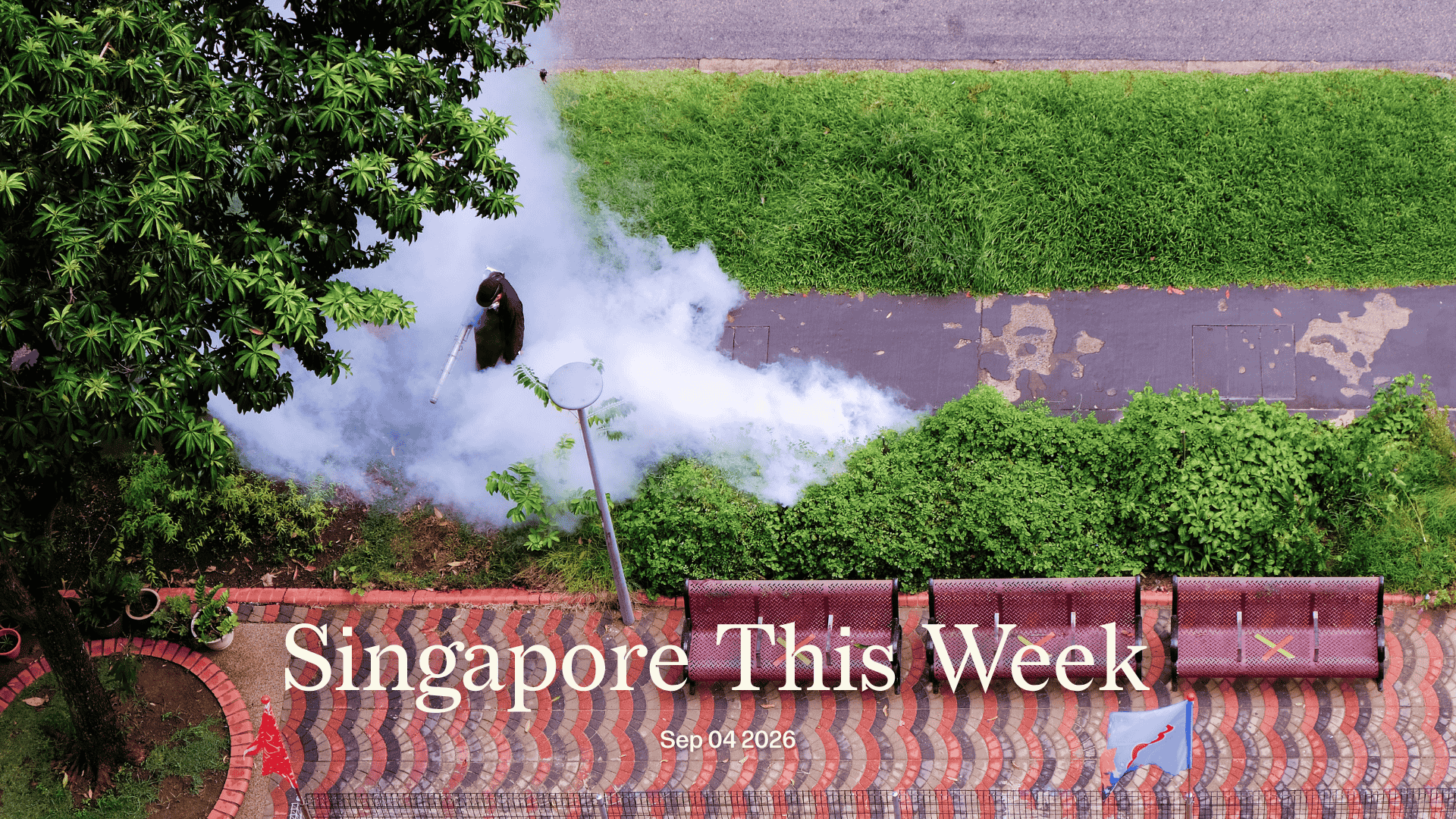
Imagine being sat in a streetside Parisian café, all café au lait, beret, baguette, and stereotypes. Warm sun, gentle breeze, and chic passersby. In this urban Eden, an incongruous sound slithers into your ear canals. Distant at first, just a hum, but unmistakably familiar. In step with your rising dread, it soon turns into a drone and then a roar, accompanied with the noxious white vapour that hangs over your getaway paradise. Singapore residents who visited the French capital in September 2023 may recall the trauma.
It was the first time that streets and neighbourhoods of Paris were fumigated against tiger mosquitoes which can carry the dengue, chikungunya, and Zika viruses—the upshot of a journey which began when their pioneering forefathers hitched a ride on used tyres sent from Asia to France in the early years of the 21st century. Globalisation took the tigers to Europe; climate change’s warmth has likely helped them flourish in the decades since. In 2022, the EU saw 71 locally acquired dengue cases. Before you say “pfft, what’s the big deal?”, pointing to over 32,000 cases in Singapore alone that year, consider that the EU recorded just 73 cases across the previous decade. The number climbed to 130 in 2023, and crossed 300 in 2024.
“Europe is already seeing how climate change is creating more favourable conditions for invasive mosquitos to spread into previously unaffected areas,” said Andrea Ammon, director of the European Centre for Disease Prevention and Control. Echoing her, Erol Fikrig, infectious diseases chief at the Yale School of Medicine told The New York Times that “mosquito-borne diseases are becoming more important in the United States.”
Countries are slowly adjusting. To combat dengue, the EU is studying the feasibility of adapting Project Wolbachia. Launched here in 2016, Wolbachia results in the female Aedes mosquito—the species that spreads the virus—laying eggs that do not hatch. Sites covered under Wolbachia have seen a 70 percent reduction in the risk of getting dengue. The EU is also educating trainee doctors in diagnosing and treating Zika, dengue, and malaria, previously mere footnotes in medical syllabi.
A reorientation of global public health systems may well be needed, as outbreaks caused by pathogens spreading in areas with previously inhospitable climates become increasingly common. Mosquitoes transmitting malaria in the east African highlands, ticks carrying disease to new parts of North America, and warming waters allowing Vibrio bacteria to infect swimmers in the Baltic Sea with sores, lesions, and blood poisoning are all further proof of global warming’s potential to disperse plagues and pestilence far and wide.
Interestingly, some evidence suggests that every one-degree rise in maximum temperature beyond 31 degrees Celsius is associated with a 13.1 percent reduction in the cumulative risk of dengue infections in Singapore over six weeks. A respite from the “Fever Demon” here would have been cause for celebration except that a hotter future holds other demons for us too, from the wider spread of Zika, chikungunya, and water-borne diseases to heatstroke.
The Ministry of Sustainability and the Environment recently outlined plans for more than 300 “cooling centres” in the event of a heatwave while the Ministry of Manpower has made it mandatory for outdoor workers to be equipped with cool drinking water, breathable clothing, and emergency ice packs from December. Laudable steps all, but with the UN just announcing that the world has handsomely missed the goal of limiting global warming to 1.5 degrees above the pre-industrial average, we may soon find that the only things staying cool and healthy are our precious data centres.
Food: Eat your veges
You’ll hop into a BYD, but will you eat a Chinese cabbage? For certain products, including cars and electronics, it seems like “Made in China” has completed the redemptive arc in the souls of Singaporean consumers, with quality and safety no longer a concern. (Mimicking the journeys of “Made in Japan” and “Made in Korea” decades earlier.)
Chinese food, however, has always been a harder sell. And for good reason. In the 2000s, as global supply chains started to spread across China’s eastern seaboard, the world’s gaze also started to turn towards the economic miracle that would, on the one hand, see millions pulled out of poverty, but on the other, expose the dark underbelly of unrestrained, amoral, market instincts. None more ghastly than in food: for instance in 2000, the 50 tons of old rice from Shandong treated with industrial white wax and mineral oil to look fresher; in 2005, the first of many scandals involving Sudan Red, a carcinogenic industrial dye used to deepen the colour of chilli products, eggs, and much else; and in 2008, the same year Beijing hosted China’s first Olympic Games, the milk and infant formula incident that would define all subsequent food-safety conversations.
It was not China’s first fake milk fracas, but its most devastating. Crafty farmers and middlemen had been using melamine, an industrial compound used in plastic production, to boost the protein content of diluted milk so that it’d pass muster. But melamine is known to cause kidney damage in humans and animals. Among other supply chain problems was that the inspection system of Sanlu, a major milk producer and the primary culprit, had been compromised since 2005. Official reports suggest that some 300,000 children were affected, of which 54,000 were hospitalised, and six died. The Chinese government dealt decisively with the perpetrators of what the WHO called a “deplorable” incident, including with two executions and three life sentences.
That didn’t deter all criminals. Notable was 2013’s fake meat scandal, where diners feasting on mutton later realised it was actually rat (or fox or mink); and the 2010 “gutter oil” saga, where perhaps up to a tenth of restaurant oil in use across the country was discovered to have been salvaged and recycled from drains and other slimy pits. But by then the die had been cast, the response had hardened. The government beefed up regulations, such as 2015’s Food Safety Laws, and began prosecuting offenders relentlessly. It’s unthinkable that any official today might act like the deputy mayor of Shijiazhuang in 2008, who told Sanlu’s board to “shut the mouths of the victims by money” and wait till the Olympics had passed. State media also now doggedly expose food safety issues.
All this has happened alongside strident consumer activism. Chinese concerned about sustainable farming and food production have organised community-supported agricultural projects, such as Beijing’s Little Donkey Farm, started in 2008. Others, meanwhile, have assumed the mantle of public whistleblowers. This includes the father who founded Daddy Lab, which began in 2016 by testing for toxicity in kids’ products, and last year found Sudan Red in cosmetics. And environmental content creators such as Yulie Qige, who last month posted a video on Douyin showing workers dipping cabbage in formaldehyde, another carcinogen, to keep them looking fresh. When young Chinese aren’t lying flat, they’re evidently crying foul.
South Korea and Singapore have increased checks on Chinese cabbages, but there’s no cause for further alarm at the moment. Better to use it to reflect on the dramatic shifts in China’s food industry over the past two decades—and ponder how we, too, can become more conscious consumers, who interrogate the ethics of our supply chains, on everything from the food we eat to the “clean” energy we buy.
Culture: Gotta catch em’ all
It was 2016 and Pokémon Go had just landed on our shores. On day one, it became the most downloaded app here. The police preemptively released an advisory reminding fans to be cautious lest the trance it induced put life and limb in peril; plenty of incidents had already occurred elsewhere. Days later, players hypnotised by the sighting of the rare and powerful Snorlax—an enormous dark blue-green Pokémon with a cream face and round belly—swarmed Hougang Avenue 10. By then, glassy stares and frozen smiles had become familiar sights, as friends tried to maintain eye-contact over dinner even as their thumbs moved instinctively, clockwise across their phone screens to launch Poké Balls in the hopes of catching magical Pokémon.
Pokemon trading cards saw a resurgence too, led by influencers sharing their rare collections, unpacking livestreams, and Covid-19 lockdowns which pushed millennials to re-discover their childhood decks. In January last year, a 1,000-strong crowd descended at Pokemon Centre Singapore in Jewel Changi for the launch of a new trading card set, forcing the store to halt sales for safety reasons. In total, there are 191 retailers here alongside 46 “gyms” (designated spaces for fans to participate in battles, make friends, buy or trade cards). Trading card events have been known to record a million dollars in transactions in two days. Singaporeans’ fandom was rewarded this week when Pokémon announced that its 2027 World Championships, which include the Trading Card Game, Video Game, and Pokemon Go, will be held here.
A day later came the news that the World Championship of Yu-Gi-Oh! will also be held in Singapore. Owned by entertainment giant Konami Digital Entertainment, it began life as a manga but now is an immensely popular trading card game. Earlier this year, the digital version of its 2022 release, Yu-Gi-Oh! Master Duel passed 100m cumulative downloads worldwide.
Pokemon and Yu-Gi-Oh! are just two manifestations of Japanese soft power that runs the gaming gamut from The Legend of Zelda and Donkey Kong to Super Mario and Sonic the Hedgehog. Its own leaders have no qualms about exploiting the irresistible charms of these games’ characters, such as when Shinzo Abe, late prime minister, dressed up as Mario to announce Tokyo as the host of the 2020 Olympic Games. Foreign leaders aren’t far behind—last year, Emmanuel Macron, French premier, showcased his Yu-Gi-Oh! card during the world championship game held in Paris. No diplomacy campaigns can beat the cutesy quirks of a down-to-earth leader. The soft power brings with it cold, hard cash too. In 2023, overseas sales of Japanese content surged to US$37.6 billion (S$47.8), easily surpassing the country’s semiconductor exports (S$39 billion). Last year, Japan officially recognised the industry as a “key driver of economic growth”.
But critics point out that Japan’s cuddly modern image has obscured the fact that it has yet to admit to, let alone reconcile with, its past. Many older Singaporeans still remember the trauma of the Japanese Occupation, even as younger ones chase Pokémons and the state continues to emphasise “pragmatism”. It was all a long time ago, we get it. But the love of games or the allure of economic prosperity should not overwhelm critical reflection, nor make us forget that an acknowledgement and an apology are still due.
History weekly by Faris Joraimi
The International Islamic University of Malaysia (IIUM) announced in late August that it had fired Solehah Yaacob, the Malaysian academic notorious for her theories that ancient Malays taught shipbuilding to the Romans and flying kung fu to the Chinese. She came to public attention after her claims went viral online, followed by widespread ridicule and mockery. Rather than piling on her even further, it’s more interesting to wonder about the following she enjoys in Malaysia, which outshines that of many serious historians. She gives the Malays a past to be proud of, where forefathers performed grand deeds and played important roles in human history. One would think such insecurity is unique to a community that remains politically and economically marginalised across South-east Asia; even in Malaysia, where affirmative action has raised up a glittering bumi-bourgeoisie, most capital remains in Chinese hands and there is still constant talk of Malays potentially “losing power” to minorities.
But the great civilisations aren’t feeling too great these days, either. In Japan, India, and China, Asia’s largest economies, material prosperity and geopolitical importance haven’t stopped busy quills from writing histories of perpetual victimhood. From Nippon Kaigi’s aim to overturn “the Tokyo Tribunal’s view of history”, to the Hindutva movement trying to revive India as a Vedic paradise before “Muslim invasions”, to Han nationalists proclaiming the rejuvenation of their so-called 5,000-year nation after humiliation by foreign powers in the 19th century, all share the same quest to right old wrongs. Decades spent plundering the masses have built up reservoirs of resentment tapped by politicians selling snake-oil history.
Despite an apparent historical orientation, these ethno-fascist movements rest on mostly modern concepts, such as the racial purity of national homelands. In July 2026, the People’s Republic of China introduced a new “Law on Promoting Ethnic Unity and Progress”, a shift from the CCP’s earlier long-standing recognition of multiethnic rights, towards increasing Sinicisation: prioritising Han Chinese language and culture at the expense of the PRC’s numerous ethnic minorities. Veneration of the Yellow Emperor, mythic ancestor of the “Chinese nation” (zhonghua minzu), has intensified. With every chant and puff of incense, state power grows. In contrast, the Malay supremacists never fully succeeded given their ideological fragmentation, infighting, and continued collusion with Chinese money at home and abroad to deliver material largesse to voters. The Federation of Malaya’s basic multiracial arrangement—where a dominant Malay party governs in coalition with Chinese and Indian ones—is fraying, but intact. That ambiguous power balance may help Malaysia ride the new world order. It’s Singapore, whose Chinese supermajority leaves it vulnerable to pressure from Beijing, that seems more wary of a resurgent Han empire reviving the old Nanyang tributary system.
Arts: Chosen family
How do you make a family when your own forsakes you? A new literary anthology spotlights the stories of nine queer families and their biological and chosen kin: a trans woman finding family in a community shelter; gay dads who navigate new fatherhood through surrogacy; a charismatic drag artist’s intimate bond with her charming grandmother, a seamstress in her 90s. SQ21 - Singapore Queer Families in the 21st Century is an homage to queer folks in Singapore who, in the past, would have had to risk not just their reputation but their livelihoods to tell these stories. The family formations and permutations highlighted in the book offer a glimpse of how sexual minorities have survived in a sociopolitical climate that is only beginning to thaw after decades of glacial movement on queer rights and protections. This is not the first anthology of real-life queer narratives to be published in Singapore: last year, editor Koh An Ting published Fearfully & Wonderfully Made: Stories from Conversion Therapy Survivors in Singapore, featuring three accounts from participants in Church of Our Saviour’s “Choices” conversion programme, and the psychological cruelty they weathered and witnessed, resulting in everything from mental breakdowns to suicide. Collections such as EXHALE (2021) and GASPP (2010) have also celebrated and reflected on queer life in poetry and prose—but nonfiction and documentary genres still give queer individuals pause. Jason Wee, SQ21’s editor, told The Straits Times that a quarter of interviewees withdrew from the publication when confronted with their stories in written form, and “realising what it meant for their personal lives to be publicly exposed”. One person who chose to share her story was Shania Saudah, a 46-year-old who met her “big brother” figure, caretaker Daniel Askre, while she was living at The T Project’s shelter. In 2024, he flew with her to Bangkok with two other queer men to celebrate her gender reassignment surgery. Shania’s chosen family is an uncanny mirror of her estranged biological family: her father and two brothers. “God took them away and then he put me with three queer men,” she told ST. “I sometimes feel that the divine works in very mysterious ways.”
The theatre has also been a recent refuge for queer stories, reenacted by actors. In June, Wild Rice presented “GIRLS GIRLS GIRLS”, a docudrama on the lives of 20 queer women. It quickly disabused audience members of lesbian archetypes and stereotypes: that all lesbians don flannel and cargo pants and move in together after the first date. This oral history approach allowed queer interviewees a bit more anonymity; playwrights Deonn Yang and Alfian Sa’at interviewed the women, then had the five cast members listen to voice recordings as they prepared to inhabit various roles. The performers were nervous about portraying real people and doing their stories justice. Actor Farah Ong told ST: “My fear is always that to respect the individual is to not [caricature] them. That’s a very fine line. How do we represent this person without mimicking them?” The 100-minute show spliced together the stories of lawyers, entrepreneurs, musicians and more as they maneuvered their way through queer rites of passage: discrimination, coming out and finding family. “At the core,” said actor Tan Rui Shan, “it’s really them trying to be loved and to love.” Aren’t we all?
Related: Jom’s position on trans rights in “Their struggle is ours”, and our 17-minute documentary “The Euphoria is Real”, which follows the gender reassignment journey—with all its attendant joys and anxieties—of Julianna Maria Hedger. Also, “What’s softest in the world rushes and runs over what’s hardest in the world.”, a 14-minute hybrid documentary about queer families by Charmaine Poh, one of Jom’s co-founders.
Faris Joraimi, Abhishek Mehrotra, Sakinah Safiee, Corrie Tan, and Sudhir Vadaketh wrote this week’s issue.
Letters in response to any blurb can be sent to sudhir@jom.media. All will be considered for publication on our “Letters to the editor” page.
If you enjoy Jom’s work, do get a paid subscription today to support independent journalism in Singapore.