

News this week included: SG proposes UN framework for global AI safeguards; how SG’s food and retail sectors are using AI; population climbs to 6.21m, citizens < 60 percent; more than 1 in 5 citizens aged 65 and above; SG leaders offer condolences over death of Mahathir's wife; worker dies after falling from height at Tg Rhu construction site; public transport fares up by 12-13 cents per ride from Dec; PAP to train mental health ambassadors to better support women; National Museum’s revamped Singapore History Gallery reopens on Oct 10th; CNA on the scourge of “S$5 per post” fake positive reviews online; youth offending rate rises, driven by jump in cheating offences; 39 people, half below 30, arrested for alleged drug activities on Telegram; ST commentary on SG, the “fine” city; community void deck dinners are in; property agents helping parents move to secure good primary school spots; ST multimedia piece on SG school uniforms; Malaysia-made caviar, wagyu, and melons; tiny songbird’s first appearance in SG; ST on F1’s value proposition to SG; Shanti Pereira’s Asian Games 100m silver and 200m gold: “the ones that believed when I didn’t”; Loh Kean Yew wins historic Asian Games silver; and death of a 24-year-old Muay Thai fighter after SG tournament.
Below are the issues we explore in depth:
Society: Pick and choose
Every five years the UN conducts a Universal Periodic Review (UPR) of its 193 member states’ human rights records. Singapore submitted its report this February, participated in the review in May, and earlier this week supported 243, or 71 percent, of the 342 recommendations made by UN member states—higher than in previous UPR cycles: 65 percent in 2021 and 53 percent in 2016.
Of the 99 recommendations that Singapore rejected, 22 were about the death penalty, and 12 with regards to the freedom of speech, expression, and assembly. In its report Singapore said that every Singaporean has constitutionally protected rights to freedom of speech, freedom of expression and peaceful assembly—but they’re not absolute and must be exercised responsibly.
Coincidentally, over the past month we also got a better understanding of how the state defines “responsibly”. The Singapore government charged 14 activists for a variety of peaceful expressions, mostly under the Public Order Act. We do not believe that any of their actions, some almost three years ago, are prejudicial to the security and harmony of Singapore, and disagree with the government’s decision to prosecute them. To the contrary, we feel that the government’s reaction will further dampen the already moribund environment for public discourse, and is at odds with the stated aim of Lawrence Wong, prime minister, to foster “a more open and participatory society”. While the courts will decide their fate, we believe it’s important for Singaporeans to better understand the alleged offences, and contemplate whether our current laws are too harsh for the vibrant democracy we’re all striving to nurture.
For more, please read “In solidarity with our activists”, our commentary this week.
Society: More egg baskets
Marvel at the culinary versatility of the humble egg. Depending on how it is treated, it can end up on your plate in myriad delicious forms. Eaten on its own, an egg can be boiled, poached, fried, scrambled, pickled, or baked. As an ingredient, it can bind, thicken, coat, glaze, aerate, and emulsify. Across cultures, it anchors dishes from breakfast to dinner. Orh luak, sambal telur, or chawanmushi, anyone? Is it any wonder it’s cracked its way into so many of our meals.
Singapore consumed more than 2.2bn eggs in 2025. That works out to roughly 360 eggs per person a year—about one egg a day. Twenty-four hours is also, more or less, how long it takes a hen to produce a fully layable egg. The shell alone requires around 20 hours to form (and just a second to crack!). Observed from the domesticated fowl’s end of the equation, the answer to the familiar chicken-and-egg paradox seems clear—without her, the egg wouldn’t exist. But the 19th century writer and evolutionist Samuel Butler turned that notion on its head. “A hen is only an egg’s way of making another egg,” he noted in Life and Habit (1877). From ovulation to evolution, Butler’s formulation recasts the chicken as a vehicle for genetic continuity—akin to all living organisms, perhaps. Hence, no egg, no need for chicken.
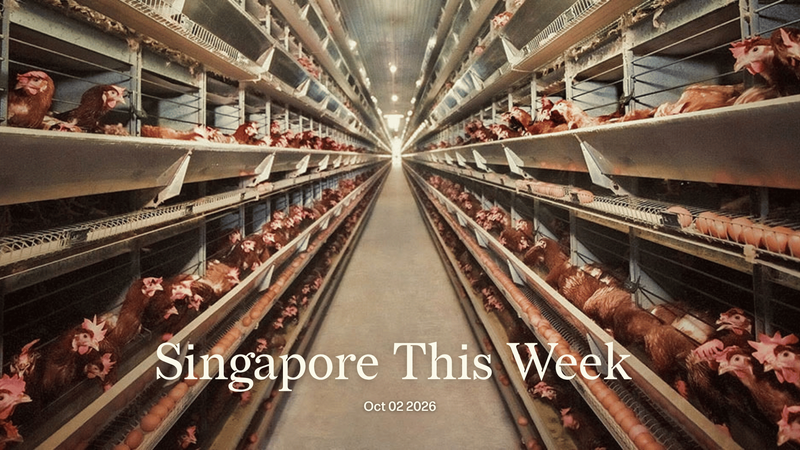
For those of us who encounter eggs primarily as food, this existential inversion becomes less a philosophical puzzle than an ethical one. While the egg is everywhere, the hen that made it is almost nowhere to be seen. The construction of Singapore’s fourth egg farm gives us reason to bring her back into view. At full capacity, all four local farms could meet half of Singapore’s annual egg needs, further reducing reliance on imports and strengthening food security.
Egg farming has evolved from labour-intensive traditional smallholders in the 60s and 70s to today’s highly automated, high-tech industrial producers who maximise output on less land. The new DoMo, or “Do More with Less”, farm is being billed as “next-generation”, using AI, smart sensors, and the Internet of Things “to improve efficiency, boost productivity and raise standards” across its operations. Its first phase will house 1.35m layer hens and 450,000 pullets, with breeding and hatching to follow.
We know that biosecurity concerns prompted a redesign of DoMo’s premises to better protect its birds from diseases circulating in the region. What is less clear is how far animal welfare has influenced these changes. As local farming intensifies, is it enough to simply keep caged hens healthy? Or should we have higher expectations for the lives of the animals that make greater self-sufficiency possible? That means asking not only whether these creatures survive and remain productive, but how well they live: how much space they have; how they are housed; and whether they can perform natural behaviours, such as perching, nesting, and dust-bathing.
In 2019, local producer Chew’s Agriculture was Certified Humane by Humane Farm Animal Care for its cage-free laying houses. It plans to triple the amount of cage-free eggs produced. Finding the balance between affordability, food security, and animal welfare will not be straightforward. Consumers here have started asking whether food imported into Singapore is produced humanely. As more of our eggs come from local farms, the same scrutiny, and the same demands for higher welfare standards, must apply to homegrown hens too.
Society: Big Brother will help you get laid
This week GovTech launched its long-awaited dating app, FirstDate. It’s currently open only to government officials aged 21-35 who are single, widowed, or divorced. Upon sign-up users are prompted to answer 33 questions, including on: their PSLE result; their favourite minister to work under; how long they’d be willing to volunteer at a primary school in order to get their kid in; and whether they’d go along with a partner who wants to climb the property ladder using confidential information about unannounced train stations—or report them.
Well, one can wish. The actual 33 questions include the following: “Now, spill! What do you actually love about your hobbies?”; “Be honest! What does your room look like right now?”; “Team sunrise, or team ‘it’s 2am and I’m still up’?”; and “Gym rat, occasional jogger, or exercise is a myth to you?” The questions are interesting as much for their content as their insights into (presumably) Gen Z bureaucrat-speak. Respondents will, of course, have to trust in the app’s confidentiality and privacy measures. Are those still up at 2am in line for a promotion? Will those for whom exercise is a myth be summoned by the Health Promotion Board? Is Indranee going to handcuff and whip those who say no to kids? (Hmmm.)
This AI-charged effort to get humans to mate is simply the latest in a four-decade effort to ensure that capitalism’s engine doesn’t run out of inputs. Quality ones, that is: government matchmaking had its troubling origins in Lee Kuan Yew’s eugenics, worried as he was that the hoi-polloi were reproducing faster than the elite. It’s on the latter group, he said in 1967, that Singapore should expend its “limited and slender resources”, for “they will provide that yeast, that ferment, that catalyst in our society which alone will ensure that Singapore shall maintain its pre-eminent place.”
In 1984, alongside the controversial Graduate Mothers Scheme, the Social Development Unit (SDU) was set up, but only for graduates. (And later lampooned as Single, Desperate, and Ugly.) In 1985, following a backlash—part of a broader rebuke to Lee’s eugenics—the Social Development Section was set up for singles with O-level qualifications. Five years later the Social Promotion Section was set up for those—gasp—who had not even completed secondary school. Only in 2009 would Singapore remove these scholarly distinctions from official matchmaking activities.
GovTech’s decision to limit it to civil servants is surely more about a focused control group for beta testing rather than a desire to manufacture Lee-loving toddlers. Yet other challenges arise, as articulated by Teo Kai Xiang, a PhD student formerly at The Straits Times (ST), in “How Singapore’s government-run dating service works, and why it won’t solve the nation’s dating woes”. His central critique is around GovTech’s use of the Gale-Shapley Stable Marriage Algorithm. In a bid to relieve users of “swipe fatigue”, GovTech has chosen an approach that collates all user inputs and matches each person with just one other, in each cycle. You can either accept or reject your match.
Teo outlines three problems with the algorithm, which, despite its name, has real-world applications outside of marriage. First, it’s more applicable in matching challenges where participants are committed and there are no external options: such as army recruits to their units. Second, its basis in ranked preferences runs into problems when there are open-ended and ambiguous questions. “If you’re a gym rat, does that mean you also want to match with other gym rats?” And third, like other apps, “The problem with modern dating is not simply a problem of mismatched preferences!”
Still, desperate times call for desperate measures. Perhaps GovTech can consider reporting high-level findings. Among many other things, it’ll be interesting to see how many inter-religious civil servant matches are produced, and which specific ones (Jew-Muslim? Atheist-Hindu?) today’s social engineering models are happy to bless.
Society: To the winners, a life of hard work
Brainwork is more relaxed than manual labour. Even the ancient Egyptians knew that. Some 4,000 years ago, the scribe Kheti told his son about the merits of his job, “greater than any profession”, contrasting it with the way smiths, masons, potters, and others toiled. In describing a “builder of walls”, he said: “His apron is mere rags and the rest-house far behind him. His arms are dead from wielding the chisel, and every measurement is wrong; He eats his food with his fingers and washes once a day.” The Satire of the Trades, as the work has come to be known, was a didactic text used to train aspiring scribes, who’d memorise and reproduce it over generations, which is how it survives today across papyri and ostraca. (Egyptologists are divided on whether it was indeed satire.)
Other civilisations had their own snobbery and hierarchies, such as Confucianism’s Scholar-Farmer-Artisan-Merchant ranking. Yet through it all, manual labourers garnered some respect and exercised some power. The artisans working on Pharaohs’ tombs in the Valley of the Kings, around three millennia ago, went on strike when Ramesses III failed to provide wheat and other rations—considered the world’s earliest recorded collective labour action. Ancient Roman and Indian guilds (collegia and shrenis respectively) predated the more recognisable ones of Medieval Europe—themselves praised and pilloried, depending on the extent to which, for instance, they behaved more like academies enforcing standards, or cartels that excluded women (and minorities) and skewed the market.
In the aftermath of the second world war, Francisco Albert Vidal, who’d been imprisoned with his blacksmith father and worked in mines under Franco’s regime in Spain, recognised a shortage of vocational and technical skills amongst the youth across war-torn Europe. So the man from Pinoso, Alicante led their revival. What’s considered the first “WorldSkills” competition took place in 1950 at the “Virgen de La Paloma” VET School in Madrid. (His wife gave birth in the school to their second daughter, nicknamed Paloma.) Over the next two decades the competition spread across Europe. The international leap occurred in 1970 with Tokyo as host city, and it’s grown exponentially since.
Last week’s WorldSkills Shanghai, its 48th edition, saw over 1,400 young people from 70 countries and regions compete in 64 skills across six sectors: from bricklaying, carpentry, cooking, dentistry, and joinery—skills our ancestors might recognise—to floristry, hairdressing, drone technicians, robot systems integration, and 3D printing. Many of these blur the distinction between brain and manual work—always a false dichotomy, surely, whether with ancient tomb artisans or modern electricians and plumbers. Hopefully our more textured understanding of skills and jobs will lead to a greater appreciation of all forms of labour, including emotional—perennially undervalued and yet ever-more important in the modern, ageing world. A reimagination of jobs and labour hierarchies is also needed if, as many predict, AI will more easily replace brainwork.
Team Singapore? Our contingent of 34 returned home with four silvers: visual merchandising, restaurant service, chemical laboratory technology, logistics, and freight forwarding; and four bronzes: software applications development, 3D digital game art, cloud computing, and digital construction. Kheti the scribe might have sympathised with the travails of Sheryl Ong, the Nanyang Polytechnic graduate and one of two team captains, as she bagged the silver in visual merchandising. “There were times where I would fall asleep while eating dinner,” she told ST, about the four-day competition in a still balmy Shanghai. “I would have food in my mouth, and my head would be on the table. And before I knew it, I had already slept a few hours.”
Society: Pics, but it didn’t happen
Last year, a prank went viral that involved creating AI-generated images depicting a dishevelled person (characterised as “homeless man” online) invading one’s home, and sending them to clueless loved ones (often older parents unfamiliar with the technology). Panicked reactions to these images were then captured in screen recordings of lengthy voice messages, frantic text messages, and countless missed calls, which became the butt of the joke. While many appeared to find the prank harmless—some videos raked in thousands of views—police departments abroad, like in Poole, UK and at least four US states, warned against carrying out such pranks. Not least because they wasted public resources when officers were dispatched to attend to false alarms. Such pranks are also classist and dehumanise the unhoused.
While there were no reported instances of the prank here, a different but puzzling case has crawled up on our shores. A man was charged for sending an AI-generated image of a crocodile at Pandan Reservoir to someone, who had presumably reported it to the police. This led to authorities searching for the reptile and suspending water activities. The incident highlights the importance of AI literacy, which might have prevented it if people were capable of discerning between AI-generated and genuine content. (It would help too if those already familiar with the technology stopped circulating misleading AI-generated images that could cause panic.) Notably, a significant gap exists between Singaporeans’ perceived and actual ability to recognise genuine content. A 2024 cybersecurity public awareness survey here found that only one in four respondents could distinguish between deepfake and legitimate videos, even though nearly eight in 10 respondents (78 percent) expressed confidence in identifying deepfakes.
Institutions worldwide are facing an increasing number of reported cases involving AI-generated visuals, despite lacking sufficient resources to verify their legitimacy before taking action. In Cardiff last year, an insurance company saw a 71 percent rise in insurance fraud over the previous year as access to AI tools has enabled more individuals to alter images and create false documents. This involved making damaged vehicles appear worse or helping support duplicate filling. US courts are seeing AI-generated evidence with deepfake footage and manipulated screenshots. While doctored evidence isn’t new, the accessibility of AI tools has expanded its scale—production of illegitimate content is outpacing the speed of detection and enforcement of defensive technologies. This is a worrying trend, as urgent cases with real evidence might be treated with scepticism and not receive the urgency they deserve.
How can we maintain social trust in an era of generative AI? The World Economic Forum suggests developing “verification literacy”. Instead of asking “does this look real?”, we should cross-reference sources to confirm a claim, examine the original source of the content, and recognise that algorithms favour emotional or sensational material. We must also resist the temptation to engage in AI doomerism. And instead strengthen our ability to establish truth and trust.
Arts: All booked up
You’ve been left here for some time, and you’re frosted with dust. You’ve lived for hundreds of years, and know your worth, the knowledge pressed between your pages—you are the only version left—but you’re not quite so sure others do. Your owner certainly does; he has gloves on whenever he lifts you gently from the shelf and brushes you off. Today doesn’t seem any different, until he takes out a device the size of a coin, with the same metallic shimmer, and slides it between your leather-wrapped backboard and translucent end pages. It’s cold, and the matte symbol of an apple is printed on one of its gleaming faces. The things you’ve seen this century! He tapes the Apple AirTag to you, and then you’re off, bundled together with hundreds of your shelfmates, perhaps a thousand, into several boxes. You hear the tear of tape and light floods back into the box. Someone grabs you by the spine; you haven’t been handled so roughly in centuries. Then they rip the covers off you, slice your back off, and dismember you, page by page, feeding your body into a high-speed scanner where your words will be mined for large language models. They turn the rest of you into a handful of dust.
That was the fate of thousands of antique, rare and out-of-print books, exposed by tech journalists from the media platform 404. Indie and antiquarian booksellers, first thrilled by a historic spike in book sales, quickly became suspicious of these bulk orders. To their collective horror, their books ended up not on bookshelves or bedsides, well-loved and well-thumbed, but in an Amazon-owned warehouse that hadn’t bothered to conceal their purpose: the building’s entrance is emblazoned with the logo of a T-rex about to eat a book. If you want to devour a local bestseller, but also have it live for years to come, you might want to think about throwing your support behind 20 of Singapore’s beloved indie bookstores tomorrow for their inaugural Singapore Indie Bookshop Day.
From Tanjong Pagar to Dakota, from Orchard Road to East Coast, these booksellers will be hosting guided tours, author visits, puppet pop-ups and, yes, antique book appraisals. It’s one way booksellers want to build community, but also give back to community. Yuree Hwang, founder of Korean-language store Bonmoi along New Bridge Road, was effusive about her customers’ generosity. “I have so many...coming up to me saying, ‘If you need somebody to look after the store for a couple of hours a day, I can. I’m here. Just call me’,” she told CNA. “Our readers are ready to show up for us, so we want to do this for them, too.” You can get a passport for the weekend—doubling as both your event directory and stamp rally—and pick up stamps from participating outlets for prizes in a lucky draw, including vouchers and gift sets. “The way booksellers understand the books you like is almost an intimate knowledge of you that is not mediated by algorithms,” Ibrahim Tahir, Wardah Books founder and one of the event’s organisers, told ST. “Go to bookstores you’ve never been to – you may never know if there’s something for you there. The booksellers are throwing their doors open and welcoming everyone.” Well, maybe not bots and book murderers. But if you’re reading this, we hope you’re a human who loves a good story and a cozy nook to read it in.
Arts: Eco-evo-devo
We’re all creatures of Singapore’s literary ecology. But how did it evolve? And how did it shape each of us, from the budding writer to the scrappy indie publishing house to the bustling Telegram channel? You might turn to ecological evolutionary developmental biology, or eco-evo-devo. This relatively new field combines ecology, developmental biology and evolutionary biology to study how we grow, change and evolve depending on the interactions of our insides (epigenetic inheritance: the genes we inherit), our outsides (phenotypic plasticity: how we respond to the environment, whether that’s diet, predators or temperature), and both of them combined (developmental symbiosis: how multi-species partnerships, such as hosts and their microbes, drive development). Books&, a nascent publishing collective and consultancy, decided it would study just that, taking the microscope—and the macro view—of the Sing Lit ecology.
The intermediary platform has just released its inaugural map of our literary and publishing ecosystem following its residency at 136 Goethe Lab earlier this year, where it first gathered responses through an online form, ran focus groups with everyone from bookstores to bookstagrammers, then put together a network-based data visualisation that looks a bit like a scattering of tiny planets orbiting one very large sun (the nearly 2,000-strong Sing Lit is LIT Telegram channel), with Jupiter loitering in another corner (the Singapore Book Publishers Association). “Rather than presenting the ecosystem as a linear publishing value chain or a neat ecosystem dynamics chart...the residency invited participants to collectively map Singapore’s literary landscape from their own experiences,” the collective wrote, “...the process understood the ecosystem as a dynamic network of overlapping communities, informal support systems, multiple forms of capital, and continually negotiated legitimacy.” Their findings aren’t surprising: that it’s hard to sustain oneself financially, that newcomers find it hard to get a foot in the door, that practitioners frequently wear many hats and work across many disciplines, that everyone’s constantly experimenting and collaborating. But consolidating all of this is a crucial first step in figuring out where our blind spots are, what invisible or under-valued labour looks like, and how we can better share resources—especially in a community where relationships, opportunities and financial support run on informal connections and tacit knowledge.
One of the big landmarks in the literary landscape is, of course, the Singapore Writers Festival, which has also just revealed the bulk of its lineup. This year, it’s taken to camouflage as its theme: “Hidden in Plain Sight”. Headliner Amitav Ghosh, whose searing prose has always confronted the ecological crises gripping our planet, will be delivering a keynote interrogating the instincts of the rich and powerful to retreat, rather than to repair, our shared world. Jom’s editorial team and contributors will also be part of the festival, and we’ve perhaps a little shamelessly picked out some of these hidden gems for you: Abhishek Mehrotra, our head of content, will be making a case for nuance and depth in an era of mindless clickbait and momentary hype; our contributors Xingyun Shen and Aditi Shivaramakrishnan will chat about the stories clothes might tell, including your own, and you’re encouraged to bring a worn garment with you; writer-researcher Li Shan Chan will discuss the ethics of trauma, and the mining of personal suffering for public consumption; and the designer of several of our print issues, Benson Chong, will talk about how he crafted a visual narrative for a tome that traces over a century of Singapore’s cinematic history. Each of us is a node in a broader literary ecology that’s always evolving, and we’ll need to develop it altogether.
Some further reading: In his essay for Jom, Isaac Neo ruminates over how we might recapture the reading spirit in Singapore, whether that’s embracing the challenges of long-form reading or the communality of book clubs.
Sakinah Safiee, Corrie Tan, Tsen-Waye Tay, and Sudhir Vadaketh wrote this week’s issue.
Letters in response to any blurb can be sent to sudhir@jom.media. All will be considered for publication on our “Letters to the editor” page.
If you enjoy Jom’s work, do get a paid subscription today to support independent journalism in Singapore.