
Last month, the Singapore government charged 14 activists for a variety of peaceful expressions, mostly under the Public Order Act. We do not believe that any of their actions, some almost three years ago, are prejudicial to the security and harmony of Singapore, and disagree with the government’s decision to prosecute them. To the contrary, we feel that the government’s reaction will further dampen the already moribund environment for public discourse, and is at odds with the stated aim of Lawrence Wong, prime minister, to foster “a more open and participatory society”. While the courts will decide their fate, we believe it’s important for Singaporeans to better understand the alleged offences, and contemplate whether our current laws are too harsh for the vibrant democracy we’re all striving to nurture.
Almost all the activists’ peaceful expressions fall within one of two social justice remits: death penalty abolition; and pro-Palestinian activism. This is unsurprising. These are both areas in which the Singapore state has exercised epistemological hegemony since independence. Unlike in other democracies, for instance, Singapore’s mainstream media would never dare publish an assessment of the pros and cons of the death penalty, never mind an editorial against it—lavishly-paid editors know very well where the bounds of thinking for plebeians are. Related, when Jom reached out to the Ministry of Home Affairs seeking comment before publishing our own commentary on the death penalty, we were met with silence. Promised dialogue but shorn of public platforms for it, some Singaporeans inevitably seek to create healthy spaces elsewhere.
These are the death-penalty-related activities that resulted in the recent charges: candlelight vigils outside Changi prison for death row inmates; and an “assembly” outside the State Courts, a prohibited area, on February 3rd 2025. The mainstream media’s reporting on the charges, intentionally or not, paints a picture of troublemakers whose values run counter to society’s. For instance, with regards to the vigils attended by Suraendher Kumarr, a vice-president at Humanitarian Organization for Migration Economics (HOME), The Straits Times (ST) took great pains to describe the crimes of the two men being remembered. For instance, “The 48-year-old was convicted in 2015 of trafficking 38.8g of pure heroin, which can feed the addiction of about 460 abusers for a week.”
The reader gets the impression of an activist with a disregard for lives lost to drugs. Far from it. As Suraendher and others in favour of abolition (including Jom) have long argued, there is a structural problem at play where the people we are killing are seemingly all low-level mules who are lured into criminal acts because of impoverished circumstances—all while the real kingpins remain safely hidden in mansions far away. A more enlightened and compassionate approach to drugs would for many reasons, we believe, be beneficial for all, mules and addicts.
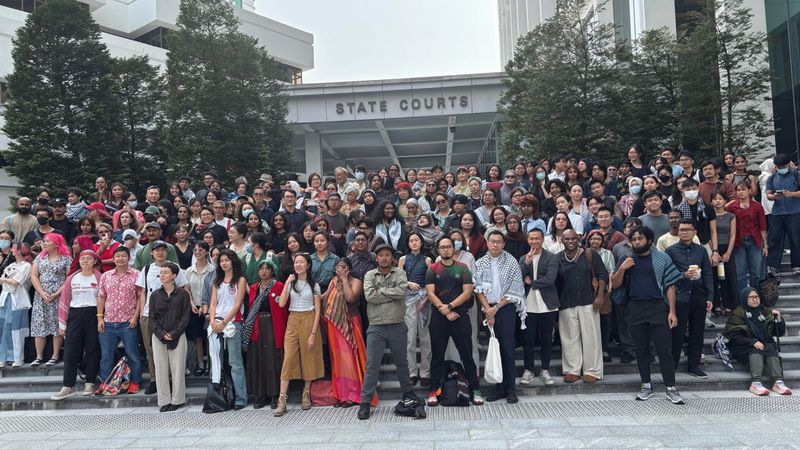
Meanwhile, ST also reported that, “Suraendher is said to have been involved in a separate public assembly held on Feb 3, 2025, at the State Courts, a prohibited area, to call for capital punishment in Singapore to be abolished.” What exactly, you might wonder, did this brouhaha entail? With the courts in the backdrop, about 20 people took a group photograph, roughly half wearing a black t-shirt with the words: “Not in my name. Abolish the death penalty.” Was this “public assembly” sufficient to incite nightmares in the Singaporean?
Similarly, the pro-Palestinian activities, relative to all we’ve witnessed globally since October 7th 2023, were almost embarrassingly mellow (yay, boring Singapore). Among them was a walk to the Istana to deliver letters by people carrying umbrellas with watermelon motifs; a mass kite-flying event at Marina Barrage; and a memorial in front of NUS’s Create building—chosen for the academic ties with Israel—featuring the arrangement of 124 shoes, in honour of Palestinian students who died during the genocide.
The one more potentially contentious act, in our view, was the chant of “From the river to the sea, Palestine will be free”, which divides opinion everywhere. Still, it occurred indoors within The Arts & Civil Space in Ubi, hardly the spot for any public moral grandstanding. (Did the area’s auto mechanics tremble?) Tellingly, the police’s charge sheet said that the phrase “supports the elimination of the Jewish state of Israel”. This is actually the Zionist interpretation, certainly not shared across the ideological divide—many regard it as a call for one state where all have equal rights.
(Other charges concerned a group that walked towards the Ministry of Home Affairs to hand over letters opposing the Maintenance of Racial Harmony Bill; a vulgar gesture made towards a public servant at aforementioned kite flying; and, quite separately, a female Falun Gong adherent.)
Though some of those charged have previously been in the news for their activism, this latest round features two new prominent faces: actors Neo Swee Lin and Lim Kay Siu. (Disclosure: they’re close friends of Jom’s editor-in-chief and subjects of an upcoming profile.) Their global profiles and ages—far older than their comrades—introduce a different complexity to these cases. On the one hand, Singaporeans who’ve blissfully ignored rumblings about activism might now perk up, fascinated that their TV and stage darlings are also now implicated. On the other hand, they’re bound to draw global attention (and sympathies) to the case—will public dialogue devolve into the simplistic, and establishment-serving binary between meddling outsiders and nationalistic patriots?
To reiterate, we raise all these issues not to in any way adjudicate the cases—that’s the job of our judiciary. Rather, we do not believe coverage of the charges by the mainstream media has been sufficiently fair and holistic. And we want our interpretation to be a corrective to Singaporeans who may have the wrong impression of our activists and their work. Ordinary people need to know more about the laws of this country and how they’re being used. The state has discretion in bringing such charges, and we disagree with its decision here.
Jom’s worldview necessitates a separation between journalism and activism. We’ve written about the genocide in Gaza and the death penalty many times, and will continue to, even as we today stand in solidarity with those charged.
This commentary is from Jom’s team.
Letters in response to this piece can be sent to sudhir@jom.media. All will be considered for publication on our “Letters to the editor” page.
Read also: “A little time in lock-up” by Kirsten Han, one of those charged, where she details the absurdities and ignominies faced by the activists. “By that point, we were already late for our court mentions, so three of us women ended up taking our T-shirts off right there in front of security and turning them inside out. (Good thing I was wearing one of my newer and nicer bras, I guess.) We were then finally allowed to go through security and head up to Court 4B.”
If you enjoy Jom’s work, do get a paid subscription today to support independent journalism in Singapore.