




Dear Jomrade,
Today we’ve published:
- “Singapore This Week”, by Jom
- “In solidarity with our activists”, by Jom
Many here have been alarmed by the wave of charges against activists last month. The depiction of the activists and their activities has been disappointing, both in the local and foreign media. We decided that we must say something, so that’s our commentary for the week.
Two global conversations, meanwhile, captivated me. One was around AI safeguards, partly following a series of podcasts by The New York Times’s Ezra Klein. Countering the enthusiasm of NVidia’s Jensen Huang—who believes that the threat of litigation is enough to keep trailblazers in check—was Bill Gates. He told Klein it’s “insane” to rely on labs to self-regulate “the most dangerous thing that humans have ever gone near”, pointing to our experiences with airline, automotive and drug safety. “Oh, you’re shipping opioids. Somebody should just sue you. I mean, we’ve created a society that tries to keep people safe not by saying: ‘Oh, we can bankrupt the person who does that.’”
Although Gates does envision an AI-powered future of superabundance, he believes there’s a long, perhaps 20-year transition period that the world must navigate: including challenges posed by AI-enabled cyberattacks and bioterror; and a job apocalypse. To mitigate the latter he supports a robot tax and “human-reserved” jobs.
I hope our policymakers start to consider more such novel interventions. I worry about the extreme AI optimism in this country, pumped up by every new AI-fuelled GDP figure. These days when I discuss the shallowness of public discourse in Singapore, I point to AI. I can’t name even one establishment figure who’s a public skeptic, cautioning against our headlong embrace. They’ve all fallen in line, seemingly. Contrast that with the debates in every other rich democracy. (Jom is working on a series about AI. Hopefully out by year’s end.)
From celebrity journalists who prod billionaires, to the muckrakers who expose corruption. Non-football fans may have missed the seismic news from the UK. Manchester City, the most successful club of recent times, has been found guilty by an independent commission of “cheating on an industrial scale”, as one pundit put it. It’s a story that gets to the heart of how global capital—in this case from Abu Dhabi—sloshes around the world with impunity. It was also vindication of the dogged efforts of a whistleblower and scores of reporters, including at Der Spiegel, The Guardian and Sky.
In short, a good week for journalism.
- With a fourth chicken farm planned, how can SG adopt a more humane approach towards chickens?
- FirstDate, the government’s latest attempt at matchmaking
- The WorldSkills competition is a window into the past and future of work
- A “crocodile” at Pandan Reservoir, and dealing with the scourge of AI-generated images
- Why tomorrow’s inaugural Singapore Indie Bookshop Day is so important
- Books&, SingLit, and the Singapore Writers Festival
Above are the issues we chose to explore in more depth.
Other news this week included: SG proposes UN framework for global AI safeguards; how SG’s food and retail sectors are using AI; population climbs to 6.21m, citizens < 60 percent; more than 1 in 5 citizens aged 65 and above; SG leaders offer condolences over death of Mahathir's wife; worker dies after falling from height at Tg Rhu construction site; public transport fares up by 12-13 cents per ride from Dec; PAP to train mental health ambassadors to better support women; National Museum’s revamped Singapore History Gallery reopens on Oct 10th; CNA on the scourge of “S$5 per post” fake positive reviews online; youth offending rate rises, driven by jump in cheating offences; 39 people, half below 30, arrested for alleged drug activities on Telegram; ST commentary on SG, the “fine” city; community void deck dinners are in; property agents helping parents move to secure good primary school spots; ST multimedia piece on SG school uniforms; Malaysia-made caviar, wagyu, and melons; tiny songbird’s first appearance in SG; ST on F1’s value proposition to SG; Shanti Pereira’s Asian Games 100m silver and 200m gold: “the ones that believed when I didn’t”; Loh Kean Yew wins historic Asian Games silver; and death of a 24-year-old Muay Thai fighter after SG tournament.
Join 1,700 members keeping Jom independent. From S$10/month—full access, no compromises.
“In solidarity with our activists”, by Jom
“Last month, the Singapore government charged 14 activists for a variety of peaceful expressions, mostly under the Public Order Act. We do not believe that any of their actions, some almost three years ago, are prejudicial to the security and harmony of Singapore, and disagree with the government’s decision to prosecute them. To the contrary, we feel that the government’s reaction will further dampen the already moribund environment for public discourse, and is at odds with the stated aim of Lawrence Wong, prime minister, to foster ‘a more open and participatory society’. While the courts will decide their fate, we believe it’s important for Singaporeans to better understand the alleged offences, and contemplate whether our current laws are too harsh for the vibrant democracy we’re all striving to nurture.”
Jom bergabung,
Sudhir Vadaketh
Editor-in-chief, Jom
Jom on activism
 Jo Teo
 Isaac Neo
 Mariyam Haider
 Kristian-Marc James Paul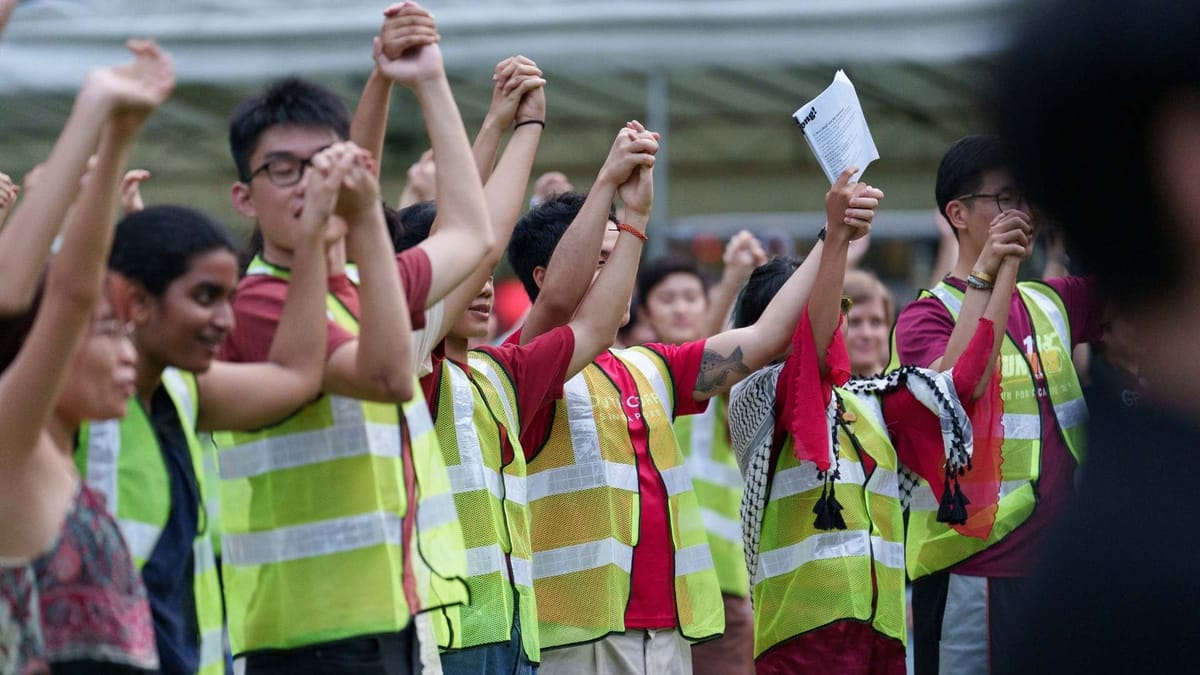
Singapore This Week
Society: Big Brother will help you get laid

This week GovTech launched its long-awaited dating app, FirstDate. It’s currently open only to government officials aged 21-35 who are single, widowed, or divorced. Upon sign-up users are prompted to answer 33 questions, including on: their PSLE result; their favourite minister to work under; how long they’d be willing to volunteer at a primary school in order to get their kid in; and whether they’d go along with a partner who wants to climb the property ladder using confidential information about unannounced train stations—or report them.
Well, one can wish. The actual 33 questions include the following: “Now, spill! What do you actually love about your hobbies?”; “Be honest! What does your room look like right now?”; “Team sunrise, or team ‘it’s 2am and I’m still up’?”; and “Gym rat, occasional jogger, or exercise is a myth to you?” The questions are interesting as much for their content as their insights into (presumably) Gen Z bureaucrat-speak. Respondents will, of course, have to trust in the app’s confidentiality and privacy measures. Are those still up at 2am in line for a promotion? Will those for whom exercise is a myth be summoned by the Health Promotion Board? Is Indranee going to handcuff and whip those who say no to kids? (Hmmm.)
This AI-charged effort to get humans to mate is simply the latest in a four-decade effort to ensure that capitalism’s engine doesn’t run out of inputs. Quality ones, that is: government matchmaking had its troubling origins in Lee Kuan Yew’s eugenics, worried as he was that the hoi-polloi were reproducing faster than the elite. It’s on the latter group, he said in 1967, that Singapore should expend its “limited and slender resources”, for “they will provide that yeast, that ferment, that catalyst in our society which alone will ensure that Singapore shall maintain its pre-eminent place.”
In 1984, alongside the controversial Graduate Mothers Scheme, the Social Development Unit (SDU) was set up, but only for graduates. (And later lampooned as Single, Desperate, and Ugly.) In 1985, following a backlash—part of a broader rebuke to Lee’s eugenics—the Social Development Section was set up for singles with O-level qualifications. Five years later the Social Promotion Section was set up for those—gasp—who had not even completed secondary school. Only in 2009 would Singapore remove these scholarly distinctions from official matchmaking activities.
GovTech’s decision to limit it to civil servants is surely more about a focused control group for beta testing rather than a desire to manufacture Lee-loving toddlers. Yet other challenges arise, as articulated by Teo Kai Xiang, a PhD student formerly at The Straits Times (ST), in “How Singapore’s government-run dating service works, and why it won’t solve the nation’s dating woes”. His central critique is around GovTech’s use of the Gale-Shapley Stable Marriage Algorithm. In a bid to relieve users of “swipe fatigue”, GovTech has chosen an approach that collates all user inputs and matches each person with just one other, in each cycle. You can either accept or reject your match.
Teo outlines three problems with the algorithm, which, despite its name, has real-world applications outside of marriage. First, it’s more applicable in matching challenges where participants are committed and there are no external options: such as army recruits to their units. Second, its basis in ranked preferences runs into problems when there are open-ended and ambiguous questions. “If you’re a gym rat, does that mean you also want to match with other gym rats?” And third, like other apps, “The problem with modern dating is not simply a problem of mismatched preferences!”
Still, desperate times call for desperate measures. Perhaps GovTech can consider reporting high-level findings. Among many other things, it’ll be interesting to see how many inter-religious civil servant matches are produced, and which specific ones (Jew-Muslim? Atheist-Hindu?) today’s social engineering models are happy to bless.
Other stuff we like
Write Back: The Quiet Defiance of Authoring Your Life, 4-5pm, Oct 17th. In this conversation, part of T:>Works’s The AGEncy Fest, gerontologist Normala Manap, cultural anthropologist Dr. Ad Maulod, and social worker Yap Ching Wi consider the ways we reclaim authorship of our lives.
Don’t let AI kill the author. “Writers of all sorts would be doing their readers a disservice if they did not use ai models for research, proofreading and, when appropriate, feedback. Elsewhere, however—in novels, speeches and even news articles—surrendering human authorship would be a mistake.” The Economist on the perils of machine-made prose.

A flavour of Jom. Occasionally, Jom publishes essays outside the paywall. These are on issues we think are in the public interest, and deserve a wider airing. In the past two years, we have published nearly 50 such pieces. Read some of these if you’d like to see samples of our work. We hope they’ll convince you to subscribe. And even if you’re here with no intention of doing so, we hope you’ll enjoy these offerings and consider it time well spent!