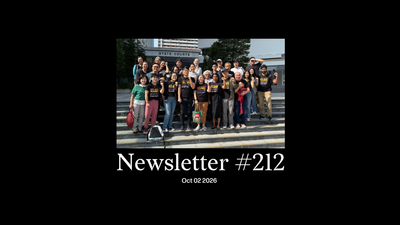




Dear Jomrade,
Today we’ve published:
- “Singapore This Week”, by Jom
- “Everyday Economics #10: Death to Hello Kitty”, by Serene Koh
- “Growth at what cost?”, Episode 3 of “The Neighbourhood Boy” podcast
Psst. We’ve just soft-launched our metered paywall. What does that mean? All of you, who are on Free memberships to Jom, can now read one paid piece a month. Check out “Singapore This Week” or Serene’s latest column! Let me know if you have any issues. Of course, we’re hoping the taster convinces you to convert to a paid membership.
Jom Cakap with Serene Koh, 1-230pm, September 26th, at Druggists. Come hang out with our Everyday Economics columnist. Ask Serene anything about behavioural science, find out how she decides what to write about, and get her insights into everyday behaviours that fascinate you. She’ll be in conversation with Abhishek, our head of content. Tickets are free but limited, and we’ll advertise it publicly tomorrow. Get yours now.
“The Neighbourhood Boy” podcast. Episode 3, “Growth at what cost?”, is out today. Synopsis: Singapore’s remarkable economic success masks deep inequalities in what’s sometimes called a “first-world country with a third-world wage structure”. Related issues that Lawrence Wong will have to contend with are the public housing conundrum, as well as low fertility and high immigration. Listen now on Spotify, Apple Podcasts, YouTube, or wherever you get your podcasts.
On Tuesday I was part of a panel discussion about “Media Responsibility in Interfaith Spaces”, alongside ex-journalist Kevin Lim and Ustazah Lina Sakinah, the honorary treasurer of the Centre for Interfaith Understanding. Natasha Ann Zachariah of The Straits Times was our moderator. It was organised by SUSS’s Current Affairs Interest Group and SUARA, a Malay Muslim faith group, and held at the university.
One point of contention was around the risk that extremists, far right or left, might grow followings and commercial platforms by engaging in ever more inflammatory rhetoric, incentivised partly by algorithms that reward outrage. Put another way, how likely is it that a Nick Fuentes could emerge in Singapore? Yes, there are specific worries—a certain Polish blogger inevitably came up—but generally there’s also hope in Singaporeans’ self-policing tendencies, for instance calling out bigotry online.
That latter notion was buttressed this week, I feel, during the fallout from the viral video of an old man patting a young girl’s head, only to be assaulted by her 40-year-old father (who’s now assisting in police investigations). Because her mum appears to be a former politician, a small online mob, from late Monday, started rousing sentiment against the parents.
Many lamented the state of affairs. But I wasn’t too bothered. Such anonymous online vitriol is simply part of our modern digital world. More encouraging, for me, is that no other public figure, notable content creator, or media channel has waded in. In many other societies, this incident would have been prime fodder for tabloids and/or partisan political point scoring. Instead, many people seem to be having an important conversation about personal boundaries and how to react when they’ve been breached.
Sure, as everybody on Tuesday’s panel acknowledged, there’s much room for improvement in SG’s media sector, mainstream and independent. But we can still be thankful for some commonsensical, ethical behaviours and practices out there.
- Why is Cold Storage celebrating its 123rd anniversary with such gusto?
- The perils of livestreaming
- How concerned should we be by pocket-sized rentals and ever-shrinking living spaces?
- The role of Singapore’s Arab community in Indonesia’s independence
- “A Matter Of Taste”, and the renaissance of dinner theatre
Above are the issues we chose to explore in more depth.
Other news this week included: SG and China sign nuclear tech MOU; SG and India sign telecommunications and food safety MOUs; Anwar irritates Taiwan by calling it part of China; over 2,000 people rally over Maju Forest & Gillman Barracks plans; HDB residents want yellow tactile tiles, a fall risk, replaced; the Competition and Consumer Commission warns bikesharing firms against attempted price collusion; LawSoc to release audit report on workplace and governance issues; new code compels social media platforms to verify advertisers’ identities; Zaqy Mohamad, new Muslim affairs minister, “deeply disturbed” by paedophilia at mosque; WA, Tele, and other messaging services face new anti-scam rules; CNA investigation into fake consulting firm trying to hire former diplomats; ST examines why so many preschools close each year; parents struggle to meet kids’ digital and mental health needs; luxury eldercare from S$8K a month; NEA defends new reverse vending machine recycling scheme; loosened nightlife rules for Boat Quay and Clarke Quay; LKY’s pen auctioned for close to S$500k; ST commentary on viral head-patting incident; woman sues NParks over alleged 2023 wild boar attack; 42 critically endangered hawksbill turtles released; SG’s sole dedicated BMX facility opens in Tengah; women’s netball team Asian champions again; and Singapore Lions beat Thailand in ASEAN semis but lose on aggregate.
Join 1,700 members keeping Jom independent. From S$10/month—full access, no compromises.
“Everyday Economics #10: Death to Hello Kitty”, by Serene Koh
Once again, Serene has used her everyday experience to shed light on some deeper behavioural and economic concepts. If you need a further taste of her work before committing to our upcoming event with her, this week she somehow ties together Hello Kitty, “Dear You”, and Maju Forest. Here’s her opening:
“In January 2000, I was a trainee teacher at the National Institute of Education (NIE). On Wednesdays at 9am we had Pedagogy of English Literature classes. Once, a classmate—let’s call him Richard—entered the classroom red-faced and agitated, more than 45 minutes late. ‘Death to Hello Kitty!’ he boomed, charging in. Turns out, the line for the McDonald’s Hello Kitty giveaway was so long that it blocked the bus exit at the Jurong East interchange, obstructing buses from leaving the bays.
Our lecturer, to her credit, didn’t blink an eye. She smiled empathetically, waved Richard to a seat, and carried on with how to make Julius Caesar interesting to fourteen-year-olds (TL;DR: it’s hard).
The rest of us couldn’t wait to hear the details at break—the meandering lines he’d watched from the upper deck of his bus, the shoving and pushing he saw, and how excruciating it was sitting in an idling non-air conditioned bus for 45 minutes while people lined up for a pair of stuffed cats. Nobody in that queue, presumably, spared a thought for the buses stuck outside it, or the trainee teacher on the upper deck trying to get to a 9am class.
The people who wanted the Hello Kitty dolls—the ones who queued, waited, and paid S$4.50 on top of their Happy Meals—got exactly what they signed up for. But Richard, who didn’t want a stuffed toy, also had to pay a price: 45 minutes of being stuck, and a missed lesson on whether casting Mel Gibson as Julius Caesar would make kids appreciate it more.
Economists would say that Richard’s plight was an externality: he experienced a cost created by a transaction between two parties he was not a part of.”
Jom fikir,
Sudhir Vadaketh
Editor-in-chief, Jom
Jom on Everyday Economics
 Serene Koh
 Serene Koh
 Serene Koh
 Serene Koh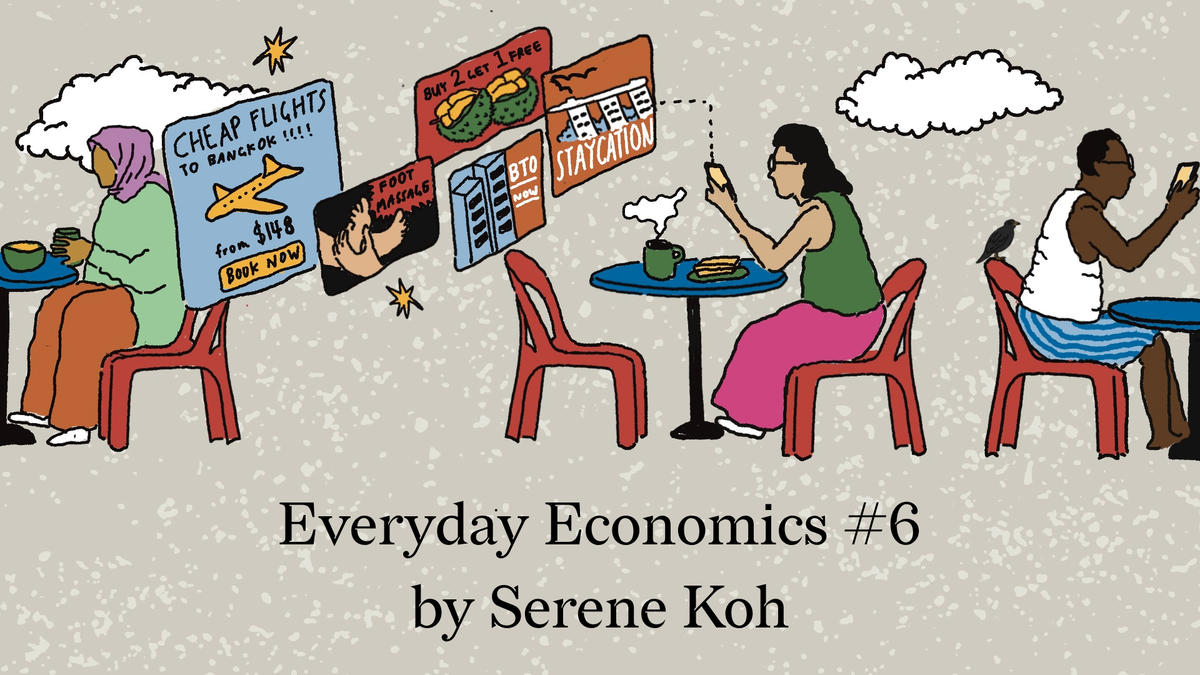
Singapore This Week
Society: Livestream lelong

Burning charcoal fumes, fragrant deep-fried foods, and bare lightbulbs hanging from the ceilings. Hair strands plastered to sticky foreheads while elbows haggled for space. Hot, humid, and hazy. Eurodance music blasted from speakers as uncles yelled “lelong lelong”, “buy two get one free!”. Before online shopping became the norm, the pasar malam (night markets) were the go-to places for good deals as long as you had either the charm to win over the vendors or skin thick enough to bargain with them.
Retail livestreaming transported the pasar malam experience to the palms of our hands. A tap on the “Live” symbol on TikTok and you can scroll through endless streams of content creators. From blouses and portable fans to “ramen corndogs” and high-end crystals—these livestreams thrive on lively, unscripted banter between curious viewers and their hosts. The pinnacle of shoppertainment. Some of these hosts are your average Singaporeans working as brand representatives with relatable qualities. Average body size, a similar office hours lifestyle, and a down-to-earth personality and meticulousness in addressing viewers’ queries—the perfect ingredients for a parasocial relationship with customers.
In 2025 DBS projected that the social commerce market that year would reach USD3.17bn (S$4.03bn), with live commerce making up to USD1.3bn (S$1.65bn), thanks to its astonishing conversion rates. The actual 2025 numbers aren’t available yet but suffice to say that live commerce is now a behemoth. However, netizens have raised concerns about the predatory sales tactics deployed by some popular creators. Acting as opinion leaders, these creators use countdowns, bells, the threat of limited stocks and the theatrics of “arguing” with the “boss” for “best prices”, all to pressure viewers into buying. These tactics are similar to the “dark patterns” designed to mislead and manipulate consumers through artificial time and stock limits.
A pair of influencers recently came under fire for abusing customers who apparently wanted to return highly sought-after items after the livestream ended. Another burst into fits of rage when viewers questioned the authenticity of the items he was selling. While recognising streamers’ labour, it’s important for consumers to be aware of their right to seek clarifications and return products, especially when the return policy allows them to.
Since live commerce is a nascent industry, consumer protections and regulations are still lagging. One user raised the need for a specific law for livestreaming sellers beyond the current Protection from Harassment Act and Consumer Protection Act catered for traditional harassment and offline retail. Beyond hosts, she suggested that platforms be held accountable, to enforce timely takedowns, investigations, and sanctions for repeat offenders.
Beyond pondering laws to protect consumers, it’s worth considering what we have lost in exchange for the convenience of online shopping. Unlike pasar malam, livestreams minimise viewers into easily replaceable numbers, and relationships become optional—stripping away yet another layer of human connection in an increasingly lonesome, ironically disconnected world.
Other stuff we like
“You don't have to use AI” in The New Atlantis. A reminder that individual agency exists, and can be exercised, despite AI-evangelists pushing us towards a future where all work, thought, and eventually, life itself, will be outsourced to machines.
CITRUS fest 2026. This free biennial festival offers workshops, conversations and communal meals committed to better care practices in the arts. You can sing your heart out at a karaoke session with fellow artists, practice nonviolent communication, or learn how to craft more inclusive contracts.
EcoCupid Film Festival, 1-6pm, August 29th. Four films, including “Itam: A Sun Bear Story” and “The Mekong Trap”. Latter will be followed by a panel discussion on Singapore’s energy transition journalism, featuring Jom’s editor-in-chief.
A flavour of Jom. Occasionally, Jom publishes essays outside the paywall. These are on issues we think are in the public interest, and deserve a wider airing. In the past two years, we have published nearly 50 such pieces. Read some of these if you’d like to see samples of our work. We hope they’ll convince you to subscribe. And even if you’re here with no intention of doing so, we hope you’ll enjoy these offerings and consider it time well spent!