



Dear Jomrade,
Today we’ve published:
- “Singapore This Week”, by Jom
- “Everyday Economics #11: Wrong shade of white”, by Serene Koh
Some news this week reminded me of how divided we are. When delegates fled the UN assembly before Netanyahu spoke, he called them “moral cowards”; many would say the same of those who stayed.
Other stories spoke to all that we share. The Trump-Xi nugget I enjoyed was the state dinner menu: a yellow squash appetiser drizzled with scallion oil; and a main course of sesame-crusted sea bass and crisp baby bok choy. Dishes chosen, the White House said, to emphasise American ingredients with a “subtle Chinese influence”, and that bring “the culinary traditions of both nations together.” A little cheeky, perhaps, though undeniably true.
A separate intercultural jam is depicted by Faris Joraimi, our history editor, in “Singapore This Week”. He writes about zapin, the Malay performance practice with historical influence from Arabia. It’s just been jointly nominated by Brunei, Malaysia, Singapore, and Indonesia for inclusion in UNESCO’s intangible cultural heritage list. Faris’s rich description and sharing of YouTube links exposed me this morning to a music that I was blissfully unaware of, one with shades, to me, of North Indian and Pakistani vocals and beats.
Two clips this week gave us an insight into the Singapore that Lee Kuan Yew created. One from Bloomberg’s interview of Kishore Mahbubani and George Yeo, elder statesmen, has been making its rounds: “unhappiness [in Singapore] being a precondition for achievement”. Lee had earlier cautioned his underlings against trying to deliver happiness.
Meanwhile, in an interview with former NMP Viswa Sadasivan, Piyush Gupta, ex-DBS boss, recounted a 2010/11 meeting with Lee. What might you have done differently? Bring the F1 to Singapore earlier, Lee answered. Lee admitted that, when developing Singapore, he had been focussing only on the “hardware”. He told Gupta: “But I realised later that to build a country, I need to create a complete country, and I need to focus equally on the software of the country.”
It’s telling for so many reasons, not least his notion of cultivating culture through F1. Why not zapin?
- With our youth glugging energy drinks, should SG better regulate caffeine?
- The reasons for optimism over mRNA’s AI-charged potential
- MMA gets a shot in the arm with Tiffany Teo’s Asian Games gold
- Zapin, the performance practice whose “play” harks back to early meetings of the Arab and Malay worlds
- “Descendants of the Eunuch Admiral” and “The Radicalisation of Mrs. Mary Lim-Rodrigues”, two new shows with similar theatrical approaches
Above are the issues we chose to explore in more depth.
Other news this week included: Trump warns the UN he’ll “annihilate” Iran; The Straits Times (ST) on Trump and Xi; Malaysiakini on the legality of Najib’s controversial house arrest; Red Dot United marks sixth anniversary with 50-candidate ambition; SG backs calls for greater frontier AI regulation; SCMP on why AI giants are using SG as a test-bed; Nvidia’s latest AI chips in SG’s public safety robots; Waymo’s driverless cars here from 2028; SIA crowned world’s best airline; ST on “money trauma” in SG; former Sembcorp Marine CEO acquitted in Brazil “carwash” corruption case; vessels collide in SG waters; Chan Chun Sing on RSIS’s 30th anniversary; Tommy Koh on SG’s foreign policy “realism”; police investigating workplace complaints at LawSoc; HDB converts some Tengah housing land to park after consultations; solar investments saved SG S$123.8m in higher fossil fuel import costs, says Finland-based centre; Shell Singapore fined for Pulau Bukom oil leaks; Tuas sorting facility boosts SG’s recycling effort; new MSF unit to faster identify child abuse (and an ST commentary on using big data for this); two arrested after Italian probe into Telegram child abuse network; more young Singaporeans seeking longevity treatments; two-year-old one of 400 globally with rare genetic disease; mid-market gyms feel the heat in SG’s golden age of fitness; CNA commentary on technology turning us into “hasty readers”; Joo Chiat’s car-free street party on Oct 3rd; ST’s “haze season” skincare guide; and horrific animal abandonment stories: 71 cats in a flat, and 23 rabbits in the wild.
Join 1,700 members keeping Jom independent. From S$10/month—full access, no compromises.
“Everyday Economics #11: Wrong shade of white”, by Serene Koh
Home reno? You’ve either experienced it, or hope to one day. In the blur of modern life, there are few more calming, restorative acts than retreating to a space that you’ve had the privilege to slowly shape. It’s your home.
Some of Serene’s columns are, for me, mostly intellectual stimulation. As much as I appreciate that, today’s also offered emotional comfort, helping me untangle and understand some of those novel feelings when I had to deal first-hand with contractors—finicky, unpredictable, overworked, and stressed contractors—in that most precious of activities: the shaping of the space where I live. Here’s some of her writing:
“When we did our home reno a few years back, I barely looked at quotes. I know, I should have. But my sister had just moved into her flat the year before and really liked her contractor. Her in-laws hired the same person as well, and so I figured I’d do the same. Just go with them– easier right? Don’t have to run around comparing. I’ve since gone on to recommend this same contractor to a bunch of my friends too. No one in this chain did any proper “research”— the last person’s confidence was all the data we needed.
This information cascade happens when a couple of people in a row make the same call and it becomes the sensible thing for everyone after them to just follow suit…
Here’s the thing about cascades, though: you think the contractor’s getting more verified with each new testimony but really, five confident people doesn’t mean five times the certainty…
Word of mouth or reviews, though—neither gets you through the renovation itself. Now that’s when you find out what you’re really made of. My neighbour was renovating her place and her guy came recommended too: good Google reviews, a decent portfolio online—“His cottagecore looks different from other people’s cottagecore,” she told me confidently a few months ago—and her husband liked that they support the same soccer team. All the right signals.
Then three weeks in, he said that the walls needed extra insulation. (Nobody needs to insulate the insulation that’s already there.) She said no.”
Jom baca,
Sudhir Vadaketh
Editor-in-chief, Jom
Jom on Everyday Economics
 Serene Koh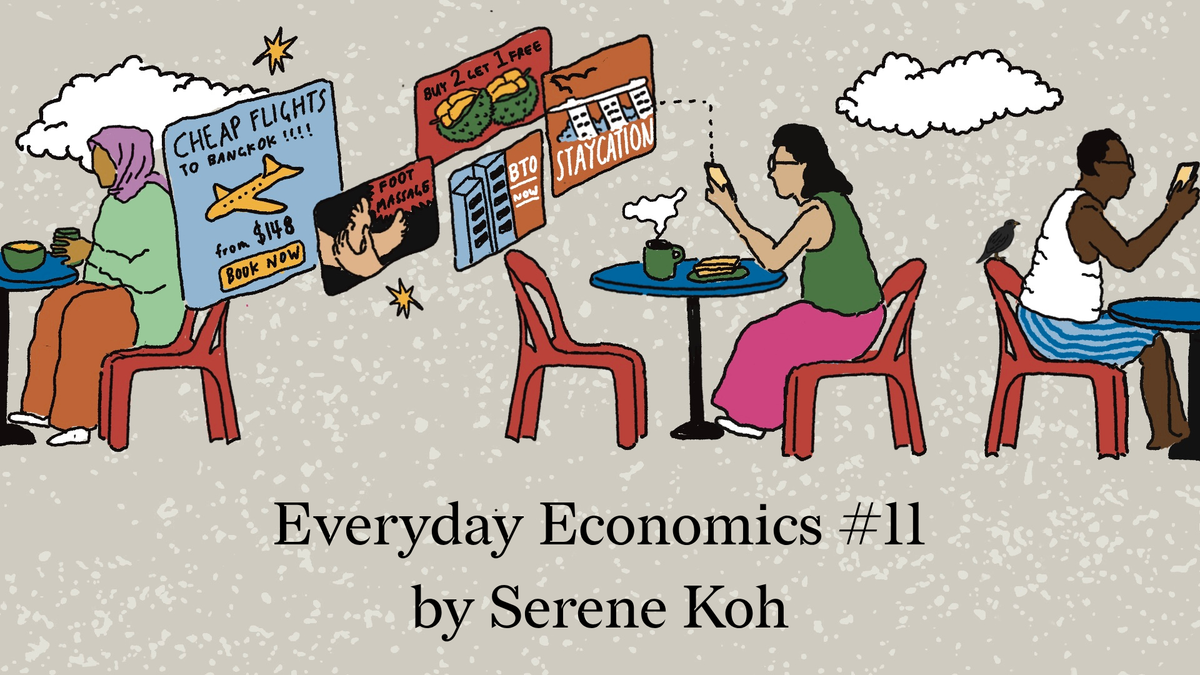
 Serene Koh
 Serene Koh
 Serene Koh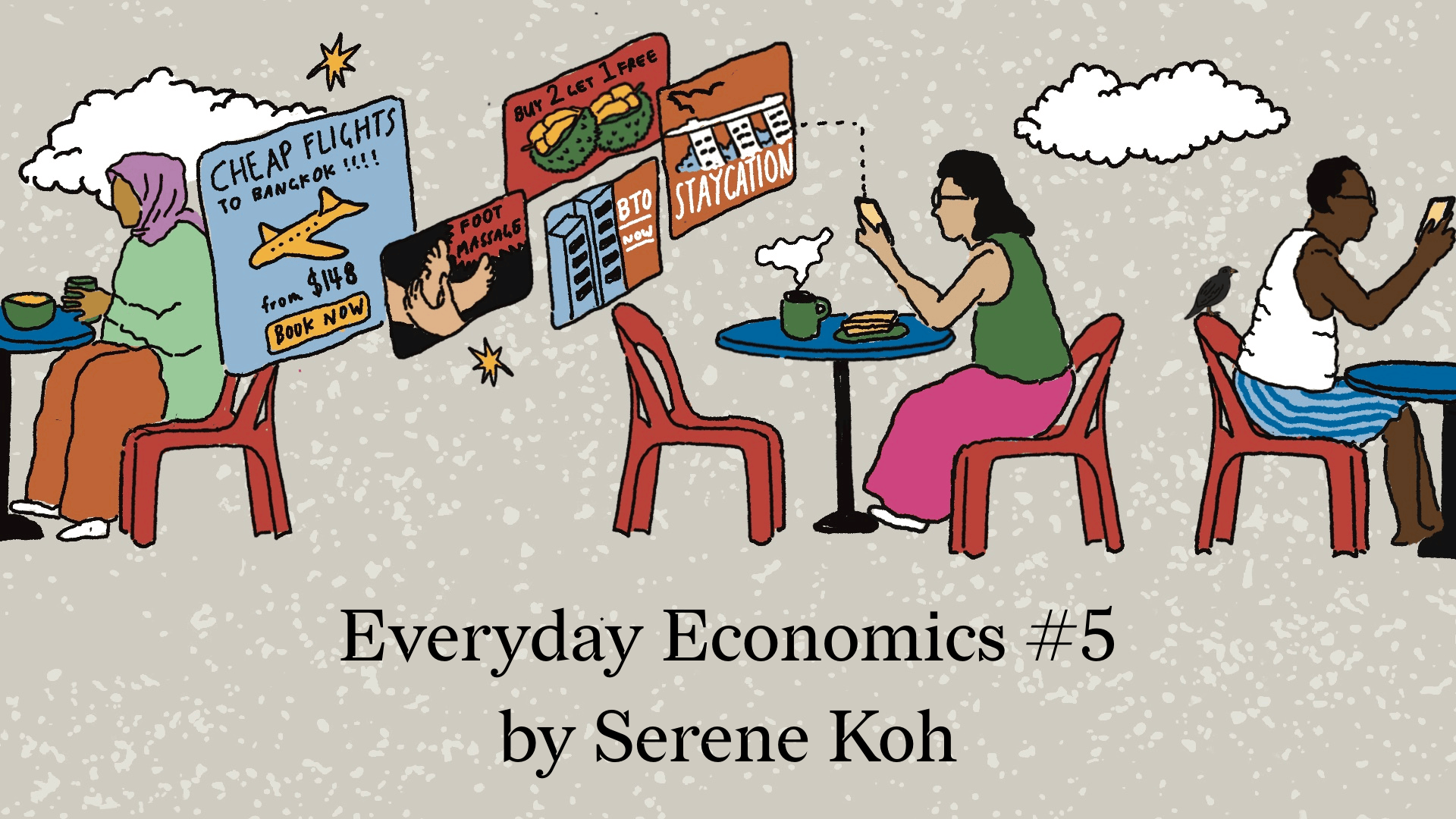
Singapore This Week
Society: The messenger

Among the billions of celestial objects floating around in the cosmos of the human body are molecules called messenger ribonucleic acid (mRNA). Within each cell, the single-stranded mRNA carries instructions from the double-stranded DNA to the part of the cell that makes proteins—like a temporary biological manual. Already in the 1970s, scientists were experimenting with ways to deliver new mRNA into human cells to better understand the body at a molecular level. Within a decade, they’d understood how to synthesise mRNA in labs too.
Some other smart people then realised that this synthetic mRNA could be used to prod the body into producing essential proteins that it lacked or proteins that could train the immune system to recognise and destroy pathogens. But among the myriad obstacles separating theory from practice was the fact that synthesised mRNA is notoriously unstable, unable to keep itself together long enough to enter cells and impart instructions. A tantalising treatment modality remained frustratingly out of reach.
Later tech advances helped a new generation figure out how to place mRNA within lipid nanoparticles (LNPs)—tiny packages made from fat-like molecules that protect fragile cargo much like helmets do skulls—so it wouldn’t degrade as quickly. By 2015, companies like Moderna had raised around US$1bn (S$1.26bn) from investors hoping for big paydays from mRNA-based approaches that could turn the body itself into a miniature drug factory and pharmacy. That grand vision proved exceptionally hard to realise.
Moderna and others increasingly focused on vaccines—seen by some as disappointingly unambitious until we were all slammed by the pandemic of a lifetime. The decades of research allowed mRNA firms to design a vaccine in days, with clinical testing beginning as many countries went into lockdown. The recipe was deceptively simple: inject mRNAs, housed within LNPs, with instructions for cells to create a version of the coronavirus’s “spike protein”, which the immune system would learn to recognise as foreign, to be dealt with sternly. There were side-effects, including rare tragic ones, but there is little doubt that the mRNA vaccine’s success during the pandemic is one of pharmacology’s crowning 21st century achievements.
It also unleashed fresh enthusiasm and funding for mRNA tech, and just last month Moderna announced stunning topline results from a Phase III trial involving 1,100-odd melanoma patients. Those who received a personalised mRNA vaccine in combination with an established treatment had a significantly lower risk of the cancer returning or spreading compared with those on the treatment alone.
Amidst all the jubilation and optimism, Singapore has announced plans to develop and manufacture mRNA vaccines which could be modified and scaled in the event of another, unknown pandemic, termed Disease X. “It [mRNA] offers the most flexible platform and fastest to market, fastest to develop, fastest to produce. And with AI technology, I think you can reiterate the solutions much faster,” said Ong Ye Kung, health minister.
Given the current gloomy AI zeitgeist, perhaps it’s a good time to be reminded of its immense potential. With mRNA specifically, AI could speed up vaccine design, allowing researchers to power through iterations, and helping them figure out how to keep mRNA stable for longer. Knowledge would compound, and millions could benefit (even though equitable access would still have to be figured out). As our ancestors with fire, we are dealing with something that could elevate life or end it. The agency, for now, still rests with us.
Other stuff we like
“In Fighting for Every Black Child, Did I Betray My Own?” A decade ago, journalist Nikole Hannah-Jones and her husband believed they were practicing what they preached when they enrolled their daughter in a segregated, high-poverty school. Now a 16-year-old, she thinks they made the wrong choice. In this astonishing, meticulous and matter-of-fact article tracing Najya’s education journey—and written with her input—we get a portrait of the devastating inequities and institutional decay that fail a country’s children.
When tennis meets dance. Singaporean dancer Sherry Tay recreated one of tennis superstar Carlos Alcaraz’s points at the 2026 ABN AMRO Open, channelling the sportsman’s speed, movement, and athletic grace through her mediums of ballet and contemporary dance. “Magnificent,” Alcaraz said after he watched it, laughing with disbelief, “she did it perfectly.”
A flavour of Jom. Occasionally, Jom publishes essays outside the paywall. These are on issues we think are in the public interest, and deserve a wider airing. In the past two years, we have published nearly 50 such pieces. Read some of these if you’d like to see samples of our work. We hope they’ll convince you to subscribe. And even if you’re here with no intention of doing so, we hope you’ll enjoy these offerings and consider it time well spent!