

Dear Jomrade,
Today we’ve published:
- “Singapore This Week”, by Jom
- “State of the media: Jom’s view”, by Abhishek and me
- “Akan datang”, Episode 4, the final one, of “The Neighbourhood Boy” podcast
Psst. We’ve just soft-launched our metered paywall. What does that mean? All of you, who are on Free memberships to Jom, can now read one paid piece a month. Check out “Singapore This Week” or Abhishek and my analysis of the media sector! Let me know if you have any issues. Of course, we’re hoping the taster convinces you to convert to a paid membership.
“The Neighbourhood Boy” podcast. Episode 4, “Akan datang”, is out today. Synopsis: What does the General Election 2025 tell us about Lawrence the politician, and Lawrence, the leader? And what do the results mean for the future of the PAP, and Singapore? Listen now on Spotify, Apple Podcasts, YouTube, or wherever you get your podcasts.
Annnnnd, that’s a wrap! Jom’s first-ever podcast is now fully out there. Friends inside and outside the establishment have been sending me (mostly positive) feedback these past few weeks. When you’re done, I’d love to hear from you too, just reply to this e-mail with your thoughts. It’ll help us improve our podcast offering.
It’s a timely week to complete the podcast, because much of Singapore was focused on the numerous announcements in Lawrence Wong’s National Day Rally speech. For those of us whose souls move to the rhythm of the ocean, whose sense of belonging is also an archipelagic one, there was the depressing news of even more ghastly terraforming of territory. We discuss the proposed Western Island in our lead blurb in “Singapore This Week”, penned by Yue Qian, our intern, in her last week with us. Meanwhile Corrie Tan, our arts editor, looks at the shift in dialect policy.
Separately, this was a week when I was reminded that the heroes of my youth are slowly leaving this life. The only reason I first saw Dolly Parton was because “Islands in the stream”, which she performed with Kenny Rogers, kept popping up on my adolescent MTV time as I was trying to follow Michael Jackson’s “Thriller”. (David Bowie and Sheena Easton were among the others I first heard then.)
Though I never listened much to her music, her life story fascinated me. In a world where people try to one-up each other about their humble beginnings, hers was the real deal: the doctor who delivered her was paid with a sack of cornmeal; she and her 11 siblings wore the elastic from old underwear as hairbands; and even then, by 10, she’d gotten a gig at the local radio station.
More importantly, in an increasingly polarised world, she somehow maintained her appeal across ideological and age lines, the Southern country music darling who at 60 performed a hit for a movie about a trans woman. “She was commonly called the Queen of Country Music, but that is exactly wrong,” wrote Kathryn Schulz in The New Yorker this week. “[S]he was democratic to her bones, of the people and by the people and for the people, the duly elected President of the United States of Americans.”
Just recently watching old videos of her speaking and reading some of her best lines, I feel, for anybody having to contend with competing tensions or groups, there is something to learn from her tact, humour, grace, and manner of deflecting. (Yayoi Kusama, also just departed, had a later and lesser impact on me.)
- How do we reconcile the new Western Island with our claims to cherish nature and celebrate our Orang Laut community?
- Getting more Singaporeans interested in plumbing and other blue-collar work
- AWARE’s new survey about men’s attitudes towards gender, family, and society makes for troubling reading
- Grand Theft Auto, and the video gaming industry’s exploitative practices
- Why has Singapore now done an about turn on Chinese “dialects”?
Above are the issues we chose to explore in more depth.
Other news this week included: Nepal floods, nine Singaporeans remain uncontactable; Air India seeks S$1.5bn from SIA as losses mount (and WP MP Kenneth Tiong responds); scam losses continue to drop; MOM taps volunteer networks, app to make it easier for migrant workers to highlight workplace issues; more parental support (including for children of unwed parents), but workplace attitudes must change too; Shopee and TikTok sellers call out auto-generated AI ads that mislead customers; Malay/Muslim youth value meaningful work, relationships, faith over job titles; reactions to Lawrence Wong’s call for Singaporeans to learn Malay; SG fashion label turns old saris into shirts; accidents involving cyclists at four-year high; four-day coffee festival in Tanjong Pagar next week; more youths investigated for shop theft; parents launch non-profit to combat childhood brain cancer; NUS researchers find drug that turns off “master switch” in aggressive breast cancer; Quah swimming siblings will not feature at Asian Games, for the first time since 2006, because they’re focussing on studies; and if you spot a horseshoe crab in our waters, researchers want to know.
Join 1,700 members keeping Jom independent. From S$10/month—full access, no compromises.
“State of the media: Jom’s view”, by Abhishek and me
It’s been three years since our last analysis of the media sector, globally and in Singapore. Abhishek was then an occasional contributor. He’s now our head of content, and is slated to take over as editor-in-chief next year (while I do other stuff in the org). And with the advent of AI and a new prime minister in town, we felt it was time for an update. Here are a few paras:
“The intersection of faith, political stability, and security is another area where Singaporean dialogue is fundamentally hobbled by the mainstream media’s meekness. Think of the leadup to nurses (finally) being allowed in 2021 to wear the tudung at work—all important public discourse was mediated by activist groups and individuals on social media. Or the numerous important post-October 7th conversations: from global ones, such as the contested definition of antisemitism, to hyper-local ones, such as Israeli arms manufacturers hawking their genocidal wares at the Singapore Airshow. What exactly did the mainstream media contribute? If anything, a mere reporting of PAP leaders’ comments.
The range of analysis and opinion in Singapore, then, is limited to what the PAP deems acceptable. In terms of editorial independence, CNA and ST have much less in common with the world’s top English-language publications, such as The Economist and The New York Times, than they do with Vladimir Putin’s Russia Today and other state mouthpieces in autocracies and illiberal democracies.
The best thing the PAP could do would be to free them of its yoke. Their talented journalists could fulfil their potential, the publications could thrive, and Singaporean society would benefit from a much broader spectrum of thought. Will a traditionally paranoid party now feel more confident in doing so? Whether Lawrence Wong, prime minister, is truly more consultative and open to diverse views than his predecessors will be partly revealed by his government’s attitude towards the media.”
Jom baca,
Sudhir Vadaketh
Editor-in-chief, Jom
Jom on media
 Corrie Tan
 Sudhir Vadaketh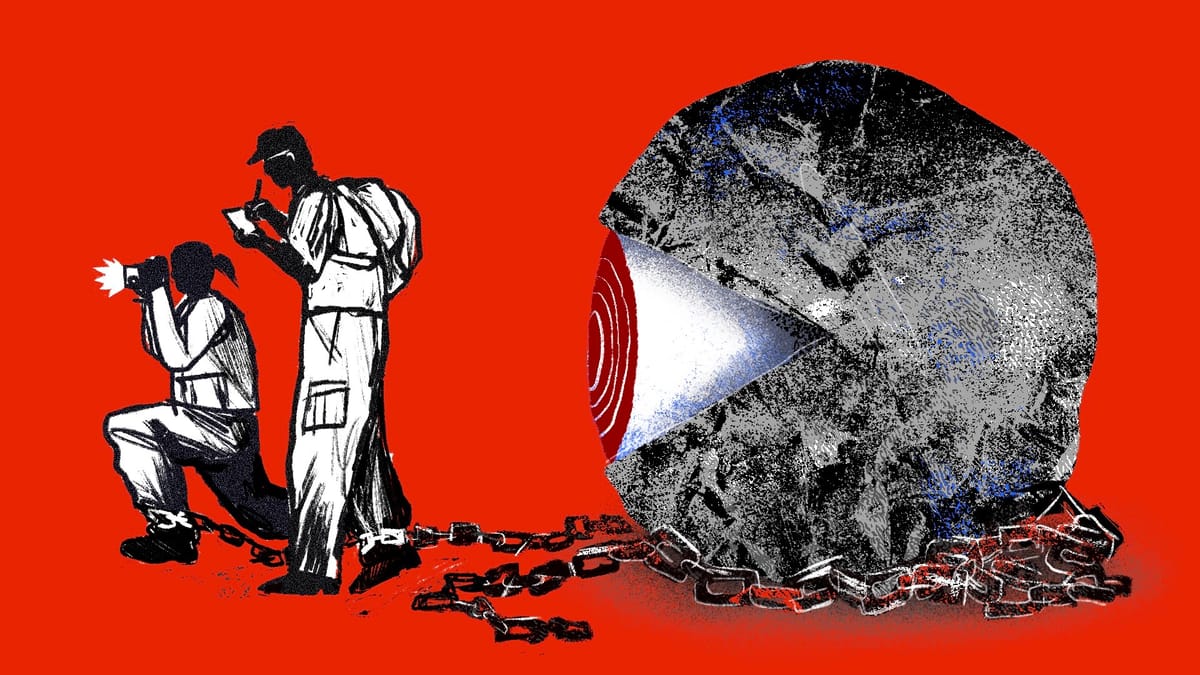
 Jo Teo
 Sudhir Vadaketh
Singapore This Week
Society: Pipe dreams

“Life consists in what a man is thinking of all day,” said the 19th-century American intellectual Ralph Waldo Emerson. Presumably, Emerson could hand out wise aphorisms because he didn’t have to worry about life’s basic needs like shelter, food, and water. And plumbing. Imagine trying to come up with something profound that literary magazines would quote over a century later when there’s a clogged toilet or leaking sink in the house.
Despite its centrality to the most noble of human endeavours, plumbing and other trades that prize both agility of mind and dexterity of hand are considered inferior to desk-bound office jobs. Singaporeans seem more susceptible to this snobbery than most. Compared to 13 percent globally, some 18-57 percent of local respondents feel that skilled trades have a “stigma” attached to them. The variance is likely down to survey design; suffice to say large numbers of Singaporeans look askance at the trades or think others do—which is revealing in itself.
The reasons for this distaste are many. As education spread more broadly and deeply, academic qualifications greasing entry into the global economy first became prized and then fetishised. The trades, meanwhile, have traditionally placed more weight on practical training and experience than on paper credentials. Besides, “[S]killed trades are sometimes still viewed as dirty, physically demanding or lower-status work,” Richard Tock, a plumber and gas service worker, told The Straits Times (ST). The abundance of regional labour that can do this “dirty” work has allowed us to shun it. Of the 186,000 tradespeople here in 2023, more than two-thirds were foreigners. This may explain the sluggish growth in trades wages. Since the turn of the century, median income for resident non-PMETs (Professionals, Managers, Executives, and Technicians), to which these trades belong, has increased only by 80 percent, compared to a 142 percent increase in overall resident median income.
One consequence of an overreliance on foreign tradespeople is the way it widens the gap between our daily lives and the systems and people who keep it running. Another invites the question: if a society regards certain jobs as dirty, what does it think of the people doing them? There are practical implications too, as Covid-19 painfully showed. Even so, “it would not be realistic to aim to grow the Singapore core in every single occupation,” Tan See Leng, then Manpower Minister, told Parliament in 2022, responding to a question from the Workers’ Party’s Pritam Singh on nurturing more local electricians and plumbers.
The recent push to flip the narrative surrounding the trades comes as fears rise about AI’s impact on white-collar jobs and the need to shepherd the resident labour force into areas beyond its immediate reach. Ironically, electricians, plumbers, and others are needed to sustain AI itself—someone has to lay the power cables feeding data centres and install the pipes carrying the water that cools them. The government is drawing up plans for more structured pathways because youngsters in a society used to looking down on, or at least away from, the skilled trades, will take them up only if they “offer visible career progression, competitive remuneration, recognised credentials and opportunities to work with technology,” said Eric Cheung, senior director at the Institute of Technical Education.
Even so, there’s no guarantee the push will succeed. Germany, long looked upon as a tradesperson’s paradise, is suffering from an acute shortage as older tradespeople retire with fewer youngsters to replace them, a problem exacerbated by changing attitudes towards vocational work. The US, another country where the trades pay well, is staring at a projected shortfall in the millions and economic losses orders of magnitude higher. Given this, the task facing Singapore may well feel Sisyphean—sweaty, dirty, and thankless. Sound familiar?
Other stuff we like
“Dolly Parton for the People”. The New Yorker’s Kathryn Schulz remembers an icon whose appeal cut across all lines, “the duly elected President of the United States of Americans”.
“How Asia Is Becoming Quantum Computing’s Next Battleground”. Barron’s examines expanding footprints in Japan, Singapore, and South Korea, in the face of China’s growing quantum arsenal.
“Singapore Needs a Broader Conversation About How to Measure Economic Progress”. In The Diplomat.
A flavour of Jom. Occasionally, Jom publishes essays outside the paywall. These are on issues we think are in the public interest, and deserve a wider airing. In the past two years, we have published nearly 50 such pieces. Read some of these if you’d like to see samples of our work. We hope they’ll convince you to subscribe. And even if you’re here with no intention of doing so, we hope you’ll enjoy these offerings and consider it time well spent!