
In 2023 we assessed Singapore’s local media sector through an analysis of the latest Press Freedom Index by Reporters sans frontières (RSF, Reporters Without Borders). Three years on, with AI ever more entrenched in our lives and a new prime minister in town, an update is in order. As a jumping off point this time, we’ve chosen the Reuters Institute Digital News Report which tracks news consumption habits. First, an overview.
The 2026 report has unearthed some alarming global trends, including the fact that some 25 percent of the 97,000-odd people surveyed in 48 countries have little to no interest in the news. Perhaps they’ve been turned off by the vicious online polarisation, misinformation, and the dopamine drips of infinite feeds—a digital dystopia that threatens to become a part of the human condition.
Whatever the reason, the implications are grim. Disconnection from societal issues makes meaningful political participation more difficult, to the detriment of democratic health. And as news consumers dwindle, the ones still plugged in become more valuable commercially, tempting outlets to pander to them with partisan information that validates rather than interrogates their biases.
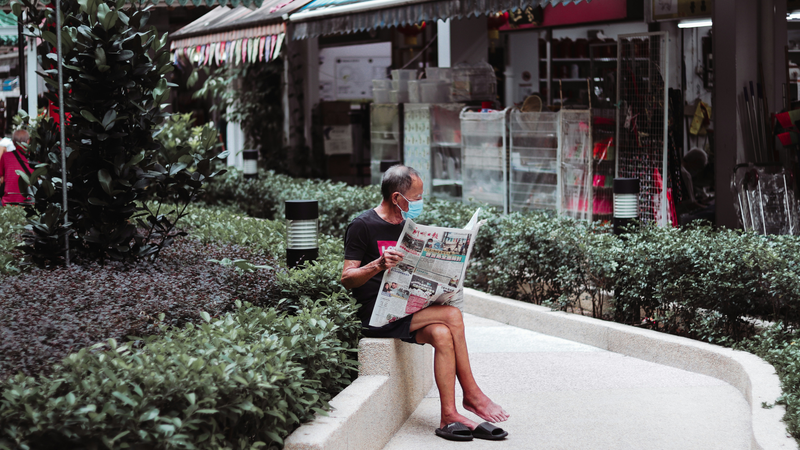
Among those still interested in domestic and global affairs, the vast majority get their information online rather than traditional television news. Much of this shift has been driven by creators, regarded by respondents as “more entertaining, easier to understand, and more relatable than traditional news outlets”.
Finally, of those getting their news online, more (54 percent) are accessing online news through social media and video networks than news organisations’ own websites and apps (51 percent). What Reuters calls the “platformisation” of news consumption is not a juvenile indulgence, occurring across all age groups. Remarkably, audiences “have a keen sense of these environments being less trustworthy, while continuing to rely on them because they remain the most convenient places to encounter other types of information,” says the report. This may explain why perception of news’ trustworthiness has dipped in most countries.
Singapore is an outlier. More residents still get their information from news websites and apps rather than intermediaries like Facebook, X, and Instagram. Are our informational diets healthier than others’? Perhaps. But social media is also one of the few places where alternate voices proliferate here. The same platforms that spread misinformation also broaden the range of available viewpoints. Avoiding them entirely may leave us nutritionally deficient.
As worryingly, even though Singapore residents get more of their news from conventional sources, the proportion who pay for it tracks global trends at around 17 percent. That figure has barely budged in a decade. The inability to convince large numbers of people to pay is perhaps modern media’s biggest failing. There are mitigating factors: the dominance of search engines and social media platforms that mediate discovery in a teeming online space; the rise of the subscription and attention economies; and the dispiriting perception of news as expendable entertainment. Still, one reason for today’s predicament lies in the race to dole out free content, based on the Silicon Valley shibboleth of getting users in first and figuring out sustainability later. That hasn’t worked out. In Singapore, many media outlets free of overt government and corporate control remain reliant on them for sponsorships and advertisements.
Singapore’s high-cost, highly-strangulated market protects us to a degree from modern media’s worst excesses. But as more people switch off—the number who rarely consume news here has risen to 26 percent from 20 percent about a decade ago—a small market is becoming tiny, making it tougher for independent news outlets to survive. That leaves taxpayer-funded state mouthpieces to spread the gospel unencumbered by contrarian voices, which one could argue is almost as harmful to democratic health as not reading the news at all.
Consider the open letters concerning the controversial Allianz-Income affair, by Tan Suee Chieh, a former Income CEO, on the eve of last year’s general election (GE). These would have made front-page news in most democracies. Here, they were ignored for the most part, tucked within framings that fronted the ruling People’s Action Party (PAP). (Probably because they cast a poor light on the PAP’s Jalan Kayu candidate, who ultimately won narrowly.) But that’s not to imply that the likes of CNA and The Straits Times (ST) have been uncritically peddling narratives from the ruling party to the exclusion of all else. Tan’s letters notwithstanding, coverage of opposition parties and voices at the GE was decent.
Meanwhile, young journalists at ST have been making their mark on newer formats. Natasha Ann Zachariah’s podcast, “The Usual Place”, has hosted some lively discussions, while Gerry and Mandy have garnered plaudits—and even some gasps—for the way they package important, provocative thoughts in cutesy, offbeat social media videos, like the one on POFMA, Singapore’s controversial “fake news” law. (Fans are mourning their current break.)
CNA and ST have also been dabbling in more investigative journalism, for instance, respectively, how AI-generated ethnically Chinese women are spreading disinformation about Singapore on TikTok, and the inner workings of The Prince Group, run by scam boss Chen Zhi.
Important as those are, investigative journalism is also where the structural limits of Singapore’s mainstream media become painfully apparent. Under the PAP’s thumb, they are unable to properly analyse a slew of issues that are vital to the collective thinking of a mature, democratic society. Thorough scrutiny of GIC’s and Temasek’s performances? Look to the Financial Times for that. Questioning any potential conflicts of interest when a minister rents a home from an agency under his charge? Thank an opposition politician’s blog. Analysis of the regional costs—human, environmental and much else—of Singapore’s “clean” energy drive? That’s left to the likes of Eco-Business.
CNA’s and ST’s lavishly-paid editors know very well which side their bread is buttered. Their organisations survive because of taxpayer money that is (effectively) channeled to them through one party. At best, they seem to have an allegiance to both groups. Their ability to platform one issue or another over time reflects this tension. For instance, over the past decade, it has become acceptable for them to lobby for broad migrant worker rights, but not, heaven forbid, to editorialise about banning the inhumane practice of ferrying workers in lorries. (Every year, on average, one dies and scores are injured in accidents.)
The intersection of faith, political stability, and security is another area where Singaporean dialogue is fundamentally hobbled by the mainstream media’s meekness. Think of the leadup to nurses (finally) being allowed in 2021 to wear the tudung at work—all important public discourse was mediated by activist groups and individuals on social media. Or the numerous important post-October 7th conversations: from global ones, such as the contested definition of antisemitism, to hyper-local ones, such as Israeli arms manufacturers hawking their genocidal wares at the Singapore Airshow. What exactly did the mainstream media contribute? If anything, a mere reporting of PAP leaders’ comments.
The range of analysis and opinion in Singapore, then, is limited to what the PAP deems acceptable. In terms of editorial independence, CNA and ST have much less in common with the world’s top English-language publications, such as The Economist and The New York Times, than they do with Vladimir Putin’s Russia Today and other state mouthpieces in autocracies and illiberal democracies.
The best thing the PAP could do would be to free them of its yoke. Their talented journalists could fulfil their potential, the publications could thrive, and Singaporean society would benefit from a much broader spectrum of thought. Will a traditionally paranoid party now feel more confident in doing so? Whether Lawrence Wong, prime minister, is truly more consultative and open to diverse views than his predecessors will be partly revealed by his government’s attitude towards the media.
Recent apparent journalistic mistakes by the mainstream media include CNA being asked to issue a correction by Cambodia on a missing person report; and ST being pilloried for its reporting on a horrific rape case. Yes, it’s important to question these—what we believe are honest mistakes—but an excessive focus on them will blind us to the aforementioned structural issues, which are some of the real, persistent impediments to healthy, robust dialogue.
In 2023, we called for “an improved legal environment conducive to journalism and, more philosophically, the free exchange of ideas.” The evidence thus far has been mixed. While many of us still worry about the chilling effect from POFMA and other laws, it was heartening that none were used during last year’s GE.
Meanwhile, one optimistic POFMA school of thought was that its presence, and possible use as a slap on the wrist, would negate the need for the government to engage in heavier assaults against the media. The recent Shan and Tan vs Bloomberg case has put that to bed. PAP ministers are as willing as they ever were to sue the media if they believe they’ve been defamed. (Our view on the incident echoes Bloomberg’s editor-in-chief’s, who, while respecting the ruling, said “we continue to believe that the ministers have imposed an extremely strained meaning on what was a solid story.”)
To be clear, there is a growing tendency around the world for public figures to rely on litigation to silence criticism. And it is not just the Shanmugams and Trumps of the world. Consider the tragic recent case of Jason Arday, Cambridge’s youngest-ever black professor who, embroiled in a scandal over plagiarism and faked research, recently died by suicide—an affair from which few emerged “unsullied”, said The Economist. Last September, Times Higher Education was going to publish a story about Arday but pulled it after he hired one of the UK’s leading defamation law firms. The media today faces attacks from right to left.
And from machines too. While much of the industry continues to focus on the use and abuse of LLMs for content generation, the Reuters report suggests that users are increasingly turning to them for news as well. Some 10 percent of local respondents said they use AI chatbots. Platforms like ChatGPT and others allow users to bypass any interaction with outlets producing the content, lulling them further into the free-news universe. Just last week, we initiated an important management conversation at Jom about if and how we should permit bots to access our work. This scrape-and-serve model could mean even fewer subscribers and advertisers, and in time, less original reporting. We risk trapping ourselves in an informational hall of mirrors, endlessly repackaging existing knowledge or encountering only what the powers-that-be approve.
What should worry journalists (and all writers) the most is how AI is changing the way people read, and consume media more broadly. In “The end of reading is here”, The Atlantic’s Rose Horowitch talks about our transition to a “post-literate” society. She references a Harvard sociology professor whose students are unhappy with their dense readings, preferring AI-generated summaries. “Rennix told me that some students now view reading as an unnecessarily burdensome way of acquiring knowledge. ‘By asking them to read,’ she said, ‘professors are arbitrarily withholding information from students by forcing them to get it through this more difficult medium.’”
Perhaps the scariest thing about AI is its unpredictability. “It’s like we understand aviation at the level of the Wright brothers, but we went straight to building a 747 and making it a part of normal life,” Anthropic’s Emmanuel Ameisen told The New Yorker, in reference to the firm’s ongoing work in machine interpretability—understanding what that artificial “mind” is, and how it functions.
Hemmed in by man and machine, the future of independent journalism is more uncertain than ever before. Perhaps our next media update, dear reader, will be a short-form, state-sanctioned video you might watch through smart glasses, and with no trace of a human by-line.
Abhishek Mehrotra is Jom’s head of content and Sudhir Vadaketh is Jom’s editor-in-chief.
Letters in response to this piece can be sent to sudhir@jom.media. All will be considered for publication on our “Letters to the editor” page.
If you enjoy Jom’s work, do get a paid subscription today to support independent journalism in Singapore.