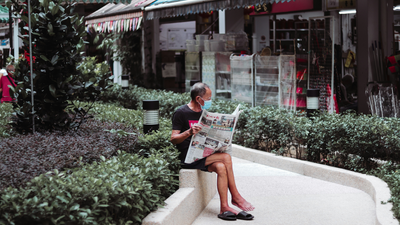


People jaywalk across Battery Road, the street in front of my office, all the time. The MRT exits deposit you right in the middle of it, but the nearest pedestrian crossings are at least a hundred metres away in either direction. It’s a one-way street with two lanes, so it doesn’t feel particularly dangerous. There’s a slight bend in the road though, and bushes and recycling bins partially obscure the sightline, which means that if a car takes the bend quickly, you won’t see it coming until it’s too close.
I cross there anyway.
On any given day, I can count a dozen people making the same crossing within the same few minutes—office workers, tourists with young children in tow, uncles off to the nearby bank with their walking sticks. With every person who crosses, the road appears a little safer. People make a vague effort to check the street but most of the time, we just go.
So why do we do it? The easy answer is that we’re being reckless—that we know the rules, know the risks, and choose to ignore both. But I’m not sure that’s quite right. When I cross Battery Road, I’m not ignoring the risk. I’m making a calculation—a fast, mostly unconscious one, based on what I can see.
Two lanes. One-way traffic. A gap between cars. Go.
What I’m not calculating is what I cannot see: the car taking the bend quickly, obscured by the bushes until it’s too late. Our brains judge the likelihood of something by how easily we can bring an example to mind. I’ve crossed Battery Road hundreds of times without incident. That history is vivid and retrievable. And because nothing has ever happened to me, my brain treats the crossing as safer than it probably is. We call that availability bias.
What caught my attention recently was a report in The Straits Times (ST) on elderly jaywalkers, specifically one man’s explanation for why he does it. “I’m not afraid of anything at this age,” said Tay, a 73-year-old Yishun resident. The police spokeswoman quoted in the same article called it a misplaced sense of safety. I agree. But I think the misplacement is of a very specific sort.
Tay is making the same calculation I make on Battery Road, just a slightly different kind. For me, the mechanism is present bias: we weigh immediate costs more heavily than future ones, so the walk to the crossing is inconvenient right now, while the accident is a possibility I discount because it’s in a future I don’t have to think about. It’s the same reason I choose to watch one more episode of “The Bear” instead of doing my taxes, or give in to the fried carrot cake two days after making a new year resolution to eat cleaner. The present pleasure is vivid and immediate; the future cost is real but distant.
That’s not quite what’s happening for Tay. It isn’t that the future feels distant to him—if anything, at 73, it’s shorter and closer to him than it is for me. But a foreshortened future has changed how he chooses to spend his attention. Research on socioemotional selectivity shows that as people perceive their remaining time as limited, they become more selective about what deserves their attention. Older people may choose coffee with their friends over a business lunch for networking opportunities, or clocking out early to spend time alone rather than working overtime for additional pay. The immediate, emotionally meaningful present takes precedence over abstract future possibilities.
Unlike present bias, which is about timing—choosing now over later—socioemotional selectivity is about priority: which goals still feel worth pursuing at all. While the research is stronger in social contexts than in physical risk, what it points toward is that Tay’s relationship with future risk may have shifted over time—a gradual reorganisation of what feels urgent, rather than a deliberate choice. “I’m not afraid of anything at this age,” Tay said, which sounds like bravado, but also tells you something about where his attention is now naturally spent.
Another way in which the elderly diverge from the rest of us is in how they assess their own capacity to respond to physical danger. Shio, a 77-year-old jaywalker in the same ST piece, was equally direct: “I know it’s risky, but I’m impatient. I’m still very fit and can run.” If Shio is genuinely physically healthy and strong, then jaywalking is a conscious and calculated decision. But older adults also tend to overestimate their physical capability, and that gap between self-perception and actual ability widens as physical capacity declines. Shio believes she can move fast enough to avoid an oncoming car. She might be less right about that than she thinks.
For many elderly Singaporeans, the habit of crossing mid-road was formed long before current traffic volumes, road configurations, and vehicle speeds. They have been crossing the same streets for decades, and the mental model they built then—roads that could be safely crossed—has not kept pace with how those roads have since changed. Compounded by an inflated sense of their own physical abilities, this is a dangerous combination. What looks like recklessness is more realistically the persistence of an old routine meeting a body that can no longer keep up.
Singapore has not been indifferent to the problem. Silver Zones introduce lower speed limits, curvier roads, and wider dividers in areas with high elderly populations, addressing the environment itself, not just the crossing. The Green Man+ initiative extends crossing times by up to 13s for seniors who tap their concession cards. These are sensible measures. But Silver Zones cover only 50 designated areas across the island—Battery Road is not one of them—and Green Man+ only helps if you've already decided to use the crossing in the first place.
The mechanisms underlying jaywalking are different, so the responses need to be too. The information gap wants information at the actual point of decision, not at the ideal one—a sign at the bend, with last year’s accident data, not a campaign poster at a crossing people have already decided to bypass. Tay’s selectivity requires something more meaningful than a statistic: an accident is abstract, a grandchild who uses the same road is not. And Shio’s possible overconfidence cannot be corrected by a warning. It needs to be corrected by something more concrete—a timed walk, a reaction test, a number that doesn’t just depend on how she feels that morning.
These are not small things but they are also not the whole problem. The more fundamental error is treating jaywalking as merely a failure of knowledge. If it is not—and I don’t think it is—then the more important question is why people have to make those decisions a hundred metres away from the crossing at all.
On Battery Road, there’s a patch of pathway where the bushes have been worn down—trampled flat by people taking the same shortcut, day after day. Nobody planned it, nobody approved it; it is simply where people needed to go. Urban planners have a term for this: desire lines—the informal trails people wear into grass or gravel by taking the most direct route rather than the intended one. Jaywalking is the urban equivalent.
Desire lines don’t appear because people are careless; they appear because the designed path didn’t account for where people wanted to go. We have spent a long time trying to change the people. The more useful question is whether we’ve been designing for them.
Serene Koh is a behavioural scientist and director of the Behavioural Insights Team in Singapore. She also teaches behavioural science at the National University of Singapore.
Letters in response to this piece can be sent to sudhir@jom.media. All will be considered for publication on our “Letters to the editor” page.
If you enjoy Jom’s work, do get a paid subscription today to support independent journalism in Singapore.