
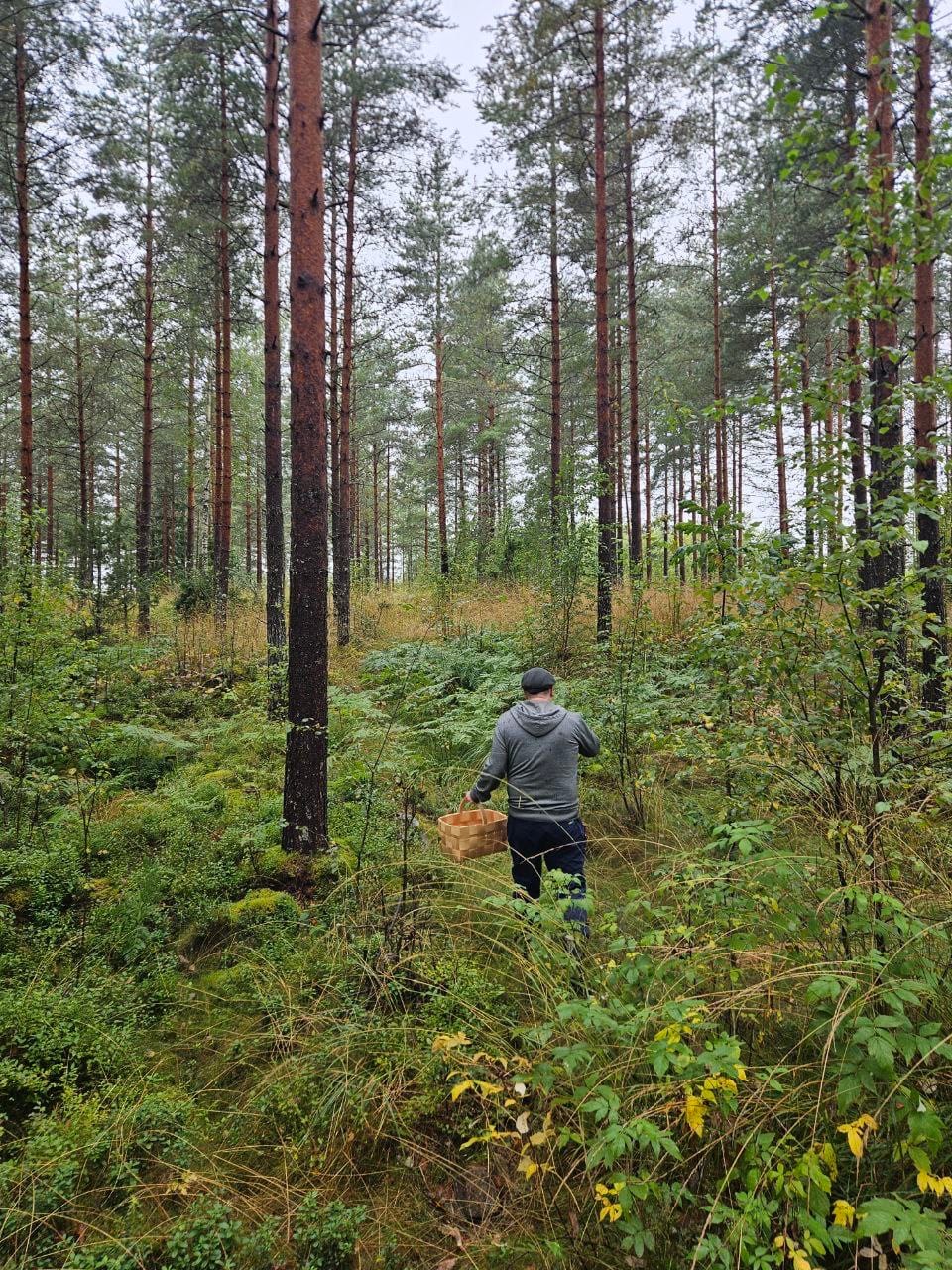
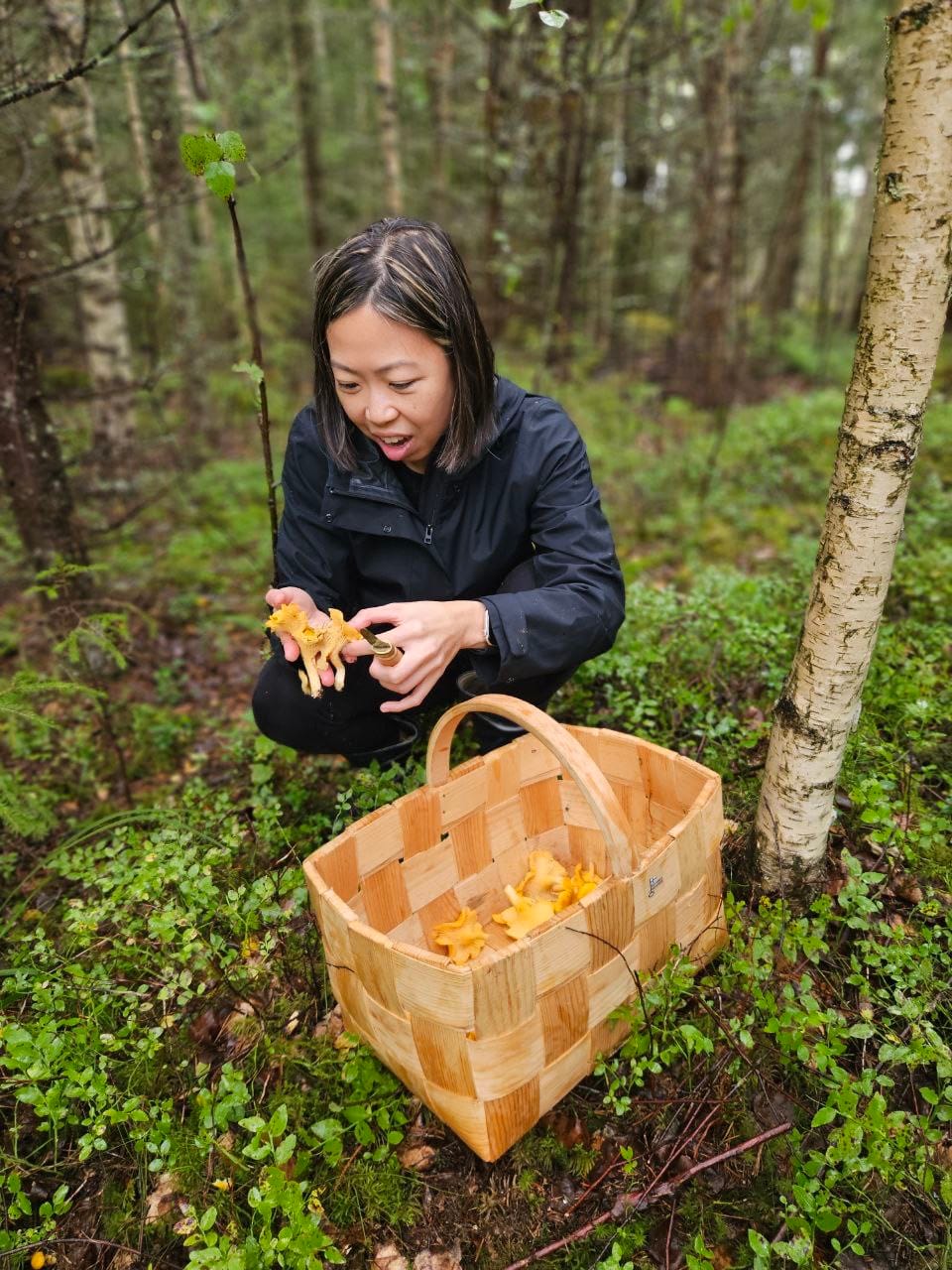
There it stood, a yellow sentry on a small rump of moss. A small funnel of gold. A lone chanterelle. Matti grinned. “Where there’s one, there’s always more.” I watched as my gentle giant of a friend—with the broad, hulking build of a former basketballer and a dainty woven basket dangling from his elbow—vanished through a clutch of pines. I followed, not quite sure how he was navigating this forest on a soggy, overcast August day. Every patch of grass and tree looked the same to me.
I found Matti crouched over a thick cache of chanterelles, tweezing them from the earth with his fingers and dusting them off with the stubby brush on the end of his mushroom knife. He was delighted. “I saved this spot on my phone the last time!” This was his apaja, a word with no English equivalent, neither linguistically nor affectively. You might loosely translate it as “area known to have plentiful catch”, and one that produces this catch reliably and repeatedly. I first learnt this term from my Finnish colleague, a multidisciplinary scientist. Roope, himself a devoted mushroom hunter, once published a paper titled “The Art of Mushroom Foraging: A Phenomenological Inquiry”, where he not only geeks out about Finns’ mycelial inclinations but also introduces us to the social context in which foraging takes place. “...knowledge of an apaja, whilst socially transmitted, is often kept a guarded secret within an in-group,” Roope writes. “An unwritten rule applies: You do not talk about an apaja with strangers.”
When I reflect on my friendships and social networks in Finland, I trace them all back to this moment a year ago: the moment I was inducted into an apaja, and was no longer a stranger. Matti, a documentary filmmaker, and Anne, a journalist-researcher, were hosting me at their mökki, or cottage, about an hour’s drive west of Helsinki, the Finnish capital. The mökki is a sacred retreat, where Finns spend the bulk of their brief and luminous summers, moving between sauna, lake, and forest, savouring the bright flicker before the long, bleak winter sets in.
Finland has a population of about 5.65 million occupying a space roughly 500 times the size of Singapore. There’s a long-running joke here that I’ve now heard at least a dozen times. After the pandemic, when the country lifted its regulatory safe distance of two metres, Finns collectively breathed a sigh of relief. “Thank god,” they exhaled, “now we can go back to being four metres apart!” Finns regularly roast themselves for their outsized respect for—and reliance on—a substantial amount of personal space. The popular Instagram account Finnish Nightmares, featuring expressionless stick figures with googly eyes, lists a few situations that might make a Finn panic internally (they never panic externally): “when you want to leave your apartment but your neighbor is in the hallway”; “you want to take a free sample but you don’t want to chat with the salesperson”; “you see a seat become vacant but don’t want [the] person next to you [to] think you move[d] away because of them”.
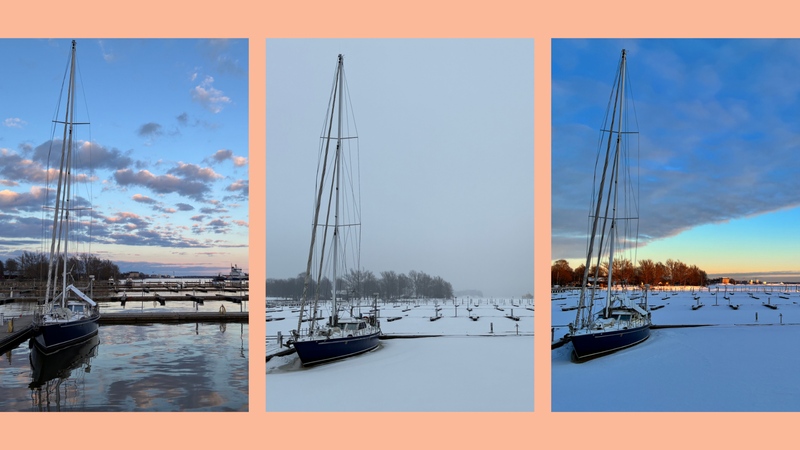
When I was about to move to Finland for a yearlong research posting, I was repeatedly cautioned: you’re going to have to be the one making friends. It felt like I wasn’t only moving to a place with a freezing climate, but with a frigid social environment. I arrived in Helsinki last August, just as the summer was cooling into autumn. Helsinki is both a port city and an archipelago speckled with some 300 islands, mostly connected to the mainland by ferry, or by aerodynamic bridges vaulting its waterways. Outside of the tourist clusters—the cobblestoned market squares, the strip of restaurants by the ferry terminal, the stately shopping street abutting the Senate Square—the closest person to me is often several hundred metres away. Helsinki has no skyscrapers, but has 130km of readily accessible shoreline; it’s a low-rise capital city strewn with parks, lined with boatyards and marinas as common as the multi-storey carpark, and crosshatched with wide boulevards dedicated to cyclists and pedestrians, some wider than the roads for vehicles themselves. It’s often quicker to get somewhere by scooter or bike than by any of the city’s ambling trams. Everything runs on time, anything rundown is almost immediately fixed, and kids run and cycle down the streets in unchaperoned little pairs and trios. It’s a city so quiet I can hear the gurgle of my stomach, and the thoughts flitting through my head.
The climate is certainly hostile, but it’s also humbling. There’s nothing like seeing the orange orb of the sun pierce the fog as the mercury plummets and the days dramatically shorten throughout November, known as marraskuu: the “death month”. Last December, the Finnish Meteorological Institute found that several parts of Finland had not seen a single second of sunshine. As an equatorial creature accustomed to 12 hours of daily sunlight, these months of darkness were brutal. The cold was more than manageable; even at 25 below, you could always sheathe yourself in a sturdy coat and rugged boots. But whenever the sun deigned to show her face, I wanted to fall to my knees in worship on the icy sidewalk.
The social atmosphere, on the other hand, is one I rarely had to endure. “Our ‘outside wall’ is high,” a Finnish colleague told me, “but our ‘inside wall’ is very low.” Hurdling that wall, however, takes some patience and practice. This is the story of how I scaled that wall—not realising it was one—in a country of extremes, but also of equanimity.
Finland is often mentioned in the same breath as happiness. Set foot in Helsinki Airport, and you’ll be greeted by walls of digital displays welcoming you to the happiest country in the world. For a Singaporean who’s been told we’re the third happiest city in the world, I was reasonably suspicious; the stories I’d heard about Finland’s rampant alcoholism, post-pandemic urban atomisation and an unhealthy culture of stoicism didn’t quite help. Happiness felt like more of a marketing ploy. Yet the year I’ve spent here has also been one of the happiest of my life.
During our orientation week at the Helsinki Collegium for Advanced Studies, our director sat us all down for her welcome speech. “Aiming directly at happiness rarely makes us happy,” she told us. “So we’re going to focus on creating conditions in which happiness can emerge.” Our cohort of academics was largely left to our own devices, to pursue “curiosity-driven research” and, as is the institution’s tagline, to have “the freedom to think”. The Collegium’s trust in us was certainly a condition for my happiness; it also paid dividends in other ways: left undisturbed, and with no KPIs, my colleagues produced entire books, secured prestigious grants, wandered into each other’s offices and emerged with startling new interdisciplinary collaborations.
The Nordic welfare states—including Finland, Sweden, Norway, and Denmark—have consistently scored highly on what’s called generalised trust. In surveys, this tends to be measured with questions like: “Generally speaking, would you say that most people can be trusted?” or “Would you say that most of [the] time people try to be helpful or that they are mostly looking out for themselves?” The Nordics also far outstrip European peers when it comes to institutional trust, including trust in the legal system, politicians, and the police.
That trust is still relatively high, but it’s also rapidly dwindling. In 2003, almost 60 percent of Finns trusted their national government, compared to the European Union (EU) average of 37 percent; now, that number is 42 percent. The Covid-19 pandemic and Russia’s invasion of Ukraine have rattled all of Europe, particularly Finland, which shares a 1,340-km border with the aggressor; Finland’s unemployment hit a staggering 12.7 percent in June, the highest in an entire century. In April, I walked past a protest of hundreds across the street from the House of the Estates. Inside, prime minister Petteri Orpo and his right-wing coalition were locked in budget negotiations proposing massive cuts to social assistance, to the tune of €218m (S$320m). Outside, I spoke with a protester who was building an installation of sticks she’d gathered. “If I could find a job, any job, I would,” she told me in halting English. “But there are no jobs. And they told us to collect sticks for money. So these are my sticks.” One of her cardboard signs read, in bold capitals: “Tax the rich or eat the rich?” The Finnish sociologist Juho Saari had a sardonic summary of the situation in a recent chapter on the structural overstretching of the Finnish welfare state. “Finland,” went one of his subheadings, “broke, but happy”.
In many ways, life here has felt like a series of contradictions. Head up to Lapland for the winter, and you’ll enter the purgatory of the polar night, where the sun doesn’t rise above the horizon and the landscape stands still in an eerie twilight for anything between a few days to nearly two months, depending on how far north you go. The same region will be blasted with light in the summer, when the midnight sun hangs in the sky and its hues shift from the oranges of dusk to the blush of dawn in a matter of minutes.
The same contradictions thread through social life. I’m a demonstrative person with a malleable face that transforms with even the slightest quiver of feeling; it took me some time to learn how to read Finnish emotion, to recognise that an inscrutable visage does not translate into a lack of interest. I’ve now had several ardent conversations with friends here whose expressions have remained largely the same throughout. There’s a Finnish saying: Kell’ onni on, se onnen kätkeköön. “Whoever has happiness should hide it.” It’s well-hidden, I’ll tell you that. But it’s also a reminder of the Finnish inclination to maintain a sense of modesty, to disavow the spotlight of achievement; most Finns I’ve met are self-deprecating, quick to laugh at themselves, and show affection by giving you a good roasting yourself. They will divulge their entire history of alcohol abuse to you the first time you meet, but they won’t sit next to you on the bus.
Finland is frequently described as a homogeneous society; before it joined the EU (in 1995) and the Schengen region (in 2001), its patterns of migration tended to heavily feature adjacent countries like Russia and Estonia. Its immigrant population has leapt since then, from barely one percent of the population in 1990 to about seven percent in 2019, with migrants all the way from India to Iraq. The Finnish term for “integration” is kotoutuminen, which conjures a sense of “domestic comfort” or “feeling at home”. Yet Finnish integration policy prioritises the workplace over the warmth of home. Integration training—language studies, upskilling, work experience—is only offered to the jobseeking and unemployed. If you’ve managed to find a job, then good luck, you’re on your own; you don’t get immediate access to free Finnish-language courses, for example. A 2022 study of immigrants and integration analysed the state’s seemingly counter-intuitive strategy: “This approach is founded on the belief that if immigrants can enter the labour market, the social and cultural aspects of integration will subsequently follow.” Yet this isn’t always true. “Finns make immigrants feel unwelcome,” went one frustrated survey respondent; Finnish society is “conservative and closed”; Finns are “difficult” and “not so social”; the immigrant’s fate is sealed by a lack of “trust” and “neglect” by the Finnish state.
I’ve mostly encountered non-white, non-European migrants in these low-skilled jobs: food delivery, ride-hailing, janitorial work. The Filipino custodian who cleans my building every week had been working a call centre job in the Philippines, then decided to seek a better life in the Nordics. What he didn’t count on was being funnelled into a cleaning company while waiting out the six-year path to residency. The transition from a desk job to manual labour was a huge strain. “I just have one more year to go”, he exhaled, his fingers tightening around the neck of our apartment block’s faulty vacuum cleaner, which he’d been trying to fix. “So I’m hanging on ma’am.” He’s not the only one. Researchers from the Migration Institute of Finland found that nearly one in three employed immigrants take on jobs below their education and skill level. They tend to be steered into cleaning, care and service work regardless of their qualifications.
When I asked one of my colleagues about this supposed exclusionary, in-group nature of Finns, he told me a story he’d heard as a child. There once was a man who set out to build a home for himself in the pristine north. (This notion of terra nullius, of course, ignores indigenous Sámi histories.) Here, he lived with his family in peace and contentment, in a beautiful, open space by a river they had claimed for themselves. One day, the man saw pieces of wood drifting downstream. He realised this meant that someone else had built a home further upstream. The man promptly grabbed his axe and headed upriver so that he could kill the intruder.
When I attempted to Google this apocryphal tale (search string: Finland + axe + peasant + murder), all I turned up were variations on the myth of Lalli the peasant and Henry the crusader. But I found this mistaken retelling of the myth revealing in itself, how a tale is rewritten and reformulated as a palimpsest for other narratives, how a national myth gains transformative power. In one variant, the bishop Henry is one of the first missionaries to arrive in Finland in the 10th century, during Sweden’s first crusade. His entourage happens upon a remote dwelling. Only one person is home: Kerttu, the matriarch. Henry demands provisions for his troupe and horses. She refuses. The men seize the food and leave. When her husband, Lalli, returns, he’s possessed with rage. He tracks down the bishop on a frozen lake and hacks him to death with his axe.
Until about the end of the 19th century, Lalli was portrayed as a brutish, amoral and murderous villain. But during the Finnish national political awakening, he was transformed into a heroic rebel pushing back against foreign invasion, a proudly pagan Finn fighting against forced conversion. Henry, on the other hand, became a suspect outsider, rather than a benevolent religious emissary.
Trust and happiness do exist in Finland, but they tend to manifest as a conditional trust and happiness, bestowed upon those who make it past that high wall. The trust upon which so much of Finnish happiness depends is doled out, sparingly, to white collar, legible migrants such as myself. I found that the moment I could dispense sentences in the tongue-twisty language’s colloquial register, and make casual mention of my university affiliation, I could quickly disarm any misgivings.
One of the most daunting administrative tasks before me upon arrival was the acquisition of what’s called “strong identification”, essentially Singpass for the Finnish state. You need to piece together all the parts of your identity as proof—your employment, housing, taxes, finances, and more—where all tasks must be sequenced in the right order, at the right time, in anonymous government offices scattered across the city. It took me well over a month to open a bank account, shocking to someone used to gliding through Singapore’s frictionless banking system. The bank teller, my final stop in this weeks-long real-time strategy game, congratulated me as she handed over my documents. Once I had assembled my “strong ID”, I felt as though I’d received a master key that would unlock my front gate, back gate, trash and recycling shed, laundry room, and house door. I do actually have a key that does all of those things, and it also cost me a stinging 130€ (S$192) in penalties and a two-hour wait for a security guard when I accidentally locked myself out of my flat—not once, but twice.
The moment the state could comprehend and accept my existence, I had access to the full wonder of Finnish welfare. I’ve never waited more than a minute in an outpatient clinic for my turn. My social security card gives me robust rights to local healthcare, and on top of that I get medical care in all of the EU. The state also takes a big bite out of my salary, but I had expected this. In a staff information session, we were gently reminded of the far preferable tradeoffs we were signing up for with a flowchart titled “WHAT DO YOU GET WITH THE TAXES IN FINLAND?” Here, the series of arrows that followed our “somewhat high taxation” flowed to less disparities in income, higher quality public services, a “higher level of experienced safety and trust in the society”, culminating in a bright blue box at the finish: FINNISH WELFARE STATE. This is the burden we were taking on for the benefit of everyone: steep taxes would yield plentiful housing allowances, pensions, healthcare, schooling, childcare and more. Our human resources staff begged us to take leave; most Finns vanish for at least an entire month in the summer, when the burden of labour is redistributed to seasonal workers (often migrants or students). The tradeoff: shops and services have very narrow opening hours, and almost everything is shut on Sundays. You quickly get used to it.
This burden—and tradeoff—also means that Finns have the luxury of taking their hobbies very, very seriously. While there are no shortcuts to intimacy, there are many other inroads that might be taken towards Finnish trust. One of them is possessing a hobby that Finns obsess over. Another is the pursuit of the qualities, espoused and encouraged by said hobby, that Finns desire to cultivate in themselves. And finally, all of this relationship-building must be done on a schedule that respects the Finns’ fastidious calibration of work, family, and leisure.
It so happens that my hobby is long-distance running. Helsinki—and most of Finland, really—is a runner’s paradise. It is home to the Kaldoaivi Ultra Trail, the world’s northernmost ultrarunning race, which takes you across hundreds of kilometres of rugged fells and remote wilderness in Lapland. But its urban trails are stunning too. You can circumambulate the entire Helsinki downtown core, in one unbroken loop, by simply following its dedicated coastline paths, trotting past long piers, lush parks, apartment blocks, rocky beaches, narrow straits, and open water. Or you can head inland and up north, where Helsinki’s verdant central park (a forest in itself) acts as a 10km green artery between the larger metropolitan region and the compact city centre. At least once a week, I run to the island of Mustikkamaa (“blueberry land”), a diamond-shaped isle about the size of Tampines Eco Green, lined with maples, oaks, and pines. It’s connected to the mainland by the delicate arch of “grandfather’s bridge”, and its well-maintained trails take you through forest and meadow. You also get sweeping views of the steepled Kruunuvuorensilta—nearly 1.2km from end to end, it’s the longest and tallest pedestrian and commuter bridge in Finland. No cars, just trams and people. And animals. One drizzly spring day, as I was scrunching through the gravel paths by the water, I saw a doe lift her head through the dappled foliage, sniff the air, then retreat gracefully into the thick green scrub.
When I moved to Helsinki, I was determined to run outdoors as part of my process of climate relocation, to keep myself moving as the mercury dropped. I am allergic to treadmills; why use a machine when the world is at your disposal? Oh, sweet summer child, someone should have told me, winter is coming. The run club Juoksut was my introduction to the fanatic Finnish ability to run in any weather. Run in darkness through snow and hail? Never, I thought. Yet my friends showed up every week in their fleece-lined gloves, windproof leggings, and gleaming reflectors strapped over waterproof jackets. As most in the Nordics would say: there’s no bad weather, only bad clothes. A runner acquaintance showed me photos of herself, a dusting of ice on her eyebrows, galloping across snow in nothing but a headband, hoodie, and tights.
As winter closed its grip on the city, I started training for a half-marathon in the spring. I endured 45km/h gales rolling in across the Finnish gulf, winds so strong they shoved me off track while crossing bridges, in fog so thick I couldn’t see the horizon line, skidding on fresh snow, skidding on slick ice, my hood cinched over my head and my fists clenched, my bones icicles, my toenails blackening and falling off after the most gruelling of long runs in subzero sleet.
As I limped back home after every run, damp and dented, my fingers so stiff I could barely turn the key in the lock of my block, I would summon three Finnish concepts. The first is reipas, the vim and fortitude required to haul yourself outside at 8am in the dead of winter, when it’s still pitch dark, don your reflectors, and go for a run. Then there’s rohkea, which isn’t only bravery or courage, but an open-heartedness to life, a porosity to new experiences. Finally, there’s sisu, a term to rival one of our own: tahan. To withstand, resist, persist; grit and grace in the face of impossible adversity. One of my running routes takes me past a line of ice-breakers, the ships that keep the Helsinki harbour open. One of them is named SISU, and I’d look up at the narrow, stout vessel and give it a nod.
The three can be a potent combination. They can also be taken to extremes. After tolerating weeks of baffling pain radiating through her hips and lower back, one of my runner friends caved and booked an appointment for an MRI. She texted me shortly after. “Hi, no good news. Three herniated discs and two of them have annulus tear. My running career stops here.” She’s 30. Then, almost as an afterthought, and probably to reassure me, she added: “Have a nice and productive meeting today! ❤️”
I am not equipped with anything close to my friend’s sisu. It took me months to build anything remotely resembling cold tolerance. But I had two secret weapons: the Finnish sauna—and avantouinti, or ice-hole swimming.
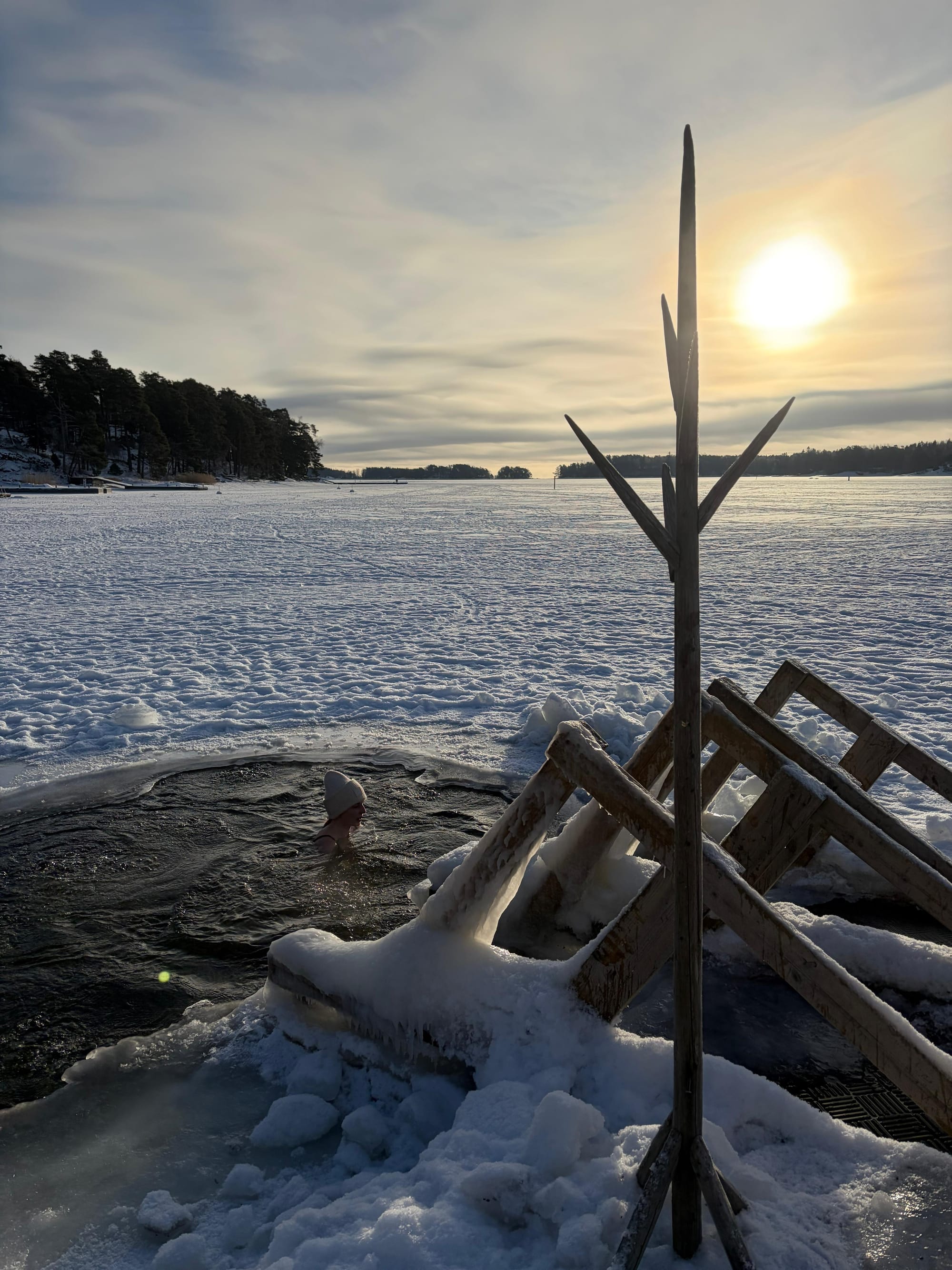
The sauna and the cold plunge: fads everywhere else, fundamental to survival in Finland. In this austere, severe environment, this is what you do to keep your circulation steady and your bones sound. Winter kept me attentive to the mechanics of my body and its regulatory barometers: breath, heat, heartbeat. My Finnish girlfriends walked me through my very first cold plunge (5C) at an indoor swimming complex in October, taught me how to regulate my breathing so I wouldn’t panic even when my body was rigid with cortisol. The tip, easier said than done: breathe evenly, and don’t stop lowering yourself into the water. I continued to practice this at an outdoor swimming pool throughout November and December. I’d warm my body up in the sauna until I was aglow in heat and sweat, then make my way outdoors in nothing but my swimsuit, then shuttle back and forth until I reached a heady equilibrium, layers of heat and cold in every strata of my skin.
Earlier this year, a series of cold snaps froze the sea ice across the Helsinki archipelago, which meant that we could walk across the water to the scattering of islands that surrounded the coast. On a crisp February day, when the temperature dropped to -20C, my girlfriends and I visited a classic seaside sauna about 20 minutes outside the city, and I did my first proper ice dip. The sauna staff had sawed a large oval into the surface of the ice at the end of a jetty. I swaddled my feet and hands in compression socks and gloves, made from a stretchy scuba material. I jammed on my sauna hat—I looked like I was wearing a bulb of garlic—then took a deep breath and strode outdoors into the sharp clap of cold, down the rungs of a slippery wooden ladder, and into the dark water below.
The Finnish sauna isn’t a spa. It could be a moment to decompress from the week’s work. It could be a 10-minute post-gym comedown before you hop into the shower. It could be a date night. It could be a post-cook, pre-dinner quiet time. It could be a two-hour gabfest, your entire party shuttling between a terrace stocked with beers and various saunas promising different tiers of communality. You could sauna with neighbours in the basement of your apartment block, or on an uninhabited rock in the middle of the ocean where your ancestors happened to build a sauna for stranded kayakers. You could sauna in your university dorm or in a plush villa with an ocean view. The Finns were prepared for an aggressive environment: they built three million saunas. Finns won’t sit next to you on the bus, but they will certainly squeeze themselves into any available inch on a cramped sauna bench. Jos sauna, viina ja terva eivät auta, tauti on kuolemaksi, the saying goes: “if sauna, vodka and tar can’t help you, you’re pretty much dead”.
Yet the sauna isn’t just a physical experience to shield one from the cold. Saunas are a site for collective emotional regulation. Had a hard week, and want to dump an entire bucket of water on the hot stones? You’ll just have to adjust your thermal catharsis to everyone else. And while you’re expected to wear a swimsuit in mixed-gender saunas, the general rule in single-gender saunas is that you must be naked as the day you were born. One of Helsinki’s iconic public institutions is the Yrjönkatu swimming hall, a neoclassical marvel with high ceilings and handsome tiled columns. Almost a century old, it’s the oldest public swimming hall in the country, and perhaps best known for being clothing optional. There are separate days and sessions assigned to different genders. I walked through the hall’s unassuming doors into a sapphic paradise, women of all ages and shapes giggling and gabbing, dawdling in the aquajogging lanes while catching up with friends, or slicing through speed laps down the centre aisles. I had never before witnessed anything close to this nonchalant and adamantly nonsexual nudity. A Finnish grandma, bald from chemotherapy, reminded me to take my chlorine-soaked swimsuit off in respect of the sauna. I complied, embarrassed. “We are all like this here,” she said, gesturing to an abdomen streaked with surgical scars.
The sauna is the great equaliser. It is the one place I exist with both my peers and my elders in a state of complete physical and emotional vulnerability. I’ve bared my heart (and my body) to my Finnish friends, sweating it out while wedged knee to knee in a muggy wooden room.
Perhaps I’m divulging my apaja to all of you reading this. Perhaps it’s something I shouldn’t speak of, this rare commodity bestowed on a chosen few. But I believe that trust and happiness are public goods. Finland doesn’t have it all right, but it doesn’t have it all wrong, either.
A few weeks ago, chanterelles began to return to the market squares around Helsinki, heaped high in luscious golden trays. I felt a pang in my heart; this meant my year here was almost done. Trumpet chanterelles were the very first thing I’d cooked in Helsinki, mushrooms I’d foraged myself in the Nuuksio national park, then dry sautéed in a pan with plenty of butter and onions. There’s a smoky earthiness and a pleasing al dente to the wild mushrooms here that I’d never tasted before. But what was infinitely more satisfying was that I immediately felt part of the Finnish ecosystem, my hands in its soil and its microbiome in my gut.
One of my closest friends had just returned to the city after a weekend in her hometown with her elderly father, where they’d picked their weight in chanterelles. Did I want some of their bounty, she asked. Of course I did, but I tried to be polite: “Are you sure?!” She laughed: “Oh Corrie, we have so much. It’s meant to be shared.”
Corrie Tan is Jom’s arts editor. From August 2025 to August 2026, she was the Kone Foundation Postdoctoral Fellow in the Arts at the Helsinki Collegium for Advanced Studies, a position dedicated to promoting new forms of dialogue between art and scholarship.
Corrie is especially grateful to: Matti, Anne, Laura, Fanny, Rebecca, Sanni, Tanja, Alina, Michelle, Timo, Dritëro, Antti, Karin, Mika, Kimmo, Juhana, Roope, Päivi, Anna and Kenny, the Helsinki Collegium for Advanced Studies, Helsinki Poetry Connection, and the run clubs Juoksut and Mellow Minutes. And to all of the very patient small business owners and service staff across the city who gamely practised Finnish with her, week after week. You have all contributed—directly or indirectly—to this essay. Thank you for trusting her.
Letters in response to this piece can be sent to sudhir@jom.media. All will be considered for publication on our “Letters to the editor” page.