
Little Luna had the “gift of sight”. She could glimpse what others in the material world were oblivious to: a parallel dimension filled with spirits, deities, angels, djinns, and nebulous energies. To her, this ability to glance between realms felt less a blessing than a curse—a split screen of horrors that haunted her childhood. Luna was so disturbed by these encounters that at 26 years old she still recalls them vividly.
Like the first time she came face-to-face with an otherworldly entity. A sinister-looking silhouette outside her bedroom, its frightful features framed by the moonlight. All pointy ears, glowing white eyes, and sharp teeth. She was just four.
“What the hell do you want? ” it snapped in Malay.
“A glass of water,” she said.
“Take it yourself.”
“No, I’m scared.”
“What of? ”
“…you.”
“Come here,” it coaxed, beckoning her to follow it to the kitchen.
Who knows what might have happened if she had. Instead, she woke her mother. The lights revealed nothing. A rustling in the storeroom proved equally empty.
Later, from her parents’ bed, she watched a ball of fire float outside the window, a lupine face at its centre. A fiery spectacle that only she could see.
The disturbances persisted: items disappeared, food spoiled, voices whispered in the night. Desperate to escape their chilly new “guests”, her parents moved the family across the island from Pasir Ris to Bukit Batok. But the sightings followed. Even abroad, Luna would point to invisible figures hanging in the closet or sitting on the bed. “No one understands the fear of [an entity] coming to you, trying to talk to you, and you have to act like it doesn’t exist,” she said, with a nervous laugh.
“Imagine they’re like ‘hey, hey, you can see me right,’ in whatever language…It traumatised me really badly to the point I had to be sent to the school counsellor.” Her father took her to bomohs to close her “third eye”. It stayed open. The only thing to do was hope that she outgrew her “insight”. Some elders say that sensitivity to the spirit world dims with age. But, while Luna’s ability to “see” dulled with adolescence, her curiosity in occultism intensified—the trauma a formative catalyst.
Raised Muslim, Luna felt abandoned by her religion from an early age. Despite her pleas, Luna’s God seemed unable to shield her from the paranormal. Faced with a crisis of faith, she sought spiritual support and guidance online, where a playground for Western esotericism and its practitioners was spreading. Western esotericism traces back to Hermetic, pagan, and mystical philosophies. Today, it spans everything from alchemy and astrology to ceremonial magic and the New Age movement. This brew of hocus pocus and genuine insight was streaming onto screens, feeding young minds starved for meaning. Here, a 10-year-old Luna searching for protection spells stumbled onto a Wiccan blog that contained incantations for every whim and fancy. Soon, she was scouring the National Library and Bras Basah’s bargain-bin bookstores for literature on Wicca—a modern pagan, Earth-centred religion—drawn to the writings of Gerald Gardner, considered the “father of witchcraft”, and Scott Cunningham, a prominent figure in modern Paganism believed to have made Wicca accessible and practicable.
Unlike structured esoteric traditions with formal initiations, lineages and rigorous training, many forms of Wicca and witchcraft are decentralised and non-initiatory. They offer diverse paths—such as those for solitary or eclectic practitioners like Luna—that feel more customisable and less intimidating, encouraging independent exploration and interpretation. Even without a coven, witchcraft can foster community and connection. “Whatever this religion teaches was in line with my own philosophy. The kinds of gods that they worshipped have more human nature. There’s no fearmongering, there’s no forcing you to do rituals or whatnot. It’s free and easy. That called out to me.”
Luna’s metaphysical coming-of-age unfolded in step with a global spiritual revival, her path forged in the crucible of magic and modern paganism. These early explorations laid the groundwork for a return to her sacred Asian roots—the source of her religious wounding. As she experimented with tarot, spellcasting, and Wiccan rituals, Luna met her first white deity in a dream. “I had to Google ‘European goddess, flowy robes with a spear…helmet and an owl’,” she said, chuckling. “She didn’t tell me her name. She just said, ‘I will help you out.’” The owl was a clue: her nocturnal visitor was Athena, Greek goddess of wisdom, warfare, and handicrafts. Through Wicca and Athena, Luna believes that she learned to channel nature’s energies and shield herself from the visions that had long tormented her. She practises what she calls “green magic”, harnessing the healing power of plants and herbs to craft rituals and spells charged with intention and faith. Athena became her sentinel, a point of focus that helped her weather school bullying and academic failure. In return, Luna offered devotion and loyalty.
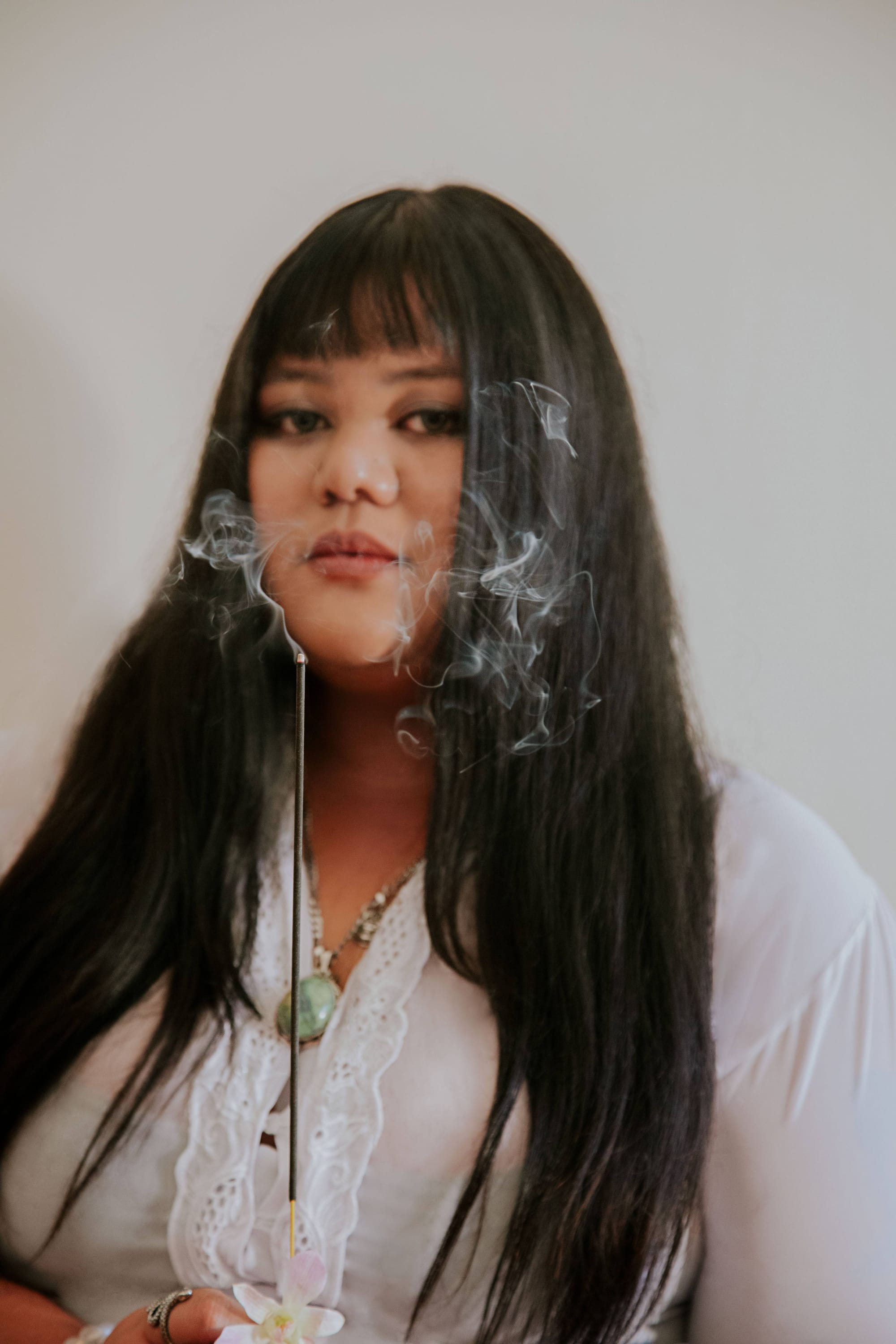
Other deities followed: the Greek Hecate, the Javanese Kanjeng Ratu Kidul and the Hindu Durga Kali. On the cusp of turning 21, Luna’s father revealed she came from a line of Indonesian healers. The news was less surprising—her clairvoyant abilities had scattered a trail of mystical crumbs—than her family not informing her earlier because it wasn’t time. “I’m still questioning their decision. This could have saved…me a lot of trauma.” Now ordained as Jero Tenung Segara—a priestess—she lives in Bali, practising Kejawèn, the Javanese syncretic blend of Buddhism, Hinduism, Sufism, shamanism, and animism. Last August, to retain ties to Singapore, Luna consecrated a shrine in Bukit Batok—part-keramat, part-sanctuary—blending artifacts from Asian spiritual, religious traditions, and non-Asian pantheons, adorned with incense, crystals, statues, and candles. The space is open to anyone in need of healing, or to witness Luna perform tarot readings, blessings, exorcisms, and purification ceremonies. Demand is high. On her trips to Singapore, she sees nine to 10 people a day—CEOs, civil servants, sex workers, students—who also purchase blessed oils or perfumes. “[W]e’ve been put through the wringer…All this stress, desperation, anger, sadness, humiliation…It will come to a point where it’s going to be too much,” she explained with a heaviness.
For a growing number of Singaporeans, the search for meaning now lies outside organised religion. Since the 1980s, the proportion with no religious affiliation has steadily risen—from 13 percent two decades ago to about a fifth of the population aged 15 and above today. This drift from dogma echoes what German sociologist Max Weber, in 1917, called “the disenchantment of the world” (die Entzauberung der Welt). He theorised that in a society demystified by science, rationalisation eroded the plausibility of theological and supernatural accounts, rendering religion and superstition obsolete in a modern, secular world.
By the early 2000s, however, sociologist Christopher Partridge countered Weber’s de-magification, observing a cultural “re-enchantment”. “[We] are witnessing a return to a form of magical culture,” he wrote. Even as organised religion waned in the West, alternative spiritualities, occult practices, and esoteric movements surged, aided by a “de-exotification” of once-obscure beliefs. In Singapore, a similar shift is underway as more millennials and Gen Zers identify as “spiritual but not religious”. Partridge’s “occulture” has gained ground here, fuelled by mainstream popular culture and media. By emphasising eclectic, experiential spirituality, personal agency, transformation, and metaphysical healing, it invites individuals to adopt and adapt sacred practices into daily life, free from traditional religious constraints.
One contemporary convert to occulture is Noel Tuan. He turned to Buddhism at 13 after his parents’ divorce. For four years, he kept up a dedicated practice—reading sutras and chanting mantras for up to 45 minutes twice a day—until a slow, gnawing dissatisfaction began to erode his faith. When he asked his sangha for guidance, the “adults” told him to continue practising and trust that clarity would come. “That didn’t sit well with me. I felt like I had no relationship with what I was doing. It was mindless.” Disillusioned, he became an atheist at 17.
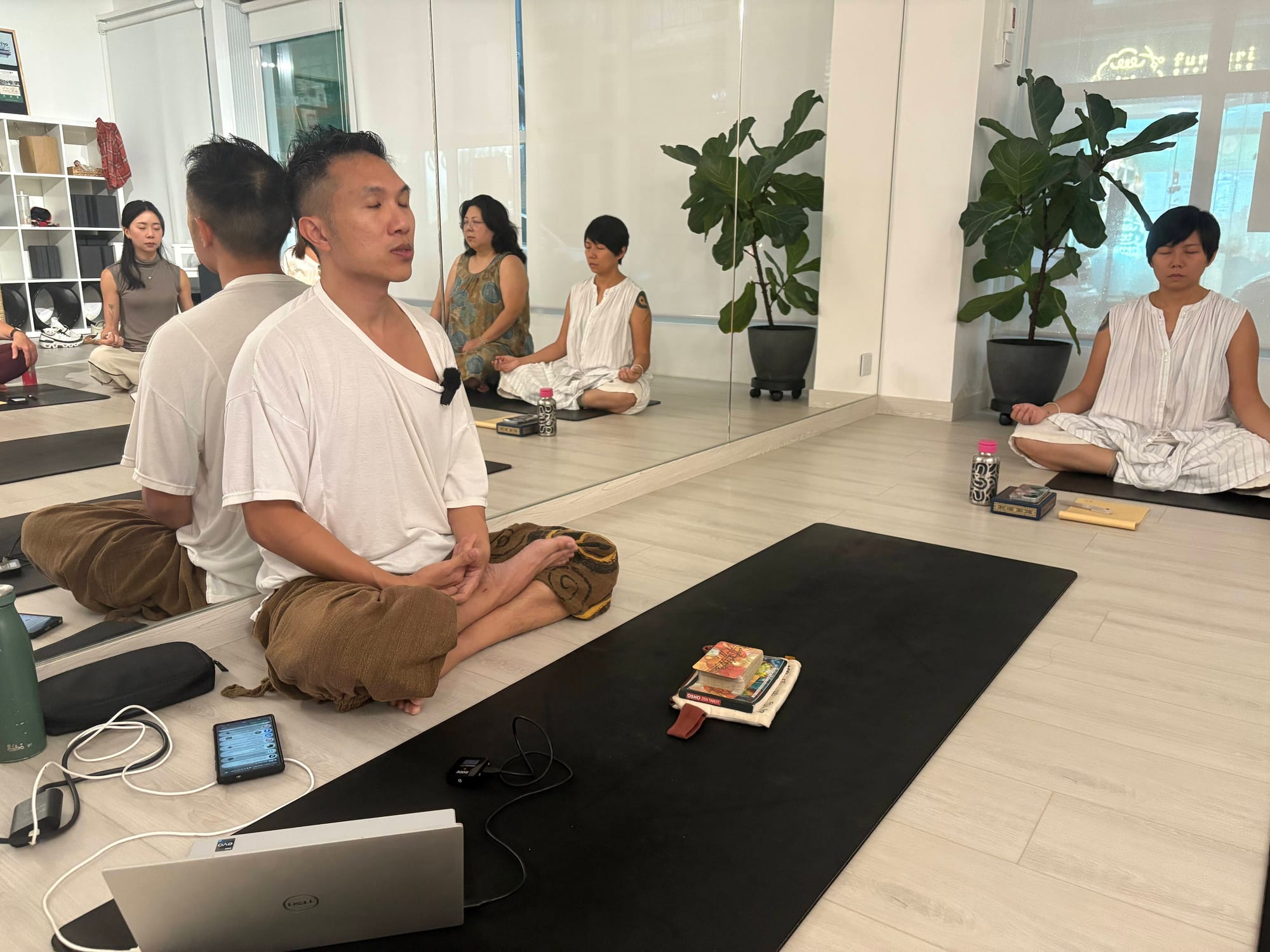
Now in his 40s, Tuan has come full circle—re-enchanted through the Akashic records, by way of an ex-girlfriend, even leaving a high-paying finance job to study and share the discipline full-time. Said to be a cosmic archive of every action, thought and feeling imprinted in Akasha, the Akashic records are “accessed” to understand one’s soul’s journey, heal, and make more conscious choices. But the disbeliever in Tuan took some convincing. “I wanted to learn the Akashic records to prove [it] was nonsensical. I needed a sign, because I don’t believe you can see beyond the physical.” During his first guided meditation, he felt a white light envelope him in a love unlike any he had known—beyond parental or romantic, alien yet intensely familiar. “I knew it was the love of God. I felt embraced, supported, held, seen, understood.” The experience erased his doubt. His mission now is to help others cultivate a reciprocal connection with the divine, rather than the “one-way street” of praying to an unresponsive deity.
I first met Tuan when he opened my records more than two years ago. Over WhatsApp, his clear, unembellished replies; lack of mystic theatrics; and zero-BS demeanour ticked every box for what I’d imagined were requisite qualities for channelling the so-called “Book of Life”. He was prepared, too, sending a six-page explainer with suggested questions, pre-session guidelines (consent form, no alcohol or recreational drugs 24 hours before) and post-session advice (drink plenty of water). By not trying to sell me anything, he had me sold.
When he answered the door—linen whites, hair immaculate—his professionalism felt almost cold. I wondered if I’d made a mistake. But once the opening chant and prayer ended, he softened into the role of astral conduit. He spoke with a gentle lilt, pausing often to ‘listen’ to the Akashic masters before speaking. He switched to Mandarin when it better conveyed the intelligence he was receiving, startling me with precise ‘insider’ details about my past and offering insight into the roots of my melancholia. Sometimes he’d admonish me—compassionately, never condescendingly—for wanting tidy answers, reminding me that life’s messiness is what makes its possibilities endless. Choices and mistakes, he said, were ours to own and embrace. Though no longer Buddhist, Tuan’s counsel carried traces of it: Buddha-nature, mindfulness, impermanence, and detachment. He seemed so attuned it was easy to believe a higher, omniscient voice was speaking through him. Even the cynic in me began to yield by the end of our two-hour consultation.
Religious disaffection also shaped Dea’s spiritual path. Growing up in a Muslim household, Dea, who uses they/them pronouns, found the religion’s structures restrictive and alienating, especially when it demanded blind obedience. “I felt very unseen…like a statistic. I would ask teachers why I had to do certain things, and they would say it’s because God intended it that way.” Over time, Dea came to resent being tied to their family’s beliefs, from praying five times a day to performing ritual ablutions. They turned to witchcraft and esoteric traditions to reclaim personal agency.
The occult wasn’t new to them. As a child, Dea’s mother, fearing family members might be hypnotised, made them eat limes for protection. “I was never sceptical. I thought it was part and parcel of life.” Aura cleansing and protective rituals were a regular routine. “Every night, I would see this certain being by my bedside. After conducting these rituals, [I] could fall asleep and not have scary dreams.”
The pandemic accelerated a lonely Dea’s search for spiritual communion, coinciding with a boom in online magical services. They sought a practice that was fluid and autonomous—capable of negotiating cultural, religious, and personal tensions. Thoughtful and effusive, with white oversized spectacles lending them a touch of goofy scholarliness, Dea attracted older mentors from the local esoteric community, offering to teach them the ways of magic. Yet, they stayed wary. “Even when I meet them and learn from them, I still don’t trust them. They just want you to believe that they’re this all-powerful man or being.”
Experimenting with magic and deity worship brought guilt and fear—of “going astray”, of “betraying” Islamic origins, ancestors, and God.
“My parents said that if you believe in anything other than God, you would be discarded by the religion. There is no afterlife for you.” Their first ritual, an offering to the djinn inhabiting an opal spirit pendant, began as curiosity but ended in shock: a towering figure appeared in the middle of a grassy field, convincing them of the supernatural and their own unforgivable transgression.
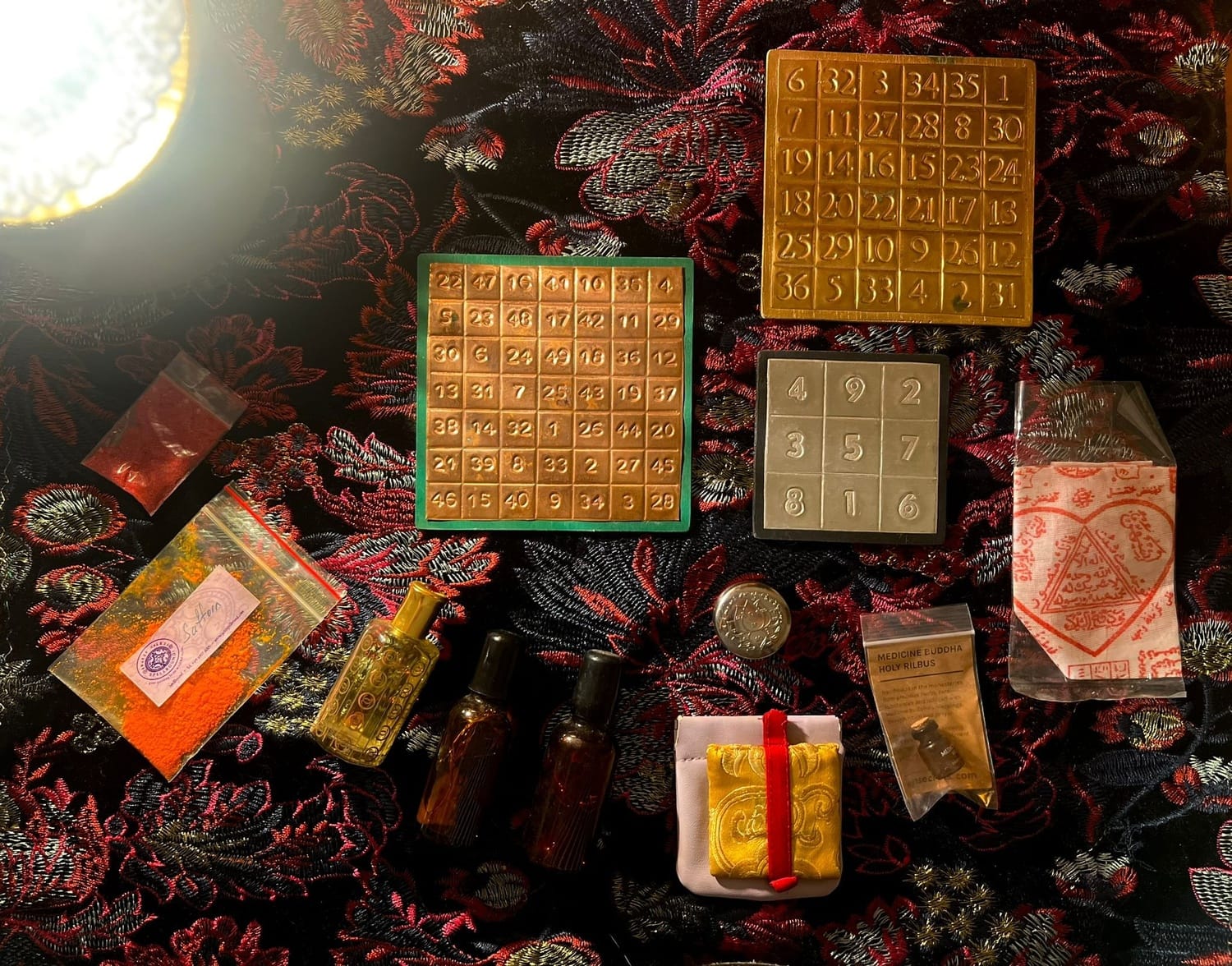
A Muslim healer later reassured Dea that working with beings like the djinn wasn’t inherently wrong, so long as they retained their agency. Syncretism, they realised, was essential to honour their cultural heritage. They started blending occult traditions with their Malay Muslim roots—Solomonic magic, Jewish mysticism and deities from Greek, Sumerian, and Tibetan Buddhist pantheons—woven together with talismans and symbols from Malay magic, such as sigils and magic squares, alongside local herbs like buluh perindu, the “root of longing”, lime, virgin coconut oil, and ginger. “Syncretism is important, not [only] because it keeps ancestral magic alive, but it’s also adaptable,” Dea asserted. “It’s a way to bridge the gap between yourself and whatever outside influences you have.”
They caution, however, against uncritical adoption of imported occult traditions. Some healers, they noted, rely on expensive, imported Western materials while ignoring local resources, believing that is the only way a ritual can work. Others use ingredients and sigils unfamiliar to local spirits, risking miscommunication, and troubling consequences. Or they work unsafely in confined spaces like HDB flats, inadvertently affecting neighbours. Context matters, Dea emphasised. “To keep a part of yourself in a very whitewashed and Western world. To keep a part of your culture.”
Syncretic movements have existed for centuries, spurred by conquests, commerce, and colonisation. Today, syncretism is generally understood as the blending or amalgamation of diverse religions, cultures, or schools of thought. Its origins stretch back to the ancient world: Egyptians and Greeks often merged deities to create more powerful ones; Rome absorbed local gods to maintain order in conquered territories. Along the Silk Road, trade carried not only goods but ideas and beliefs across East Asia, the Middle East, and Europe. Buddhism, for eg, syncretised with traditional beliefs in Japan (Shinto), Tibet (Bön), India (Hindu tantra), and China (Taoism and Confucianism). Colonialism left its mark too—European missionaries imposed Christianity in Africa, the Americas, and Asia, which fused with native spiritual practices.
Religious syncretism thrives in an increasingly interconnected world, giving rise to traditions such as neo-Paganism and the New Age movement. What’s new is the speed and reach of this fusion. In cosmopolitan Singapore, a multicultural and multireligious society makes fertile ground for syncretism in spaces both public and discreet. For instance, informal keramats have endured British colonialism and rapid urban development. They infuse “sacrality into Singapore’s urban landscape”, wrote art historian Sujatha Arundathi Meegama. These sacred sites honour figures from Sufi saints to Taoist gods, often sharing altars and attracting devotees of different backgrounds. Thus, they act as spaces of transcultural contact, interaction, and socialisation. Liyana Taha, in “Life in Death: The Case of Keramats in Singapore”, called these “ground-up efforts” the “real-life definition of religious and racial harmony.”
For many modern practitioners, syncretism is a kind of transnational spiritual “bricolage”, a concept popularised by French anthropologist Claude Lévi-Strauss in the 1960s. These practitioners are bricoleurs in the Lévi-Straussian sense: they construct spiritual worlds from whatever materials—ancestral memory, imported esotericism, digital resources—are at hand.
Though mysticism is frequently dismissed as pseudo-science—party tricks for giggles and gasps—many of its branches have seeped into mainstream culture.
Nowadays, one might imagine pairing chakra balancing with Traditional Chinese Medicine or jamu herbal tonics; or blend new moon ceremonies with Taoist altar practices and affirmation journalling. Whether drawing on Western psychospiritual methods or Eastern cosmologies, the combinations in this buffet-style approach are endless. In this sense, bricolage enables invention and resilience—cultural, existential, and social—but it also raises ethical questions. Where does creativity end and distortion begin? How do we distinguish cultural preservation from cultural loss, healing from exploitation? These questions haunt the syncretic bazaar as much as they animate it.
Exposure to multiple faiths at home—her mother a Taoist Buddhist from Indonesia, her father a Catholic turned Buddhist from Hong Kong—taught Elaine Mok that many religions share core values. A part-time tarot reader with a masters in linguistics, Mok received her first tarot reading at 19 in Salem, Massachusetts. This coastal state in the northeastern United States is still known as the “land of witches”, the site of the infamous 17th-century witch trials. The reading left an indelible mark. “I’ve never opened up to someone like that before,” she told me. “I enjoyed how iterative the process was…the bouncing off of energy [with the reader]. I remember leaving and thinking, ‘this is so cool, I wish I could talk to people like this.’” She promptly bought a deck.
While working at now-defunct indie bookstore The Moon to make extra cash as a student, Mok started giving ad-hoc readings to customers at the owner’s urging. These sessions honed her craft and taught her how to relate to a wide spectrum of people, from sceptics to believers. She enjoyed the challenge. “There is a lot of value to be had from one-on-one interactions,” Mok said. “That’s why people go for therapy. That’s why we have best friends.”
Mok hasn’t stopped since. Her Instagram page, @tarotonthemoon—a nod to the Chinese moon goddess Chang’e—counts over 2,600 followers. Her practice draws from Asian traditions like Vedic astrology, and dharmic and karmic systems, carving a niche in Singapore’s crowded New Age space. “That’s how I make tarot my own and closer to home,” she explained. With a flair for the theatrical, she also adapts her style to fit the brief—channelling ‘biker chick chic’ and ‘hippie goth’ at a pop-up for KVD Beauty; or wearing all-black for a Chanel dinner and dance where she read for guests. Little wonder she’s sought after by brands. “Tarot can be so contemporary and relevant because it encourages that sort of expansive, open-minded thinking,” Mok enthused.
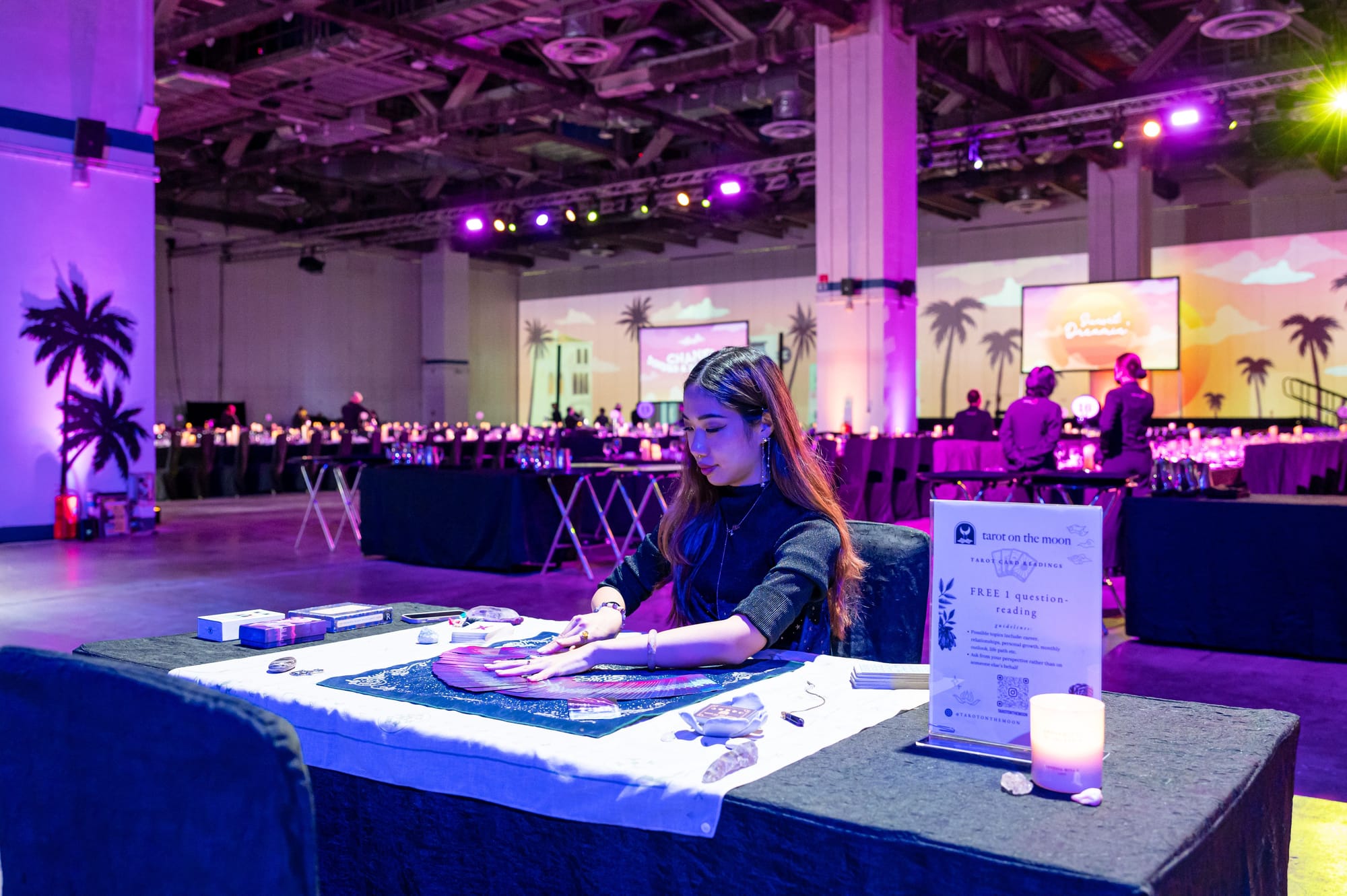
She sees tarot as reflective, not deterministic or predictive, deploying the cards’ symbolism to tell a story. “I don’t want to prescribe a solution for you,” she explained. “I’m here to mirror your life back at you…you notice things that you might not be consciously aware of in your everyday life. Your focal lens changes.” True to her storytelling leanings, she often pairs tarot with her creative interests. Like literary tarot pop-ups with online bookshop Wormhole, bundling readings with book recommendations or mystery books. Sessions range from S$15 to S$50, depending on factors like the number of questions or cards the querent pulls. She also aligns her work with sociopolitical and ecological causes, aiming to deepen and expand her audience’s worldview. There was the podcast she recorded with “The Political Prude” before the general elections. She’s done readings at an Earth Day event by the circular fashion platform Swapaholic, and has been vocal about her pro-Palestine advocacy. The latter included donating part of her Chanel gig earnings to Medical Aid for Palestinians. One of her recent social media posts reads: “A divinatory and/or spiritual practice that doesn’t address widespread violence misses out on understanding larger forces that drive grief and injustice.”
In cosmopolitan Singapore, Chinese metaphysics, Indian traditions, Malay mysticism, Western esotericism, and New Age spirituality intersect. But globalisation and consumerism have converted spiritual succour into big business—stripping esoteric traditions of historical, political, and cultural depth. In Selling Spirituality: The Silent Takeover of Religion, religious scholars Jeremy Carrette and Richard King argued that privatised spirituality lets corporate powers repackage and rebrand religion as a lifestyle product to sell “in the marketplace of ideas”.
Spirituality, they noted, has become a “new cultural addiction”, a “panacea” for contemporary angst. Technology, via apps like Co-Star, has likely accelerated its spread. The global astrology industry is projected to reach US$22.8bn (S$29.2bn) by 2031.
Mok acknowledged the pull of the market, conscious of the tightrope she walks, balancing organisational and individual clients to ensure she retains a level of independence in her practice. She also conceded that it was difficult to be completely free from the lure of consumerism, noting that to reject her position within the capitalist system meant bypassing an aspect of society that impacts her material conditions. “We have rent to pay and a living to make. So I do have to charge for my services,” she asserted. That said, Mok insists on values-based practice—sliding scale rates to keep readings affordable for private clients, higher fees for corporates with deeper pockets, and surplus income channelled to mutual aid. “Healing shouldn’t only be for the financially privileged.”
Dea, Mok, Luna, and Tuan refuse to be reduced from knowledge-holders to trifling cultural vendors.
Their syncretic practices reassert self-empowerment and openness, allowing the dysfunction of their earlier relationship with religion to inform, rather than cripple, their desire for reenchantment. Local languages, symbols, and cosmologies are often whitewashed and ‘Goop’-ified for export—think jade eggs, mindfulness-lite and the Om symbol stamped on jewellery and bumper stickers. But these practitioners distil from them an antidote to homogenised global spirituality.
Mok centres authenticity: “…seeing everyone as human beings with stories to tell and listening with earnest and open ears.” Using tarot to build community has been transformative: participants draw cards, share reflections, and foster dialogue and collective growth. “I believe in collaboration more than competition,” she said, and within these “diverse, safe and brave spaces”, people connect with themselves and one another. Others do the same: Tuan runs pay-what-you-wish journey circles for men to “drop the mask and get real”. Dea acts as a “pit-stop”, guiding clients to solutions or other practitioners, keeping prices low with local ingredients and materials.
Twenty-two years have passed since Luna confronted her first hantu. Behind her luminous eyes lies a steely conviction, her youthful anguish tempered by the realisation that life isn’t to be taken too seriously. She credits her hard-won equanimity not to herself, but to her practice and celestial advisors, grateful to be “chosen” to “carry out God’s work” after witnessing her clients’ lives transform.
“Once you let go [and] try to find peace, everything will come much easier,” Tasha recalled Luna telling her. They’d met through a mutual friend, and she had first dismissed the readings as a gimmick. But the cards proved uncannily accurate—naming her anger issues and foretelling the mental and financial toll her nursing job would take. “It really happened…I was very surprised. A stack of cards can tell you that?” Luna didn’t just dwell on the negative; she offered a way through, but only if Tasha was willing to work for it. “She told me it was important to be my own boss. You’ll never be happy working for other people.” Tasha started her own business and life improved. “It’s slowly made me a better person…I’m very grateful to her. I wouldn’t have the peace I have now.”
For Reena, Luna’s aura-opening rituals quieted her restlessness. Focus and meditation came easier, and the shrine deepened her bond with her Hindu gods. But the most profound change was at home. “I had insomnia. I would snap at my husband [and] daughter. It mentally exhausted me. I’ve become more composed, grounded, thankful. I used to always want more, but I’m satisfied…People perceive me better.”
Some turned to Luna and her peers for clarity when modern psychology fell short.
Ailee, meanwhile, approached Dea online at The Unnatural Oracle for deeper insight. A tarot reader herself, Ailee believes that tarot and divination are waypoints—markers along the journey to one’s better self. “It’s about developing a relationship with the divine,” she said. “I’m a lot happier. I used to be anxious, resentful. [S]pirituality…taught me to be impartial, to appreciate the smaller things.” Now, she moves through life one step at a time, trusting she’ll recover from setbacks, certain that “divine guidance” walks beside her.
Not unlike Jesus walking beside a believer, Christians might contend. In an unregulated spiritual marketplace, scepticism remains necessary. What makes a practitioner credible, and not just another charlatan, when they’re simply piecing together practices that suit them? How do we know we’re not sipping artisanal Kool-Aid, snake oil in sleeker bottles? Should we trust word-of-mouth, do our own research, or rely on direct experience? For most clients, it’s a mix. Some have nurtured a lifelong relationship with the occult, others dabble but remain sceptical for religious reasons, the rest are curious, if cautious. The motivations are timeless: help with love, career, health, fortune, and coping with the uncertainties of the future; as well as the longing to connect with the divine beyond the body.
“You have to learn to sieve through the bullshit based on experience and judgment,” said Reon, a Buddhist-raised client of Luna’s. Drawn to the occult during their teens, it just seemed “so much cooler”, they still balance science-based treatments with traditional beliefs. “Western medicine and Luna’s methods [melukat purification ceremonies and minyak pasupati virgin coconut oil concoctions] work in tandem to heal me.”
For Tasha, ethics matter as much as efficacy: “Do your background checks. See what they’re saying—[does] it make sense, does it sit right with you? I stuck with Jero Luna because she aligned with my morals. I agree with what she stands for.”
Syncretic spiritualism is invention, not obedience. In this creative act of becoming—a kind of spiritual authorship—belief is chosen, shaped and renewed. Self-making, in this sense, is repair: a reclamation after disillusionment; an attempt to restore balance between the natural, the empirical, and the sacred. For Luna, it’s the patient labour of deities. For Tuan, a return to the divine through a library in the sky. For Dea, a splice of magic that honours ancestry and self. And for Mok, an alchemy of story and symbol, distilled through reflection.
Mere superstition, or plain delusional? The label matters less than the fact that every era reinvents what Susan Sontag once called “the project of spirituality”. In Styles of Radical Will, Sontag saw art as its modern incarnation, a means to wrestle with the human condition. A yearning to find meaning and purpose; to confront the paradoxes of existence. Ours is an age of re-enchantment. By mixing the imported with the indigenous, these practitioners are writing their own scriptures in real time: a blend of magic, ritual, and ancestral remembrance.
The turn to the esoteric is not to repudiate therapy or organised religion, but a recognition that neither alone can make us whole. And that together, perhaps they can.
“God is in everything,” Reon tells me. “… in the community cat sleeping on the bench…in the soggy receipt becoming one with the grass in the rain..in the old man spitting on the sidewalk…” The point of spiritual practice, they conclude, is to “fill us with wisdom, justice, and love.”
Faith without fear. Freedom without rigidity. These are the currencies of our time, buying passage back to the divine. Towards the gods we remember, the gods we abandoned, and the gods we dare to invent.
Waye is Jom’s co-founder.
This piece was first published in Jom’s annual print magazine issue No. 3, released last year.
Letters in response to this piece can be sent to sudhir@jom.media. All will be considered for publication on our “Letters to the editor” page.