
“Bring your shoes in, they’ll get stolen.” Before CCTVs were installed at the staircase landings and corridors, that was my mum’s standard greeting to guests to our rental flat. Over the years I’ve had my rollerblades (thrifted from Cash Converters), a knockoff Yeezy hoodie, multiple pairs of shoes, and even an umbrella, stolen. Before this unit we were living in a three-room HDB flat in Bedok but—in a story familiar to others, I’d later realise—multiple financial missteps forced us out of our home and into the public rental flat system. My memories of the move are hazy, I was nine. Scavenging cardboard boxes. The noisy shredding of masking tapes. The rallying of help from extended family members. I remember sitting at the back of my uncle’s lorry, alongside some chairs, several boxes, and foldable mattresses. The journey took 25 minutes and once everything was unloaded, I sat in the new living room playing Purble Place.
Before she moved out, my sister and I used to share the same bed. Our bodies negotiated inches and my mornings were greeted with her drool on my pillow. Outside, in the living room, my parents sleep on single mattresses unfurled in front of our TV console. My father’s snores carry through the flat, cutlery clanks at midnight as instant noodles are prepared, the sounds of the bathroom tap running echoes without restraint. Sound moves easily here, crossing the short distances between rooms.
As a Malay rental flat dweller, it’s hard to not feel like I’m living the stereotypical Malay experience—one that is shaped by prejudice and misrepresentation. Online, you’ll see forums or videos associating Malay identity with a litany of social ills: teen pregnancies and marriages, health deficiencies, deviances, and dysfunctional families. The typical “type M” behaviours. While scholars have problematised such reductive views and called for a more structural and empathetic understanding of the “Malay problem”, the caricature still persists even in mainstream media reportage and national speeches.
Meanwhile, intra-community tensions are sometimes captured through the phrase “Melayu makan Melayu” (Malay eat Malay). It’s a colloquial expression that describes the sabotaging tendencies of envious individuals towards more successful counterparts, often through gossip. Variations exist elsewhere: crab in a bucket mentality, sour grapes, and the more local vernacular of “sinkie pwn sinkie”. But uniquely, Melayu makan Melayu adds a layer of race to this zero-sum mentality. The lack of Malay representations in successful positions (through official statistics) and the caricatures of “Malay failures” (through informal online commentaries), serve not only as “proof” of racialised community failure but also convey the illusion of scarcity—there are limited number of spots for Malays who need to fight among themselves to secure one. Those at the top must do their best to maintain their position, those at the bottom must use whatever means to climb up. This is the narrative I grew up with. Through interviews with 12 other rental flat dwellers—some identified below through pseudonyms—I’ve tried to unpack and situate it within the context of their aspirations as well as their lived realities.
In 2020, The Straits Times (ST) reported that the proportion of Malay households living in 1- and 2-room HDB flats rose from 8.7 percent in 2010 to 16 percent in 2020. This was a much higher increase than for Indian (4.9 percent to 7.7 percent) and Chinese (4.6 percent to 6.5 percent) households. In 2021’s National Day Rally speech in Malay, Lee Hsien Loong, then prime minister, said that “we must help more households in rented flats recognise that renting is only a temporary housing solution, and to encourage them to stabilise their income so that they can move towards home ownership, and progress with the rest of society”.
In Singapore, homeownership is a cornerstone of national identity that shapes citizens’ aspirations. This is largely due to public housing being central to Singapore’s social compact, underpinned by a financing system that binds homeownership to the Central Provident Fund (CPF), a compulsory savings scheme, and an array of state-backed grants and loans. By allowing these savings to be channelled into housing purchases, the state has rendered homeownership not merely attainable, but foundational to everyday economic security: the red-hot property market has allowed home owners to grow their nest eggs more quickly than through many other investments (including the guaranteed 2.5 percent interest from CPF).
Yet access to this promise is tightly regulated. Public housing eligibility is governed by a dense web of bureaucratic categories—citizenship, marital status, and age. Singaporeans between 21 and 34 can only buy public housing if they conform to a narrowly defined, heteronormative family nucleus (orphans and widows above 21 can buy a HDB flat). Those who do not, like (unmarried) 27-year-old me, must wait until 35 (or turn to even pricier private housing).
The Public Rental Scheme functions as the state’s primary form of social housing—covering, by 2020, some 50,000 households. Heavily subsidised, with rent starting as low as S$50 (and up to S$400) a month, it nonetheless mirrors many of the same bureaucratic constraints. Applicants must be Singaporeans, without property, unable to afford alternative housing, and without family members who can house or financially support them. Monthly household income is generally expected not to exceed SS$1,500, though applications are assessed on a case-by-case basis.
Between 2016 and 2020, HDB received an average of 7,500 rental-flat requests annually, approving only about 2,600 each year. Rejections were commonly justified by assessments that applicants did not meet the aforementioned criteria. In 2023, however, some 9,000 rental flats were occupied by households earning above the stated income threshold—an indication of how discretion, rather than rules alone, governs the system.
The block my family lives in is low-rise (nine floors), with units protected by beige gates that still use a skeleton key. It’s nestled between landed housing and other HDB blocks. A short jog southwards and you’re greeted with private properties—condominiums, terraces, and bungalows. I listen to the splashes of their swimming pools, and am awed by their interiors. These jogs offer both respite and resentment. When frustration builds over my predicament—staying in a cramped home at what feels like an already-ripe age—I find myself Googling the prices of these houses. Oh, it’s a little over a million. Jog a little further down and the landscape shifts, into the wealthier enclave of Novena. This proximity of interweaving social strata offers a sense of accessibility that masks wealth inequality, how far apart our everyday lives really are. Look closer and other traces emerge. Cardboard boxes tucked into corners of public spaces. Figures resting on benches into the early hours of the morning—people with nowhere else to go. My sister moved out of our home when she was 23, when she got married and bought a home. It’s quite scary to realise sometimes that my desire for romantic relationships is partly shaped by my desperation to move out of the rental flat. Public housing policy operates as social policy too: reinforcing marriage, and positioning flats as matrimonial assets.
Marsha’s experience with applying for a public rental flat reflects the system’s elusiveness. “Initially I applied [for a public rental flat] and was rejected. Simply said, I bought a house before,” she told me. Marsha, an orphan and the sole breadwinner for her brother with disabilities, lived in a purchased HDB flat until it was taken away from her after she’d defaulted several times on her loan repayments. She added, “how can I afford a house while supporting my younger brother? One mistake and the house will be withdrawn from the bank [again]”. While at times a little brash, her husky voice often carried a commanding presence even when her internet connection wavered in-between syllables. For 15 years, she was suspended in a kind of administrative limbo: unable to purchase a house or afford to rent in the open market, with no relatives to seek shelter with. Her only option was to live across the causeway. An in-between state, of countless entries and exits from immigration checkpoints, her life became shaped less by personal choice than by policy architecture.
The inflexibility of the public rental flat scheme seems intentional and reflects a broader logic underlying welfare provision in Singapore. Aid is non-universal, shaped by a persistent anxiety over “free-riders”. Welfare is framed not as a right, but as a last resort—recipient assumes labels of dependency and moral failure. As sociologist Teo You Yenn observes in This Is What Inequality Looks Like, Singapore’s system is “residual rather than comprehensive, narrowly targeted (through asset and means tests), and highly conditional.”
The conditionality embedded in this system carries social costs. Since access to welfare requires applicants to repeatedly prove and quantify their “deservedness”, support is often inadequate and accompanied by a sense of indignity. Teo recounts numerous instances where respondents chose not to apply for assistance because “the process is so difficult and, even more astoundingly, because they think they should ‘leave it for others’ in greater need.” Perhaps all in the name of self-reliance, one family’s hardship should be endured for the greater good of imagined, more impoverished families.
Marsha’s experience echoes this pattern. Her move into a public rental flat came only as a last resort. Although her job as a marine delivery driver pays between S$2,500 and S$3,500 a month, her cash flow was persistently strained. She described in exasperation, “[d]on’t assume just because someone’s salary is big, they’re able to afford everything. They [outsiders] don’t think about what’s behind closed doors. My debts with the government, they don’t know about that.” In 2020, the Covid-19 restrictions made it increasingly impossible for her to re-enter Singapore for work. Out of desperation, she appealed directly to a local Member of Parliament (MP) for access to a public rental flat. She pleaded, “If you don’t want to look at me, look at my brother with disabilities. Just because my salary is big, I can’t get a rented flat? How can I live like this? I can’t possibly go back to Johor Bahru every day. What if my brother is sick? How can I possibly have a domestic helper? If I was rich, I wouldn’t have to approach for help.” Her appeal was successful and she eventually moved into a neighbourhood close to Lavender.
Social assistance in Singapore, in keeping with the ruling party’s longstanding aversion to welfare, rests on three principles: encouraging self-reliance, positioning the family as the first line of support, and mobilising community organisations under the banner of “Many Helping Hands”. This involves non-state actors voluntarily meeting the needs of less-resourced Singaporeans. The state acts as “the coordinator, facilitator, and regulator of social service provision under the umbrella of a quasi-governmental body, the National Council of Social Services, through a network of religious and nonreligious welfare organisations”. In 1991, former prime minister Goh Chok Tong said that “[c]ommunity organisations know the problems of their community best”, adding that shared cultural ties enable them to provide “warm, emotional support much better than an impersonal, efficient bureaucracy.”
The four ethnic-based Self-Help Groups (SHGs) exemplify this approach: The Chinese Development Assistance Council (CDAC), Singapore Indian Development Association (SINDA), Yayasan MENDAKI, and the Eurasian Association. While these organisations receive some funding from the state, the majority of their operations are funded by community members—philantrophic donations and a (opt out) wage deduction mediated by CPF. Muslims, for instance, are expected to contribute to the Mosque Building and Mendaki Fund—monthly contributions range from S$3 to S$26, depending on income level. This approach may also be a byproduct of the racial tensions that marked Singapore’s early years of independence, framed as a means of uplifting communities without provoking racial sensitivities.
When census data revealed an overrepresentation of Malays living in public rental flats, Project DIAN@M³—an initiative by three key Malay-Muslim institutions, MUIS, MENDAKI, and PA MESRA—was introduced to tackle the “problem”. As a form of SHG, it aims to “guide” and support Malay families in public rental flats in their efforts to become homeowners. Masagos Zulkifli, the former minister-in-charge of Muslim affairs, attributed this overrepresentation of Malay dwellers to their participation in gig work (such as delivery riders) as a permanent career, where they lacked CPF contributions that can be used to purchase public homes (this was before the implementation of Platform Workers Act in 2025). “We are worried that it will be an entrenchment of our community within this rental paradigm”, he claimed.
Poverty, and the attendant media reportage and social initiatives, contribute to the production of a racialised underclass. Malays are overrepresented in public housing, and our socioeconomic outcomes are often scrutinised against the implicit standard of what an idealised, self-sufficient citizen should look like. Policies targeting low-income families generally adopt a “raising aspiration” strategy—a disciplining tool intended to “nudge” particular communities into adopting ideal attitudes, dispositions, and desires. The Community Link (ComLink+), a scheme by the Ministry of Social and Family Development (MSF), is one such example. Briefly, the scheme aims to: raise the attendance rates of lower-income children in preschools; help adults secure jobs paying at least S$1,400 per month with CPF; and assist lower-income families with debt clearance.
Likewise in project DIAN@M³, improving employment outcomes of dwellers is aimed at ensuring they are in “stable jobs” that follow this specific definition, as it is seen as fundamental for dwellers to gain homeownership. Collaborating with MENDAKI SENSE, families are “guided” to use their SkillsFuture credits to upgrade their skills and provided with career counselling. Targeting mothers, the Women at Work (W@W) programme aims to “Restart, Rebuild, and Re-integrate” women who have been unemployed for more than six months into the workforce. Through skills upgrading, capacity-building, and job matching, the initiative is aimed at promoting dual-income households by ensuring women remain in the workforce.
The challenge of pushing a definitive idea of stable employment to rental flat dwellers is that a substantial number of them are divorcees and among them, women disproportionately shoulder the responsibility of being both the caregiver and breadwinner of their children. (Synonymous with gendered caregiving norms elsewhere.) Moreover, there isn’t a sense that “the village” around can be trusted to help. Rental flat dwellers sometimes adopt a protective parenting style as they perceive the neighbourhood to have a higher prevalence of deviant behaviours. Two of my interviewees recalled childhood experiences of seeing syringes and glue canisters at their staircase landings. Parents often disallow kids from mingling with neighbours. Yenni, a 37-year old mother of three children, described the neighbourhood kids as “impudent” and it “feels like their parents do not care enough for them”.
Through anecdotal experiences discussed on online forums and media reportage, there’s a narrative that suggests that dwellers living in rental flats behave differently from those in purchased HDB housing. The “bad” rental flat dwellers are caricatured as people who litter cigarette butts at communal spaces and play loud music through the night. These are behaviours that are seen as bad influences for the “good” children living in purchased housing. The neighbourhood space is then stigmatised by association with unfavourable behaviours.
The relative care shown by owners versus renters is a topic of rich inquiry globally. Economists define “rental externality” as the impact on a property’s quality through possible overuse by tenants and undermaintenance by landlords. Such incentives, as well as available resources—perhaps renters have less money to spend on upkeep—may explain differences. Yet in Singapore we tend to attribute it more to individual character and behavioural flaws. (“Rental flat dwellers have no sense of ownership of their space”, a town councillor once told me, in response to a public area that had become dirty quickly.) By virtue of living in a rental flat, dwellers are marked as a racialised underclass—an identity produced by outsiders that dwellers themselves can rarely contest. They themselves then partake in isolation strategies in attempts to differentiate themselves from other dwellers. (We’re not like the other Malay renters.)
Loïc Wacquant, a French sociologist known for his work on urban marginality and race inequalities, has found a similar pattern in his transatlantic fieldwork on the hyperghettos of inner Chicago and declining housing estates of outer Paris. He found that residents articulate narratives that disparage their own neighbourhoods as “nests of social vitriol, vice, and violence”. The stain of dwelling in such neighbourhoods is deemed as a sociomoral purgatory which reifies, validates, and perpetuates the narrative. To negotiate this, residents hide their addresses, don’t invite guests over, retreat into the family sphere, and don’t get involved in local organisations or communities. Similarly, after becoming more aware of my class status in primary school, I never invited my peers over to my place, let alone admitted that I was living in a rental flat. I still feel a constant humming fear that my state of housing will override my identity as a person. As it is, it shapes every interaction of mine, from friendships to romantic relationships—structural conditions bleeding into personal lives.
My conversation with Nora, a 53-year-old single mother with four sons, illuminates the uneasy feelings parents living in rental flats endure. As a homemaker, Nora was scrutinised for not having a job when she sought financial help during a Meet-the-People Session with her local MP. “Eh I got four boys, I need to supervise them,” she responded when asked by the staff why she remained unemployed. Further explaining, Nora added, “of course it'll be good if I got a job but it’s difficult to get a good job. It’s either my boss is bad, or my colleague is bad…If I want to succeed, I have to suffer. But I have suffered enough, and I cannot endure anymore. Why would I want to suffer again?”
Her response points to something policy frameworks often overlook: working conditions. Stability and flexibility alone are insufficient if working conditions are unsustainable. For low-wage workers, these conditions are highly dependent on their luck and the benevolence of their employers (as opposed to enshrined workers’ rights that all are aware of and respect). At times, stable employment comes with unfavourable working conditions that make jobs difficult to sustain in the long run. For instance, while Marsha’s salary was higher than what is typically considered “low-income”, it came with laborious work hours and low bargaining power. She worked consecutive days of long hours and overnight shifts, until one day, she dozed off briefly while manning the ship. That led to a three week suspension. Her salary was disbursed late and at the height of Hari Raya festivities, she had to turn to her “basikal buruk” (rusty bicycle), to work as a delivery rider so she could feed her family. Despite its limited protections, gig work serves as a backup that at least provides a source of income and flexible working hours where workers’ autonomy is somewhat respected.
When I asked Marsha about her neighbours, she said “[s]ome are okay, some are not okay”. Her attitude is shaped by indifference and reluctance to mix (tak campur). “Sometimes I feel stress about neighbours, cost-of-living, and money. But I try to adapt. I focus on my brother, family is more important,” she explained further.
Eight of the 12 people I interviewed are Malay women. Among them, five shared a similar sentiment of tak campur when describing their relationships with neighbours. Yenni described a contrasting experience when living in a purchased flat as opposed to a rental flat. “Eh, last time when [living in a] purchased flat, the type of place is different. We will always exchange dishes…but for this floor [of her current rental flat], we exchange food while we gossip. [It’s as if] there is a lot of free time to talk about other people…Because of that I don’t like it,” she shared.
Similarly, Lisa and Hayati, both 53-year-old married women who worked as hawker assistants, saw tak campur as a preventive measure against gossip which would lead to unsavoury rumours. Lisa said, “when talking to neighbours, later they will gossip, so I don’t like it. Actually, I don’t like it since long ago.” Hayati explained that, “…scared later create problems, if we continue like this [gossip] we can start conflicts”.
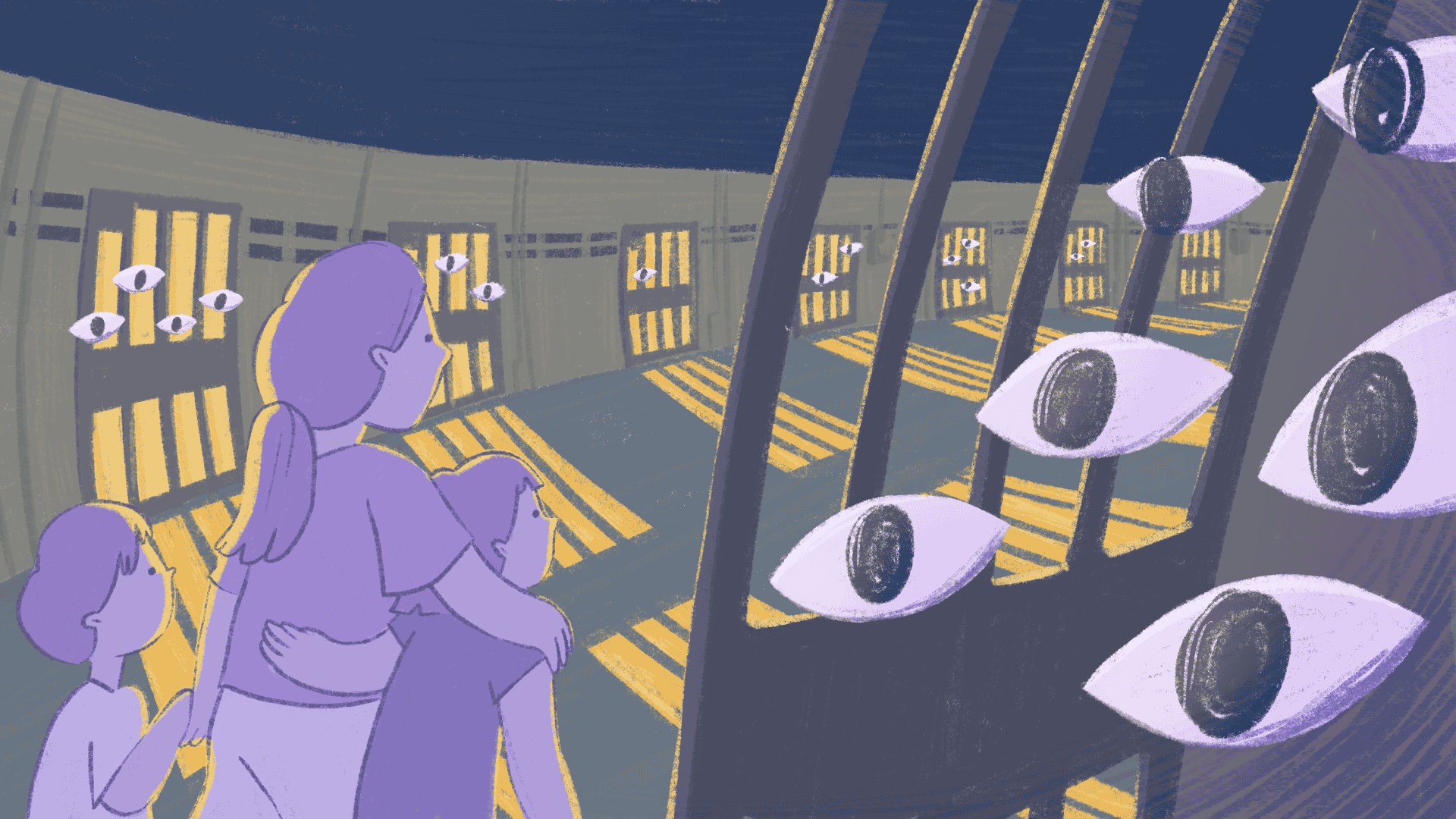
Tak campur is a self-isolation strategy that dwellers adopt to manage and protect themselves from having their identity being “stained”. The architecture and layout of rental flat blocks contribute to a spatialising effect on gossip. There are two types of public rental flats: two-room and single-room, L-shaped flats. In L-shaped flats, the living room doubles as the bedroom. Privacy is brief and conditional, marked only by the closing of a bathroom door. Next, their corridors are lined with houses that are staggered so they face each other at a narrow diagonal, a small mercy that spares you from direct eye contact with your neighbours when unlocking your gate. Without leaving the home, you can hear a neighbour’s karaoke drifting through your Sunday afternoons or smell the acrid bite of their antiseptic floor cleaner at four pm. This proximity blurs the public and the private, a panopticon effect where you feel constantly under surveillance, right in your own home.

Many of the rental flat dynamics—shame, eagerness and gratitude for help, the perceived dangers of mixing and gossip—are evident when SHGs volunteers distribute door-to-door welfare packs. It’s a scene familiar to me. Perhaps because my block sits within a constituency with the highest number of private properties in Singapore, our flat has long felt like the district’s token site of charity. My family has been incredibly lucky to receive help from various SHGs: church volunteers distributing loaves of Gardenia raisin bread during Christmas, bubur masjid from mosque volunteers, and the occasional Halal mooncakes from the senior activity centre.
But other times, a more awkward interaction unfolds. For instance, students doing their mandatory community service distributing canned sardines, instant noodles, and other non-persishables while conversing via a script off their phones. Then, there are distributions by staff dressed in white accompanied by flash photography from a DSLR camera. Goods passed from hand to hand. A forced smile captured mid-morning, my hair usually uncombed and pyjamas still on. In these moments, we’re meant to feel gratitude because how can you enjoy a free lunch without swallowing a little bit of your dignity? These images might eventually circulate on the Facebook page of someone with relative authority. A kind reading of this is the importance of signalling the state’s care of our least fortunate; a more cynical one is the production of poverty porn for political currency.
This sense of transaction and conditionality is intensified in neighbourhoods like the mature estates of Bukit Merah and Toa Payoh, where rental flats are clustered. When resources are seemingly scarce due to an uneven distribution, residents’ deservedness is subjected to heightened scrutiny. Marsha was once denied a welfare package as there were rumours that her salary was “too high”. She articulated her discontent as racialised betrayal: “although we’re all Malay but if we tell them one thing, they tell their friends another thing”. What began as informal talk within the community had material consequences, shaping who was seen as deserving of aid and who was not.
Scholars have argued that gossip, an exchange of information between two or more people about another, plays a significant role in social settings, becoming a form of “democratic surveillance” among less empowered communities. Everyone regardless of social status can access and exchange gossip. Those who are powerless can become powerful by controlling and steering the direction of an exchange or gossiping episode. What’s notable about it is it often deals with information where there’s discrepancies between the “impression” and “reality” of the concerned person—Marsha having a “high” salary while being a rental flat dweller. At times, gossip is a form of envious undermining intended to implicate the reputation of the individual being gossiped about. This envy is rooted in the “unconscious experience of loss of good and the powerlessness to reclaim it”. The “good” is something desirable—status, security, money—that the gossiper does not have and cannot get. Thus, their aim is to diminish it in one who does.
Yet, gossip is at odds with the Islamic ethic of “jangan bukak aib”—never expose what should remain veiled. A quiet instruction many Malay-Muslims grow up with, which tells us to not discuss our personal fractures or those of others, whether it’s family disputes or the slow unravelling of a marriage. To speak is to risk turning pain into spectacle and eventually, slander—an act understood in Islam as among the gravest of sins. Marsha’s experience reflects why this ethic exists: what begins as casual talk can harden into unchecked rumour with real-life consequences.
This brings us to the notion of “Melayu makan Melayu”. Often viewed from a cultural deterministic perspective, structural problems of income inequality and poverty cycles are rendered as community faults. Those who have failed to climb up must resort to sabotaging their peers as it’s the only way in a system that feels like it’s working against you. As a result, it’s not uncommon for many of those who have become a successful model minority to exhibit a defensive othering—separating themselves from the rest of the Malay community (I'm not like other Malays). This division leads to fragmentation that intensifies intragroup rivalry, where interactions that can mediate empathetic understanding of one another are precluded.
Yenni discussed her aspirations with a mix of despair and racial determinism. “[M]ost Malays have business mindset but no capital…But some have capital but their friends, whoever, not just friends lah…family members would also potong jalan (interfere with intentions to sabotage).” She added, “for the Chinese, everything they want, they can get. But for Malays we have to go step by step… For Chinese, if they want to upgrade, it seems easy…They have strong support…” Her reflections reveal how everyday interpretations of inequality are shaped not only by lived experience but also by circulating narratives about race, opportunity, and support.
These internal tensions do not emerge in isolation. They are shaped by broader public narratives. In the past, Malay National Day Rally speeches followed a broad pattern: celebration of Malay’s achievements, then a pivot to problems such as rental flats, students falling behind, women needing empowerment. (This pattern has become less pronounced in recent years.) Kamaludeen Nasir, a sociologist and associate professor at Nanyang Technological University, has described this as a “celebration of the deviant”. The achievements function less as endpoints and more as a backdrop against which deficiencies are measured, keeping the community perpetually in a state of monitored progress. The repeated use of individual success stories is also significant. By spotlighting exceptional Malays, the speeches frame achievement as a matter of personal effort rather than structural change—which preserves the deficit narrative for those who don't make it into the speech.
Listening to these stories, gossip begins to feel less like careless talk and more like a language shaped by uncertainty—one I recognise intimately. This research on rental-flat communities was part of my undergraduate thesis, framed around understanding their aspirations. But, perhaps selfishly, it was also an attempt to reconcile my own memories of poverty and instability in my teenage years with the sociological tools I honed in university. While I am very lucky to have completed a bachelor’s degree, the path toward it often felt opaque and fragile. I had no close role models who had taken that route and I did not fully understand why university would be beneficial. I only applied because my peers were doing so—and even then, I rejected my first offer, unable to justify pursuing something that did not immediately generate income after my polytechnic education. It took a year of working, and nagging from my relatives, before I applied again.
When you grow up without safety nets, future planning narrows to the urgency of the present. Paycheck to paycheck, month to month. Not participating can feel safer than risking failure. Disqualifying yourself becomes a form of protection. Perhaps this is what precarity does: it turns ordinary milestones into acts requiring extraordinary courage.
It is important to refract the lived experiences of rental-flat dwellers who extended trust and access to me through a sociological lens. The varied rays that emerge on the other side offer a far more nuanced, and complete picture than popular portrayals. Gossip, comparison, and phrases like Melayu makan Melayu are not simply moral failings or cultural traits. They are part of how people interpret uneven opportunity while navigating dignity, uncertainty, and survival. The challenge, then, is not only to listen closely to what communities say about themselves but also to examine the structural conditions under which they speak.
Sakinah Safiee is Jom’s head of social media and research
Letters in response to this piece can be sent to sudhir@jom.media. All will be considered for publication on our “Letters to the editor” page.