


News this week included: Tharman extols Malayan brotherhood on first state visit to Malaysia; RSIS’s Ariel Tan analyses last week’s Johor state election; economic growth eases in Q2; Singapore contributes S$2.5m to support Ebola outbreak response in Congo and Uganda; the Auditor-General’s annual report finds lapses and irregularities across the government, including 120 people entering casinos despite exclusion orders; IRAS nabs 279 high-income earners over sham tax arrangements; more seniors living alone; the tragedy of Abdul Rani, the caregiver who snapped; a Singapore international school provokes nativist backlash in Sapporo; Sheng Siong’s new S$520m facility; FairPrice to remove vegetables from at least three local farms; SCMP on how scammers are using AI-generated visuals of leaders’ faces to con you; CNA analysis of AI-generated women spreading disinformation about Singapore on TikTok; three in five PMETs not confident in identifying AI-generated misinformation; ketamine therapy at IMH for hard-to-treat depression; ST obituary of Jeffrey Low, sports journalist who coined the Kallang Roar; the Circle Line completed; some 25 ha of forest to be cleared for housing “designed around nature” in Gillman Barracks and at Sunset Way, sparking environmental concerns; and Malaysian durian parties as prices crash.
Below are the issues we explore in depth:
Our picks
Society: Poor ministers defamed
Few public figures are as polarising as K Shanmugam, Singapore’s fearsome home affairs minister. For over three years, his housing has been under scrutiny. First were revelations that he’s been renting from the government a palatial colonial bungalow on Ridout Road; and subsequently that he sold a good class bungalow (GCB) on Astrid Hill for S$88m, or almost 150 times the value of a median resale flat. With the former, he emerged unscathed from a ministerial review. And this week saw the dénouement of the latter saga, when a court found that Bloomberg and its reporter Low De Wei had defamed him (and manpower minister Tan See Leng) in an article, “Singapore Mansion Deals Are Increasingly Shrouded in Secrecy”.
Though the accuracy of Bloomberg’s reporting on both ministers’ respective GCB transactions was not disputed in court, in her judgement Audrey Lim, high court judge, mentioned “material falsehoods” and repeatedly referenced the “impression” that was being conveyed to the reader, concluding that “the natural and ordinary meaning of the Article is that the claimants took advantage of the absence of checks and balances or disclosure requirements to conduct their property transactions in a non-transparent manner, and that they did so in order to hide their transactions and avoid scrutiny that might extend to the possibility of money laundering.”
Bloomberg’s editor-in-chief, while respecting the ruling, said “we continue to believe that the ministers have imposed an extremely strained meaning on what was a solid story.” This too is our view. We worry that such interpretations by the subjects of stories will have a chilling effect on all journalists. It’s notable that while the mainstream media regularly reports on property transactions by the rich, it appears to shy away from the political elite. Put another way, such public interest journalism is not being performed by our taxpayer-funded behemoths. Sure, not all in this country would agree with this purpose. “[T]here isn’t any legal recognition or political acceptance of the media as a Fourth Estate,” SMU’s Eugene Tan told The New York Times.
But maybe there should be. This is a world where wealth and power are increasingly concentrated in the hands of plutocrats. The wealth gap between Singapore’s senior politicians and ordinary citizens appears to be widening by the day, whether through property dealings or otherwise. Unlike many other democracies, Singapore doesn’t require public asset declarations by its politicians. How might personal investments in, say, Singapore landed property, Chinese firms, or AI bias one’s policy decisions? Even if we accept that our current politicians are squeaky clean, will it always be so?
These weren’t Bloomberg’s lines of inquiry, but we worry about the judgement’s broader impact on such interrogations. In his response, Shanmugam said that he chose to “bring defamation proceedings” because if “irresponsible outlets like Bloomberg get away with publishing lies and falsehoods about public officers, it will set a new norm” that might eventually deter others from seeking public office. It’s a puzzling assertion. None of these property “scandals” appear to have affected Shanmugam’s popularity—his team romped home with 73.81 percent of the vote at GE2025. And the ruling People’s Action Party (PAP) has such a robust pipeline that it was able to introduce a whopping 32 new faces last year, nudging five MPs out after just one term.
On the contrary, beset by digital disruption and other forces, the media industry globally is staring into the abyss. The vulnerable group in Singapore is not PAP politicians but journalists. Any suggestion of victimhood by the former effectively functions as a sophisticated exercise of power. What Singaporeans should actually worry about is that one day we’ll be left only with neutered, sycophantic media outlets and lots of AI slop. Which perhaps is what some prefer.
Some further reading: Lim’s entire judgement, particularly her discussion of the Reynolds privilege, a development of the common law defence of qualified privilege in England, which the defence had argued they can rely on (she disagreed), and which touches on the balance between constitutional free speech and protection of reputation. She ordered Bloomberg to retract its original article but a copy remains visible at the bottom of the judgement.
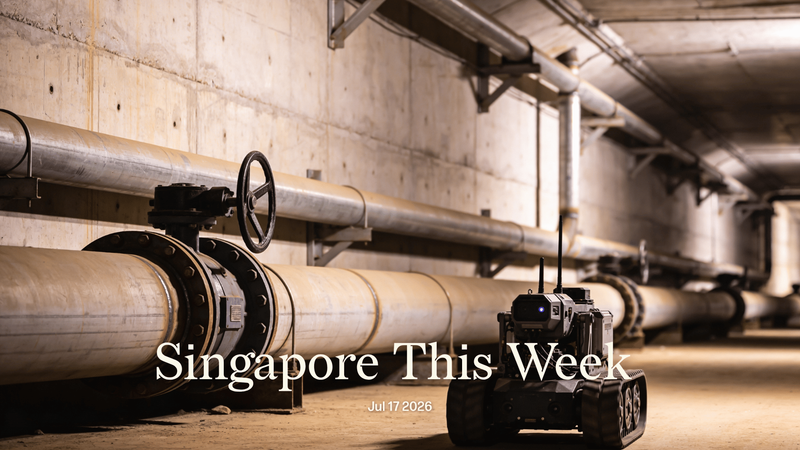
Society: Aye, robots
You wouldn’t know it from the hundreds of construction sites teeming with toiling workers—you can probably see one from your window right now and almost certainly hear it—but the sector is facing a manpower crunch. Mega-projects like the Cross Island Line and Changi’s Terminal 5 have driven up demand, alongside the surge of HDBs due to hit the market over the next few years. Meanwhile, competition from other countries has reduced the supply of foreign labour in an industry that locals still eschew. “Frankly speaking, whose son wants to go into a construction site?” a subcontractor told The Straits Times (ST), a reminder of who builds and rebuilds this shiny city.
The shortage has refocused attention on an issue policymakers have grappled with for years. “The level of productivity in construction today is just over a third (35 percent) of the level seen in Japan…Reducing our dependence on foreign labour has to be accompanied by innovation,” said Tharman Shanmugaratnam, then deputy prime minister and minister for finance, in 2012. When he was minister for national development, Lawrence Wong said that the labour-intensive nature of local construction would lead to a “far larger pool of foreign workers than we can possibly accommodate in Singapore.” Still the pool has become considerably larger. The number of work permit holders in construction, marine shipyard and process grew by 28.4 percent in the six years to 2024.
That year, economists Linda Lim and Pang Eng Fong estimated that the vast majority of Singapore’s growth in the preceding decade and a half was driven by labour and capital, not productivity. They wrote that the “heavy reliance on low-wage foreign labor is responsible for Singapore’s low productivity growth, as it removes the necessity and incentive for employers to invest in automation and skills.” The consequences of lower productivity range from depressed wages to higher inequality, warned Lim and Pang.
Government efforts to address the issue have seen limited success. Take Integrated Construction and Prefabricated Hubs (ICPHs). Launched as part of a productivity push in 2012, ICPHs are highly automated factories that manufacture concrete parts—including walls, facades, and even bathrooms—which are then assembled on site. The approach is meant to cut manpower needs while making construction two to three times faster. But only six of the 10 ICPHs announced in 2012 were eventually completed, and some operators now feel it could take decades to turn a profit. Among the reasons cited were frequent changes to government policy (storage issues and cross-Causeway competition were the others).
Attention has now shifted to robotics. JTC Corporation has made it compulsory in all construction tenders, while nearly half of new BTOs tendered since 2025 will incorporate robotic systems. Japan is a leader here. Its Naruse Dam Project used remotely-operated machines that dug, smashed, and moved material for nearly three days straight. Besides being able to work like, well, robots, machines have the potential to take over some of the industry’s most dangerous jobs, reducing risks for the migrant workers who currently perform them.
The transition won’t be painless. Robots require substantial investment upfront, and can become obsolete quickly as tech advances. SMEs, especially, may instinctively shy away. But if labour continues becoming scarcer, many could find they have little choice but to automate. Some firms built on cheap, replaceable labour will struggle to survive; others will, in the short to medium term, see their costs go up, which’ll probably be passed on to developers like HDB and end-buyers. Yet, if what emerges is an industry that builds faster, relies less on exploited labour, and makes construction safer, it’s a price worth paying. Even bleeding hearts like Jom would find it difficult to complain about robots being bundled into lorries.
For a counterview, read “The myth of low construction productivity”, in ST.
Society: The new home-based business
The slow drawing of curtains. The tumbling of laundry in the washing machine. Tables cleaned. Floors swept. Neutral palette interiors. All accompanied by light storytelling. Quiet vlogs turning everyday life into mindful practice garnered millions of views on YouTube during the pandemic. Covid-19 normalised the home as both subject and backdrop. Armed with a phone and a clip-on mic, anyone could just “create”.
Other influencers have sprung up in recent years, bootstrapping their way to sizable followings. Faizah is a local Gen Z TikToker sharing styling tips in front of her closet. Sometimes, she poses outside her home dressed in various outfits, with the HDB corridor as backdrop. The aesthetics of filming at corridors of HDB flat is iconically Singaporean but also depicts an air of effortlessness—on-the-go but stylish, chic but relatable. Faizah also hosts “Wardrobe Raid”, a Mediacorp series in which she rifles through the closets of other influencers. Invariably, viewers are treated to pleasingly tidy bedrooms and impossibly organised closets filled with carefully curated clothes reflecting a specific aesthetic. This is a big change from the past when fashion influencers would seek out stylised spaces to shoot their content, either lugging entire suitcases worth of clothes to hotels for one night or booking out an entire apartment, like the one offered by Village Marketing in Manhattan’s SoHo neighbourhood for a cool US$15,000 (S$19,300) per month.
It’s not just fashion. Geradine Toh turned her personal home renovation journey into a full-blown business. Newton Nguyen, a Vietnamese-American, began his content creation career filming cooking videos in his family’s trailer home. Today, he has billboards in New York hawking his cookbook, and a new backdrop for his 9.8m TikTik followers—a swanky apartment in Los Angeles.
The phrase “home-based business” has taken on a new meaning in this new age of social media. Instead of being a mere site of production—think the homemade bakes of the next door auntie—the home itself has become part of the product. A once private sphere turned into a hyper-public, monetisable space. But this “staging of everyday life” obscures the hard work, conscientious housekeeping, and middle-class consumption required to maintain a well-refurbished, clean home. Anthropologists have termed this “tacit labour: a collective practice of work that is understated and under-visibilized from being so thoroughly rehearsed that it appears as effortless and subconscious.” Somewhere off-camera is a tripod, a ring light, a mess pushed just out of shot. The home, once the place we retreated to when the performance ended, is now where it begins. When the front door closes behind us, the set is simply reset for tomorrow’s upload.
Some further reading: “Instagram, Typology and Architecture. The Interiors of Social Media” by Javier Fernández Contreras and Paule Perron. Two architects examined 11 most followed Instagram accounts, arguing that Instagram has transformed celebrities’ bodies and private domestic spaces into new architectural types staged for public consumption.
Arts: Act blur, live longer?
A Singaporean army camp. Chinese New Year. There isn’t a Chinese soldier in sight, and the gleeful handful of brown boys left on guard duty are counting on a relaxed evening with the minimum amount of work. That is, until Corporal Russell Lim inexplicably shows up. By the next morning, Russell is dead, and so is another Malay soldier. “Charged”, first staged in 2010, takes the flimsy fantasy of our multiracial utopia and turns it into the state’s worst nightmare. Did you think those were spoilers? Don’t worry. “Charged” isn’t a whodunit. It’s a howdunit. We know how it ends; we just don’t know how it went down. Playwright Chong Tze Chien’s tragedy about the dark side of army days is a searing account of what might happen when frank discussions about race, class, and prejudice don’t get the airing they need. “And that’s a conversation that is long overdue, because the rhetoric in Singapore is, you don’t go there because it’s a ticking time bomb,” Chong told ST in 2015. “But the conversation needs to start, because it’s about disarming the time bomb.”
Over 15 years later, the critically acclaimed play is finally getting a rerun next week, with new cast members taking on old concerns. Chong envisioned a “twisted” take on “Army Daze”, the 1990s feel-good cult flick that paved the way for the “Ah Boys to Men” multiverse. Where these warm-and-fuzzy films thrive on the multiracial camaraderie forged in the crucible of Basic Military Training, “Charged”, well, charges in the opposite direction. It doesn’t flinch from ubiquitous but unspoken racist stereotypes. That Malays are “lazy and stupid”. That Malays aren’t given senior posts in the army because their allegiances may allegedly lie with our Muslim-majority neighbours. That one might even question the sanctity of national service. Yet an early draft of the work was “too polite”, according to Zizi Azah, the play’s previous director. “It didn’t push or face racism head on, or the ugliness of racism...which is why people avoid talking about it,” she told ST. “When he [Chong] wrote the next draft, it was brilliant because it said all of the things we are so afraid of talking about. We know that it happens below the surface.”
The play was inspired not just by the politics of fear and suspicion on which much of our nation was built, but also by a real-life incident. When Chong was close to completing his national service, one of his platoonmates—who had already racked up several run-ins with authority—went AWOL. “The whole exercise was cut short because they couldn’t find him. When they confronted him, there were two things floating around: He couldn’t take it and wanted to malinger, and...that he had seen ‘something’ that told him to go home,” Chong said. “We never got to the bottom of it. But he was...made to do something like seven guard duties.”
Some further reading: In “National Service: why we need a deeper discussion”, Sudhir Vadaketh discusses the limitations of Singapore’s male-only conscription model, and what reforming NS might look like.
Arts: The epic portraiture of Chua Mia Tee
“Siapa nama kamu? Di mana awak tinggal?” What is your name? Where do you live? Squint and you can just make out the questions chalked onto the blackboard. The Malay cikgu bears a look of placid equanimity. One of his presumably Chinese students, back straight and head bowed over his book, appears to be mid-answer. These are questions so common to identity and to language learning as to be stripped of their meaning altogether. Yet these questions were new and fundamental in 1959, when artist Chua Mia Tee painted them into “National Language Class”. And before he painted parliamentarians and politicians—you’ll recognise his portrait of Yusof Ishak on every banknote—Chua was first of all a social realist painter.
Born in Shantou, Chua was just six years old when he migrated to Singapore in 1937, a pivotal year in the former colony’s history. Did he arrive in time for the coronation of King George VI in May, where—from his new home on the banks of the Singapore River—he watched parades of loyalty to the empire? Or did he witness from his window the subsequent uprisings against colonial exploitation, as thousands of rubber, coal, municipal and construction workers went on Communist- and nationalist-inspired strikes? Whatever the case, it was these workers who eventually featured in his paintings, eyes haunted and limbs shining with sweat. Chua chronicled the utopian ideals of a shared Malayan identity—but also its difficult realities.
The Nanyang Academy of Fine Arts graduate joined the Singapore Chinese Middle Schools’ Graduates of 1953 Arts Association, which despite its mundane mouthful of a name was in fact a left-leaning, anti-colonial, and fiercely proactive group of artists committed to social change. They researched the struggles of the working class, involved their subjects in their artwork, and didn’t hold back in their critique of the colonial administration. “Art belongs to the people—it is the public, and should serve the public,” proclaimed one of their catalogues. In a 1956 travelling exhibition, Chua would showcase one of his most strident and sensitive paintings about Malayan nationalist ideals. “Epic Poem of Malaya” depicts a charismatic young man, palm to the heavens, sainted by rays of light from a crack in the clouds. He’s clutching a red book and encircled by a rapt audience of peers. Chua was a master at capturing the range of reactions to a single moment, portraits of a populace that weren’t a monolith. He didn’t paint in the primary colours of emotion (anger, sadness, joy, disgust), but with all the shades of their complexion (doubt, caution, mischief, aversion). This painting was part of a fundraiser for Nantah, the ground-up university that would eventually be shuttered for its political foment. As would the leftist arts association, which was dissolved a year later, just after the 1956 Chinese middle school riots.
Chua’s leftist leanings were rehabilitated enough for him to receive the 2015 Cultural Medallion. His meticulous oil paintings of everyday people and daily life now take pride of place in the National Gallery Singapore’s permanent collection. The social realist married a hyperrealist: Lee Boon Ngan was known for her delicate and precise botanical paintings that, at first glance, look like photographs. She died in 2017, and he died last week, aged 94. Yet his work persists, portraits of a Malaya coming of age—and a Singapore now long gone.
Abhishek Mehrotra, Sakinah Safiee, Corrie Tan, and Sudhir Vadaketh wrote this week’s issue.
Letters in response to any blurb can be sent to sudhir@jom.media. All will be considered for publication on our “Letters to the editor” page.
If you enjoy Jom’s work, do get a paid subscription today to support independent journalism in Singapore.



.jpg.html?ref=jom.media)
.jpg.html?ref=jom.media)
%20copy.jpg.html?ref=jom.media)