
Our picks
Society: Men, masculinity, and mental health
About halfway through the second series of Tina Fey’s charming Netflix show “The Four Seasons”, one of the protagonists, 40-something Jack, is on the beach, deep in conversation with a new male friend. The two are talking about the grief of profound personal loss—close friends, parents. Sprawled on deck chairs some distance away, the rest of Jack’s group watches with bemused curiosity. “What are those two dipshits talking about?” asks one, a gay man, turning to Jack’s wife. They play out a bro-dude mini-sketch, all bass voices and exaggerated shrugs: “Oh I just bought whiskey-flavoured body wash,” intones the wife. “I’m gonna wash my taint with it,” grunts her companion. “Men do sound exactly like this,” giggles a third member of the mocking party. The real and imagined exchanges capture heterosexual masculinity’s current predicament. A traditional conception, in which male vulnerability is concealed beneath a gruff bravado and banter, is (very) slowly receding. A new, embryonic one in which men can be vulnerable with each other is emerging. This uncharted space is being fought over by everybody from empathetic feminists to misogynists who weaponise vulnerability to reassert gender dominance.
In Singapore, National Service plays a critical role in shaping masculinity. Young men are socialised into a hierarchical world that can “build discipline…but it can also sharpen the instinct to compare yourself against other men: Who commands, who follows? Who’s stronger, who’s weaker?” wrote Helmi Yusof in The Business Times. Thus imprinted, these individuals are then left to find their way in a highly competitive society that expects them to be stoic bread-winners, internalising their struggles.
Among local efforts challenging this patriarchal masculinity is Bros Before Woes, a group that argues for “healthier conversations, mindsets and practices around masculine identity and what it means to be a man in a modern and progressive society.” Together with 11 other groups, (a number that itself signals growing awareness of men’s issues) it has launched #mentoo, a movement to create space for men to talk about relationships, loneliness, financial stress, and modern life’s other vicissitudes.
Besides that, #mentoo has commissioned a study examining the pressures men feel at different life stages: young adults entering the workforce, middle-aged men becoming parents, and older ones confronting the prospect of retirement and loss of identity long anchored to work. “The idea is…to better understand the conditions under which men flourish, and under which conditions they would seek support or remain silent,” said Amy Lim, the Murdoch University lecturer leading the study.
Hopefully, #mentoo thrives, not least because it could occupy spaces currently dominated by the likes of Andrew Tate, and strangle poisonous outgrowths such as toxic masculinity, incel culture, and the red pill movement. The most depraved strands of these ideologies are still insignificant in Singapore, but Tate and his ilk exert a pull on the young man struggling to find his feet amid masculinity’s shifting grounds.
The only quibble is the name itself. At first glance, #mentoo can seem like a negation of or pushback against #Metoo. (Men in India have used the same hashtag to fight allegedly false claims of sexual harassment. The movement’s merits can be debated, but its framing seems to be confrontational.) But as awareness spreads, they will perhaps be seen as allies working for the flourishing of men, women, and all the other glorious strands that make up our wonderful human tapestry.
Some further reading: In “The new Gen Z male hustle”, Ee Ming Toh finds out how young men are navigating changing gender norms and economic anxiety in ways both brave and worrying. In “Boys will be boys? Masculinity in Singapore’s National Service”, Athena Thang emphasises that masculinity is not monolithic; nor should men be told so.
Society: Fighting deepfakes, protecting likeness
In December 2017, a Redditor named “deepfakes” used machine learning algorithms and publicly available videos to morph celebrity faces onto porn performers’ bodies. Shortly after, deepfakes created a subreddit that swelled to 15,000 subscribers. Most were there to gorge on the smut; some created apps that allowed anyone to make more smut. Within months, “deepfake” had entered the cultural lexicon as any synthetic media created by combining elements from actual photos, videos, and audio. Reddit eventually banned the community, but the phenomenon had already taken a life of its own. In 2020, a cybersecurity company found a bot on the messaging app Telegram that made the process even easier. It was free but users could pay US$1.50 (S$1.93) to skip the processing queue or remove the watermark on the “stripped” photos. By 2020, at least 100,000 women had had their likeness compromised by it.
While the images are fake, their consequences are real. In 2023, Mathilda Huang, a local content creator, had to request several websites to remove her deepfake nudes, a degrading and humiliating process. News of the incident invited lascivious messages from strangers online. “It felt like my inner world was too heavy,” Huang, who is still unsure about the creator’s identity, told The Straits Times (ST). That year, the number of deepfake videos jumped five times from 2022.
Cut to 2026. Users discovered that Grok, the LLM owned by Elon Musk, allowed them to create sexualised images of real people with basic prompts. A photo deluge of “stripped” women rendered in bikinis or in provocative poses ensued. Indonesia, Malaysia, and the Philippines banned the bot until the company implemented safeguards. What began a decade ago on the fringes of Reddit and Telegram has been dragged into the mainstream—and only now, after years of warnings, have governments stirred: Britain and the European Union have publicly condemned Grok, though condemnation is not regulation, and people have already found ways to bypass the LLM’s new safeguards.
Meanwhile, Singapore has passed the Online Safety (Relief and Accountability) Act to protect survivors of online harms like deepfakes, doxxing, and sexual harassment. The Online Safety Commission (OSC) created under the act has powers to force platforms to remove harmful content and unmask anonymous perpetrators. Survivors can also file reports with the OSC if platforms fail to remove harmful content within 24 hours.
However, many experience re-traumatisation during reporting processes, having to repeatedly explain their experience to different law enforcers. Acknowledging how isolating this can be, The Moxie Collective offers a space of solace for survivors of image-based sexual violence. The collective organises monthly meet-ups for members with activities like wellness sessions, book clubs, and reflection journalling circles. For those seeking more preventive measures, Image Angel, a UK organisation founded by a survivor, provides a tech solution that embeds invisible forensic marks into every piece of content, every time it’s viewed. The watermarking system allows complete traceability of images—the platform and the user who deepfaked the image.
Before machine learning, people pasted magazine cut-outs on pornographic images, then came Photoshop face-swaps. But the thicket of thorny issues, many centered on consent, stemming from AI-generated images is unprecedented. If only we were as excited to teach consent as we are to build tools that make its violation so easy.
Some further reading: In “Consent, trauma, and healing: a survivor’s (messy) story”, Cherry Tan asserts the need to embed consent as a cultural norm in her harrowing testimony of rape and molest.
Culture: The queue is the reward
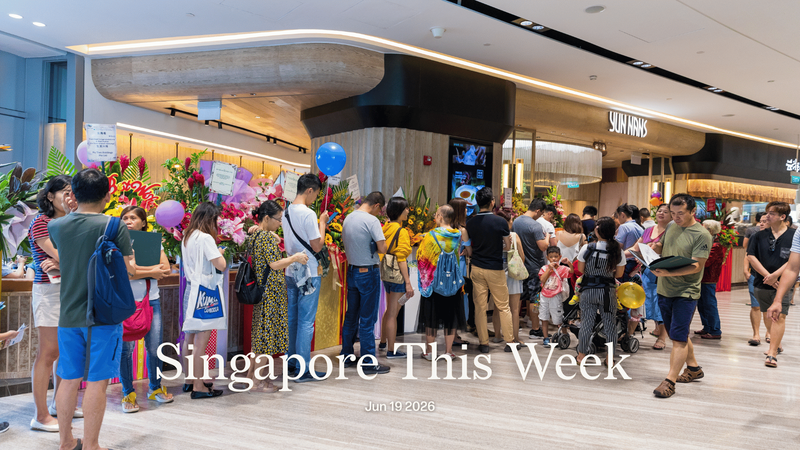
In Singapore, queuing has quietly become a ritual of its own, a form of cultural literacy, one that says as much about the people in line as it does about whatever they are waiting for. Recent consumer events, from the AP x Swatch “Royal Pop” launch to Mercury Festival’s virtual queue debacle at Suntec to Cj Hendry’s plush “Flower Market” at Gardens by the Bay, have all drawn thousands of people willing to wait hours for access to something ultimately modest in scale. In a society where productivity and “value” are constantly measured, shopping and consumption have become social activities as much as economic ones. Queuing then functions less as an inconvenience and more as a form of self-expression and validation.
Meanwhile, the “lipstick effect”, or newly dubbed “small treat culture”, refers to consumers reclaiming a sense of autonomy during economic downturns by forgoing big purchases in favour of small affordable luxuries. The Royal Pop pocket watch, at over S$500, occupies this sweet spot: special enough to feel like a treat, yet attainable relative to AP’s usual five-figure price tags. Cj Hendry’s Flower Market exploits a similar dynamic at an even lower entry point, with one free plush flower per visitor and additional stems at just S$7. The accessibility fuels the frenzy.
But the lipstick effect today is not just about the object, it is also about the act of acquiring it. Queuing has become visible, shareable proof that you were there, that you were part of something valuable. This is also where Singaporeans’ entrepreneurial streak kicks in. At the Flower Market’s opening, a now-deleted Instagram video showed visitors rushing in and stuffing bags full of Singapore-exclusive blooms, prompting accusations online that many were resellers rather than genuine flower lovers. Listings for the S$7 plush flowers soon appeared on Carousell at much higher prices.
If some queue for validation, then the backlash to these scalpers exposes the inverse phenomenon. Fewer people actually buy resold flowers or watches at a markup, and those who do rarely post about it. Without the queue, the fad disappears, and so does the social currency. This suggests that what people are truly chasing is not the object itself, but the process of obtaining it: the prolonged gratification and accompanying bragging rights. The second-hand buyers, by contrast, get the product but none of the prestige, which is perhaps why resale demand for such items, despite the hype, often quietly fizzles.
Mercury Festival’s virtual queue chaos at Suntec offers a parallel case study, minus the resale element. A viral video claimed an estimated 8,000 people were in queue at one point, joking that “the whole Singapore, plus Malaysia plus Philippines plus Indonesia are here”. Attendees shared similarly aggrieved accounts of joining the virtual queue at noon and only receiving entry notifications five to seven hours later. Yet none of this stopped people from posting, and the posting itself became the point. Ultimately, this is a society where consuming well and being seen consuming well—complaints and queues and all—is part of how people define themselves. The process has become inseparable from the product, and often more valuable than the product alone.
Food: Gut instinct
How do you get a kid to chug a probiotic? Sugar, colour, flavour. Kawaii and functionality help too. Generations of Singaporeans will remember squeezing the waist of that curvaceous bottle with one hand, while pulling the foil at the top with the other (or plunging a teeny straw in). “Original, Grape, Green Apple or Orange?” is the Yakult Singapore equivalent of “Chocolate or Vanilla?” Grown men still get weak in the knees, and drop their cans of beer, when offered that viscous portal to their youth. Which explains the tears shed around town this week following the news that Yakult will replace Orange with Peach next month.
While Coke, Pepsi, and Dr Pepper were originally formulated by pharmacists tinkering with botanicals and tonics, Yakult was born in a microbiologist’s lab. Aghast at the cholera and dysentery ripping through early 1900s Japan, Dr Minoro Shirota, attracted to preventive medicine, focused his research on microorganisms. In 1930, he cultured a strain of lactic acid bacteria resilient enough to glide past gastric juices and bile, their predators in the stomach’s murky soup, to reach the intestines where restorative magic could be performed. The first bottle shipped in 1935, and in the 1960s-70s the firm entered countries with sizeable Japanese populations: Taiwan, Brazil, Hong Kong, Thailand, South Korea, the Philippines, and then, in 1979, Singapore.
Local operations grew from three containers at Hillview Avenue to the current large plant in Senoko. Peach is the first new flavour here in 46 years. As society’s perception of sugar has evolved—the NUTRI-GRADE “D” rating is like a stain on Yakult’s otherwise salubrious packaging—the brand has responded with salutary alternatives, such as Yakult Ace Light, which received the Healthier Choice Symbol by the Health Promotion Board (aka our gastronomic killjoys).
Yakult’s health benefits are easy to overstate. Still, it was ahead of its time, an appetiser for the smorgasbord of fermented foods that have lately perfumed—or polluted, your senses depending—this zeitgeist of the microbiome: kefir, kimchi, kombucha, miso, sauerkraut, yoghurt, and whatever else is multiplying in that hipster’s cobwebbed cupboard. Humans have long instinctively understood the digestive system’s salience to wellbeing: from the ancient Greek’s melancholia, literally black bile, as a determinant of mood, to the Japanese conception of hara—variously translated as abdomen, stomach, and gut—as a person’s spiritual centre. (Hara wo kimeru, the belly has decided, just one of many metaphors.)
Our modern scientific understanding of the microbiome—the trillions of microorganisms that live in and on us, especially in the intestines though rarely in the (perilous) stomach itself—is really in its infancy. It’s been called “the second genome” and “the second brain”. “[T]here’s this sack of shit in your gut that is influencing what goes on in your head,” author Michael Pollan said recently, noting that it’s finally time to discard dualism, or the Cartesian distinction between mind and body. Ours is increasingly a world of somatic practice for bodies that keep the score. A World Appears: A Journey into Consciousness, Pollan’s latest book, questions whether consciousness itself might emanate from our bodies, rather than our minds. Food for thought, the next time you glug on a Yakult.
Sports: Boleh tahan
490BC. The sandy, pine-studded Bay of Marathon in southeastern Greece. The Greeks endure a days-long stalemate against invading Persians, who outnumber them at least two to one. Then, in a dramatic turnaround, the Greeks win, forcing the Persians to flee to their ships; in the chaos, some stumble into the surrounding swamps and drown. For the victors, enter Pheidippides, one of the greatest hēmerodromos of his time. The “day-runner”, or long-distance courier, sprints the 40km from Marathon to the Greek capital—he must circle Mount Pentelicus en route, scrabbling up and down the foothills of its imposing 1,109m—whereupon he bursts into Athens’s citizen assembly and gasps, “Nenikēkamen!” (“We’ve won!”) before dying of exhaustion. That’s one version of the story. In another, he runs a 300km out-and-back to seek the Spartans for help against the superior Persian forces. Either way, Pheidippides makes the popular road marathon, named for his feat, look like a walk in the park. The historical legend wasn’t just a marathoner; he was an ultrarunner.
And Singapore—just over 50km in length from east to west, with barely 164m of natural elevation—has somehow managed to become home to a growing community of ultra- and trail runners who are following in Pheidippides’s muddy, blistered footsteps. Earlier this month, more than 1,300 runners from 30 countries took part in the annual Ultra Trail Singapore (UTSG), running between 20km to 165km in the thick tropical heat, and scaling up to 5,246m: roughly the height of Everest Base Camp. Organisers had to be exceptionally creative about maximising race routes in a miniature urban space. In one section, runners hopped on an MRT train to shuttle them from the knolls of Mount Faber to the trails of Bukit Timah; in other categories, runners would repeatedly ascend and descend Lorong Sesuai at Bukit Batok Nature Park to gain about 65m of elevation each time. “Just for us to be able to clock the elevation, or to gain more elevation, we have to do a lot of repeats,” Edi Huang, race organiser, told CNA. “Some people say UTSG is U-turn SG.” Ultrarunner Lim Wen Yi, who’s raced in the dramatic mountain ranges of Andorra and the Pyrenees, told ST: “In Singapore, we train with a lot of constraints—to be able to cross that finish line is really a huge win for people who do not live in these kinds of native environments.”
Sadiq Mansor, freelance illustrator and winner of UTSG’s 35km category, partly attributes the growing popularity of trail running to Singaporeans’ ability to tahan, or endure. It’s a trait that’s valorised, sometimes to extremes, in endurance sports such as this one. Natalie Dau, the Australian ultramarathoner who’s been based in Singapore for over two decades, holds the Guinness World Record for the Fastest 1,000km Thailand-Singapore Ultramarathon, a 12-day feat she completed in 2024. She ran through a hip injury on the first day, then a bloody urinary tract infection that lasted seven more. But this tahan culture looks set to endure.
On the way back from Sparta, a delirious Pheidippides was visited by the god Pan. The deity demanded attention from his Athenian devotees; Pheidippides assured him of their allegiance. This divine intervention guaranteed the Greeks their victory. Ultrarunners often cite a spiritual high that buoys them through those gruelling final stretches, especially when they “hit the wall”. “[E]very so often, when our muscles are mangled and every ounce of our physical being is telling us to stop, we catch a glimpse of something much greater,” writes David Roche, ultrarunning coach. “We find spiritual transcendence.”
Abhishek Mehrotra, Maria Oshige, Sakinah Safiee, Corrie Tan, and Sudhir Vadaketh wrote this week’s issue.
Letters in response to any blurb can be sent to sudhir@jom.media. All will be considered for publication on our “Letters to the editor” page.
If you enjoy Jom’s work, do get a paid subscription today to support independent journalism in Singapore.