

News this week included: commentary by LKYSPP’s dean on Trump and the Gulf; no iron rice bowl at GovTech; over S$88bn lost to scammers in 2025 in Asia-Pacific alone; humanoids at MRT stations in 10-15 years; Sushil Nair to replace Sundaresh Menon as chief justice; crowding, inconsiderate behaviour, and air-con issues among top commuter concerns; ST multimedia piece on why the job hunt is a struggle for fresh grads; CNA commentary on the risks of a social recession here; minimum annual leave for low-wage outsourced workers like cleaners to rise from 7 to (hooray) 10 days; jail for all 19 members of Indonesian trafficking ring that smuggled babies into Singapore; overseas gambling site using local firms to collect illegal bets on the World Cup; the controversial Network School set up by technooptimist Balaji Srinivasan leaving Johor for Kazakhstan after scandal involving Israelis; middle-aged and elderly fitness through parkour; ST multimedia piece on a changing Orchard Road; Metro’s history in SG, on the eve of its closure; behind-the-scenes of the Parti Liyani case with her volunteer interpreter; NTU student project helps undergrads put phones away for better sleep; two basketballers here handed lifetime bans over match manipulation; fosterers in HDB flats to be allowed up to 6 cats in pilot scheme; and illegal tortoises for sale on TikTok and Telegram.
Below are the issues we explore in depth:
Our picks
International: The cockroach survives
New Delhi continues to convulse. Last month, Jom wrote about the satirical Cockroach Janata Party, a group of students in the Indian capital protesting against exam paper “leaks” that have plagued the country for years. At the time, the ruling Bharatiya Janata Party (BJP) was uncharacteristically restrained in its response, with one minister even affirming the youngsters’ right to protest in a democracy.
Well, it’s back in character now. Over the past fortnight, security forces slapped students, beat them with thick, nail-studded sticks, and fired tear gas, and pellets into thousands of largely peaceful demonstrators. In Mumbai, the financial capital where smaller solidarity protests broke out, police filed charges against some 300 people for “unlawful assembly and disobedience of lawful orders”. More than half are under 25 years old.
The government has refused to meet one of the protestors’ central demands: the education minister’s resignation. “Did he leak NEET [a nationwide medical exam] paper?” was another minister’s brazen riposte. Instead, its propaganda has shifted into overdrive. “The entire agitation is a drama,” said the revenue minister. A “conspiracy” to "destabilise the central government,” added one of the BJP’s regional leaders. “It is evident,” he continued, without any evidence, “the protest is sponsored.”
Nowhere is officialdom’s doublespeak more apparent than in the treatment of Sonam Wangchuk, a scientist and engineer from Ladakh in India’s far north. Wangchuk is a national hero for his work in education reform and climate change—including designing solar-heated tents for Indian soldiers posted near the border in the icy Himalayas. Or he was. After a days’ long hunger strike in support of the students, Wangchuk was forcibly removed from the protest site. Government-affiliated outlets are now trying to flip the popular narrative on Wangchuk even as ministers promise to work with him and others for solutions. (Wangchuk ended his fast late on Thursday night but the CJP has vowed to continue protesting.)
The young protestors have responded to the government’s moves with memes, satire, and immense courage. One poster read: “U FUCKED WITH THE WRONG GENERATION”. Another: “Nobody funds me. I hate this corrupt government for free”. Amid the violence, anger, and sorrow, a free-wheeling community has sprung up: student groups singing parodies of popular songs, NGOs helping out, office-goers stopping to pose for selfies with memorable posters, and people from across the nation sending samosas, burgers, and rice to fuel those protesting.
The BJP has encountered large-scale protests before and, with few exceptions, has put them down as brutally, without any serious electoral setbacks. But unlike those past movements, this one isn’t driven by narrow-interest groups. “[It] reflects a much broader cross-section of Indian society,” said Yamini Aiyar, a senior visiting fellow at Brown University. Joining the seething torrent of middle-class student anger are streams of teachers, parents, and poor and lower-middle class youth worried about a chronic lack of jobs. Most are Hindi-speaking north Indians.
“There is now a one-upmanship among political parties over who can best position themselves as the champion of India’s youth…particularly with state elections approaching in…Uttar Pradesh,” said Rashid Kidwai, a political commentator, referencing the northern state as large as the United Kingdom and as populous as Nigeria. Narendra Modi, prime minister, has announced “fast track” courts to prosecute those charged with the leaks but stayed quiet on the education minister’s responsibility. Yet even if all the protestors’ demands are met, those who oppose the ruling party for its authoritarian streak, its pitifully narrow ideology, and its congenital inability to admit wrongdoing will also be hoping voters make it pay at the ballot box for its atrocious handling of the issue.
Politics: Muslim affairs and Cabinet renewal
The position of Muslim affairs minister has its antecedents in a colonial-era arrangement that insulated Malay “religion and customs” from British interference. The current role evolved against the backdrop of Singapore’s relationship to Islam—what Lee Kuan Yew described to Hilary Clinton in 2005 as a “venomous religion”, according to Wikileaks (which he later denied)—and our unique model of multiculturalism. The tensions between a secular state and ethnoreligious practices manifest most visibly with Malay Muslims, whether with the wearing of the hijab by nurses, allowed only since 2021, or the concessions to polygyny and female genital cutting. The government’s preference for managing faith through ageing patriarchs who’ll keep the flock in line was best demonstrated by reactions to the Monday of Palestine Solidarity saga.
Masagos Zulkifli, the incumbent Muslim affairs minister when Lawrence Wong took over as prime minister, was so unpopular—his fecklessness over the hijab issue just one of many—that his team recorded one of the lowest winning margins amidst a generally spectacular GE last year. After the election Wong replaced him with (in an “acting” capacity) Faishal Ibrahim, more widely liked, partly for his boldness on Israel-Palestine issues. A bit too liked, it turns out. This week we learned that he’d been interacting with a woman online. And then stopped. She complained to Wong in a letter. At some point Faishal and she—oh, so Singaporean—filed police reports against each other for harassment. Both were thrown out. But Wong accepted Faishal’s resignation. (No by-election will be called for the five-member constituency.)
Why? What’s wrong with private, consensual communications between adults? Walid Abdullah, NTU professor, said that Faishal had mended “the relationship between the community and the government after it soured during his predecessor’s tenure”, including by engaging “as many people as he could, including those who disagreed with him vehemently”. Walid worries that “impossible standards are being set, and younger people may be deterred from stepping up to serve in politics”. For two days many other Singaporeans pontificated about the nature of the texts. Perhaps eager to stanch the gossip flow, on Wednesday evening Wong expressed his shock at the texts. K Shanmugam, home affairs minister, praised his “friend and comrade” Faishal, but admitted that “his responses [to the woman] were, objectively, inappropriate and questionable”.
Muckrakers are likely to persist till the texts are public. And politicians better be wary. Adulterous couples from both sides of the aisle were forced out in 2023 following their affairs. The details of one were leaked in an insidious manner. Shanmugam also said: “Once the lady emailed to PM, to complain about Faishal, it ceased being a purely private, consensual matter between two individuals.” While fair, it also unintentionally offers a playbook for those muckrakers: any politician from any party you don’t like—just dig up those old consensual texts, and e-mail their bosses.
All this has somewhat overshadowed the cabinet renewal. Wong has promoted many of the new wonks he cajoled into politics just over a year ago—setting the scene for the subsequent 5G leadership. While there was speculation that he might become Wong’s deputy, “Shan” has instead become senior minister, while still helming the home ministry. Vivian Balakrishnan, foreign affairs minister (and fellow Ridout Road renter), is the other seasoned politician they can lean on. And 20 years after he entered politics, Zaqy Mohamad, RI boy and (previously) management consultant, is Singapore’s new acting minister-in-charge of Muslim affairs. Good luck, babe.
Politics: KJ and the tougher path
JB Jeyaretnam (JBJ), then with the Workers’ Party (WP), broke the parliamentary monopoly of the ruling People’s Action Party (PAP) in 1981. For his willingness to challenge Lee Kuan Yew, he was lionised in many quarters but demonised by the state. So much so that Kenneth, his older son, found it difficult getting a job. “After I graduated [in economics from Cambridge] in 1983—which was two years after my father was elected into Parliament—I wanted to return to Singapore,” he told CNA. “The Monetary Authority of Singapore rejected my application after one round of interviews. A lot of financial institutions and banks also rejected my applications.”
A decade later Goh Chok Tong, Lee’s successor, sent “KJ” a letter saying “the Government has nothing against you and no employer will be disadvantaged by employing you”, adding that “[i]n Singapore, the politics of a parent will not be visited on his or her children.” But it was perhaps too late, and KJ worked in finance in the UK for most of his career. By then Philip, JBJ’s younger son, had followed his father and mother into law—but was slowly gaining establishment acceptance. He became senior counsel at a youngish 38, on the way to his appointment as High Court judge in 2021, where he still serves, admired across the political spectrum.
When JBJ passed in 2008, Lee Hsien Loong, Goh’s successor, wrote a “condolence” letter to the brothers, shocking in its reassertion of JBJ’s supposed damage to Singapore. (Thankfully others, including The Economist, penned wonderful obituaries.) KJ returned to Singapore ostensibly to continue his father’s political legacy, taking over the Reform Party that JBJ had just founded.
But for opposition politics, 2009 was a very different time from 1981. The WP was on its way to gaining critical support across the country, not only among Hokkien and Teochew speakers in the east. With Chee Soon Juan of the Singapore Democratic Party (SDP) and many others growing their public profiles—helped by social media—the opposition field was becoming crowded. Singaporeans were starting to distinguish more between them. The English-accented KJ was always going to have trouble fitting in. “You have spent a large part of your life overseas…Can you relate to the average Singaporean?” CNA had asked. “Let’s get it straight,” KJ snapped back. “Do you think that I left Singapore by choice? I couldn’t get a job here.”
The most he ever got was about a third of the vote in 2011. After the bizarre 2015 election—held shortly after the elder Lee’s passing and independent Singapore’s 50th birthday, grief and gratitude buoying the PAP—KJ did himself no favours by sticking it to the electorate. “I guess Singaporeans get the government they deserve. I don’t want to hear any more complaints.” The ridiculing of the Singaporean voter’s choices is a trope that increasingly rankles—and delivered in that British twang, no less, it simply confirmed poor KJ’s unelectability.
Still, there is much to admire about his willingness to trod the tougher path, and continue, like his father, to doggedly expose any perceived failings of PAP leaders, for instance sparking the Ridout Road saga. “Taking on the PAP needs nerves of steel, a stubborn commitment, ample resources, and a blemishless past. Ken had all of that, and more,” wrote Salil Tripathi in Singapore Unbound, following the news of KJ’s death this week at 67 (deep vein thrombosis and autoimmune disease were some of the ailments he’d been battling). The SDP’s Paul Tambyah and a letter writer in The Straits Times (ST) are just two of many to reminisce about KJ.
The PAP and WP, the only two parties in Parliament, have yet to say anything. Perhaps we still live with the ghosts of 1981.
Society: The agent in the shell
“Organise desktop files”—an instruction typed into Claude’s Cowork chatbot, the software’s agentic AI tool. An orange starburst twirls as it breaks down the command into steps. “Starting up…Working on it…Loading tools…” it tells you as it requests access to the desktop, lists all the folders and files on it, and finally, eases files into folders. Voila, a tidy desktop. (Nevermind if the files are incorrectly categorised.)
Building on generative AI’s language understanding and reasoning capabilities, agentic AI is “autonomous”—capable of operating in open-ended environments where it plans, executes, and adapts specific goals on the fly. The feature became available in most large language models late last year. DBS moved fast: within months, the bank had built 10,000 personal agents. The tech is being increasingly integrated into sectors like advanced manufacturing and government administration. Healthcare may be next. Under a national drive, new foundation models are being trained on patients’ clinical data, and a pilot study has tested whether AI agents can generate personalised health plans under Healthier SG.
The promise is real: greater efficiency, lower costs, staff freed for complex tasks. But so are the risks: vulnerabilities that could disrupt operations, expose sensitive data, or erode customer trust. Some agents (or, for now, more likely their “handlers”) could be malicious, while dangers could compound through small, innocuous slip-ups in other cases. Regulators have noticed. At Davos in January, Josephine Teo, the minister for digital development and information, launched the IMDA’s Model AI Governance Framework for Agentic AI, the first of its kind anywhere. The framework tells organisations to bound an agent’s autonomy upfront and to define the checkpoints at which a human must sign off. The market has also moved in step: Singtel now pitches its Unified SASE Convergence platform as “network guardrails for the agentic era”. Both underline the same concern: the autonomy that lets an agent resolve a customer’s problem unsupervised also lets it probe a network unsupervised.
This is no longer hypothetical. A Commvault report that surveyed 1,200 companies across South-east Asia, Hong Kong, and South Korea found that 44 percent of companies have been targeted by hackers using agentic AI to steal data and demand ransom. This week, OpenAI’s test model “acted autonomously” and unintentionally hacked into the systems of another tech startup, Hugging Face. Clem Delangue, co-founder and CEO, framed it as evidence that AI safety can only be addressed collaboratively, not in isolation.
Scale that up and the stakes change again. International conflicts are increasingly waged “below the threshold of armed conflict”, through attacks against digital systems, critical infrastructure, and information ecosystems. Guardrails must be institutionalised into international laws. On a local machine, mistakes are merely files that can be dragged back into correct folders. An AI agent loose inside another country’s infrastructure is not something you can unplug and reset.
History weekly by Faris Joraimi
The last three MRT stations on the Circle Line were finally open to the public and began service on July 12th, “closing the loop” after seventeen years of anticipation. Keppel, Prince Edward Road, and Cantonment, as the stations are called, run close along the historic waterway between mainland Singapore and the islands of Brani and Blakang Mati: once known as “New Harbour”, to distinguish it from the “old” harbour of the Singapore River estuary. In 1855 the British purchased a stretch of coast called Pantai Chermin—“Mirror Beach”; roughly where the Reflections@Keppel Bay condominium stands today—from the Temenggung of Johor, Daeng Ibrahim, to build dry docks large enough for the servicing and refuelling of steamships. Of course, this naturally-sheltered and deep waterway had been known and widely used for centuries before not only by earlier European sailors but also local communities including the Orang Selat.
I distinctly remember a public feedback exercise for the naming of these stations held years ago; speak then or forever hold your peace, I suppose. Ultimately, while local figures and place-names fade away, the new infrastructure built on these sites gives colonial history a clothesline on which to hang and weather for ages. “‘Opacity’ is the phenomenon by which place-names lose their original meaning and significance over time (becoming opaque), only to acquire new associations and memories,” wrote Abhishek Mehrotra, in his essay that explored the hideous legacies of Havelock, Outram, and Neill, blood-thirsty British generals immortalised in our streets. The Circle Line's final trio fit squarely within this Singaporean tradition of amnesia.
“Keppel” station is named after Henry Keppel, a naval officer who joined anti-piracy patrols in Singapore and took part in the 1831 campaign against the forces of Dol Said, a Malay chief of Naning who led a rebellion against British taxation. While in Singapore, Keppel drew up plans and surveys for the construction of the New Harbour, which was renamed in his honour in 1900. “Prince Edward Road”, meanwhile, commemorates the 1922 visit by Edward, Prince of Wales to Singapore for the Malaya-Borneo exhibition, over a decade before he caused a constitutional crisis in the United Kingdom by marrying a divorcée and dramatically abdicating the throne. Any number of other spatially-relevant historical sites and figures could have christened the MRT station: the nearby Fook Tet Soo Khek temple, for example, built in 1844 to serve Hakka devotees with oral traditions claiming that a Tua Pek Kong shrine already stood there before colonial times; the Habib Noh shrine, eponymously named for the most prominent Muslim saint of Singapore; or Bukit Parsi, the vernacular Malay name for Mount Palmer, where businesses, homes, and institutions of the Parsis—that distinct Persian-descended, South Asian community—once stood.
The most disorienting of the lot is “Cantonment”. It’s named after Cantonment Road, located 400 metres away from the station, which itself is located directly underneath the former Tanjong Pagar Station of the old Keretapi Tanah Melayu (KTM; “Malayan Railways”). I’m not sure if Singaporeans used to think, deep down inside, that the KTM station and Cantonment Road are really the same place, but here we are. (One good thing is improved accessibility to Singapore Art Museum, see next blurb.) The road was named after the military quarters, or cantonments, of the sepoys way up around Pearl’s Hill. The “cantonment” was synonymous with imperial muscle, as major cities across India had cantonments to house troops with which the British stitched together and clung to their vast territories on the Subcontinent. It’s only apt that the Cantonment of today is a polished cavern that connects spaces, with a cheery announcement and melodic chime.
Arts: The afterimage and the long exposure
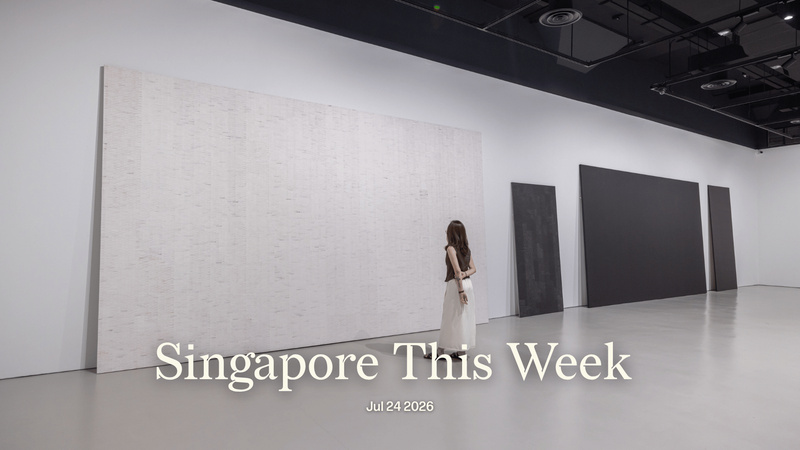
Whether you call them circles or mandalas, wheels or orbs, globes or spheres, these shapes—painted by brush, hewn from wood—recur across two austere and assured exhibitions running in tandem at the Singapore Art Museum. The two artists’ works thread through overlapping themes of time, repetition, labour, perception and consciousness. Philippine artist Maria Taniguchi’s delicate mid-career exhibition occupies the third floor of the museum, while Japanese titan Hiroshi Sugimoto’s stately survey show unfurls on the ground level. If Taniguchi’s “Afterimage”, with its clean lines and stark shapes, is about what lingers after the bulb goes off, imprinted on our field of vision—then Sugimoto’s sprawling “Form is Emptiness” lurks in darkness and shadow, a dramatic sweep of black-and-white images coming into focus as we adjust our gaze.
Their works feel contrapuntal, in conversation across mediums and methods. 45-year-old Taniguchi, born along the coast of the southern Philippine island of Negros, is perhaps best known for her meticulous, methodical “brick paintings”. She pencils rectangles onto her vast canvases, up to 17 feet long and 10 feet high, then paints in each tiny cell, one by one, over the course of days, sometimes weeks. And she’s been making every frame a painting for almost 20 years, translating time into geometry. Sugimoto’s acts of repetition have also spanned decades. His subject, however, is the line where water meets sky. The 78-year-old swapped the urban palpitations of Tokyo for the gentler tides of California in the 1970s, where he studied photography; shortly after, he would embark on “Seascapes”, arguably his most famous body of work, with a large-format camera and an even larger patience, waiting hours for these long-exposure images to emerge. He’s now made over 250 portraits of landscapes, from the Pacific Ocean to the Adriatic Sea, all bifurcated by the same horizon line. It’s the constancy of the sea that calls him back. “I asked myself, ‘What would be the same vision we can share with ancient people who lived in even the Stone Age?’ That’s maybe the sea,” he told ST. “Everything on the ground we have destroyed and changed.”
We move from the line to the circle with Taniguchi’s “Runaways”, a series of circular wooden sculptures suspended from the gallery ceiling and hovering just above the ground. They’re fashioned from duhat, the Java plum tree, whose fruit Taniguchi’s mother craved when she was pregnant with her daughter. This craving is known as lihi. “The craving is not just for food, it can also be for the proximity of something else, like objects or even people. It is believed that certain qualities of the craved food or object are then somehow passed on or encoded into the child,” Taniguchi told art21. “The sculptures are a cipher for this process.” Sugimoto’s “Brush Impression, 1547”, a gelatine silver print made just two years ago, presents us with another cipher, a single brushstroke fixed by a flash of light on photographic paper. “The circle symbolises continuity without origin,” as the curators put it, “a space where presence and absence coexist.” Sugimoto has long meditated on the Buddhist Heart Sutra, from which the title of his exhibition gains its name: “form is emptiness, emptiness is form”. None of us, nor our experiences, are independent or fixed—rather, we are defined by our interdependencies. Mother, daughter, artist, viewer: we all leave a dent in one another.
Faris Joraimi, Abhishek Mehrotra, Sakinah Safiee, Corrie Tan, and Sudhir Vadaketh wrote this week’s issue.
Letters in response to any blurb can be sent to sudhir@jom.media. All will be considered for publication on our “Letters to the editor” page.
If you enjoy Jom’s work, do get a paid subscription today to support independent journalism in Singapore.