


“The Shake Shack there?” asks the Grab driver when he sees I’m headed to Neil Road, the one-kilometre stretch of tar between Outram Park and Tanjong Pagar stations linking South Bridge Road to Kampong Bahru.
The Shake Shack is quite new, as are the artisanal coffee places and gyms (‘Kinaesthetic centres?’) that serve the residents of The Pinnacle@Duxton—a hulking presence in the background—as well as the busy folks zipping around the CBD (Central Business District). There’s the inevitable condo construction site, proclaimed by a banner that reads ‘Dream, Dine, Play’. I wonder if this is an instruction or a promise that buying a unit will make my life complete.
The crowing of roosters, their alarm clocks gone awry on this muggy, May afternoon, breaks my reverie. There are hordes of them, foraging for food on the grassy knoll in front of the HDB block just after the Cantonment Road junction. Why are roosters running amok in downtown Singapore? I resist the temptation to investigate further—pressing ahead towards the upper part of Neil Road, with its rich yellow and deep blue houses pressing back into a severe, cloudless sky.
This part of the road, informs a URA (Urban Redevelopment Authority) plaque outside one of these houses, was first developed when rich merchants moved away from the cramped lanes of nearby Chinatown. Among them was Choa Kim Keat (1858-1907)—of the eponymous road in Balestier, and Kway Mee Koo (1876-1940)—who built many of early Singapore’s roads and drainage systems. Just two doors down is Number 147—at one time the property of Lee Kuan Yew’s grandfather, where the boy Lee spent many of his days.
There’s a palimpsest effect at play here, the new inscribing itself on, but never completely erasing, the old—the 100-year St Matthew’s Church and Kindergarten opposite the restored shophouses has recently been appropriated for refurbishment and ultimately, absorbed into the expanded Police Cantonment Complex. Roosters apart, Neil Road is a microcosm of Singapore at large—development rubbing up against preservation, newness straining against antiquity.
It just happens to be named after one of the most monstrous English generals of the 19th century.
Summer 1857: A century after the East India Company’s victory in the Battle of Plassey had made it a major force on the sub-continent, North India was afire. Native soldiers had rebelled against the Company and bedlam reigned in the garrison towns of Kanpur, Lucknow, and Meerut.
Discontent had been simmering for a while. Between 1848 and 1856, Governor-General Dalhousie had brought numerous princely states under direct company rule via the Doctrine of Lapse, which allowed for annexation if the ruler did not have any male heirs. This went against Hindu tradition, which gave kings the right to adopt successors. Then Dalhousie had gobbled up Awadh in 1856, a prosperous northern kingdom and also a British ally, on the flimsy pretext that its ruler was feckless. This had made the soldiery, many of whom hailed from the region, deeply resentful. So, when a rumour spread that the Company’s new Enfield rifle cartridges had to be inserted with the help of grease made from pig and cow fat, it was seen as a deliberate attempt to dishonour Muslim and Hindu soldiers. The fury this engendered spilled over in an orgy of violence across the great Indo-Gangetic plains.
The rebels’ plan included restoring power to Mughal Bahadur Shah Zafar II, the titular Emperor of India, but in truth a rag doll propped up by the Company for its own ends. The situation was serious enough for Governor General Lord Canning to summon reinforcements from colonies across the globe.
Four thousand kilometres away, Singapore, albeit ruled by the Governor-General of India, was both spatially and spiritually far removed from the upheavals rocking that country. In less than four decades since the British set up shop here, the young colony had become the clearing house for the Empire’s eastern trade and now bustled with unceasing economic activity. Immigrants looking for a meagre share of the colonial-capitalist pie could scarcely care less about the hurt religious sentiments and financial hardships of a people they had never met.
When the mutiny broke out James Bruce, 8th Earl of Elgin, had just arrived on the island. He had been tasked with prying open the Chinese market to British trade and was in Singapore awaiting the arrival of HMS Shannon, a state-of-the-art warship meant to assist English forces in the ongoing Second Opium War (1856-1860). However, when he received his former Oxford classmate Canning’s plaintive telegrams though, Elgin took a momentous decision.
The HMS Shannon was directed to change course towards Calcutta.
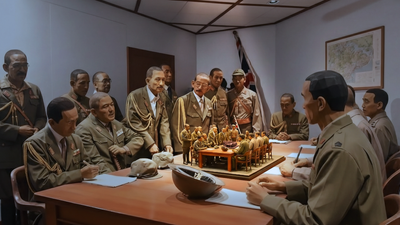
All these forces, however, would take time to arrive. Meanwhile, the task of keeping the flame of Empire lit fell to Lieutenant-General James Outram and Major-General Henry Havelock. Assisting them was Brigadier-General James George Smith Neill. The 47-year-old veteran of the recently concluded Crimean War had been back in Madras only six weeks when, as the Indian summer reached its fiery apogee in early June, he was forced to trek north with his men.
Tall, commanding and possessed of a rare ferocity reminiscent of an Old Testament figure, Neill strode across the plains after disembarking at Calcutta. At Benares, he organised hanging parties where his men ranged across the district’s villages and towns, picking up anyone suspected of being rebels and hanging them from the nearest tree. In one instance, young boys suspected of waving rebel flags were strung up; in another, some villagers were taken to a mango orchard and lynched in the form of the figure ‘8’, because colonial violence was a spectacle that both terrified and entertained. In Allahabad, the next major city on Neill’s map, thousands upon thousands of citizens were hanged, their bodies dumped into the Ganges.
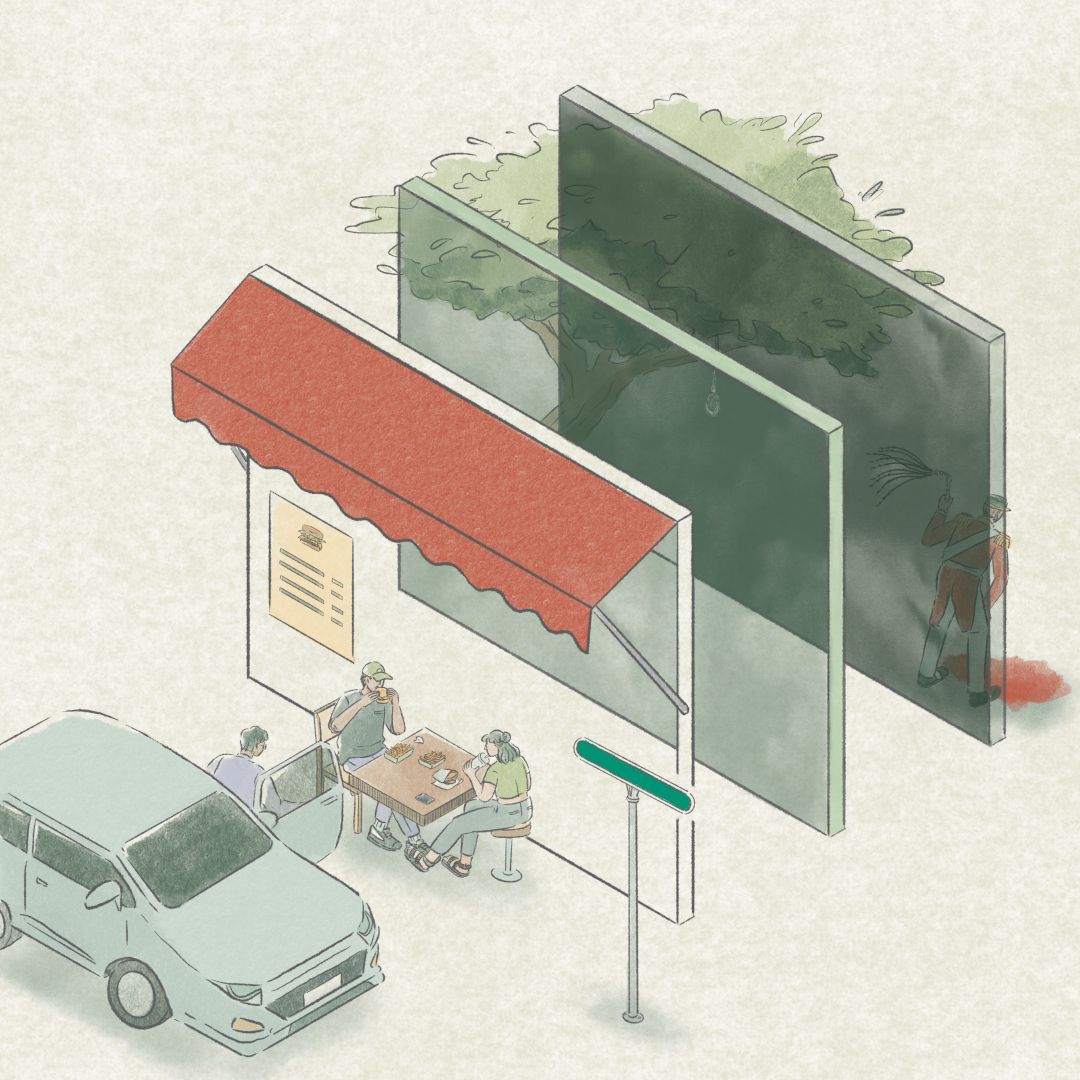
It is at the next stop though—Kanpur (then spelt Cawnpore)—that Neill transforms from garden-variety colonial official to perverse tyrant. In retaliation for the brutal imprisonment and subsequent murders of nearly 200 English women and children, suspected rebels were forced to clean up the blood of the dead, and those accused of egregious crimes were forced to lick it. Anyone who objected was lashed with a cat o’nine tails. Their gruesome task complete, Hindus were forced to eat beef, hanged and buried; Muslims were fed pork, hanged and cremated. These were awful, debasing acts for a society steeped in religious custom including fervent belief in the afterlife. Other executions involved tying traitors to the mouths of cannons and blowing them to smithereens—blood, guts and gore showering over the watching crowds.
His ghastly mission in Kanpur accomplished, Neill joined Havelock and Outram on the march to Lucknow where, on September 25th 1857, a hiding rebel shot him in the head as he was giving instructions to his aide-de-camp.
On November 1st 1857, The Straits Times carried the following snippet as part of a report on the happenings in India:
Brigadier General Neill, during his short but active career in Bengal, had won the respect and confidence of the Government of India: he had made himself conspicuous as an intelligent, prompt, self-reliant Soldier, ready of resource and stout of heart.
Its contemporary Singapore Free Press and Mercantile Adviser had this to say:
Our joy at the relief of Lucknow is in part clouded by the death of General Neill, the illustrious hero who, within six weeks, has passed away.
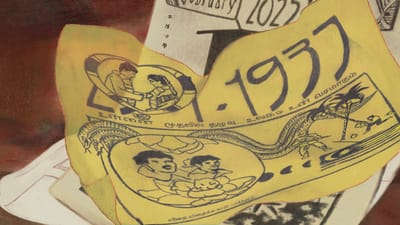
On March 8th 1858, at a meeting of the Municipal Commissioners in Singapore it was unanimously decided that the heroes of the 1857 War deserved to be commemorated in the Straits. And thus were born Havelock, Neil and Outram Roads.
When the writer John McPhee travelled to Colonsay, the island in the Hebrides from where his ancestors migrated to the United States, he realised that “almost every rise of ground, every beach, field, cliff, gully, cave and skerry has a name.” Names like The Glen of the Baglike Plain, The Shelter of the Miserable Women, Bald Kenneth’s Daughter’s Fishing Rock and The Ruins of the House of Boisterous Angus which, writes McPhee, “sketch the land in language.”
What would a similar sketch of Singapore look like?
Neill, Who Hanged Indians for Sport; Kitchener, Who Killed More Than 40,000 Sudanese in Concentration Camps; Clive, the Unstable Sociopath Who Caused Famines; and Petain, the Nazi Collaborator.
McPhee’s Colonsay ‘sketch’ is in praise of life itself; Singapore, an ode to the macabre.
Our ‘own’ John Crawfurd, the second Resident whose name is carried by the street connecting Kallang Road to Nicoll Highway, expressed these views four decades after he left the region:
In understanding, in judgment, in taste, in invention, in reach of imagination, in enterprise, in perseverance, and in the moral sense, the European, placed under equally favourable conditions, is greatly superior to the Asiatic.
And:
…it may safely be asserted that there [in Asia] the most civilised nations are found to be the least truthful, among whom may be named the Persians, the Hindus, and the Chinese. Integrity is most prevalent among the educated classes in Europe; but, with the more civilised, the want of it pervades all classes in Asia.
Lord Elgin, the saviour of the British Empire and whose eponymous bridge sits over the Singapore River, had this to say of the Chinese:
…So much to admire in them, and yet with a perversity of disposition which makes it absolutely necessary, if you are to live with them at all, to treat them severely, sometimes almost cruelly.
It is difficult to assess which is worse—roads named after blood-thirsty British generals who never visited Singapore, like Havelock, Outram, and Neill; roads named after administrators who saw the necessity for cruelty in dealing with the Chinese, like Elgin; or those honouring residents who spent decades in Southeast Asia before writing racist screeds, like Crawfurd.
Does it matter though? What import do men, long dead, have in a world so removed from the one they inhabited?
In the first few years after independence, when Singapore was grappling with questions over its identity, culture and its very viability, the economist Albert Winsemius advised Lee Kuan Yew to signal to the departing British that there were no hard feelings after the 140 years of colonisation.
Lee, his dalliance with Fabian socialism well in the past, did this by uniting with the British against the communist threat, both real and perceived. He also retained the signifiers of British overlordship. Thus, at a time when other Asian countries were shedding their colonial garb, Singapore hugged its tighter. Stamford Raffles retained his place on the pedestal—his name adorned streets, hotels, hospitals, train stations, businesses. Lesser names—Clive, Havelock, Kitchener, Neill, Outram, Pickering, among a host of others—helped paint the gloss onto a friendly veneer.
It is not easy to understand the fears and anxieties that gripped a fledgling nation, so much so that decisions that might have seemed obvious at the time may appear ridiculous today. For instance, other newly independent nations began to decolonise even as they traded with their erstwhile masters. But, whether one agrees with Winsemius’s recommendation or finds it bizarre—what it did do was deny Singapore a chance to have a conversation about its past.
In the colonial enterprise, had Singapore been a victim, a collaborator or both? Who benefitted from British control of the island, and at whose expense? What role did it play in helping the tentacles of imperialism and war wriggle ever forward into India, China and other territories? And how much of its prosperity was because of this?
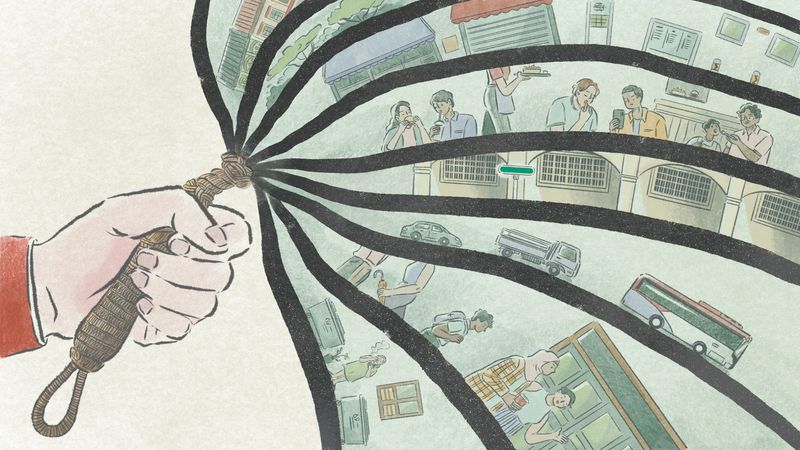
But who has time to interrogate the past when the future is uncertain? Between Winsemius’ advice and the existential crisis (real or manufactured) gripping the nation once the British slunk away and things with Malaysia didn’t pan out, Singapore’s childhood issues were swept under the carpet. This tendency has gradually become part of the collective psyche. Discussions on road names and troubling commemorative statues languish alongside worries about horrific labour conditions and reckless resource extraction in the national attic—occasionally dusted off, but mostly ignored.
In urban toponymy, ‘opacity’ is the phenomenon by which place-names lose their original meaning and significance over time (becoming opaque), only to acquire new associations and memories. In this, they are different from statues, the objects of so much recent anti-colonial sentiment. Until future generations completely recontextualise the Raffles statue, he will continue gazing out across Singapore, benevolently bringing civilisation to the wildlings; transforming an island-jungle into an energetic entrepot. Roads are more supple, tracing the contours of new eras, deriving meaning from, as well as giving meaning to, their changing inhabitants.
If Neil Road was once remembered in honour of a British general who helped maintain the British Raj in India, and by extension colonial rule across South and South-east Asia, it certainly is not the case today. Through the centuries, it has been the house of the Jinrikisha Station (early 20th century); the site of the Tiger Balm Factory building (mid-20th century); the area where the former Maxwell Road Driving Centre held tests to award driving licences (late 20th century) and today, as my Grab Driver referred to it, the Shake Shack place. Does revisiting the circumstances of its christening serve any purpose?
Renaming roads honouring prominent colonialists has had mixed results. In London, the renaming of Havelock Road to Guru Nanak (after the founder of the Sikh faith) was the culmination of nearly four decades of campaigning by some migrant Indians, who felt affronted by having to live on a road named for a colonial oppressor. Others felt that this was all fire and brimstone, signifying nothing but empty self-righteousness. Or worse, that it constituted an erasure of history—the very sin our colonial masters were accused of committing.
In India, the current Bharatiya Janata Party (BJP) government has renamed three islands of the Andaman Archipelago. Havelock is now Swaraj (Freedom) Island, Neil is Shaheed (Martyr) Island and Ross is Subhas Chandra Bose Island. These changes would have been more palatable (Bose himself had proposed the first two names in 1943) had they not been part of a larger project to wash away India’s heterogeneity under a wave of Hindu ideology.
Delhi’s Aurangzeb Road—after one of the Great Mughals—was renamed within weeks of the proposal being mooted. Now there are calls for Aurangzeb’s great-grandfather and probably the greatest of the Mughals, Akbar, to be sent the same way. Across India, roads, bridges, stadiums and railway stations are being renamed in service of the ruling party’s ideology.
In neighbouring Pakistan, there were no takers for Karachi’s Napier Road because it’s where the city’s red-light district is. Closer to home, in Kuala Lumpur, Holland Road is now Jalan Belanda on the mistaken assumption that it was named after the country. It in fact commemorated the architect Hugh Holland. Locals call it Jalan Blunder.
These examples (and there are many, many more) prove two points. Firstly, names matter. Secondly, because they matter, any renaming exercise is susceptible to being hijacked by politics, ideology, and occasionally, idiocy. It’s probably not a good idea to lobby for renaming unless it is to right an egregious wrong. There was a clear case for the Democratic Republic of Congo’s capital Leopoldville to be renamed Kinshasa, given the despicable acts sanctioned by the second king of Belgium in the African nation.
Since the vast majority of cases are not so clear-cut, many countries have tried to find a middle ground. Amsterdam’s Louis Botha Street, named after the South African prime minister during the Anglo-Boer War has “Former” prefixed to it. Above it is its new name—Albert Luthulistraat, after the anti-apartheid activist. Others have installed plaques describing the circumstances under which a road was named after an individual, as well as that person’s historical significance.
However, by expecting the state to step in, we are ceding even more space to it. In colonial Singapore for example, it was the Municipal Authority (i.e. the British state in situ) that directed how roads should be laid down, and what they should be named to reflect “their vision of what a colonial city should be and how it should function”, and to “identify the urban landscape with civic notions of appropriateness and ordering.” Wherever the state can arrogate power, it does. So why hand it over on a platter?
Can one hope that civil society in Singapore takes up the mantle with monetary and logistical support from ordinary citizens? The idea is not as far-fetched as it seems. In recent times, citizens’ coalitions in Amsterdam, Glasgow, and New York have stepped up to organise walking tours that highlight the lesser-known and more unsavoury aspects of their cities—the injustices and transgressions pivotal to their growth.
While some walking tours have been organised by knowledgeable locals here, this writer is not aware of any that mention the likes of Crawford, Havelock, Neill; of Singapore’s role in the opium trade or that it “literally lived on the back of the opium-smoking Chinese coolie.” Scant attention is paid to the labourers, the rickshaw-pullers, and the sex workers who once breathed life into this country; or to the natives whose ways and means of living were wiped out, and who were castigated as lazy for their refusal to participate in colonial-capitalism.
This is not self-flagellation. This is growth and maturity; of a desire to deal with childhood issues; to learn and improve. This is also love. If you can unearth your country’s deepest, darkest secrets and not be repelled; if you can stare at it in the face, warts and all, and still feel affection stirring within; if you can say, ‘I know what you did. I know you can do better, you can be better. And you’re still mine.’ Is there a greater love than that?
Abhishek Mehrotra is a Singapore-based writer and researcher.
Additional research by Jean Hew, Jom's head of research.