

The first time I visited the Zhoushan islands, in 2016, I was a younger man desperately trying to rescue a relationship with M. She was back home on vacation from NUS on Daishan, the second largest island of the archipelago in the East China Sea. To get to Daishan, one has to fly to either Ningbo or Shanghai, before getting on a bus, and then one or two ferries. Undeterred, I boarded my flight into Shanghai, whereupon missing my ferry connection that morning I embarked on a four-hour-long bus ride, followed by a boat, bus, and boat before finally arriving in Daishan just in time for dinner. I almost did not make the final connection because the high winds and waves that winter threatened to cancel the ferry. Providentially, I found my way, and with some more luck, our relationship persevered.
Shuttling across the islands on multiple commuter ferries, one could almost feel the vast expanse of the ocean, and the rhythms of its movement shaping everyday life on the islands. Of course, even back then if one looked closely enough the horizons would sometimes be punctuated by massive bridges in various stages of construction. But for the most part, it was a breathtaking experience of feeling and listening to the ocean. With a population of 1.15m spread across over 1,300 islands (comprising nearly 1,440 sq km), but less than five per cent urban built-up area, the Zhoushan archipelago was a stark contrast to the neighbouring urban megalopolis of Ningbo or Shanghai. The magnificent ocean vistas and chilly air were a refreshing change, but for a Singaporean accustomed to hyper-efficiency and well-connected transportation systems, the lack of accessibility felt somewhat disconcerting. It was entirely possible to get “stuck” for days.
Beyond my admittedly parochial concerns, life on the archipelago shapes the rhythms of everyday family and social lives in much more consequential ways. Absences abound. Over half the men in M’s family were employed on ships—at sea fishing from almost the whole of August to May. Local women laugh about having husbands far away who make good money for their wives to spend at home. For many in M’s generation, archipelagic rhythms shaped their formative years through perennial absences that they later struggled to reconcile. She started boarding school on the “main island” of Dinghai in Primary Three, but many others started boarding as early as kindergarten, simply because many outlying islands lacked educational access and commuting daily was impossible.
The greatest irony, of course, is that it took me a while to remember that Singapore too, is an island. As a young person growing up on one of the smallest islands in the Nusantara, Singapore never felt “small” to me because its transportation and knowledge infrastructures shaped my entire universe—a universe which felt quite cosmopolitan and worldly. Commensurate with Singapore’s ascendance as a new Asian center for global capitalism, air travel was very much a part of my formative years, a luxury increasingly central to Singapore’s national cultures of consumption. But we forget that the island of Singapore is part of something bigger: the various maritime geographies which shaped it. Singapore’s location within the Johor-Riau archipelago, for instance, was only referenced publicly to reaffirm our place as the coordinating centre for global capital within the region. The South Seas, or the Nanyang—the historic locus of a vibrant migrant ecology—too, did not have much contemporary valence in a world of nation-states demarcated by clear geopolitical boundaries.
The Zhoushan islands, much like Singapore, have a rich heritage and history that was rudely interrupted by Western colonialism in the mid-nineteenth century. Like Singapore within the Johor-Riau archipelago, Zhoushan’s history was largely shaped by its location within a broader maritime ecology of the East China Sea. Situated at the mouth of Hangzhou Bay, ten miles off the coast of Zhejiang province and 100 miles south-east of Shanghai, the Zhoushan archipelago has, at least since the Tang Dynasty and the Northern Song, been a central node in trade routes now popularly described as China’s “maritime silk road.” The largest concentration of human settlements was in the county city of Dinghai, which 17th century European observers likened to Venice. By the 1400s, contemporaneous with Singapore’s ascent within the Majapahit Empire as an important node in a vast maritime trade emporium, the Zhoushan islands had fallen to Ming Dynasty’s prohibition on overseas migration due to the imperial court’s anxieties over coastal piracy. While not as wealthy as the more prosperous regions of the Yangtze River Delta, the Zhoushan islands—with easy access to fishing and marine products—remained significant for their location in the East China Sea.
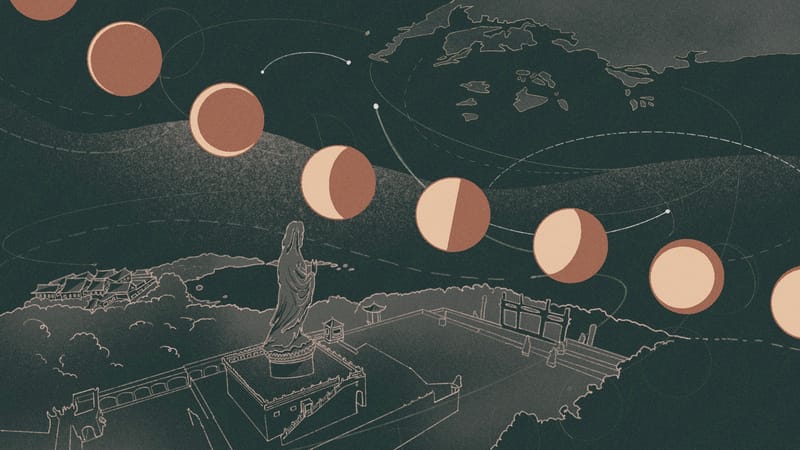
For Buddhist pilgrims, the Zhoushan islands are perhaps best known within a sacred geography centered on Mount Putuo, where the South Seas Guanyin (Avalokiteśvara Bodhisattva) sits facing the oceans. Singaporeans may be more familiar with the Southern Putuo Mountain (Nanputuo) in the port-city of Xiamen, a key node in the circulation of humanistic Buddhist thought across the South Seas and Singapore in the early twentieth-century. However, comparatively fewer have visited its northern counterpart. Mountain inscriptions, shrines, pilgrimage stories and miracle accounts regarding the Guanyin have been documented since the Song dynasty, when Mount Putuo was produced as Guanyin’s Potalaka (Boddhisatva’s residence) in the South Seas. Journeying monks, pilgrims, and increasingly, Ming and Qing Dynasty court officials stimulated and enabled thriving transportation infrastructure and commercial networks across the archipelago.
By the 17th and 18th centuries, the British East India Company’s sights were firmly set on the Zhoushan islands. Favored for their abundant deep-water ports, and access to Hangzhou silk and Fujian tea, the islands featured prominently in the imagination of British merchants and free trade activists. The unsuccessful Macartney Mission to the Qianlong Emperor of 1792, specifically requested that British merchant ships land and trade in Zhoushan, and an “unguarded island near Zhoushan for the use of British businessmen” be made available for free trade. In the wake of the ill-fated 1840 opium war which ceded Hong Kong as the “first British colony in Asia,” Britain’s other Opium War possession was the Zhoushan Islands, which came under British military occupation first in late 1840, then again between 1841 and 1846. According to historian Christopher Munn, conditions for colonial settlement seemed so favorable that a number of British observers even contemplated exchanging Zhoushan for Hong Kong, where its “rolling hills and healthy breezes could hardly have provided a more striking contrast to the stark peaks and subtropical insalubrity of Hong Kong.” Many expected the island to be permanently retained; some spoke of turning it into a second Singapore.
By the mid-19th century, Zhoushan’s prominence waned as new treaty ports in Shanghai and Ningbo became magnets for foreign settlement, shipping and trade. The islands however, remained an important frontier in ongoing economic and political transformations on the East China coast. Neighbouring Shanghai, a growing metropolis, was hungry for the islands’ fish and other marine riches. So were other booming Asian cities, as local junks faced off against Japanese steam-powered trawlers. These habitats became a terrain of diplomatic rivalries and contested sovereignty, foreshadowing more ominous conflicts to come in the mid-twentieth century.
Following the 1949 Communist Revolution, the offshore islands of the East China Seas again emerged at the forefront of the Chinese civil war, as chronicled in the histories of the PLA’s battles and amphibious operations against retreating Nationalist forces. Zhoushan, whose rolling hills and pristine vistas inspired such romanticism among British observers and naturalists a century ago, was now characterised as a “strategic defense area” at the frontline of military conflicts across the Taiwan Straits. Under the Communist Party’s centralised economic control, the intensified extraction of marine resources achieved results that prior regimes could not. This accelerated plunder and overfishing further degraded the environment.
The rhythms of island life were indelibly marked by the effects of political campaigns, rising production targets, and extractive regimes. But they were not fully subsumed under the Communists’ revolutionary programmes either. There were always spaces for manoeuvering between high politics and everyday life; freedom at sea was sometimes a respite from hyper-politicisation on land. In the Reform-era of the 1980s and 1990s, new opportunities beckoned, and the gradual privatisation of even small-scale fishing gave rise to employment of seafaring labour from Anhui province. In turn, youth from Zhoushan flocked to garment and textile factories in neighbouring Ningbo and Shanghai, but state-owned factories there were soon increasingly privatised as well. Newly unemployed, the workers were forced to seek fortunes elsewhere yet again. They trudged south: many to Shenzhen, and in some cases, farther to Singapore.
Our most recent trip back to Zhoushan in 2023 was a somewhat surreal experience. M and I had now been married for some time, but we had not visited for four years because of the lengthy lockdowns in China’s protracted battle with Covid-19. Beyond China’s victory over the pandemic, our driver told us, the greatest “achievement” of recent times was being able to drive directly from the mainland to Daishan Island.
The overland commute was meant to be an extended spectacle of engineering: first, the Hangzhou Bay Bridge (36km), then the Jintang Bridge (the longest cable-stayed bridge on sea, at 27km), Xihoumen Bridge, Fushanmen Bridge, and then the final leg through the Dingdai Bridge, completed only in 2021. An estimated four hours from Shanghai’s Pudong Airport, the five cross-sea bridges span around 100km on the G9211 (Ningbo-Zhoushan Expressway) and promised to eliminate sea travel entirely. Overland connection to the main county seat of Dinghai had already been completed in 2009—in what local media referred to as the “Second Liberation” for economic production in the Zhoushan islands. Even so, M’s home in quieter Daishan Island where her mother now lived, finally received its connecting bridge in 2021.
I felt a sense of disquiet even before we got on the road. Things didn’t feel right. We no longer had to stay in a hotel for the night before catching the bus for the first morning ferry; we could simply hop into the car from Pudong, and arrive on Daishan that very night. It didn’t help that it was one of the most humid and hazy evenings in Shanghai, with a cranky toddler raging against the summer heat. Two hours into the drive, just before the Hangzhou Bay Bridge, our car was struck violently by a lorry delivering goods to the Ningbo port. We narrowly escaped, physically unharmed but thoroughly shaken. Waiting by the roadside on a crowded freeway for hours, seeing massive lorries filled with seaborne goods drive past, I was nostalgic for the older, slower, commuter ferries which now seemed a much safer option.
When the skies cleared the next day, we were able to fully appreciate the ongoing changes to the islands’ landscape and topography. The Dinghai-Daishan Bridge which commenced construction in 2017, was now a massive 16 kilometre expanse, towering over the hundreds of fishing trawlers spread across the bay. The fishing communities on Daishan island now felt the gradual encroachment of a commanding new industrial facility, an “integrated refinery” plant on Yushan Islands. Described by the Zhoushan Daily News as benchmarked against Singapore’s Jurong Island—a “green petrochemical industry” in the Garden City—the Yushan Refinery was now part of a “World Class Petrochemical Cluster” drawing a massive 10,000-strong workforce into its once-quiet backyard. It now houses the largest single petrochemical industry project invested in China, processing 40m tonnes of crude oil annually with a total industrial output value of 287.49 billion yuan (S$51.3bn) in 2024. This national strategic energy project was arguably why Yushan now had a bridge to Daishan, which in turn had a bridge to Dinghai and the mainland. Like Singapore’s Jurong Island, an amalgam of seven islands made through an extensive reclamation project in the 1970s, the Yushan industrial site likewise transformed a “small fishing village” with a mere 500 dwellers into a “super factory,” one global node in the capitalist economy.
Another borrowed trope from Singapore was impossible to miss. The Zhoushan government refashioned itself as a “Maritime Garden City” in 2017, a testament to the global footprint of Singapore’s “brand” of urban planning. The garden city project was deployed by local bureaucrats to discipline the habits of unruly locals, but also in the visible act of making the islands hospitable and generous to tourism. Local inns and hotels have sprouted everywhere, served by packed tour buses from neighbouring Shanghai and Hangzhou. One of M’s cousins, the family’s most successful entrepreneur, made his fortune through a chain of boutique hotels marketing wilderness tourism across the islands.
Amidst the rapid development, other spaces within the archipelago have become less accessible, such as Qushan island, the hometown of M’s grandmother. Qushan is among the closest to Shanghai—but the once regular commuter ferries from the metropolis have dwindled, with many bypassing it. As the island has emptied of people, it's increasingly left with the old and young. The only middle school closed a few years ago. Many services have drifted to neighbouring islands like Daishan. Younger teachers and bureaucrats leverage every possible informal connection to escape postings there. The scarceness of medical facilities was acutely felt by M's family, after a distant relative fell from a second-storey window. For six hours she lamented her misfortune while neighbours contacted local fishermen to arrange transport to the nearest hospital, in Shanghai. They didn't make it in time, and she died.
This phenomenon is not without precedent. A few decades ago, as Reform-era market capitalism drew youth from fishing villages to the cities, local economies could not keep up with the widening inequalities and unevenness of development, and simply disappeared. The previously prosperous fishing village of Houtouwan near Zhoushan’s Shengshan Island, with a permanent community of 2,000, gained the moniker “ghost village” after it emptied by the 1990s, as people moved in search of better amenities, services, and employment outside of fishing. On our last visit, we wondered whether a similar fate would befall Qushan, where M and her parents had grown up and spent their formative years. Few, however, were sentimental. M’s father had not been back to the old house in years, not even to visit his mother during the Lunar New Year holidays. Sequestered in his luxury high-rise condominium in metropolitan Ningbo, he harbours few romantic ideas about the slower rhythms of the archipelago; only frustration at its lack of infrastructure. He had no plans to return anytime soon.

Visiting Zhoushan, experiencing the shifting rhythms of movement, and witnessing these changes over time, have given me the briefest glimpse into how my great-grandparents may have felt when crossing the South Seas in the early 20th century. My China-born grandfather took a steamer from Swatow to Singapore in the late 1940s. The journey took two weeks, passing rivers and oceans unknown to people of my generation.
With this belated realisation of Singapore’s “islandness”, I increasingly began to reflect on its geographical and ecological situatedness as part of an archipelago in the Malay world, and its implications on our shifting sense of space and place. I was aided by the Martinican scholar and intellectual Édouard Glissant who wrote about the Francophone Caribbean. Glissant’s notion of “archipelagic thinking” urged a reflection on one’s sense of place through the specific geography of archipelagos (islands existing in relation to each other), and by extension, a broader relationality in our engagements with our neighbors, our ecological context, and the Other. Glissant and the corpus of literary scholarship his work inspired asks: if the “archipelagic” resists isolation but emphasises new forms of relationality, then how can one island meaningfully interact with others in ways that nourish and sustain life collectively?
In an era of unprecedented air travel and ever-shortening travel itineraries, a return to island-hopping worlds or the slowness of my grandfather’s journey to Singapore is all but impossible, and even no longer recognisable to most Singaporeans. Yet, people have continued to imagine, invoke and inhabit archipelagic worlds, in text, in art, and in memory activism aimed at showing alternative modes of being.
Contemporary reflections on Singapore have drawn on Glissant’s “archipelagic,” to reflect on how shifting topographies and sense of place produced new subjectivities among writers. “Archipelago Dreaming” was the theme around which the New York-based nonprofit Singapore Unbound organised the Singapore Literature Festival of 2022, bringing together writers from the archipelagos of Southeast Asia and Caribbean, for dialogues on alternative, connected futures outside the boundaries of both ethnonationalism and global capitalism. Historians have documented how the nation-building project has produced a significant narrowing of the polyglot cultures and regional fluidity in languages and identities in favor of rigid national ones. Artists and writers have helped us visualise and appreciate the physical narrowing of Singapore, the island-city, and its impacts on our everyday lived experience. The territorialisation of Singapore may be a foregone conclusion, but reflecting on the largely irreversible nature of this process has also encouraged people to produce new imaginative and discursive forms of an archipelago they can no longer traverse as easily.
In Rachel Heng’s beautifully crafted historical novel, The Great Reclamation, Singapore’s “islandness”—and its eventual disappearance—functions as an irresistible metaphor for the costs of developmentalism in the Singapore Story. “The Great Reclamation,” of course, was the tag name for the coastal landfill project in the 1970s which produced a much-extended East Coast shoreline and Marine Parade area. Heng’s novel invites readers to contemplate this process from the vantage point of Singapore’s coastal fishing communities whose ways of life were traumatically upended by this massive feat of engineering. They lived through Singapore’s transformation from “fishing village to world-class metropolis” with a deep ambivalence.
The Great Reclamation wonderfully evokes a sense of loss, delineating how the spatial consolidation of the island-city narrowed its cultural and geographical imaginaries. But this process historically did not immediately result in the complete disappearance or loss of the other islands to landfills, inasmuch as it offshored everything deemed as superfluous or inconvenient to the modern cityscape. In this new spatial hierarchy, the mainland of Singapore now became a pre-eminent center of productive capacities and progress, while offshore islands were made to absorb everything else. In the colonial era, they were spaces of quarantine, disease management, or incarceration. Now they serve economic functions from industrial engineering, food production, energy generation to waste disposal. During the height of the COVID-19 pandemic in 2020, one of the most revealing commentaries published in The Straits Times called for the offshoring of migrant worker dormitories and quarantine centers outside mainland Singapore, banishing their humanity from our physical proximity.
This process of narrowing imaginations in the postcolonial Singaporean state was conveyed most evocatively in Wild Rice’s 2022 play, “Pulau Ujong: Island at the End of the World”, which visualised the extent to which the modern state shaped its ecology in improbable, sometimes frustrating and devastating ways. Loosely based on “interviews” with human and nonhuman animals in multi-species Singapore, “Pulau Ujong” drew on a range of historic and contemporary resources to make an urgent call to action in light of the climate crisis and impending ecological devastation. As playwright Alfian Sa’at wrote, it was during the COVID-19 lockdowns, walks and hikes and gradually making legible a “mass of green things,” that he discovered the complex and delicate ecosystem of which Singapore was part.
While one of the playwright’s main interventions was having nonhuman animals speak back to human power, more compelling were the sections foregrounding how the rhythms of human life, which mirrored nonhuman migrations across the archipelago, have transformed beyond recognition. One such section centered the perspectives of Pulau Semakau kampong dwellers, who were relocated to mainland Singapore in 1980s and then resettled into HDB flats. Now famous as the world’s first offshore landfill, Pulau Semakau was historically the home of thriving Orang Laut communities, who have been largely forgotten in public memory. Pulau Semakau’s official website celebrates the “coastal and marine biodiversity haven” and ongoing abundance of research conservation efforts among the mangroves and coral reefs, with little mention of its displaced human inhabitants. What struck me in Pulau Ujong was the recentness of these many transformations, the historical memory and intergenerational trauma of the enforced move. As with the compromises elucidated in The Great Reclamation, it is difficult to debate pragmatist efficiency in governance and allocation of resources. Intangible losses, however, are hard to measure.
In recent times, descendants of Singapore’s seafaring island communities have created initiatives like Wan’s Ubin Journal, or Get Hooked SG, creative efforts to publicise their memory activism. These oftentimes involve critical tourism, embodied practices, and unsurprisingly, food. A leading voice profiled in “Pulau Ujong” was Firdaus Sani, one of the descendants of the Pulau Semakau residents who were boxed into an HDB flat. Now, he runs Orang Laut SG, a website and community project which among other things, includes a weekend catering business to preserve and promote what little remains of a fast-disappearing way of life. It is food, beloved by all, which provides an accessible point of entry for those curious. Indeed, food has the remarkable potential and ability to reorient one’s worlds in multisensory ways. This, perhaps, accounts for the immense influence and success of Khir Johari’s monumental 500-page tome, Food of the Singapore Malays which swept multiple book prizes—from last year’s NUS History Prize to top prizes at the 2023 Singapore Book Award and the Gourmand World Cookbook Awards in Sweden.
More than simply a carefully curated selection of reflections and recipes from across the Nusantara, Khir’s is a wonderful project of documenting, preserving, and reconstructing the culinary worlds which are increasingly slipping away from Singapore. Through travels across the Nusantara—from the tiny fishing village of Pulau Pemping, to the great city of Medan in Sumatra—Khir introduces readers to Singapore’s centrality in regional sojourning networks. He demonstrates how travelers between the South Seas and Indian Ocean, and regional traders, all made Singapore a culinary hub, and not only in the sense of diffusing Western/British influences. Singapore was a site of Nusantara cosmopolitanism with significant impact on regional cultural developments. The book’s main achievement is re-inscribing Singapore as a Nusantara kitchen, and making a persuasive case for its centrality in the Archipelago. As Faris Joraimi, Jom’s history editor, notes in the afterword, centering place-based cultures and “historical cartographies of taste,” emphasising the local within the regional, is a way forward to mediating difference across borders; it is an invitation to a shared banquet, produced by a common regional identity.
As I witness the ongoing transformation of the Zhoushan islands, the fast-paced development with irreversible consequences, I reflect on the Singapore I did not know, and on now living and working in a Singapore where occasions to publicly pause and reflect on the costs of development are few and far between. In retrospect, witnessing this process of islands being connected, fading away or forgotten in Zhoushan, helped me appreciate the improbabilities of the Singapore I grew up in—the “international” city which, at least from the perspective of privatised consumption, seemed to have everything and lacked nothing.
Funnily enough, what we did lack, as I discovered when my father-in-law visited recently, was seafood from the East China Sea. His favourite adage during a week spent here was that he only eats seafood from the East China Sea; nothing else can compare. His seeming parochialism and conservative palate frustrated us to no end. But perhaps read charitably, his words suggest not only nativism but also an alternative sensorial attunement to place and taste embedded in a local ecology which cannot simply be transplanted elsewhere. I wished I could share with him about the Nusantara cuisine centered on the culinary cosmopolitanism of Kampong Gelam and Singapore’s unique maritime ecology, but in truth, I did not know where to begin. In a city of shopping malls and dining increasingly characterised by franchise capitalism, one wonders if a return to the culinary worlds that Khir Johari envisions is possible, and if not, how might the ethics of our consumption, or shaping of everyday practices, shift ever so slightly to reflect those historic inheritances in our present? Or, put differently, how might we find ways to relate to an archipelagic space that is not commodified or neoliberal?
There is a resurgence of interest in Singapore’s Southern Islands. Naturalist groups now traverse them freely by boat, documenting and photographing our multi-species communities surrounding us. The Ministry of Sustainability and the Environment included a tour of the Southern Islands by the Maritime and Port Authority of Singapore among its “Go Green SG 2025 activities.” For the most part, this resurgence is less a critique of modernity than an extension of the commodification of nature under global capitalism. The phenomenon of “Glamping” on Lazarus Island for S$400 a night, or bankers on luxury yachts, hardly evoke vistas of hope. It remains to be seen whether an interest and reflection on archipelagic spaces can offer resources for us to reconnect with the traditions, practices, and life worlds fast disappearing from view in Singapore. A first step might be through extending our travel itineraries to further-off islands like Pulau Lingga, or even the beaches scattered among kampungs on Bintan’s East Coast, outside Singapore’s “purpose-built tourist enclaves.”
The Zhoushan archipelago, too, is now growing its reputation as a premier tourist destination in the East China Sea for Buddhist pilgrims, seafood aficionados, and nature lovers alike. On holidays, visitors throng the Putuo Island, a Buddhist pilgrimage site which now boasts its own airport. For travelers moving at a slower pace, billboards surrounding Shanghai’s Nanpu bus station, two hours away from the Yangshan ferry terminal, promise itineraries across the islands: to Gouqi island, Dongji, Zhujiajian. Interestingly, the previously abandoned Houtouwan “ghost village” on Shengshan island, has recently emerged as an unlikely magnet for eco-tourists and photographers drawn to the thick foliage and vegetation which have completely engulfed the manmade structures in the uninhabited village. Houtouwan has even been dubbed by BBC Travel as the “Greenest Village in the World,” the attraction to its landscape perhaps reflecting a desire for re-enchantment amidst a glut of manmade attractions. Thinking about the gaudy tourist kitsch prevalent in the more built up areas of Zhoushan, the bleached rocks and artificial beaches of Sentosa, perhaps what we need most urgently are glimpses of these shared pasts—across archipelagos—to show us the way.
Joshua Hong Yi Tan is a historian and researcher from Singapore. He is a postdoctoral fellow in History at NUS, and is writing a book about Chinese international students in America's Cold War.
Letters in response to this piece can be sent to sudhir@jom.media. All will be considered for publication on our “Letters to the editor” page.