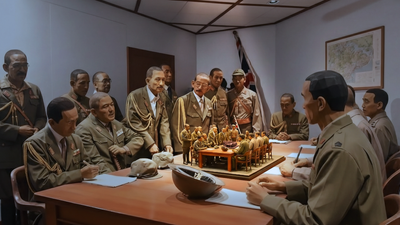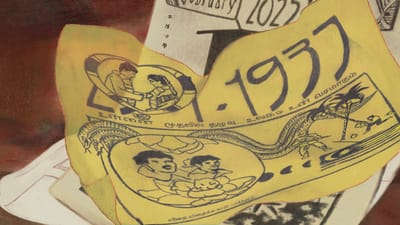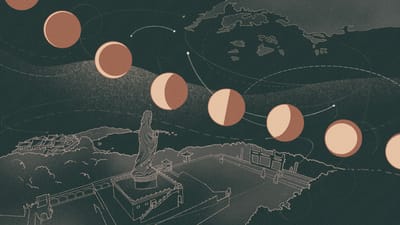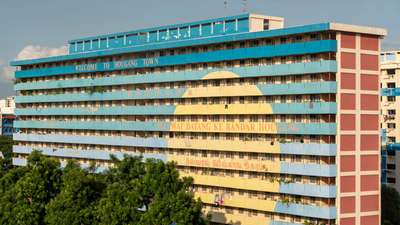



A history lesson by Ho Ching, former boss of Temasek, provoked some controversy last month. Known for compulsively sharing articles on Facebook with her 173,000 followers, this time she produced an essay exceeding 500 words, declaring that Singapore had no significant history before 1819. Whispers of Tumasik, the 13th-century port-polity, and Sang Nila Utama, the Palembang prince who founded Singapura in 1299, were “sketchy mentions at best, and do not speak of a large or significant thriving kingdom”. Archaeological finds at Fort Canning suggest “some early ruler or local warlord abode” on the hill. The records went silent afterwards, and local dynasties were passing clouds: “the royal households come and go, sometimes fleeing to Malacca, sometimes moving up the Johor river.” Singapore was a fringe of various neighbouring empires, until European explorers came and dominated the region through conquest and diplomacy. Only the British miracle-worker Stamford Raffles “gave life to Singapore”.
Paeans to the British Empire’s impact have been occasionally penned by Singaporeans across the political aisle, though rare is the edict that so negates place and beings before 1819. It reads like a school textbook from decades past. Or the present-day proclamations of a consultant who parachutes into disciplines and collapses complexity into PowerPoint takeaways. Whatever her motivations for doing so, it’s offered us all an opportunity to meditate on important concepts about our history, including the notion that the contemporary, territorial nation-state lens is necessarily the one through which we might understand ourselves—and that enigma called “Singapore”.
But first, let’s give Ho credit where it’s due. There’s a lot that historians still don’t know about Singapore before 1819. The hard empirical data is uneven and imperfect. A variety of sources—Malay, Chinese, European—describe economic activity and political organisation in 14th-century Singapore, but conflict with one another on information that’s not easy to verify. For example, Wang Dayuan, Tomé Pires and the Sulālat al-Salaṭīn (also called Sejarah Melayu) disagree on the name of this island, who lived here, and what happened to its rulers. It’s also probably correct that until 1819, there was no large, permanent settlement on this island comparable to the colonial town that became today’s Singapore city.
That’s about as generous a reading as anyone could give to this account of our history. Many Singaporeans online were perplexed by how it contradicts what historians have said in the last decade. Plentiful fresh evidence casts light on the “black hole” between the fall of the early Singapura kingdom and the arrival of Raffles. On a factual level, we now know that Singapore was, between the 15th and 18th centuries, an important naval base and domain of the Malacca and Johor sultanates. Major events in regional and global history took place in Singapore and its waters. The capture of the Portuguese ship “Santa Catarina”, off Changi by Dutch forces in 1603, led to legal debates that still shape today’s international Law of the Sea. An Acehnese invasion of Johor in 1613 involved an attack on the town of Singapore by an army of more than 20,000 men.
Facts aside, the more serious issue is the way we judge the past based on the standards of the present. These are standards laid down by modern, territorial nation-states that were never the default condition of human existence. Even the most thriving port-cities in old South-east Asia were tiny relative to today’s metropolises. Yet for over a thousand years, these little emporia played a vital role in international trade and politics. As Nazem Suki, former leader of the Singapore Malays National Organisation (PKMS) argued in his rebuttal to Ho, “Significance lies not only in size, but in the role a port played connecting worlds. To dismiss Temasek because it was not Angkor or Majapahit is to misunderstand how maritime civilisations worked.” Those royal households were linchpins of economic and political cooperation between diverse groups.
But because we live in a time of territorial nation-states, history is often told as the story of how nation-states came to be. The past must always be backward and uneventful until the nation brought us into the bright dawn of history’s stage. Ironically, Ho’s own phrasing revealed this modernist bias, saying that Singapore’s “modern history” began in 1819. As Donald Low, economist, pointed out, this is obvious to the point of tautology: “The idea of ‘modernity’ itself is a western, post-Enlightenment construct. It’s like saying ‘the history of Paul’s bachelorhood began when he didn’t marry.’”
The fact that the state already officially endorses a national history stretching back way before Raffles, to the time of Sang Nila Utama, raises further questions about why Ho made this post. Singapore: A 700-Year History, a publication first released in 2009 by historians Kwa Chong Guan, Derek Heng and Tan Tai Yong, was updated in 2019 as part of the Singapore Bicentennial with additions by Peter Borschberg. The book provided academic ballast to the refreshed Singapore Story rolled out that year. “Stamford Raffles did not ‘discover’ Singapore, any more than Christopher Columbus ‘discovered’ America,” said Lee Hsien Loong, Ho’s husband and then prime minister, at the opening of the Bicentennial on January 28th 2019. “By the time Raffles arrived in 1819, Singapore had already had hundreds of years of history.”
Even this retelling of the past was an instrumentalist outcome of changing policy priorities. While the Singapore Story 1.0 followed the rise of the nation as an independent city-state under the heroic guidance of the People’s Action Party (PAP), the 700-years narrative responded to 21st-century aspirations to become a global city. The authors of A 700-Year History wanted to “locate these aspirations within the long cycles of the maritime history of the Melaka Straits.” The value of this new approach was to expand the horizons of what should be considered part of Singapore’s history, in terms of time period, place and people. But as a result, the nation-state was projected even further back into the past and claimed more distant locations, processes, and worldviews into one timeline culminating in modern Singapore.
The problem is that it’s still a national history. Did the peoples and kings of the Malacca Straits—who for hundreds of years traded and negotiated, dreamed and told stories, fought wars and formed relationships—see themselves as a prologue to “Singapore”? In this revised history, are we interrogating colonialism and its deep, enduring legacies: from racism and exploitation to borders and capitalism?
No. And that’s probably how many in the ruling PAP prefer it. One can trace its embrace of neoliberal globalisation to 1819. Part of the British Empire’s genius was the wiring together of resource-rich colonies—where land and labour were exploited—with mercantile port cities, including Hong Kong and Singapore. The latter served as the glittering administrative, financial and trade hubs of an unjust and unequal economic system. Many merchants and other new residents of 19th century Singapore, hailing from across the world, were often insulated from the excesses of their trades and the surpluses extracted from enslaved South-east Asian labour.
As just one of many examples, Manasseh Meyer was a Jewish Singaporean tycoon who, like many in the colony’s multiethnic elite, made his initial fortune off the opium trade. So feted was Meyer that he hosted Albert Einstein in 1922, later helped Einstein’s fundraising drive for the Hebrew University in Jerusalem, and today is immortalised by a road housing some of the East Coast’s priciest properties. Other places memorialising opium tycoons include Seng Poh Road and Hong Lim Park. In global public discourse today, from diplomatic ruminations about China’s opium wars to literary explorations from the likes of Amitav Ghosh, tragedy is often depicted in terms of bonded farmers and destitute addicts. The entrepot and its middle-men like Meyer, who earned supernormal profits by lubricating the trade, rarely get a mention.
One of the reasons pre-1819 Singapore’s fortunes ebbed and flowed was because a maritime civilisation had multiple nodes rather than one all-dominating centre. Lives, communities and cultures were linked across coastal places. It was an archipelagic notion of home and belonging. British colonialism and then fervent decolonial agitations all slowly precipitated the rise of Singapore, the territorial nation-state. Its worldview, combining a devotion to global supply chains with a fiercely independent and self-reliant ethos, was intensified by Lee Kuan Yew.
The British Empire’s Singaporean subjects were left comfortably numb and oblivious to the real human and planetary costs of their trades. So too are the PAP’s citizens today. During Ho’s tenure as boss, for instance, a subsidiary of Temasek’s poster child, Keppel Corp, engaged in corrupt acts in Brazil, the sort that squeaky clean Singapore vigorously keeps off its shores. It’s a similar story with deforestation and fires in Borneo and Sumatra. Singaporeans whine about the fog and point fingers at our neighbours, but rarely the offending companies who are domiciled here. Other contemporary regional environmental impacts include sand mining in Cambodia for reclamation; and land dispossession in Indonesia to serve our clean energy goals.
The focus on a national history, whether it begins in 1819 or lurches uncomfortably back 700 years, is convenient for neoliberal globalisation. It narrows our conception of life to a little red dot, and permits both the owners of capital and richer workers to wash our hands of the tragedies, traumas and sins beyond our borders. Inside, it frames the gross inequalities and the deprivation of rights to migrant workers as the natural state of affairs for a “global city”. Unlike cities like London and New York, Singapore has not been subject to class pressures emanating from suburbs and rural hinterlands, for ours are in other countries. “Modern” Singapore is both economically linked to, and emotionally lobotomised from, exploitative global supply chains. The balance of the two in our societal consciousness, with the national history as intellectual scaffolding, is part of the lullaby that seduces and sedates us.
The most puzzling bit of Ho’s post came at the end where she urged followers, “let’s not in a fervour of anti-colonialism or anti-British try to rewrite the founding of modern Sg. Unlike many other former colonies, we have not tried to pull down statues or deny the arc of history, however distasteful or uncomfortable to present day sensitivities and sentiments.” But thus far, only professional historians and archaeologists have debunked Ho’s preferred narrative: the authors earlier mentioned, Imran Bin Tajudeen, Michael Flecker, and John Miksic, to name a few. Where are the radicals tearing down statues and demanding official apologies to Singapore’s indigenous peoples? In fact, we might have the opposite problem, where Singaporean youths have no idea what is “colonial” and what’s so bad about it. Perhaps this is also by design, for an interrogation of colonial sins might naturally flow into an interrogation of the PAP’s.
As Ho Ching’s post proved, anyone with enough literacy and time on their hands can write history. But besides robust evidence and arguments, there’s also an ethic to writing about the past that’s just as important. Historians now reflect more on their own positions, as a privileged group trained to reconstruct the past a certain way. Many acknowledge their special responsibility in interpreting complicated events with care and tact. History isn’t an abstract video game of simple losers and winners, no matter what our retired diplomats think. Values like fairness, justice, and the right to self-determination underpin the international rules-based order Singapore depends on. Cavalier attitudes towards such norms, embolden the erosion of global institutions we witness today. When we dismiss colonialism as just an “uncomfortable” episode for “sensitive” people, we downplay the proven magnitude and scale of its ongoing effects. Such casual condescension echoes the way colonisers demeaned the people they dominated, and unwittingly justifies unspeakable things committed in the name of progress, civilisation, or in today’s terms, security.
The act of writing history always produces a power relation. Why do the histories we celebrate happen to benefit us and not others? Why do we insist that the “arc of history” is natural and unchanging? Nobody stands outside and apart from history’s burdens. So whoever we are, a little mindfulness of our position and background can help us form more responsible public opinions.
Faris Joraimi is Jom’s history editor. Sudhir Vadaketh is Jom’s editor-in-chief.
Letters in response to this piece can be sent to sudhir@jom.media. All will be considered for publication on our “Letters to the editor” page.