
On a hot weekend afternoon in May 2006, a Hougang resident spat on a politician from the ruling People’s Action Party (PAP). Maybe.
On that day, the tension in the air was palpable at the Hougang Avenue 7 market; a restless low murmur, an animated gesture, the occasional exclamation. The focus of the 2006 general election (GE) was the lack of estate upgrading in the only two opposition-controlled wards. Low Thia Khiang of the Workers’ Party (WP) had been Hougang’s member of Parliament (MP) since 1991 and Chiam See Tong of the Singapore Democratic Alliance had represented Potong Pasir, with different parties, since 1984. Almost as punishment for having rejected it at the ballot box, the PAP had deliberately and controversially pushed those districts down the pecking order for estate upgrades. These residents would have laughed if told they were living in a “first world country”.
The 2006 GE was Lee Hsien Loong’s first as prime minister. He wanted every elected seat in Parliament, something the PAP had not achieved since 1981. In a bid to lure voters, Goh Chok Tong, his predecessor and then senior minister, had dangled upgrades worth S$100 million and S$80 million to the residents of Hougang and Potong Pasir, respectively, should they return the PAP to power. New lifts, fresh coats of paint, better sidewalks—for Singaporeans fed the idea of property as prosperity, this was likely one offer they could not refuse.
Armed with smiles and flyers, Eric Low, the PAP’s candidate for Hougang, chatted with a group of residents outside the market. Before he could finish his conversation—presumably about the upgrading—an old lady stopped him, told him to wait there and ran up the staircase nearby. A minute or so later, she popped her head out of the block, four stories up, and shouted at the PAP team below, in Teochew: “Take your lift upgrade and go and die!” A glob of spit followed. The PAP once again lost both seats.
Various versions of this tale are told around Hougang. In one, the old lady was a middle-aged uncle; in another, he/she wasn’t even down at the market and merely shouted from the corridor above; in yet another, there was no spitting involved, only a scolding and a middle finger. We will never know what, if anything, really happened. Camera phones were still a rarity then. The market and many of the surrounding blocks were also demolished in 2008, and replaced with a swanky new HDB commercial-residential complex 15 years later, making it almost impossible to track down first-hand witnesses. Always, the tale’s narrator claims to have heard it from someone else.
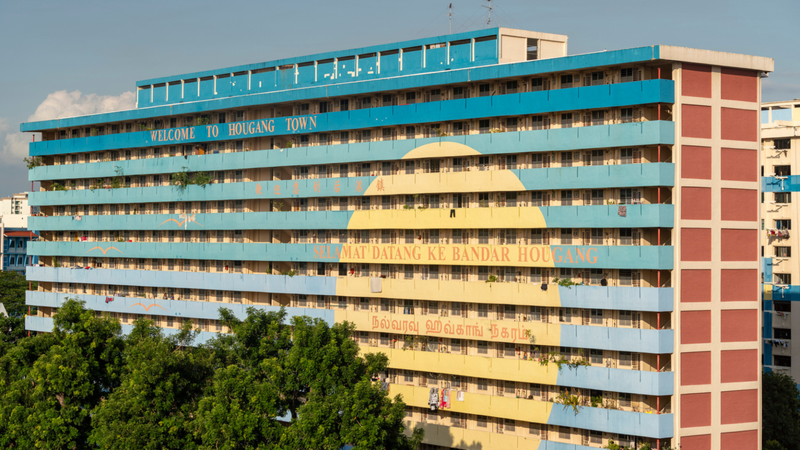
The persistence of this apocryphal story, its memory so vivid nearly two decades on, captures the peculiarity that is Hougang. Why would tens of thousands of people forego a windfall? Why would they reject uniformity and conformity when these very elements are touted as some of the key ingredients in our success? Why would they wish to stand out in a country where towns and neighbourhoods often meld into one another?
Google “Hougang Spirit”, and you’ll find an array of results, from news articles covering various GEs to HardwareZone forum threads to studies from as far back as 2011, all hailing the togetherness and communal spirit of its residents. Searching for the “Bishan Spirit”, on the other hand, opens a portal into the supernatural, while “Clementi Spirit” throws up invitations to explore the intoxicants available in the neighbourhood. “MacPherson Spirit” does get a few hits, but it’s a campaign label manufactured by the People’s Association. In contrast, Hougang Spirit appears to have organic origins, first translated from “后港精神” to describe the WP’s 2011 electoral victory in Aljunied GRC.
While it may have entered the vernacular recently, and even though the word Hougang itself first appeared on Singapore maps only in the 1970s, the Hougang Spirit actually owes its origins to the urban-rural divide in colonial Singapore, as well as post-independence resettlement policies that saw many erstwhile kampungs consolidated into the same estate. Even today, former kampung residents stay within shouting distance of each other. They share stories of a life that may no longer exist but whose spirit continues to animate the community, to which my family belongs.
In the 1800s, Singapore comprised two distinct worlds. The southern and central regions bustled with activities related to the increasingly busy port, while the rural areas—effectively everywhere else—were dominated by plantations: gambier, and then pepper and rubber. Major arteries branched out from the business district towards settlements in the island’s corners before splitting and spreading further into the kampungs. For the north-east, the arterial road was Serangoon Road, which led all the way to Punggol Point, with branches into kampungs in Yio Chu Kang and Punggol. On rainy days, certain roads would be impossible to navigate; even on clear ones, the business district was a bone-rattling five-hour journey by bullock cart. Plantation workers thus spent the vast majority of their time in and around the north-east itself. Attap settlements sprang up, forming many of the first kampungs there. Shops, usually around the milestones which marked the major roads, followed—to serve the kampung inhabitants, and presumably, any wayfarer who decided to brave the journey north-east. In time, these shops and their owners would become part of the tightly knit communities that characterised the area.
Between the mid-1800s and mid-1900s, Singapore’s population grew from just over 52,000 to nearly 1m. Most new migrants settled around the southern business district and its fringes. Things were, to put it mildly, cramped. A 1947 British Housing Committee report indicated that 72 percent of people lived in the city-centre’s 80 sq km; the rest were spread out over 498 sq kms—a stark contrast to the evenly-spread population today. The report was damning in its assessment of Singapore’s housing conditions in the post-war era, calling it “one of the world’s worst slums” and “a disgrace to civilised community”.
From the time they arrived on these shores in 1819, the colonial authorities had been reluctant to spend on any public works. The Singapore Improvement Trust (SIT, precursor to the HDB), was belatedly established in 1927 to manage urban planning, including public housing. But the island’s breakneck growth meant slums and utterly squalid quarters continued to outpace the SIT’s efforts. To address this issue, HDB was set up in 1960, by which time the population had swelled to around 1.7m. Lim Kim San, Singapore’s first minister for national development, was appalled at the wretched living conditions: “Underneath the staircase was a single plank. A man was lying on the plank. He had rented it. That was his home!” Harry Potter without the magic. Lim also highlighted a case of brothers so poor that they had to share a pair of pants. This meant that the pants-less one had to stay at home under the blanket in Singapore’s heat while the other was at work—not quite the brotherhood of travelling pants.
HDB moved quickly. By 1964, just four years after the public housing program was launched, nearly one in five Singapore residents was living in a flat. By 1980, two in three were. Resettlement was a much-needed policy—conceived and executed brilliantly. Even though they resisted at first, for most living in the city-centre, the move was an upgrade; they were no longer at the mercy of landlords and had decent living space. However, the policy’s broad, nationwide thrust meant that the kampung folk—those living in far-flung areas away from the port and its economy—were forced into giving up the freedom of living off the land and being in nature. A nation-wide policy that was a godsend for the urban world was disastrous for many in the rural. This included the north-east. There, disenchantment with the changes would unite communities and ultimately coalesce into what is now called the Hougang Spirit.
Yet, to understand these bonds we must consider not only the area’s socio-economic milieu, but also its ethno-linguistic and religious moorings. The mushrooming of kampungs in the north-east was accompanied by the growth of the most distinct group that persists till today: the Teochew Catholics. The Catholic identity in southern China was seeded in the early 1800s by missionaries in Swatow, Guangdong. When the Teochews migrated, they naturally gravitated towards familiar faces and faiths.
To serve the growing Catholic community in Singapore, Father Ambrose Maistre, a French missionary, built a church in 1853—known today as Church of the Nativity of the Blessed Virgin Mary. Four years later, he purchased 40 acres of land (approximately 30 football fields)—including the site on which the church stood—from the East India Company (EIC). He retained some of it for the church’s needs and doled out the rest to other Catholics, either church workers or converts who desired proximity to their place of worship. This became kampung Kangkar, near the 8th milestone, on Punggol road. In Teochew, “kang” means river; “kar” is leg, an allusion to the village’s location at the mouth of Serangoon River. The river provided direct access to the Punggol coast, allowing Kangkar’s inhabitants to live off the sea. Over the years, other community markers emerged, including an upriver seafood market in the early 20th century where Kangkar fishermen could unload their catch, and the Montfort School in 1916, where most Catholics in the area sent their children. Nearly nine decades later, I too would attend Montfort.
My family hailed from the kampung at Punggol Point, in the farthest corner of the north-east. In the mid 1800s, around the time that Father Maistre was negotiating with the EIC for land, a musician, Wak Sumang, landed on Punggol beach. Legend has it that Wak Sumang was fleeing from the last ruler of the Riau-Lingga Sultanate, Sultan Mahmud Muzaffar Shah, after his virtuosity so bewitched the Sultan’s daughter that she asked to marry him. Following the EIC’s blessings, Wak Sumang founded kampung Punggol, beyond the 11th milestone. Oral history records suggest that a public officer came to the village in 1890 to facilitate building a road that would cut across the village. Long Amat, Wak Sumang’s eldest son who became headman after his father’s passing, chose to forgo the monetary compensation, requesting instead for kampung Punggol’s land to never be taxed—an exception which lasted until the entire village was resettled after independence.
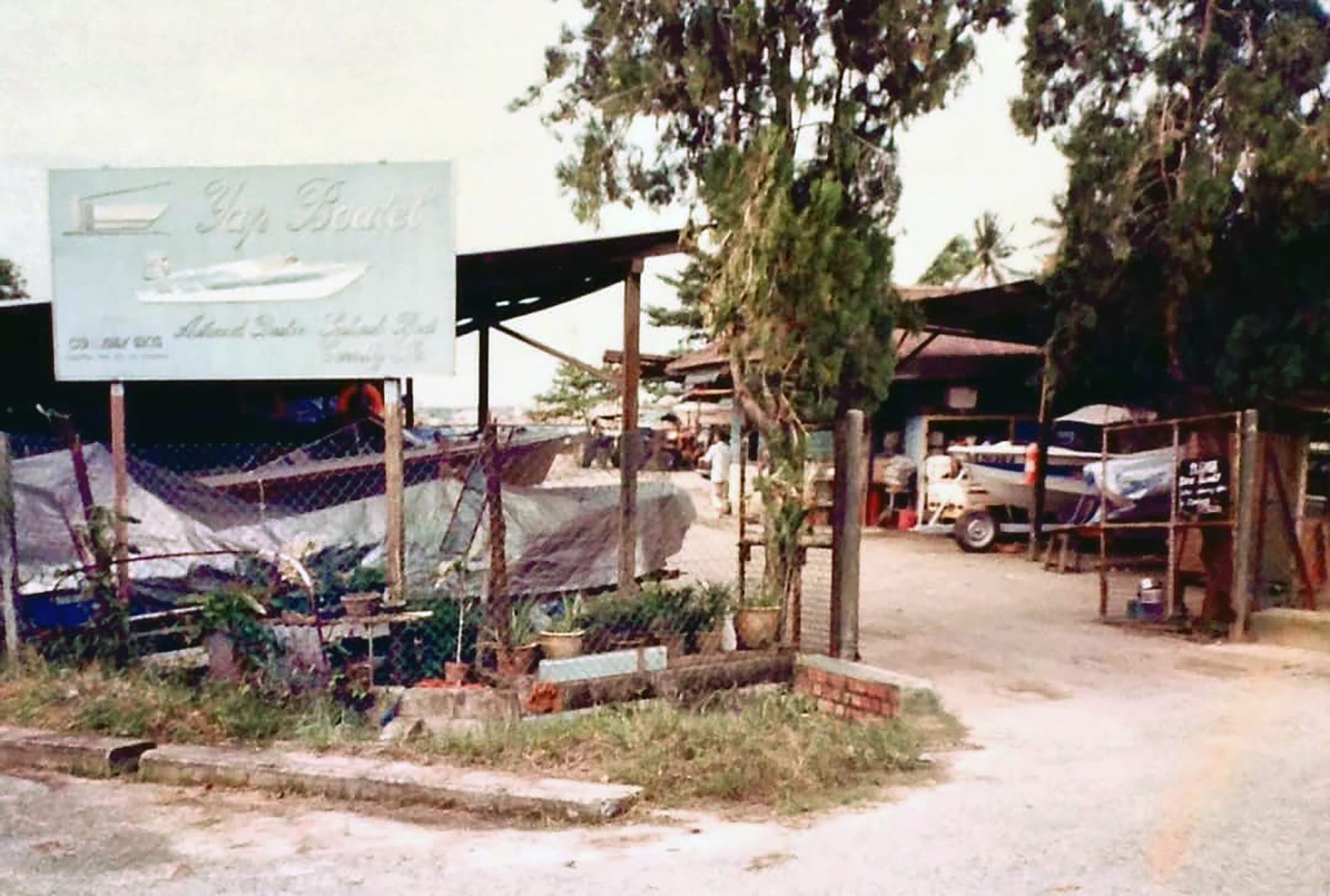
Apart from a brief and bloody interregnum during the Japanese occupation, when it was forcibly vacated for the beach to be used as one of the Sook Ching massacre sites, kampung Punggol existed as an almost self-contained seafaring settlement. After the war, it took in refugees from inland Singapore (as well as Johor) and became a recreational getaway due to its seafood and boating facilities. We were part of this re-migration, settling as one of only four Chinese families among the 50-60, mostly Malay ones, living there at the time. My grandmother and uncles operated the eponymous Yap Boatel, one of the eight boatels in the area. It was an isolated existence.
The nearest place to get groceries was at the 9th milestone, near where St Anne’s Church stands today—a half-hour bus journey or well over an hour by foot on a forested, hilly, rollercoaster of a road. On the rare occasions they boarded the only bus into town, some people would hang from the doors to avoid paying for a ticket.
“We went to places like Capitol Theatre and Peninsula Plaza on special occasions like Hari Raya. We felt like suakus (country bumpkins) in town! Most of the time, the furthest we went was [the] 8th mile junction [the Kangkar market].” Uncle Bujang, my father’s best friend from childhood, told me. Bujang means “bachelor” in Malay. Despite having known him all my life, I still do not know Uncle Bujang’s real name, and likely neither do many of his friends and family. Once, after he was retrenched from a marina where he and my dad worked, no one found out about it for days, because the name on the retrenchment list was his real one. I found this very “kampung”.
The isolation ensured that large parts of the north-east remained outside Singapore’s economic and cultural mainstream in the first two decades after independence, even as other parts of the island were being transformed at breathtaking speeds. “Life [in the kampung] was not easy,” recalled Aunty Peh, whose husband, Uncle Peh, ran the Chinese medicine hall Ban Siew Tong (万寿堂) at the same 9th milestone. Even after being relocated to Hougang Ave 8, Uncle Peh continued to be my family’s sinseh until his death a few years ago.
“We did not have fresh water, so we had to pump water manually early in the morning to make food.” There was no electricity either. After dusk, the light from kerosene lamps helped villagers avoid falling through the toilet, a fancy term for two planks over a malodorous, fly-infested hole in the ground. Despite such rudimentary facilities though, most people from the era remember being healthier. They walked everywhere, and swam almost daily. Since they lived off the land and sea, most did not need to work every day. “We seldom fell sick and very few people have [sic] diseases,” remembers Aunty Peh.
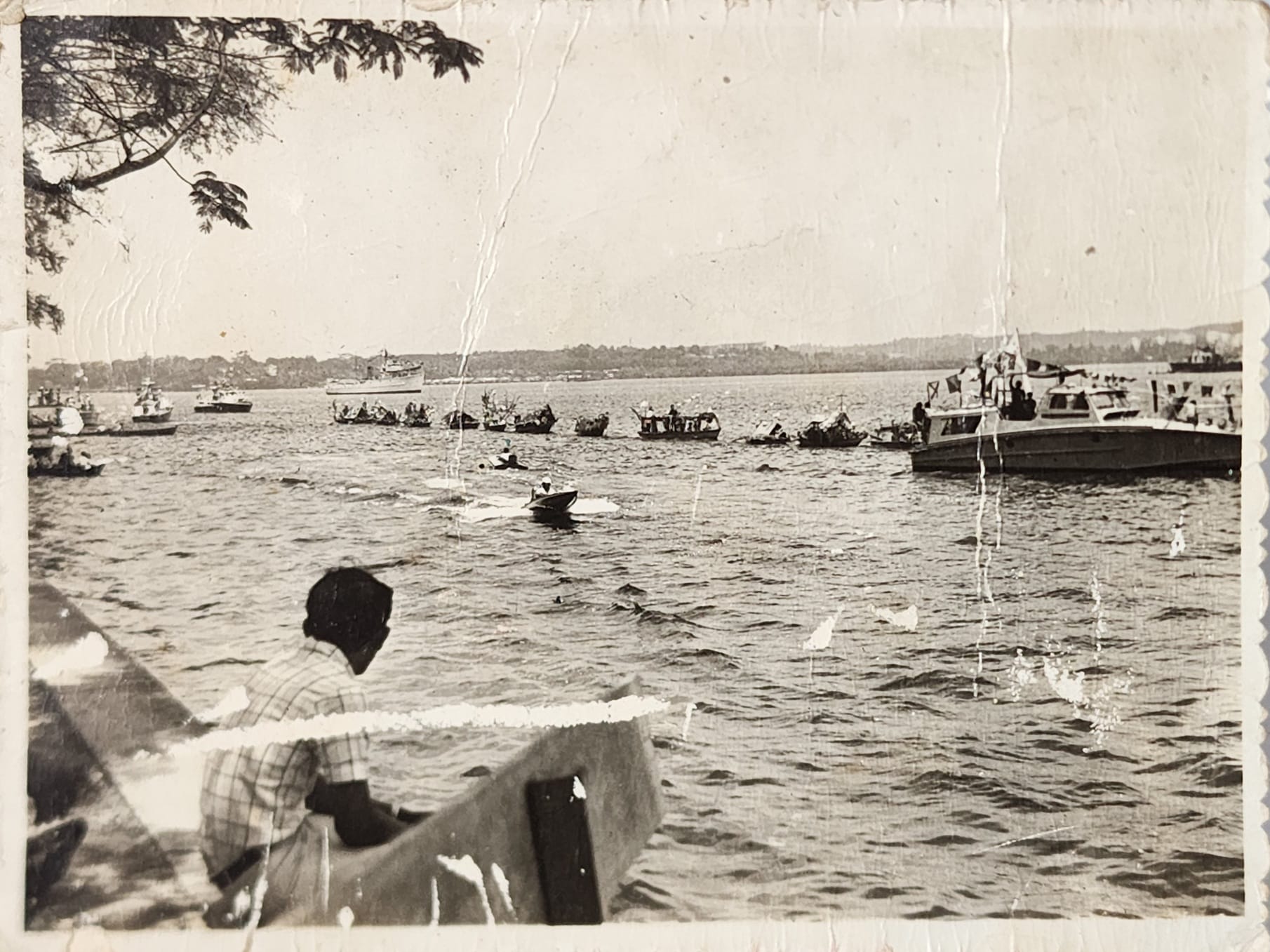
Being isolated from the trappings of the urban mainstream also ensured that community remained a hallmark of kampung culture. Doors were always open; families cared for each other. “Your grandmother last time always put out food at the table outside, whoever that was hungry can go and eat,” Uncle Abu, another one of my father’s friends, told me. Children played in each other’s houses, or spent time together outdoors, catching spiders or playing with marbles and slingshots. If someone was getting married, it was understood that neighbours would make their houses available as part of the arrangements. “Everyone was friends, abang-adik (older brother-younger brother), no matter the race,” added Uncle Bujang. Even as modernity started encroaching in the 1970s-80s, with concrete houses replacing attap huts, the community spirit stayed intact. When they got a landline phone in their 9th milestone shop, Aunty and Uncle Peh were happy to let anyone come over and use it.
When Singaporeans talk about the old north-east today, it’s usually the pig farms they first remember (“On a windy day I could smell sewage!”). The pig farmers moved into the area last, as personifications of independent Singapore’s original quest for self-sufficiency. Until the 1960s, most pig farms were concentrated around the Kranji and Kallang rivers due to their intensive freshwater demands. In 1975, as industries and people were moved around like pieces in a giant jigsaw, nearly 3,000 farms were relocated to Punggol and Seletar South. This was part of the government’s switch to intensive pig-farming. It set aside over 10 sq km of land, complete with cables, pipes and roads, and built apartments to house the families.
By 1977, Singapore was declared “self-sufficient in pigs”, which allowed the young country to save millions of dollars every year by minimising pork imports. That very same year, in response to a parliamentary question by the PAP’s MP for Punggol, the senior minister of state for national development reassured resettled farmers that they would be able to continue farming for at least another 15 years. The reason why farmers were skittish was because of the toxicity of pig waste, which had necessitated a move away from the Kranji catchment area in the first place. But promises such as these, and new policies, including mandatory waste treatment and a joint Singapore-German pig research centre, introduced in 1981, were reassuring.
In September 1983, the Primary Production Department, which oversaw the nation’s farms, announced a full-time, nine-month course on pig farm management in Punggol. In December, 21 commercial farms, each with more than 11,000 pigs, committed to building waste treatment plants, in line with new regulations. The government set aside tens of millions of dollars (partly derived from an environmental levy) to subsidise the construction.
Three months later, in March 1984, came a shocking development. Goh Keng Swee, deputy prime minister, announced that pig-farming would be phased out entirely. The government had concluded that, actually, importing meat—it would shortly embark on a campaign encouraging the public to consume frozen pork—was cheaper and friendlier for the environment. “Does it make sense to spend some S$80 million on waste treatment plants to achieve poor environmental standards? If pig farms have eventually to go, why prolong the agony?” Goh asked in Parliament.
In May, Goh Chok Tong, then minister for defence, said that the decision to end pig farming in Singapore was made due to Singapore’s land constraints. The country needed space for more flats and factories, and more roads to connect them. Worse, this time there would be no resettlement. Pig farmers were told to change to farming other livestock or crops, or accept government compensation and switch careers. For many farmers who were in their 40s and 50s and largely illiterate, this was a period fraught with anxiety.
“The announcement was like an atomic bomb to the farmers. When we heard the news, we were dazed, we couldn’t eat or sleep” said Lim Chor Hau, one of those affected. “Everyone was selling their pigs. There was a news report in Punggol that some starved their pigs to death. Some said it was animal abuse and immoral, but the farmers had no other choice. If you don’t do that, you were left with a pig no one wants to buy.”
Lim had the opposite problem. He’d signed a contract with a waste treatment plant stipulating that his farm had to have a certain number of pigs by a certain date, so that the plant’s efficiency could be measured. Failure to meet the number would incur additional costs. “We did not have enough species in Singapore, so we had to ship some from England by air. The cost came up to around S$1,300 to S$1,400 per pig.”
Today, society understandably shines a spotlight on the three former pig farmers with the most successful business pivot stories: Koh Swee Lai of Seng Choon Eggs, Tan Chye Huat of Prime supermarket and Lim Hock Chee of Sheng Siong supermarket. But far more common were tales of farmers having their careers cut short, being forced to give up the farms they nurtured over decades, all in the name of national progress.
To understand the Hougang Spirit then is to also appreciate the remarkable series of coincidences that created it. The fact that the pig farmers were moved to Punggol and the fact that the economic rug was pulled from under their feet so abruptly. It is a spirit forged by successive waves of hardworking rural Singaporeans suddenly disenfranchised by an unsympathetic, developmental state. Then there was the timing of it all. For in the mid-1980s, the great Singapore resettlement was entering its third and final phase.
The three-decade long resettlement exercise had started in the 1960s with new townships in Queenstown, Redhill, and Toa Payoh, among others. The 1970s were focused on the likes of Geylang, Telok Blangah, Ghim Moh, and Clementi. Punggol’s turn came in the next decade, although boatels like my family’s and a few other businesses were given an extension until 1994.
“We were only given two to three months between the notice and having to move,” Uncle Bujang shook his head. It was a jarring experience, having to leave behind the open spaces of the kampung for cramped HDBs. It stung all the more because many vacated areas were only developed more than a decade later, thanks to delays brought on by economic crises, SARS and a slump in Singapore’s construction sector. In the years towards the end of the millennium, the lalang field at Punggol Point became a favourite of newlyweds in search of exotic backdrops for their photoshoots. The delays were mostly out of policymakers’ hands, but it was difficult for the old residents to not feel hard done by. “They never build [sic] anything there [at the kampung] for 10 plus years. Why did they make us move?” complained Uncle Abu.
Life’s textures changed. Community centre swimming pools replaced the river and the sea. The drudgery of daily jobs replaced the luxury of living off the land, and fishing for food. Television replaced nature. Or, as Uncle Abu put it, life was reduced to “watch TV, sleep, work, eat, watch TV some more”. Almost to a person, every former kampung resident I spoke to claimed the switch from rural to urban living adversely affected their health.
Resettlement also brought with it fresh economic anxieties. Many residents of kampung Punggol were living in stilt houses on the water—not properties eligible for compensation under the Land Acquisition Act. All they got was a paltry moving fee. Near the 8th milestone, families who had lived on church land in kampung Kangkar since Father Maistre’s time in the 1800s were recompensed only for their trees and livestock. To compound matters, many kampung folk did not contribute to their CPF, even though the scheme had been set up in 1955. Shopkeepers and business owners were dealt a double whammy—figuring out how to pay for their new flats as well as coping with new rents for their business premises.
“We had no CPF so we used a lot of cash for the move. We were paying S$25 per month at Punggol for the shop, but after the move, we had to pay S$600 to S$700 per month (including utilities),” remembers Aunty Peh. “This was in 1986; it was a big sum back then. My children were entering secondary school as well, so the worry was real. We did not dare to apply for a bigger flat because of that. We hated to move away.” Meanwhile, there was a flurry of new bills to contend with—water, electricity, town council. The one saving grace of this new life was that resettlement policies led to former neighbours staying nearby, perhaps the only feature of their former lives that retained its flavour in the so-called “vertical kampungs”.
“For us, our first choice was at Hougang Ave 7. Most of us grew up here, we knew each other, and liked living here,” said Margaret Yeo-Koh, a Teochew Catholic from Kangkar. Meanwhile, residents from kampung Punggol were given the choice of moving to Hougang Ave 8, Hougang Ave 10, or Ang Mo Kio. Most chose to remain in Hougang, near the road leading to the Punggol coast so that they could continue working as boat drivers or repairers.
Even today, the gang, my father included, hangs out in the coffee shops around Hougang Ave 8. Despite the very Singaporean ethos of climbing the property ladder, the notion of moving away has never crossed their minds. “Many of us still stay here in the same neighbourhood today even when we can sell [the flat] for money because friends and family are here,” remarked Uncle Bujang.
Punggol, Kangkar, 9th milestone. Pig farmers. Economic hardship and memories of a simpler life. Neighbours and community. The bedrocks of the Hougang Spirit which first made its presence felt during the 1991 GE, when the WP’s Low defeated the PAP incumbent. “Mr Low came alone, walked everywhere in Hougang, even wrote a Teochew poem during a rally. He brought a dialysis patient to the centre himself and asked the staff for subsidy,” remembers one long-time resident.
Though ostensibly like any other region in the country, with malls, coffee shops and HDBs as far as the eye can see, Singapore’s north-east continues to exist outside the mainstream as a WP stronghold since 1991. Hougang is the only constituency in Singapore that, since 1965, has been represented longer by the opposition than the PAP. As illustrated by the urban tale of spitting on the idea of lift upgrading, there is an intrinsic rejection here of the notion that material comfort is all that matters.
Every interviewee told me they’d give up the comforts of modern Singapore for a return to kampung life. It’s something to ponder as we look back at our journey from “third world to first”; and as we look ahead, wondering what our next step should be.
Kelvin Yap is a former journalist and editor who plied his trade with ESPN Star Sports, Fox Sports Asia, NewsCorp, and OneFootball. These days, he spends too much time diving into socio-economics, history, and philosophy in a desperate attempt to make sense of a world obsessed with infinite material growth. His Instagram handle is @the.bloody.wordsmith.
Letters in response to this piece can be sent to sudhir@jom.media. All will be considered for publication on our “Letters to the editor” page.