Eighty years ago, on September 12th 1945, the Commander of the Japanese 7th Area Army General Seishiro Itagaki surrendered to Lord Louis Mountbatten, Supreme Allied Commander of the South East Asia Command, in the City Hall Chamber. The moment sealed Itagaki’s fate in more ways than he could know. Tried for war crimes, he was executed in 1948. Notoriety of a different kind lurked in what The Straits Times (ST) described at the time as the “vermillion-coloured wax” on the instruments of surrender into which he pressed his personal seal and that of the Japanese army. For the obverse of Itagaki’s imprint would be his own likeness in wax, reproduced three decades later alongside those of his six fellow officers, and 20 representatives of the Allied forces in a tableau of the scene. 

Now more than half a century old, the “Surrender Chambers” waxwork exhibit of the Japanese surrender remains on display to this day, alongside one showing the British surrender to the Japanese on February 15th 1942. Timeworn and unlovely, the exhibit’s very persistence in Singapore’s otherwise footfall-driven, high-tech experience economy suggests there is more to it than meets the eye. 

Taken together, the story of the waxworks’ creation, their vexed relationship to the event they depict, and the unsettling experience they continue to offer visitors combine to tell a fascinating and overlooked story: one that is all about Singapore, without a Singaporean in sight. 

Given the long and complex past of the region in which Singapore sits and its relative youth as a postcolonial nation state with a multi-ethnic population, it is unsurprising that the national imaginary includes historical and cultural representations from before independence and beyond its borders. 

Still, it is striking when an independent state continues to invest in such representations. In December 1970, the Singapore Tourist Promotion Board (STPB) convened a Special Committee for Selective Historic Sites into Tourist Attractions. Having identified a site by the Singapore river where Sir Stamford Raffles was thought to have landed in 1819 to “found” modern Singapore, a white polymarble reproduction of Thomas Woolner’s 1887 bronze statue of Raffles was erected in 1972. Later that year, an 8.6m tall fountain depicting the STPB’s hybrid fish-lion mascot, the Merlion, was placed at the mouth of the Singapore river. And in March 1974, a waxwork reconstruction of the formal Japanese surrender to Allied forces opened at the City Hall Chamber. 

These attractions spoke to the complexity of Singapore’s self-imagining at the time. Tellingly, Singaporeans were not represented in any of them. Yet more intriguingly, between an imperialist icon, a cartoon myth, and a historical tableau, it was the latter that would prove most contentious.

Why? In January 1971, the Singapore Herald reported that the STPB was planning “a Madam Tussauds of sorts”, which would represent the 1942 British surrender to Japanese General Tomoyuki Yamashita (the so-called “Tiger of Malaya”). To be located on the British surrender site at the Ford Factory in Bukit Timah, the goal was “to lure more Japanese tourists here.”

Cash-strapped post-independence Singapore was indeed aggressively pursuing the Japanese tourist dollar. STPB had set up a tourist office in Tokyo in 1970, and began hosting Japanese tour operators and providing language training for local tour guides. By December 1973, these and other initiatives would enable the Board to announce overall annual visitor numbers had almost doubled from 579,000 in 1970 to the financially and symbolically significant milestone of a million. 

However, news of the British surrender waxworks plan caused a furore. The Appeal Committee for Singapore Chinese Massacred by Japanese, a pressure group which had successfully pressed for reparations from Japan during the mid-sixties following the discovery of mass graves dating from the Japanese occupation, described the plan as “disgraceful”. Low Yong Nguan, a member of Parliament, castigated it as “an insult to the dignity of our people.” The STPB countered that the waxworks were part of a larger initiative that would also represent the Japanese surrender to the Allies, and that the plan was not simply to please tourists “to earn a few more yens”. 

However, several voices were also raised in support of the Japanese because of the blow they had struck against western imperialism. In a letter to the press arguing that Yamashita helped “Asia to regain her self-respect and identity”, one D. E. S. Chelliah asserted that “not only would it be proper for Singapore but also for every other Asian country which has been liberated from the shackles of the colonial powers a[s] a result of the last World War, to erect a statue in memory of Tomoyuki Yamashita.” 

CI Danker echoed the sentiment, reasoning that “the three Wise Men of Singapore as discoverers of modern Singapore are Stamford Raffles, Tomoyuki Yamashita and Lee Kuan Yew” while a further anonymous correspondent asserted that “but for the Japanese victory we would have had to live with the concept that is the White man’s divine right to rule and the Asian’s divine right to serve the White for many a day to come.”

The waxwork plan had become a lightning rod for debates over how freshly-minted Singaporeans should interpret and relate to their recent past. The speed with which discussion of a representation of Yamashita in wax morphed into the question of his commemoration in a statue underscores the relative strength of anti-Japanese sentiment among Chinese Singaporeans, and anti-Western feeling among—if we go by the names of the letter writers—some non-Chinese Singaporeans. 

This arguably reflected the legacy of the “divide and rule” approach to racial governance of the Japanese occupation. Ultimately, however, the pro-Japanese arguments for the waxworks did not prevail. The British surrender project was quietly shelved while the waxwork display showing the Japanese surrender to the Allies went ahead, though not without difficulty. 

As a fascinating 1971 STPB report makes apparent, it’s one thing to commit to the creation of such an exhibit: it’s quite another to work out what, exactly, it looks like, and what it might mean. Written for the exhibit creators, “Historical Research on the Surrender Ceremony at City Hall on 12th September 1945” summarises everything its authors could discover about the surrender at the time. It also catalogues everything that was unavailable or incompletely understood. 

For instance, the report notes gaps in contextualising information, such as the identities of five of the seven Japanese officers. Since the journalists in attendance were pooled together, all the photographs were shot from the same angle, offering “mostly left profiles and ‘three-quarter-face’ views of the Japanese representatives.” This meant significant gaps in what could be seen, including the facial expressions of leading figures, close-ups sufficient to distinguish the faces of the Japanese, the legs of the Japanese, relevant details of participants’ uniforms and decorations, the positioning of ceremonial guards, and the banners on the pillars of the room. The absence of colour images led the authors to fret that “it is impossible for the maker of wax figures to reproduce the colours of the uniforms, decorations, ribbons, skins, hair, etc. of the key Allied persons who took part in the Ceremony.”

Some of this information—such as the identities of the Japanese officers—would be added later. Nevertheless, the STPB researchers’ investment both in the information that could be wrung from extant documents, and the cataloguing of the gaps, speaks of a desire for total visual knowledge that would be disappointed not only because such knowledge is impossible, but for another reason specific to the setting. 

As the sociologist Robin Wagner-Pacifici puts it in her book The Art of Surrender, surrenders mark “a break in the narrative flow of history.” Representations of such events therefore “struggle to be competent in navigating and successfully signifying this middle ground where an end meets a beginning, where one world meets another.” 

Indeed, surrenders are not only hard to represent accurately, they are unstable acts in their own right. For reasons that spoke to the disorderly realities of war’s end and the transition to civilian rule, the Japanese surrender was no exception. 

Because the Japanese capitulation had been prompted by the bombing of Hiroshima and Nagasaki, the occupying army in South-east Asia remained large, well-armed, and intact. It was not clear they would observe Emperor Hirohito’s Imperial Rescript on Surrender without a fight. Mindful of this, Mountbatten wrote to General Douglas MacArthur, Commander of Allied Forces in the South-west Pacific Area, expressing his concern that the circumstances of the capitulation would “enable the Japanese leaders to delude their people into thinking they were defeated only by the scientists and not in battle, unless we can so humble them that the completeness of defeat is brought home to them.”

Indeed, so tenuous was the Allied grip on power in Singapore at the time, one has to wonder how much the surrender ceremony comprised a formal representation of a change in state and governance, and how much it was simply an isolated event that referred first and foremost to its own enactment. Personnel shortages meant Japanese soldiers were drafted to guard the parade route of their own surrender, and Mountbatten openly included Communist guerrillas from the Malayan People’s Anti-Japanese Army (MPAJA) in the event. They had fought alongside the Allies during the Japanese occupation, but had developed a powerful anti-colonial ideology, informed in part by Japanese narratives of western colonial oppression. 

It is little surprise that the surrender ceremony itself was roiled by representational instability. When control of territory and people is changing hands, such ceremonies formalise a definitive transfer of power. Yet representatives of the losing side must retain sufficient legitimacy to admit defeat, so they and those they represent may thereby be divested of that power. Here, it fell to the ceremony to maintain this fine balance in the face of a number of underlying complexities that spoke both to the necessity and fragility of theatricality in the surrender process. 

Itagaki himself was standing in for Field Marshal Hisaichi Terauchi, Commander of the Southern Expeditionary Army, who had suffered a stroke in Saigon, and was unable to travel. But in a sense, Itagaki was also standing in for himself. He and his delegation had already effectively surrendered to the Allies aboard the HMS Sussex, off Singapore, a week earlier, on September 4th. This led to the withdrawal of 35,000 Japanese troops to the peninsula over the ensuing 24 hours, at the same time as a non-combative landing of 100,000 Allied personnel that has been described as “a three-day propaganda spectacle offering photographic opportunities galore for the British media.” 

Indeed, in historian Romen Bose’s view, the September 12th ceremony “was significant purely as a tool to restore British pride and status among the local population.” We find support for such a claim in the small details. Bose reports that after Mountbatten discovered he had forgotten to bring the medal ribbons for his white Admiral’s uniform from SEAC headquarters in Kandy, Sri Lanka, he had a subordinate begin to improvise a makeshift set overnight. In the event, the decorations arrived in time for the ceremony on a plane specially despatched for the task. Later, Allied participant Admiral Arthur Power complained about the number and behaviour of the press in the chamber, noting that “the sides and galleries resembled batteries of searchlights”, marring “the conduct of proceedings” by causing them to “resemble a football match.” 

Meanwhile, refracting the original surrender ceremony through the waxworks throws into relief a particularly intriguing detail: ST’s eyewitness account made multiple references to the “impassive” and “immobile” Japanese in the surrender party. With the exception of one “who twiddles his thumbs and twitches his feet”, the delegates remained “looking straight ahead”: a point picked up in the STPB research document, which noted “the expressionless faces of the Japanese representatives who were looking straight at the Allied table.”

Even accounting for orientalist journalistic clichés about Asian inscrutability, this behaviour strikes a distinctive note. At the very least, we can say that the Japanese officers sought to withdraw their subjectivity from the event; we might venture that they were withholding their selves from subjugation. Writ large, we can point to a significant military and national cultural hinterland that extolled the virtues of fortitude and composure in the face of suffering: the Imperial Rescript itself called upon Japanese subjects to “[c]ultivate the ways of rectitude” to assist in “enduring the unendurable and suffering what is insufferable.” Writ small, we might say that this behaviour anticipates the present context in an intriguing way: whether chosen by the principals, or produced by the massively straitened circumstances in which they found themselves, the Japanese were already approaching the condition of wax. 

When the Japanese surrender waxworks opened in March 1974, their cost dwarfed other tourist initiatives: S$430,338 (S$1.5m today), by comparison with Merlion Park (S$135,935) and the ornamental Siong Lim Garden (S$22,349). Six months later, in September 1974, the exhibit was relocated to Sentosa at a further cost of S$179,183. It has remained there on almost continuous display, first at what would become the Sentosa Wax Museum, and now as part of the Fort Siloso complex. 

In August 1981, the tableau was finally joined by one of the British surrender. It was manufactured in Japan for less than a third of the price (S$130,000); ST reported rumours that Sentosa Development Corporation had initiated the project because “the influx of Japanese tourists caused some embarrassment…over the incomplete picture given in the Surrender Chamber.” A Corporation representative insisted the rumours were unfounded, but went on to say that while the original waxworks were drawing big crowds, including Japanese tourists, “the new wax works may interest them more.” 

This was a far cry from the accusations that had greeted the first such announcement almost a decade earlier. No doubt many factors played a part. Singapore-Japan relations were warmer. Memories of the Japanese Occupation were fading, and Japan was a dominant Singaporean trading partner, occasioning a perhaps strategic degree of historical amnesia. 

It may also point to a broader transformation in how Singapore was beginning to see itself. This involved reconceiving its relations with both pre-independence imperial powers, and working out what its own identity would be. It was now acceptable, indeed desirable, for the general manager of the Sentosa Development Corporation to justify the opening of the new waxworks by saying: “We got the tail end but no beginning…We want Singaporeans to know the whys of the Second World War in relation to Singapore.”

Fast forward four decades. To encounter the waxworks today is to be presented with a discrete object whose presence and consistency lend it an authority that belies the complexities of the moment it represents. It does so because it is actually a representation of representations: a composite of actions and configurations that took place over the course of a ceremony that seemed already to be performing the role of theatrical representation of many other representations: a surrogate event, peopled by surrogates, archived in profile, then filled out by a combination of guesswork, and the casts of other people’s bodies. 

For example, the Japanese have been given hands. In almost all extant images of the ceremony, only Itagaki’s hands can be seen; those of the others remain hidden in their laps. In the waxworks, five of the seven Japanese officers have their hands on the table. This adds character and dynamism. Indeed, the hands return subjectivity, in wax, to those who withheld it at the event itself. Hands can be expressive without being beholden to a distinct reference point as heads are; you can cast them from a stranger of roughly the right size, and no one should mind too much, even if some of them are suspiciously well-manicured for the occasion. 

By contrast, the individuality of the Allies is minimised. The contemplative chin-holding of Admiral Arthur Power, apparent in photographs, has been replaced by a more routine table pose, with both hands before him. Likewise, while Brigadier K. S. Thimayya largely clasped his hands during the ceremony, footage shows he briefly extended them before him—and it is this fleeting moment that has been captured in the display. If the addition of Japanese hands restores subjectivity, then, the selection of Allied postures from different moments in the ceremony introduces temporality into the frozen exhibit. We are not looking at the tableau of a single moment, but a “supercut” of appropriate gestures, with poetic license fleshing out the Japanese.

Nor does this mark an end to the chain of stand-ins that arc back through the history of the waxworks. For we are yet to reckon with the bodies of the spectators who observe the exhibit, and how they experience its uncanny combination of inarguable thereness and historical contingency—a quality that has only intensified as the waxworks have aged. 

The waxworks have no Singaporean figures

When the resort island of Sentosa was re-branded and relaunched in 2004, ST noted: “Before it can be a Singapore idol, it must face the harshest panel of judges: Singaporeans themselves. Industry insiders say it must overcome decades of prejudice among deeply unimpressed citizens, some of whom possibly still associate it with school excursions to see scary wax figures in the Surrender Chamber.”

With the passage of time, the waxworks have become museum pieces in their own right. Nothing in the display reflects on their historicity—the basic fact, for instance, that an ever-greater span of time has elapsed since their inauguration in 1974 than the 29 years between that moment and the event they depict; or that the Mountbatten figure wears a uniform worn by Mountbatten himself, and donated, as reported in 1976, “to help depict the reality of this historic scene.”

At the same time, one senses that the figures continue to be displayed more because longevity itself has earned them a privileged claim to unmolested perdurance, than that they perform serious educational, historical, or touristic work. Eclipsed both by the “Images of Singapore” and Madam Tussauds attractions they anticipated, and by many more kinetic, immersive tourist experiences on offer today, if anything they testify to the major transformations in Singapore’s tourist industry over the past several decades. 

But to the curious observer, the relative obsolescence of the exhibit provides an opportunity for quiet reflection on its meanings and effects. As waxworks, they participate in a museological tradition of figuration associated today with celebrity, and historically with the macabre notoriety of criminals. Following on from wartime atrocities and the atomic bombs, and foreshadowing the war crimes trials in Tokyo and elsewhere in Asia, the Japanese surrender scene is glossed by the same associations: three of the Japanese depicted were subsequently executed; Mountbatten himself would be assassinated by the Irish Republican Army in 1979. 

But waxworks are not only associated with death by dint of Tussaudian prurience. The texture and implicit warmth of wax as a material, and the combination of uncanny verisimilitude and absolute stillness it affords, locates the resulting figures unsettlingly between life and death. At least, that was my experience the first time I visited them in 2016. Alone in the exhibit for an hour or so, I could subject them to a level of scrutiny they might not ordinarily be expected to support, and they me. To spend time in the Surrender Chamber is to find the historical elements of the scene falling rapidly away, and confronting, instead, the details of hands, eyes or hair—theirs and your own. It is to feel quickened among the eerily still; mortal at a frozen moment. Surrendered.

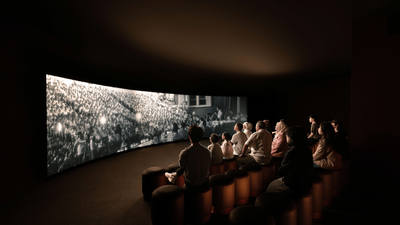
A year later, the exhibit had been reframed by a time-based audiovisual accompaniment. Special effects and a voiceover now ushered the visitor peristaltically through the separate chambers, with both the British and Japanese surrender waxworks illuminated for short periods within the larger narrative. The technology remained rudimentary: the entirety of the bombings of Hiroshima and Nagasaki was captured in a single strobe flash. Nevertheless, the reframing changed one’s engagement with the exhibit. With less time for scrutiny, the representational shortcomings of the waxworks were minimised. Instead, they crystallised the preceding narrative of Japanese invasion and local wartime suffering, the upheavals of the war, and the stakes in the surrenders now partially displaced from the waxwork figures into the bodies of spectators themselves. Automated lights guided viewers towards and then away from the things they were invited to look at or listen to, requiring more active, embodied participation as one variously observed, pushed interactive buttons, and bent to listen to small speakers. Dramatic music, coloured and flashing lights, and the shift from light into darkness created an immersive experience that was felt affectively as much, if not more, than processed cognitively. Uncanny when left to their and the visitor’s own devices, as previously, the waxworks had now been co-opted into narrative. 

I revisited the exhibit this year, on a relatively busy Sunday. The attendant explained that the audiovisual experience was still available, but I would need to wait for the Chambers to clear of other visitors. I was happy to forego the invitation, and linger once again at my leisure. Previously, I’d been alone with the waxworks, so the novel experience of looking at them alongside other living beings was quite unsettling. A stranger and I stood next to each other, staring at an inanimate object that invited us to invest in its lifelike qualities. I grew self-conscious, in a way I would not in an art gallery, say. I felt compelled out of embarrassment to state the obvious: that I knew the figures weren’t real, that they were mainly objects that just happened to take human form. I kept my mouth shut.

That said, there is an outlet for such expressions. Exiting the chamber, visitors are invited to confess the morality of their participation in the experience by sharing their “message of peace” on a poppy-shaped post-it note which they can then stick on the ‘lest we forget’ wall. The messages left during my own visits speak to the different kinds of responses the exhibit provokes:

“Singapore stay Peace And No TAX!!!” 
“After 23 years I again relive the memories of Surrender Chamber” 
“We will remember them always”
“Charles Osborne British Indian Army Engineers one of first into Changi Jail to relieve Japanese commander of his post in 1945”
“They should have dropped another bomb.”

In November 1981, an overnight power cut threatened both the climate-controlled wax figures and another Sentosa highlight, the “Coralarium”. An emergency generator saved one of the two displays. Or, as a newspaper headline put it, “Generals escaped, fish did not.” The living died, the undead endured. And endure still. The low-level persistence of this rudimentary exhibit—static, misshapen, ever so slowly oozing, barely seeing enough footfall to rise to the level of collective consciousness—remains as the faintest imprint of a moment increasingly distant in time, but whose legacy continues to be reassessed, and to invite controversy. The remains of two generals depicted in the surrender exhibit, Itagaki and Lieutenant-General Heitaro Kimura, are among the 14 Class A war criminals whose souls are periodically worshipped by Japanese officials at the Yasukuni Shrine, to Chinese, Korean, and sometimes Singaporean chagrin. Before she became Japan’s prime minister, Sanae Takaichi was a regular visitor to the shrine, including as recently as August this year, to mark the surrender’s 80th anniversary. Speculation continues as to whether she will make the incendiary decision to visit again. 

The surrender waxworks’ relative minimalism enables them to hold within themselves, and throw into relief, complexities about the past that more iconic and readily reproducible representations might—paradoxically—obscure.

In particular, even though the event depicted did not feature anyone from Singapore, the creation of the waxworks offered an opportunity for Singapore to think about its own sovereignty. This is something the 2017 addition of the ‘lest we forget’ wall highlights: by including the voices of Singaporeans in the exhibit, we are reminded that the waxworks themselves show us a Singapore without Singaporeans—a genuinely striking omission whose meanings have changed over time. 

Revisiting the end of the war in 1945 from the vantage of nascent nation-building in the 1970s was arguably a way of joining up two moments of relative political clarity and setting aside the long interregnum of the Emergency and the failed attempt at federation with Malaysia, which had significantly muddied the waters of allegiance and identity. 

In The Art of Surrender, Wagner-Pacifici gestured to the psychology of such a moment: “The witnesses of historical transformations are positioned to observe something that happens in ‘real time’ and yet must also attest to that happening by freezing time…They are called on to bear witness to a vision of the world that is remade at the very moment when witnessing becomes relevant.” If the surrender waxworks were one such freezing of time, they tell us as much about those who observe as those depicted. It was a moment when Singaporeans became “relevant” to a historical moment that otherwise excluded them, by recreating it in and for the eyes of Singaporeans (and others).

While the Japanese and Allied forces were long gone by 1974, the waxworks testified to the prevailing and increasingly self-reflective presence of Singaporeans as witnesses. Today, the waxworks seem out of time as exhibits, but perhaps that is the reason they align so well with their subject matter. They depict a pivotal event combining decisiveness and contingency that fired the starting gun on the antagonisms and transformations of postwar South-east Asia. Their creation tells the story of Singapore’s changing attitudes towards Japan and the West, and its sense of itself. Their enduring, uncanny effects teach those who visit them what it means to bear witness to one’s own creation, at an ever greater distance in time.


Paul Rae is Professor of Theatre Studies at the University of Melbourne. He writes on contemporary theatre and the performance cultures of the Asia-Pacific, and maintains a Substack called ‘What the Theatre Said’ at https://theatresaid.substack.com/.

This essay is adapted from a longer chapter by the author in Cold War Asia: A Visual History of Global Diplomacy, edited by Matthew Phillips and Naoko Shimazu, and published this year by Cambridge University Press.

Letters in response to it piece can be sent to sudhir@jom.media. All will be considered for publication on our “Letters to the editor” page.