

ABC. The letters drummed into Natasha when she was young stand for “Australian born Chinese.” She felt confused by the phrase; something about it didn’t sit right with her. Under the umbrella term “ABC” is a mélange of mixed identities, from those whose families emigrated directly from China to those whose ancestors came via a third place: Mauritian Chinese, Fijian Chinese, Cambodian Chinese, and more. Why were these specificities glossed over? Growing up in Australia with a Chinese-Malaysian father and an Indian-Malaysian mother, Natasha didn’t really feel “ABC”.
They had few relatives in Australia and Natasha spent most of her childhood connecting with her mother’s side of the family, who are Tamil. Twice a year, with her parents and her older sister, she boarded a flight to Malaysia to visit her paati, periammas, chinnammas, mamas, akkas and annes.* Frequent and cheap flights were one of the perks they enjoyed from Natasha’s father’s job as an engineer with Qantas, Australia’s national airline.
One of her enduring memories from these bi-annual visits to Ipoh, Perak was celebrating Thaipusam, a Hindu festival celebrated by ethnic Tamils across the world on a full moon night in the month of “Thai” (which coincides with January/February on the Gregorian calendar). In Malaysia and Singapore, where ethnic Tamils account for around five percent of each resident population, Thaipusam is celebrated with great fervor. It’s a public holiday in Malaysia, but hasn’t been in Singapore since 1968, when it was one of several religious holidays relinquished by leaders of respective faiths. (There are occasional calls to reinstate it.)
In the morning, Natasha would wake at four and don a pattu pavadai, a traditional outfit worn by Tamil girls. Her most memorable pavadai was a shimmering yellow made from pure silk, with gold brocade trim on the sleeves and skirt. Natasha and her sister would pile into cars with cousins, uncles and aunts, and drive ten minutes from her aunt’s house to the Maha Mariamman Temple. From there they’d join thousands of other devotees in walking barefoot to the Kallumalai Arulmigu Subramaniyar Temple, or the Murugan Temple as it is famously known. Natasha and her cousins would each carry milk in a metal bowl, the smallest kavadi or physical burden devotees offer to Lord Murugan. Most of the milk would’ve spilled out by the time she stopped walking, leaving her with sticky hands.
To properly see the bigger kavadis—ornate structures that can weigh up to 30kg—at night, they’d go to the large padang in Ipoh, its surrounding streets cleared of vehicles during the three-day celebration. From the edge of the padang, Natasha would watch devotees dance as if in a trance, their mouths skewered with long metal spears. Others had their backs pierced with large metal hooks, and some went so far as to balance several metal frames on their shoulders, their tongue sticking out, pierced through the middle.
At home in southwestern Sydney, Natasha’s upbringing had been decidedly Tamil-Indian. For everyday meals her mother cooked “Malaysian Tamil” dishes, food that originated in Tamil Nadu in the southern region of the Indian subcontinent, inflected by Malaysian flavors. Masala thosai, rice flour crepes stuffed with a spicy potato mixture; lamb varuval, a spicy lamb curry; prawn curry with mango; and coconut flavored desserts. As backup, for days when her mother was too busy or tired to cook, their freezer was (and is) always stocked with frozen roti canai, an Indian-influenced flatbread ubiquitous in Malaysian cuisine, which they buy on monthly trips to the Indian grocery store. Her favorite dish is a spicy, watered-down chicken and vegetable soup flavored with fresh curry leaves, which her paati (grandmother) in Malaysia made.
Natasha is keenly aware that her own sense of identity is often at odds with how people see her. Strangers and acquaintances alike have imposed every type of Asian identity on her: Vietnamese, Thai, Japanese, Korean, Filipino. She believes people find it difficult to pin her down because, like the Malaysian writer Tash Aw, she has a “pan-Asian look.” One that comes from her Indian, Chinese, and Malaysian roots; the contours of her face shaped by the crisscrossing migratory patterns of her ancestors.
Until her friends came home and sampled her mother’s cooking, many thought she was Chinese. Natasha’s paternal grandfather was born in 1911, the year of the revolution that toppled the Qing empire and paved the way for the Republic of China. At 12, he traveled alone by boat from his village in Guangdong province to Malaya—driven by poverty, Natasha believes, to make the solitary journey across the seas to the land of 南洋 (Nanyang), to look for work so he could support his family back home. He found work as a carpenter’s apprentice in Teluk Intan, Perak, rising through the ranks swiftly to become master carpenter. He must have had a promising career, for he married the boss’s daughter in 1939. Their son—Natasha’s dad—born in 1951, was the third youngest of nine.
Although his Chinese looks were inevitably passed down to his kids, culture and heritage never flowed as easily through a man Natasha calls a “classic Asian dad” and “a man of few words”. He did not speak much about his parents’ past lives. Even though he went to Mandarin school in Malaysia and spoke Cantonese with his family, he didn’t insist on Natasha or her sister learning Chinese (aside from an abortive one-year in Sunday Chinese school when Natasha was 11). Chinese New Year was the only festival he seemed to really partake in. He’d take them to Sydney’s Chinatown and buy them lanterns. Afterwards, he would enlist their help in unfurling red banners with gold characters on their doorway, heralding the new year.
By contrast, part of the reason Natasha feels so strongly Indian, she believes, is the influence of her maternal grandmother, Sarojini. Having taught Tamil to primary and middle school students for most of her life, Sarojini (and her Tamil husband) made sure to pass on the language, rituals and culture of being “Tamil-Indian” to each of her seven children. Natasha’s relationship with Sarojini is both uniquely intimate and distant. Since Natasha and her sister don’t speak Tamil, they communicate with their paati in English, a language Sarojini understands in part but does not speak fluently. And of all her children and grandchildren, Sarojini’s face is best mirrored in her granddaughter Natasha’s visage.
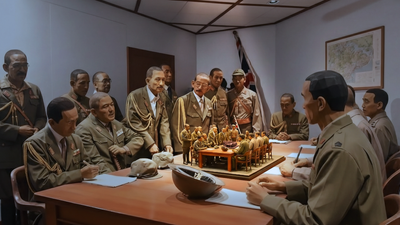
1941. Sarojini was on the run. She was four years old. With her parents Munusamy and Poongavanum, she went from Buntong to Jelapang to Jalan Silibin and beyond. At each suburb or town, they spent a few days or weeks hiding in ramshackle houses and unused water barrels. They were living through the second world war, which had come raging, disrupting and upending their lives. And the Kempeitai, the secret military police arm of the Japanese imperial army, seemed to be targeting the Chinese in Malaya.
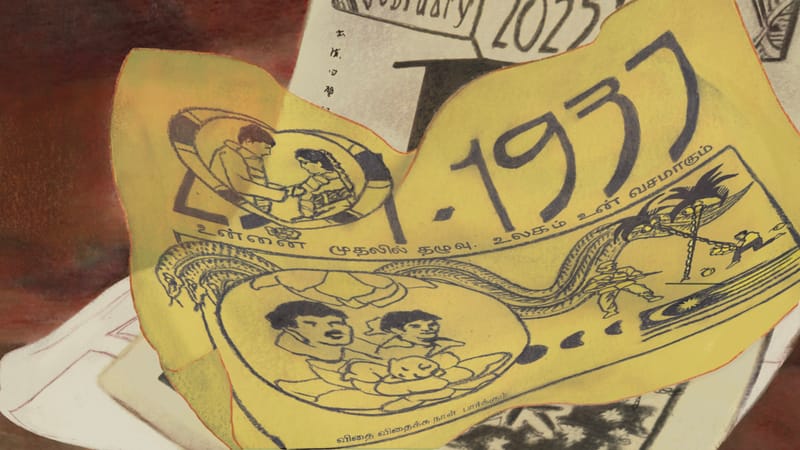
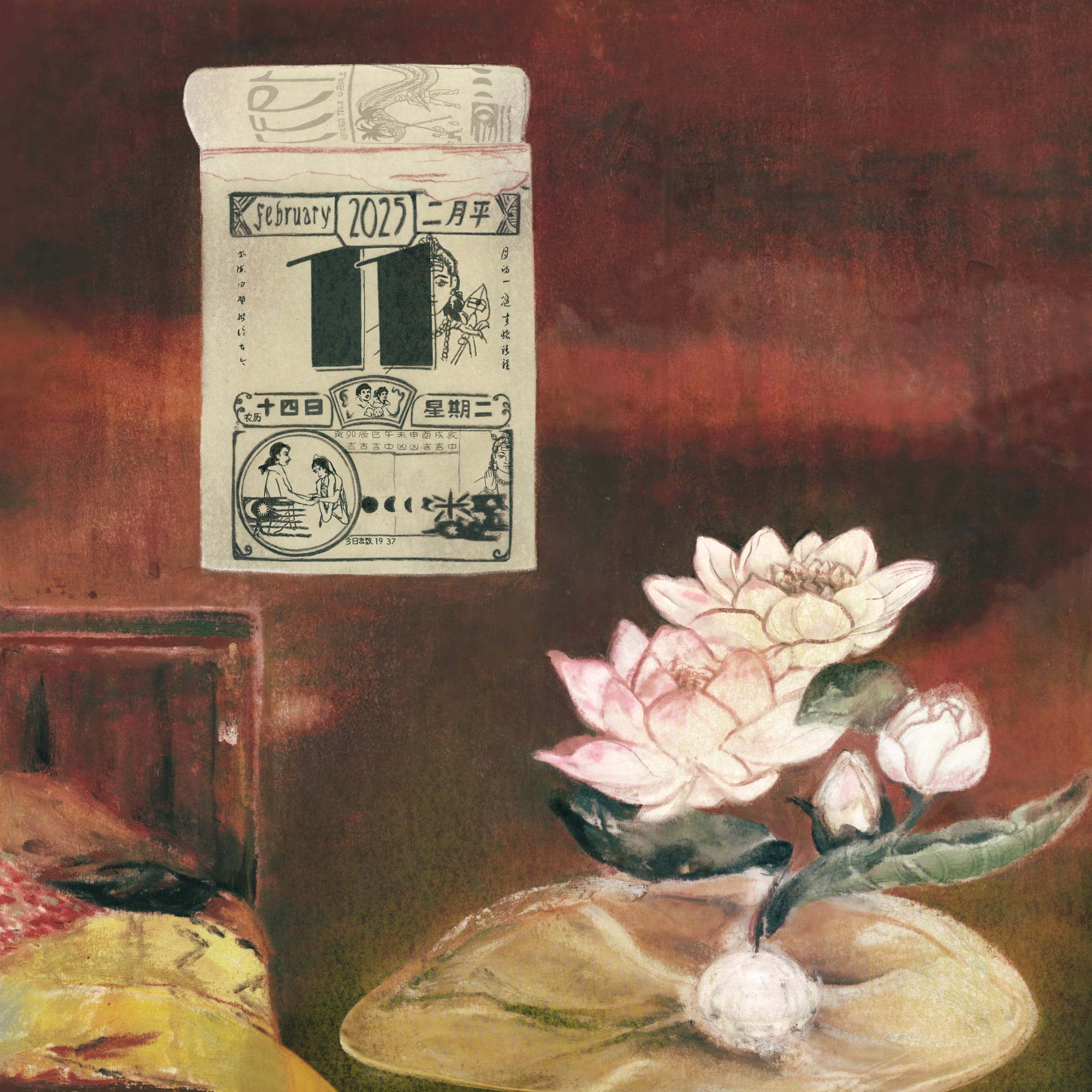
Sarojini was born Chong Chaw See in 1937, in a small tin-mining town called Tronoh in Perak. By then, it had become a communist stronghold. The Malayan Communist Party, founded in 1930, was especially popular in Perak, drawing support from thousands of Chinese tin miners who lived and worked in squalor. It is likely that Sarojini’s birth parents were Chinese tin miners who could not afford to raise another child. They might also have favored boys over girls, like innumerable other families that gave up their daughters at birth or soon after. Through hushed conversations in the tin mine where both Munusamy and Poongavaanam worked, they heard that a Chinese family was looking to give away their daughter. The childless, Tamil-speaking couple welcomed Chong Chaw See, just a few weeks old, into their home, and named her Sarojini, meaning “a cluster of lotuses.”
When the war began and the Kempeitai closed in, Munusamy and Poongavanum knew about the threat to Sarojini’s life and were prepared to do everything they could to keep her safe. Cross-racial adoptions such as Sarojini’s were common across early to mid twentieth century Malaysia and Singapore, both of which were then part of a constellation of territories known as “British Malaya.” In “The Chinese Daughters of Indian Parents,” Ann Wee, the British- born Singaporean fondly referred to as the founding mother of social work in Singapore, posited that “a sizeable but only partially documented number of Chinese baby girls passed in adoption to Indian and Malay families.” Of this number, most, like Sarojini, “changed hands on a de facto basis.” More recently, the Singaporean anthropologist Theresa W. Devashayam has shown just how ensconced ethnic Chinese adoptees became in their adoptive families.
It is unsurprising then, ethnicity and visual difference notwithstanding, that her parents’ protection and affection likely helped Sarojini become Indian culturally. Whatever internal identity conflicts she might have weathered, throughout her life she presented as being firmly Indian. The few times they were caught, Sarojini remembers her mother begging the Kempeitai to spare her life. Poongavanum would grasp her close, crying, covering her with the end of her sari as if to keep her from falling out. Desperate, she would point to the little girl’s mukuthi (nose stud) and pottu (vermillon dot worn on forehead), and then point to her own. Then she would utter a cascading string of sentences in Tamil and urge Sarojini to recite a Tamil poem or rhyme. Did the Kempeitai truly believe they were related? Or were they moved by this devoted mother’s performance of maternal love? Whatever the reason, each time, Sarojini and Poongavanum left the encounter with the Kempeitai largely unscathed.
Once, it was Munusamy who had to go out on a limb to save his daughter. It was the summer of 1942, Sarojini had just turned five. On a balmy late summer evening, Munusamy, Poongavanum and Sarojini set out for a walk. They were walking past tall coconut trees when out of the corner of their eyes they noticed some men in uniform. Munusamy and Poongavanum, who were standing on either side of Sarojini could feel the fear rising like bile in their throats. There were four men, and they were now walking straight towards them. Should they make a run for it? No, the men appeared to be armed. Poongavanum readied herself. As the men neared, Munusamy realised they were Kempeitai officers. The family slowed down, coming to a full stop next to a grove. One of the officers came up to them while the other three stood back. He looked straight at Munasamy and said “kelapa.” Coconut? Munusamy looked up at the tall trees, and back at the officer, who cocked his head to one side and repeated, deliberately enunciating each syllable “ke-la-pa” and proceeded to jab him sharply with the end of his stick. Munusamy had heard stories of Malay and Indian men being forced to climb up coconut trees to fetch tender green coconuts for Japanese officers. Some fell to their death while others who were unsuccessful in reaching the fruit were simply shot down.
For hundreds of years, pigtailed macaques were enlisted to harvest coconuts in Malaysia and Thailand. They were excellent climbers and more importantly, unable to articulate any demand for a wage. Munusamy steeled himself, threw a last glance at his wife and daughter, and grasped the tree closest to him. He had no rope, no harness. Intertwining his legs around its thick trunk, he tried to hoist himself up. Would they shoot him if he was too slow? Poongavaanam and Sarojini clung to each other as they watched him grope his way up the long tree trunk. When he reached the top, Poongavaanam looked away and covered her daughter’s eyes. One hand steadying his perch, he reached out with another to break off the nearest fruit. It slipped out of his hand and fell to the ground, shattering. The policemen stepped back. Taking a deep breath, he caught hold of another fruit and twisted it until it broke off. He gripped its stem between his teeth and broke off a second and a third. Gingerly, he placed the ribbed stems of the three coconuts between his teeth and began to lower himself down. When he reached the ground, his arms and legs were chafed and bloody. The policeman standing closest sneered at him, took the fruits Munusamy offered with outstretched hands, and left, closely followed by the other three.
In June 1942, the Japanese army began a railway project to transport supplies from Thailand to Burma, which they had seized from the British earlier that year. To construct what became known as the “Burma–Siam Railway” or “Burma Railway,” the Japanese army forced about 60,000 Allied prisoners of war—including thousands of Indian soldiers—alongside more than 180,000 conscripted civilian laborers from across South-east Asia. One such civilian worker was Munusamy, then in his early 50s. On the tracks, working sixteen-hour days, Munusamy may have recalled his daughter Sarojini skipping on train tracks at Ipoh railway station during its idle hours. When a laborer in Munusamy’s camp died, his body was thrown out to be buried underneath the rubble and ballast that supported the tracks. A few months later when Munusamy fell sick, he knew he was lucky to be allowed back home to Ipoh for treatment. After the war ended, surviving prisoners of war and conscripted civilian laborers told the world how many lay under the tracks of the Burma Railway. It came to be known as “The Death Railway” and was taken apart. It would later be memorialised in popular culture after the river that flowed under a section of the railway: Mae Klong, later known as the “River Kwai”.
Natasha spent most of 2019 living and working in Yangon, Myanmar but until recently, didn’t know of her great-grandfather’s work there. She hasn’t seen “The Bridge on the River Kwai”, a 1957 film directed by David Lean, based on the 1952 novel by Pierre Boulle which documents a love story set against the backdrop of the railway’s construction. Learning of her great grandfather’s participation in the construction, she is miffed, but not surprised, by the film’s predominantly white cast. His absence from the story on screen reflects a broader pattern: families like hers are rarely represented in cinematic retellings of empire, even though their lives and labour are entangled in its making.
Her family’s story, marked by intermarriage and interracial adoption in Malaya, is not uncommon. Like so many others, Natasha’s ancestors’ lives unfolded amid social and political upheavals, wars, and economic crises such as the Great Depression. The shape of these family histories was defined in part by the classificatory order of British Malaya. Across the first half of the twentieth century, British Malaya was governed not only through territory and trade, but through the classification of people. Early censuses experimented with categories like nationality and language, but by the 1920s and 1930s race had hardened into the primary axis of difference.
Racial categories like “Malay,” “Chinese,” “Indian,” and “Other” became the scaffolding of empire, determining who could inherit certain lands, avoid deportation, or claim belonging. The “Malay” label encompassed a wide array of ethnic groups such as Minangkabau, Javanese, Acehnese and Bugis migrants, many of whom later sought to be classified as Malay. Chinese migrants, too, came from multiple dialect groups and provinces while Indians included Tamils, Malayalees, Punjabis, and Bengalis (as well as a range of other South Asians from Ceylon, Pakistan, Burma, and Bangladesh). This high degree of demographic complexity set Malaya apart from other territories such as Burma, where approximately two-thirds of the population were Burmese, or Ceylon, where nearly three-quarters were Sinhalese. Malaya’s ethnic and linguistic pluralism was unusual not just within Asia, but across the British Empire. Compounded by religious diversity, this exceptional plurality of communities compelled British administrators to invent and enforce new classificatory systems. Malaya’s pluralism was thus not incidental but constitutive of its colonial order.
Yet this classificatory system was never applied uniformly. Malaya’s layered administration—combining British colonial governance with deference to Malay rulers and religious authorities—made the policing of these categories especially fraught. At the same time, Malaya’s position at the crossroads of the Indian Ocean and East Asian maritime circuits meant that laws, people, and ideas—from the Bay of Bengal to the South China Sea and beyond to Japan—constantly unsettled these boundaries. Debates over indigeneity and the “proper” balance of ethnic groups in society grew more intense during the decolonisation era. Meanwhile, families who adopted across racial lines, women who married across boundaries, and children of mixed parentage forced authorities to navigate contradictions, exposing how classification was less a rigid taxonomy and more a lived and contested process.
In Malaysia and Singapore, nation states carved from British Malaya, colonial era racial categories continue to govern public life. For those with mixed heritage, this presents both problems and advantages. The slipperiness of their identity spares them from easy categorisation but at times it also makes them especially vulnerable to racial discrimination.
Although the “Chinese daughters of Indian parents” Ann Wee described, now form a rapidly dwindling minority, those who remain occupy an uneasy position between categories. Because adoptees are officially slotted into the racial category of their adoptive fathers, they are classified as “Indian.” Yet in Malaysia and Singapore, where race is the primary marker of difference, this produces a peculiar duality. The plural fabric of Malaya once made such cross-racial lives possible, but it is precisely here that officials have come to question them—when a name does not seem to fit a face.
Natasha is keenly aware of the dissonance between assigned and personal identity. In the past, she has been intercepted by cries of “konnichiwa” from strangers who mistook her as Japanese. Now she’s working on a passion project to celebrate multiculturalism in Australia through food and family history. Natasha writes, “While I was born in Australia, like many Australians, my ancestors were born somewhere else. As a ‘Third Culture Kid’, I’ve been able to experience life as someone who not only identifies as being a proud Australian—but also Malaysian, Chinese, and Indian.”
Natasha still feels that her identity is in flux, but maybe this is part of coming from a multicultural family—and will always be the case. It was her grandmother who helped her understand her Indian identity; her grandmother, who was born Chinese, but firmly took on the Tamil-Indian identity of her emigrant Indian adoptive parents. Sarojini, Natasha said, lived her life as a Tamil-Malaysian woman, never expressing nor entertaining doubts as to the “Indianness” of her identity. Natasha, who is pleasantly surprised to learn that her grandmother’s name means “a cluster of lotuses,” shows me her laptop wallpaper: a photograph of lotus stems peeking out of clear blue waters. Perhaps one day she will find more meaning in the first three letters of the alphabet. Or maybe she won’t. Sarojini’s example taught her granddaughter that she can be whoever she feels she is.
Sudarshana Chanda is a historian of empire, migration, and family in the Indian Ocean in the nineteenth and twentieth centuries.
Author’s note: As a social historian studying the lives of ordinary people, I often encounter archival sources only as fragments. To breathe life into these, historians sometimes turn to a method known as critical fabulation. Devised by scholar-writer Saidiya Hartman, it allows us to imagine what might have been. In addition to oral histories gathered from Natasha and her family, I used critical fabulation to reconstruct her great-grandparents’ interactions with the Japanese military during the second world war. My approach, however, is cautious: I consult newspapers and other oral histories to ensure that scenarios I describe are historically plausible and grounded in the broader context of the period.
*Glossary: paati—grandmother; periammas—literally, “big mother”, can refer to mom’s older sister or dad’s older brother’s wife; chinnammas—literally, “small mother”, can refer to mom’s younger sister or dad’s younger brother’s wife; mama—uncle; akka—elder sister; anne—elder brother; padang—field.
Letters in response to this piece can be sent to sudhir@jom.media. All will be considered for publication on our “Letters to the editor” page.