


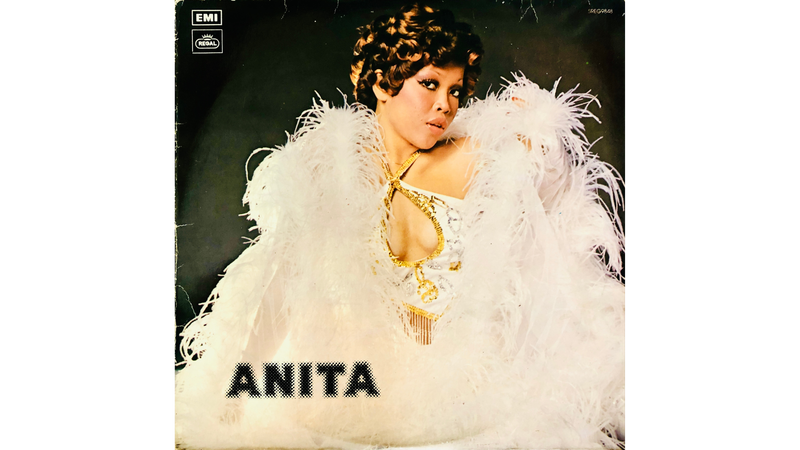
A female voice is singing in Malay, the music soft and sentimental. Then she stops, as a vigorous drum roll introduces brass and strings. They take us to a dance floor, where a chorus of voices belts the familiar refrain of “Rasa Sayang Eh.” You may cringe if you’ve known this melody for years, canonised as one of several “folk” songs taught and performed on National Day. A staple of school celebration singalongs, “Rasa Sayang Eh” now evokes cheesy patriotic rituals. But this version of “Rasa Sayang Eh” is different. The arrangement is upbeat and pop-like; the recording is sharp; it sounds like it was meant to be enjoyed.
This is the opening track of an album of the same name, produced in 1974 by Electric and Musical Industries, or EMI. The British company was one of the world’s biggest and most successful recording companies of the 20th century until its acquisition by Universal Music in 2012. It was behind The Beatles, Frank Sinatra, Nat King Cole, and Pink Floyd. From the 1920s, EMI was also Singapore’s leading music producer. It set up Singapore’s first purpose-built recording studio in 1951, on the fourth floor of MacDonald House along Orchard Road. Local performers were plugged into a corporation with tremendous resources and advanced infrastructure. And so the Singapore pop craze of the 1960s was born.
Alongside English, Malay, and Mandarin pop, EMI produced a lot of traditional Malay music, indeed some of the finest. Its albums from the 1960s to the early 1980s include among the best performances of this classic repertoire ever recorded. Singapore’s separation from Malaysia in 1965 is often said to be the end of the golden age of Malay cinema and popular culture, as many of its talents emigrated to Kuala Lumpur. Yet in some ways, it continued in different forms; Singapore remained a hub of Malay music production, with creative contributors straddling both sides of the Causeway.
Like so many albums of the period, Rasa Sayang Eh was made and sold in analogue media: in cassettes, cartridges and, most abundantly, vinyl records. Unlike a digital playlist, a vinyl record carries a lot of information on its sleeve. You encounter the album as a visual and textual object first before you listen to it. The cover has an abstract design of pink and purple splashes against a black background. On the back is the track listing, which includes the titles of other familiar folk songs such as “Chan Mali Chan”, “Di Tanjung Katong”, and “Kenek Kenek Udang”. Listening to them, one is transported to a place and time not physically present, or perhaps not anymore: a festive Malay gathering in an older Singapore, with our usual stereotypes that it was more communal and carefree.
Recorded sound offers a way into a past, however much imagined. It is an industrial product that not only preserves but also helps to create “tradition.” It bends time, advanced technology making accessible the old. We tend to think of “folk” or “traditional” music as anonymous, the spontaneous and organic expression of a people or group from an earlier age. But many things today considered heritage were invented more recently than we think.
A material artifact like a vinyl record makes antiquity less faceless, and perhaps not so distant after all. There are names of performers, sound engineers, composers, lyricists, arrangers, and producers—the labor that makes culture possible. Rasa Sayang Eh’s roster of singers were the stars of their day: Saloma, Kartina Dahari, Ismail Haron, Anita Sarawak, and Sanisah Huri, among others. It was arranged by the guitarist and producer Reggie Verghese. And at the bottom is the name of the woman who ruled EMI Singapore: Daisy Devan. An era captured in a list.
In this era, EMI drew on the seasoned hands of Malay theatre and film—which always had song and dance—and made new stars out of obscure youths. Many of their songs are still played on radio, evergreen shoots in today’s relatively more barren landscape. Enhanced technology produced a more immersive and lush sound compared to what was possible in older film music, especially those made for and stored in shellac records. Much of this boom goes to Devan, a Malayali woman who took the reins of EMI as its artist-and-repertoire manager in 1957.
She started out arranging shipping, insurance, and export for Société des Matières Premières Tropicales, which supplied natural Malayan rubber for the French tyre maker Michelin. Among other commodities, rubber made Malaya rich, and Singapore into a city important enough to support the latest technology and culture, including recorded music. Yet natural commodities also supplied the physical material of records. An early plastic, polyvinyl chloride (PVC), took over record production in the mid-20th century. Cheap, durable, and lightweight, PVC—shortened as “vinyl”—needed natural ingredients, namely petroleum, coal, or natural gas mixed with chlorine. Even our most synthetic inventions have an environmental history.
EMI recruited and sent Devan to the famous Abbey Road Studios in London, and Dum Dum, India, where Asia’s most state-of-the-art vinyl record factory was located. She learned about record-making, pressing, distributing, and marketing for six months before returning to Singapore. By the early 1960s, she set up Singapore’s first record-pressing factory in Jurong, as well as retail stores across the island.
Devan had a personal role in launching the careers of such Singaporean pop icons as The Quests, Sakura Teng, and Rita Chao. There is a photograph of her hosting Ravi Shankar, the Indian classical musician, on his tour to Singapore. In another, she hands Tunku Abdul Rahman, Malaysian prime minister, an EMI recording of the Qur’an. In many images, Devan is the only woman in a room full of business-suited men.
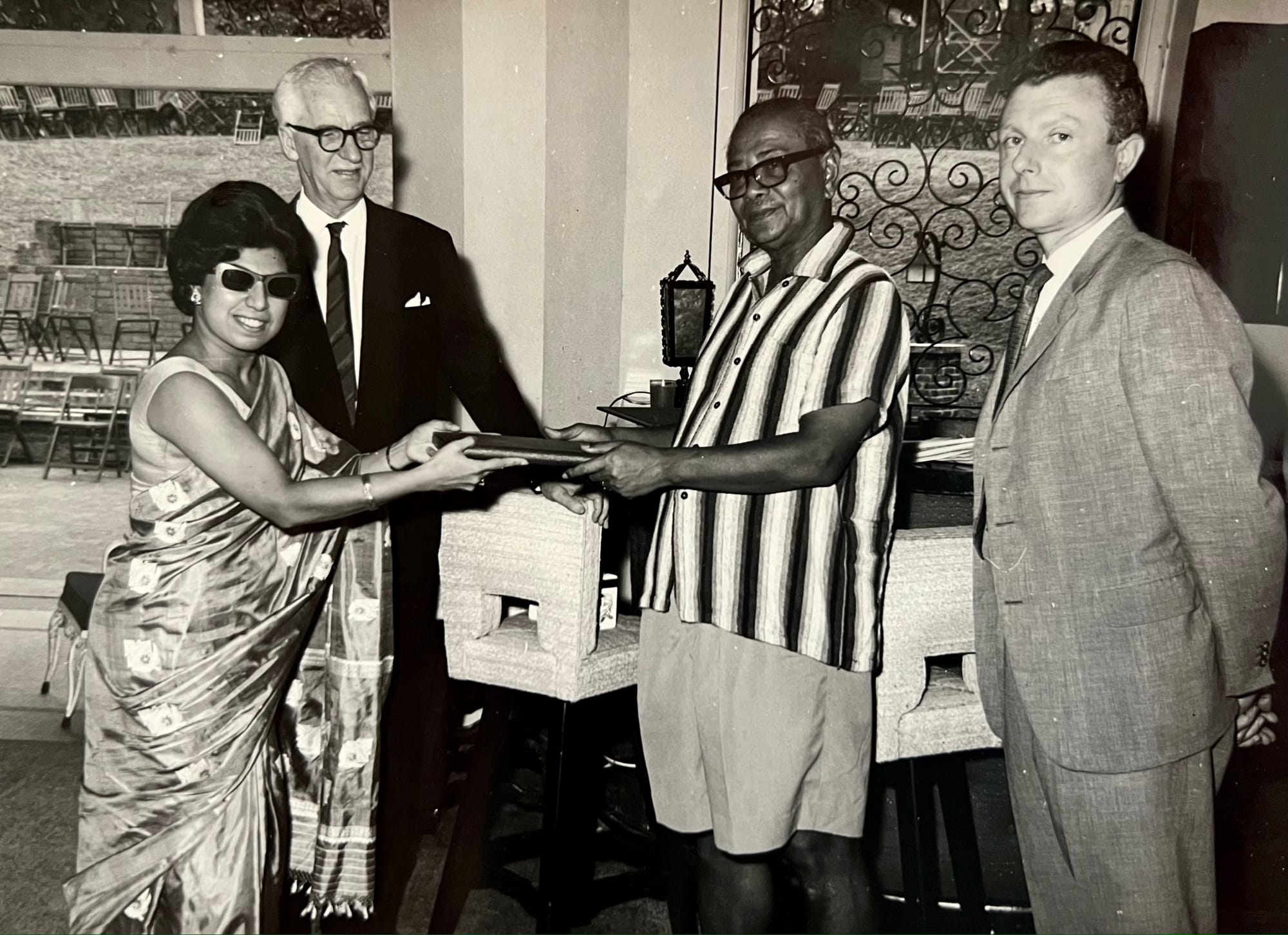
Today, Devan’s accomplishments are recognised by a spot in the Women’s Hall of Fame, to which she was posthumously inducted in 2018 as “Singapore’s Mother Music”. The year before, playwright Ahmad Musta’ain Khamis directed “When Mother Music Comes for Tea”, a lecture-performance by Khir, one of this essay’s authors, about Devan at the Singapore International Festival of the Arts. Beyond broad biographical outlines, however, little is known about Devan. Few of the albums she produced credit her by name. A CNA documentary earlier this year entitled The Untold Legend of Daisy Devan has actor Rebekah Sangeetha Dorai interviewing former EMI artistes, the sound archivist Ross Laird and other industry experts to assemble a more vivid picture. It even has Dorai acting as Devan in imaginary scenarios.
So much of what we know of her survives through narrative repetition and reenactment. The maker of visible celebrities was a somewhat mysterious figure herself, a legend. This story of an era in Malay music also inhabits a similar place of ambiguity, and the present writers are themselves receivers of oral tradition. Much of what follows is drawn from anecdotes and conversations, circulating unrecorded in official media. The account is not too worse-off for it. What the vinyl record captures and immortalises, the anecdote and conversation elaborate and expand. The Malay records of EMI themselves tell many stories: about geography, culture and practice—vital elements of being in the Malay world—that may slip from the analytical eye of historians and archives. Both are portals through time.
According to one such anecdote, Devan felt a need to document and transmit local music heritage. EMI, after all, had produced and distributed the works of classical masters elsewhere, from India’s Ravi Shankar to Egypt’s legendary Umm Kulthum. Its Malay contributions spanned folk songs (“Lagu Rakyat”, “Rasa Sayang Eh” among them), children’s songs and rhymes (“Lagu Kanak-kanak”), religious music and instrumental music.
A major instrumental album of the period was Irama Tarian. Released in 1972, it includes 14 renditions of music across the classic genres of asli (Sekapor Sireh), inang (Inang Baru), joget (Joget Pahang) and keroncong (Kemayoran). Four of the numbers were original compositions by the celebrated film and music star P Ramlee. He was one of the great codifiers of traditional Malay music after the Second World War, and its classification into those genres earlier mentioned. Nearly every type of media—music, theatre, film, literature and visual art—was a resource for cultural nationalism as colonial rule waned. Ramlee was part of it, with his films promoting pride in Malay values, while criticising social inequality. The songs reinforced these messages.
Faris and Khir’s playlist
“Inang Baru”, for example, first appeared in P Ramlee’s film Penarek Becha (1955) in a scene where a slow, swaying dance called the inang is performed to an audience. Lyrics mirror the choreography, linking physical grace to ideals of Malay gentleness and cultural rejuvenation: How delicate are the arms and legs/ Such movement is sweet to the eye/ Malay dance will never fade/ Let it continue for ever/ It should be shown everywhere/ As proof of our great culture. As the performance ends, someone in the audience punctures the reverie: “Eh, samba la! Let’s go home, I hate watching this.” Ramlee’s lament, directed at Malays who would rather hear samba than inang, contains insight about how tradition comes from change. The struggle for an authentic cultural expression was a reaction to Malay society’s wide-ranging musical experience and taste to begin with.
EMI’s Irama Tarian was a compilation of the works that rose out of that surge, and which continued the project of stabilising Malay “identity” after independence. Schools were a key site of this identity-making, where Irama’s grand orchestral arrangements were the preferred backing tracks to accompany traditional dance. From the 1970s to the present, Malay Language, Debate and Drama Societies—or MLDDS—have been prolific users of Irama Tarian’s tracks. These extra-curricular clubs provide cultural education beyond the formal syllabus, organising workshops and competitions in debating, oration, storytelling, singing and dance. The practical purpose of Irama Tarian, however, belies its captivating quality and beauty, which suggest how joget or inang are not merely background “dance” music, but like Argentinian tango or Andalusian flamenco, are forms of listening music as well.
Take another EMI masterpiece of instrumental numbers: Berdendang Irama. It features Malay dance genres, but the performances are so virtuosic in and of themselves to warrant attentive appreciation. The stars of this 1974 album are the violin maestro Hamzah Dolmat and the Sumatra-born pianist Ahmad Wan Yet. Like Irama Tarian, it also adapts songs from films, such as Zubir Said’s “Sirih Pinang” from Bawang Putih Bawang Merah (1959). Its closing track, “Selintas Lalu Selayang Pandang”, belongs in a period drama, perhaps based on one of the Malay sagas or hikayat relating heroic adventures in far-off lands. The highlight of Berdendang Irama, however, is “Kencana Wati”: a single percussion line unites three sections, with the middle boasting Hamzah’s technical skill and personal style.
Turn back the clock two decades, however, and a Malay “dance” album can sound very different. Irama Tarian follows an earlier album released in 1957 under the EMI label His Master’s Voice (HMV), called Lagu-lagu Untok Menari. With the exception of “Rentak Seratus Enam” and “Tari Selendang”, the album almost completely contains Latin-inspired pop songs with lyrics about love. They were likely meant to be danced to at casual social gatherings indoors. One number, “Whisky dan Brandy”, has witty lyrics about an evening tipple, with a playful warning about the potential risks of inebriation. This is far from the tradition-conscious, reformed Malay that a compilation like Irama Tarian was made for.
Another significant anthology of classic songs was Aslirama—a portmanteau of ‘asli’ and ‘irama’—released in 1972. Like Irama Tarian, it featured both standalone compositions and fresh covers of Malay film songs; the old cinema arts continued and renewed. Both sides A and B open with resonant, melancholic songs of yearning by Sharifah Aini (“Patah Hati” and “Halimun Malam”), in the asli genre. Saloma has a pair of soaring, almost extravagant asli performances: “Sekapur Sireh Seulas Pinang” and “Kuala Sedeli”.
These are songs of desire, loss, heartbreak and separation, themes we find in contemporary pop tunes too. But the asli song inhabits quite a different emotional state, one that welcomes pain, even indulges in it, and is in no hurry for a cure or resolution. It is the joget songs that break the sorrow spell, and both sides of Aslirama end with cheerful joget numbers by Sarena Hashim and Ismail Haron respectively.
These genres, which EMI replicated and augmented, had histories. They were shaped over decades by the flourishing popular entertainment in the Straits of Malacca and the Java Sea. From the late 19th century, keroncong bands, bangsawan companies, joget ensembles and boria troupes created new and distinct musical forms blending local performance traditions with genres from around the world. Many acts, like the Dardanella company, reflected the diversity of the Malayo-Indonesian archipelago and also toured internationally.
To the port cities of this region, Arab and Hindustani musical styles flowed from across the Indian Ocean. Filipino musicians brought American jazz, while foxtrot, tango and rumba were heard both in European dance halls and amusement parks. Composers and musicians in Malaya—many of whom were sojourners from Sumatra, Java or further away—listened to and played them all. Ahmad Jaafar, for example, conductor of Radio Television Singapore Orchestra from 1967–1982, was known for incorporating a “big band” style and sophisticated Western chords into his compositions.
From these interactions, the idea of a distinctly “Melayu” music solidified between the end of the second world war and the pop craze of the 1960s, according to Saidah Rastam, a Malaysian composer, pianist and author. Ethnic nationalism and social movements had their role, but like Malayness itself, this music was without borders and had many origins. It continued to refuse borders in the time after Malaysia and Singapore’s separation, let alone Indonesian independence.
This borderlessness continuously disturbs the coherence of nation-states. In 2007, a controversy brewed over “Rasa Sayang Eh” between Malaysia and Indonesia. The former designated it the official song of its tourism campaign, marking its 50th year of independence; Indonesian lawmakers objected to this by citing the song’s origins in the Maluku islands, making it the intellectual property of the Indonesian government. This was but one in a series of hostile custody battles between the two countries over shared memories.
EMI was involved in the 20th century’s rapid, confusing transfers of loyalty and territory. As Singapore prepared for full independence from Britain through merger with Malaya, Sabah, and Sarawak to form Malaysia in 1963, the Ministry of Culture commissioned Malaysia Songs. Listening to these dozen patriotic tunes takes us to a small pocket dimension where merger may have succeeded. All except one of the songs were performed by famous singers Julie Sudiro and Ahmad Daud. They sang in English on side one and the National Language on side two. Track one, “Happy and Free”, is about “people without unity” now together, “equal and free with merger and Malaysia”, to the tune of “Chan Mali Chan”.
Filmmaker Boo Junfeng’s 2013 short film, also entitled Happy and Free, uses this song in a karaoke video showing a Singapore that prospered within Malaysia. In that act of imagination, which the song invites, the quarrelsome troubles that plagued the political union appear more tragic than natural. This is another way the music disrupts nationalist accounts of history, linear and bordered. Like the films of Shaw Brothers and Cathay- Keris, Malaysia Songs asks: who owns the art of our undivided past?
Some things outlived the separation. Devan oversaw the first official recording of the State of Singapore’s anthem “Majulah Singapura” in 1959, under the HMV label and EMI-owned Gramophone Company. While this anthem remained through Singapore’s Malaysia years into the Republic period of the present, this recording—performed by the Singapore Military Forces Band—was soon replaced by recordings of the Berlin Chamber Orchestra’s 1960 performances as the official version used at state functions.
EMI’s activities straddled both secular-civic and religious spheres. Under Devan’s tenure it also produced recordings of the Qur’an and songs of praise to God and the Prophet Muhammad—practices making up the allowed vocal tradition of Islam. The human voice calls the faithful to prayer five times a day, poetry called qasida is performed on the Prophet’s birthdays and tournaments of Qur’anic recitation judge competitors not only for accurately vocalising the Arabic sounds (tajwid) but also melodic expression (tarteel). “And recite the Qur’an in slow, rhythmic tones,” enjoins the holy text in its 73rd chapter.
Sharifah Aini, the Singapore-born Malaysian singer of Arab-Malay ancestry, was a Qur’an prodigy, having won a national recitation competition as a teenager. Hearing her melisma and lung power, one can’t help but detect that same trained voice chanting divine commandments. The EMI celebrity crooner, Ismail Haron was not only a frequent Qur’an reciter in Singapore mosques but also drew upon Islamic mysticism (tasawwuf) for the lyrics he wrote. Lines he penned for such legendary ballads from the 1970s as “Ilham Pujangga”, “Insan Mulia” and “Rahsiaku Rahsiamu” were stimulated by Ismail’s forays into the spiritual literature of Kahlil Gibran and Hamka.
That influence co-existed with Ismail’s interest in counterculture and the anti-war movement waged against the US’s campaign in Vietnam. Ismail’s philosophic wanderings inspired the Sufi-infused “Nusantara” music of M Nasir, rock-balladeer Ramli Sarip and folk band Rausyanfikir in the 1990s. For these artists, the line between sacred and secular art was indistinct.
The same is true for Hari Raya songs, a category of Malay music that EMI propagated in the 1970s . Made to commemorate the Islamic festival of Eid al-Fitr (Hari Raya Puasa) at the end of Ramadan, these songs don’t come under a single genre but range from asli and joget to cha-cha and azz. Common to them all are lyrics about being with—or away from—family members, practices like home-visiting, dress, greetings and festive cuisine. The idea of dedicated Hari Raya songs is peculiar to Southeast Asia, hardly shared by other Muslim communities which also observe Eid al-Fitr. These songs create a space where worldly joy is also pious.
A handful of Hari Raya songs were made in preceding decades, most notably in the Parlophone album Selamat Hari Raya (1959) performed by P Ramlee and Saloma. The Singapore-recorded EP has just two songs, but they are both all-time classics: “Suara Takbir”, with vocals by Ramlee and words by longtime film lyricist S Sudarmaji, as well as “Selamat Hari Raya”, sung by Saloma to the words of Ahmad Jaafar. The latter song was rearranged for a second version by Saloma in the first of EMI’s essential Hari Raya albums, simply titled Selamat Hari Raya Aidilfitri (1973).
That release, together with Bergembira di Hari Raya (1977), Album Hari Raya (1981) and one album by the Senada label Senandong Hari Raya (1977), contains some of the most beloved Hari Raya songs. You may have heard these songs in shopping malls, supermarkets or at the Ramadan retail fairs of Geylang Serai and Kampung Gelam. Special mention goes to the album Reg Guitar (1974), where among the instrumental guitar solos by Reggie Verghese is a memorable rendition of Ahmad Jaafar’s song “Selamat Hari Raya”. These albums are as timeless, perhaps, as Bing Crosby’s Merry Christmas (1945), Vince Guaraldi’s A Charlie Brown Christmas (1965), Atco Records’ Soul Christmas (1991) or any other holiday special that conjures cosy gatherings.
No music was too trivial or lowbrow to be recorded. In 1974 and 1975, EMI released two popular albums of children’s music: Selamat Hari Lahir and Dua Angkasawan respectively. The first featured veteran singers Saloma and Nona Asiah in the opening number, as well as a Malay version of “Old MacDonald Had a Farm” entitled “Kebun Pak Mamat”. More importantly, the albums recorded some nowendangered Malay nursery rhymes, including “Enjit-enjit Semut”, “Oh Bangau” and “Neng Neng Pong”. Many of them reference local flora and fauna and domestic objects, in ways that more widely available children’s media set in European or American locations don’t. Undergirding these lessons about opposites, colors, and being kind to your friends was a way to relate with the world that was attuned to local knowledge and experience.
This is also what essentially defines the album Lela Manja (1979)—one of, if not the greatest traditional Malay music album EMI recorded. It’s remarkable not only for its lyrical and musical sophistication but also for being a momentous collaborative event in Malay music. Its creation involved three titans. Alfonso Soliano, the Filipino impresario, was the producer; he helped build Radio Malaya as its orchestra conductor and became known as “the father of Malaysian jazz.” It was also billed as a duet album between superstar Sharifah Aini, providing tour-de-force vocals, and Hamzah Dolmat, the aforementioned violin maestro.
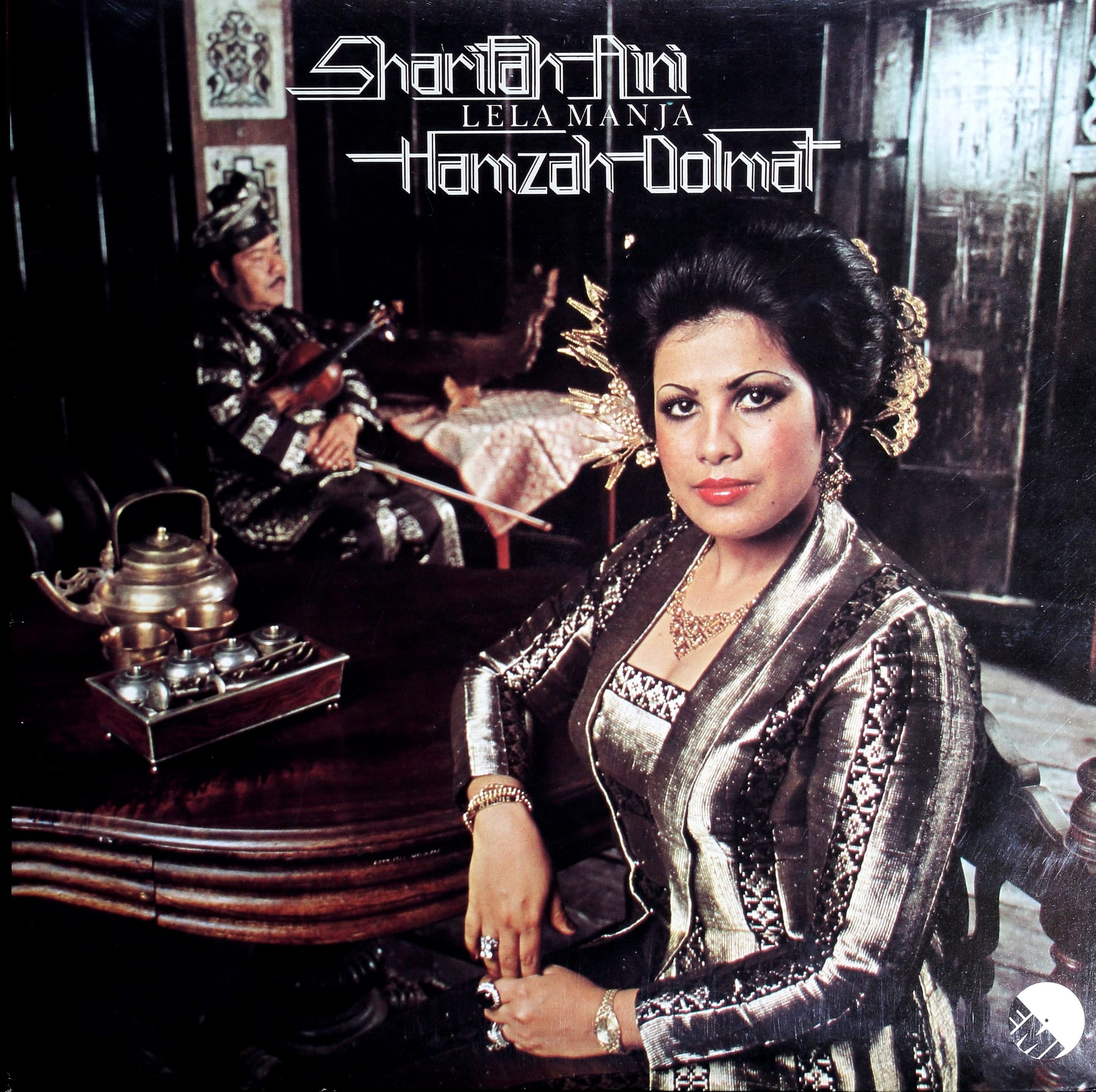
A current of Malay music history runs through them, with Hamzah from a family residing along the Kallang River, within the Singapore-Riau sphere where the court of Johor once held sway and patronised many performance arts. His sister Kamariah Noor was a renowned asli performer, while Hamzah’s father was a living library of old Malay songs, said to have played violin at musical gatherings on Pulau Penyengat, the capital of the Riau-Lingga Sultanate and an old center of Malay culture. Soliano, who felt great affection for Malay music, was part of the decades-long Filipino presence in Malayan entertainment. Sharifah, of course, was part of the Arab Peranakan community that adopted Malay culture via centuries of intermarriage and settlement. They introduced musical forms such as zapin and the plucked lute instrument called gambus (Arabic: qanbus).
Recorded at a Rediffusion studio in Kuala Lumpur, Lela Manja sounds cavernous, a product of technical limitations. But this accidental defect is also what makes it feel authoritative, antique. Every track in the album is replete with imagery evoking the environmental and human setting of the Malay world, presented through rhyming quatrains or pantun, such as:
Bunga kiambang tegak berdiri
Disunting anak permaisuri
Jasa ditabur tidak terperi
Hilang akal kerana budi
(The water lettuce stands upright
It is cut at the stem by a princess
Good deeds scattered beyond description
Sanity lost due to selflessness)
—“Ratapan Kamarulzaman” (side A, track 2)
Pasir putih di pinggir kali
Tempat menyabung ayam berlaga
Kasih tak boleh dijual beli
Bukan benda buat berniaga
(White sand on the riverbank
A place for hosting cockfights
Love cannot be bought and sold
It is not merchandise for trade)
—“Pasir Roboh” (side A, track 4)
Landscapes and people are contained in four short lines. The first two lines, or pembayang (“shadow” verses), usually only provide the A-B rhyming pattern for the second pair of lines, or maksud (“intended” verses). However, they may sometimes create one cohesive scene, such as this pantun from Sri Sarawak (side B, track 1), which narrates a sad parting at the harbour:
Sayang Sarawak sungainya sempit
Buah rengas di tapak tangan
Hendak ku bawa perahuku sempit
Tinggallah sayang, tinggallah intan
Alas, the Sarawak river is narrow
A rengas fruit in the palm of a hand
I want to take you, but my ship is narrow
Farewell my love, farewell my diamond
A song may have up to three pantun or even just one, repeated or elongated to suit the melody. While brief, they are full of colour and scenery that liken them, according to the French pantun connoisseur Francois Rene-Daillie, to still-life paintings.
Lela Manja’s literary quality was partly what earned it tremendous acclaim upon release. Years later in 2004, Mahzan Musa, an academic, celebrated the album in an essay for Dewan Bahasa, Malaysia’s premier literary magazine. Mahzan noted the songs’ use of metaphor and symbolism, but also obscure words related to cuisine, architecture, and geography unfamiliar to Malays in recent times. There are nautical terms: serampang laut (fishing trident), perahu Aceh (ships from Aceh), perahu mayang (a type of Javanese fishing vessel), perahu mudik (riverboat), layar dikembang (a sail spread out, like a flower in bloom), kemudi (rudder or helm). These call forth the region’s maritime atmosphere, of routes and networks, coming and going.
In the making of the album, Soliano, Sharifah and Hamzah took part in this history of mobility and connectivity. Mahzan remarked that the “mysterious” composers of Lela Manja’s traditional songs made them the inheritance of all who live in the Malay world. This “mystery” is what makes the history of Malay music less easily recounted through the biographies of great composers and theorists honoured, for example, in Western classical music. Many of the repertory melodies in Malay genres such as asli, joget and dondang sayang were transmitted through discipleship and imitation. Songs like those included in many of these EMI albums have no clear genealogies, having been performed by so many practitioners adapting and adding to them over generations.
An oral tradition therefore, is also a community of time, rather than a succession of individuals, let alone the property of a single ethnic community.
Not having a history told through inventors lets us pay attention to the collective and collaborative nature of cultural production. EMI itself was one player—the largest, no doubt—in a Singaporean arena of other major recording labels such as WEA, Warner, Polygram and Senada. Each was a company, staffed with people who had to work together so the records would sell. Devan herself had to constantly grapple with practical considerations to keep her employees’ livelihoods.
Admittedly, the relatively more modest means of the Malay community meant that EMI had to also rely on more profitable productions. Its commercial successes, such as bestselling Chinese releases featuring Sakura Teng and Rita Chao, offered Devan the financial cushion to support traditional Malay music, despite unpromising returns.
What was accomplished in this era is ultimately difficult to quantify. The 1980s brought electronic synthesisers, which took over physical instruments in much recorded traditional Malay music. Better technology didn’t always improve listening pleasure. It was a flatter, less inspiring sound, despite the persistence of skilled singing performances, as evident in Album Melayu Deli Volume 1 (1982), Volume 2 (1983) and Deli Aidilfitri (1984).
Then came the 1990s, with the dazzling revival of Malay traditional music in Malaysia. It catapulted Siti Nurhaliza and Noraniza Idris to stardom, based on songs composed and produced by the prolific Suhaimi Mohd Zain, more widely known as Pak Ngah. Their albums Cindai (1997), Masyhur (1998), and Seri Balas (1999) by Suria Records defined a new generation of Malay “ethnic pop.” Fandoms in both Singapore and Indonesia grew around these covers of old songs, alongside new numbers inspired by Malay genres. Their choral backing vocals and faster beats, however, occasionally resemble Malaysian patriotic songs (Pak Ngah was, after all, behind some of them). So while the tradition continued and enthralled audiences again, it was also mutable.
The sound had changed. Though not always for the better; there’s a luxuriousness to the instruments and vocals of Aslirama or Lela Manja that’s scarcely found in any Malay album since. Decades after her career at EMI ended in 1981, Devan wondered whether the music she helped produce could be replicated today. She asked her sound mixers and engineers, and concluded: “I don’t think so. It was an era. And that era has passed.”
This was a way of understanding historical change by listening. The Malay singing voice changed too; she is almost shouting when you hear her in records from the 1930s, fresh out of a time before amplification. With better microphones in the 1950s and 1960s, she acquired the mellower pitches of an international pop singer, closer to Billie Holiday or Sarah Vaughan. By the 1970s, traditional singing was thoroughly a joint handiwork, between human and machine.
So what does traditional mean when it never sounded the same across time? People strove to create an idea of the past amid unrelenting political, social and economic transformations. It is continuous work, and it needs material means. It is how the past stays alive and very much “present”.
Unlike history, traditional music may not strive for an accurate representation of the past, but it does invite continuous, active engagement with it. It reinvents itself, contrary to widely held notions that tradition insists on the pristine and belongs in the museum. It is a used, rather than displayed, artefact.
Devan must have understood that, wearing a sari everywhere she went, as if to say, “I do not fear being traditional.” Like her impeccably draped saris, tradition was always something of a conjuring trick, at once illusory and palpable. As miraculous perhaps, as recorded sound.
Faris Joraimi is Jom’s history editor. He studies the history of the Malay world. He believes Singapore cannot be fully understood separately from its ancestral archipelago. Faris is pursuing his PhD at New York University. This is his fifth essay for Jom. Read the others here.
Khir was born and raised in historic Kampong Gelam, Singapore. He has long been passionate about the food cultures of maritime South-east Asia, alongside his interest in ethnomusicology. Khir is the author of The Food of Singapore Malays, which won the 2024 NUS History Prize, and the 2023 Gourmand World Cookbook Award. He relishes every opportunity to document oral histories and preserve objects of material culture such as old publications, artefacts, textiles and music.
Letters in response to this piece can be sent to sudhir@jom.media. All will be considered for publication on our “Letters to the editor” page.