

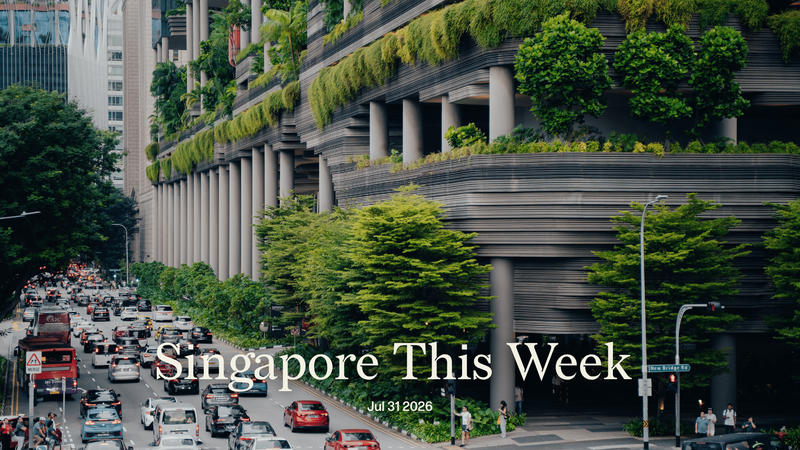
News this week included: GIC’s returns down; financial sector grew 4.3 percent last year; government reviewing eligibility age for singles buying HDB flats; ST on the highest-paying jobs in the private sector; scam centres in Forest City busted; suicides among people in their 30s up 50 percent from 2023 to 2024; fewer than 30,000 babies born in a year, the first time since independence; new book series details 25 years of legal reform; car ownership falling and rental rising; South-east Asian youth hooked on illegal online gambling; a Myanmar national injured in an accident returns home because she can’t afford surgery here; writer Don Shiau opens up about his amicable divorce under new mutual agreement clause; ST’s coverage of rhabdomyolysis, “When a workout becomes a medical emergency” (and a spin instructor’s response); the threat of 2027’s El Niño to our corals; Singapore’s inaugural bald community meet-up draws 80; Police investigate Massive Attack for Palestinian solidarity at concert here; 10 newcomers to the Michelin Guide 2026; fake Jack Ma the latest disinformation ploy; four nurses win the President’s Award; and gymnast Amanda Yap, 16, wins our first Commonwealth Games medal.
Below are the issues we explore in depth:
Society: The Gods must be crazy
And Sam said: the Singularity is here. And Elon said: within 5 years, AI will possess more intelligence than humanity, and after ten, it’ll usher in a period of “amazing abundance” in which we won’t need money. Dario, Demis, and Mark will soon issue their latest commandments. (Regarding style, in April The Economist said that “the age of the AI demi-god” is defined by “five tech bosses so iconic you need only use their first names”.)
AI has already fundamentally improved our lives, from the everyday (such as this sentence’s grammar) and the occasional (that Google Translate convo in Bangkok) to the unfathomable. With “the protein folding problem” described in 1972, scientists had till recently only mapped the structure of about 150,000 of the 200m known proteins in nature. In 2016, Demis’s team trained their AI system on those, and by 2022 had completed the remaining 99.925 percent—for which he and two others (some John, and some David) won the 2024 Nobel Prize in Chemistry. Alzheimer’s, cancer, diabetes, and many more—the Gods are coming for you.
AI has already fundamentally destroyed lives too. Oklahoma’s Kimberlee Williams was wrongfully arrested and jailed for 6 months for a crime in Maryland, a state she’d never visited, after facial recognition technology screwed up. UnitedHealth was sued in 2023 for allegedly denying care to the elderly because it used an AI system that it knew had a 90 percent error rate. Adam Raine killed himself after ChatGPT apparently encouraged his suicidal thoughts. And Israel’s Lavender AI system assigns Gazans a score of 1-100 that denotes their likelihood of being a militant, producing 37,000 targets in the genocide’s early days. Energy, resource exploitation, the list goes on, as we overturn this planet, and soon others, to welcome the age of amazing abundance.
But what we must fear most are the human traits of some of our demi-gods. Sam and Elon possess a singular narcissism that’d make Odysseus blush. “He’s unconstrained by truth,” an OpenAI board member said in The New Yorker’s April profile of Sam, noting his “sociopathic lack of concern for the consequences that may come from deceiving someone.” And when The Economist’s Zanny Minton Beddoes interviewed Elon last week, the hubris and boorishness of the all-conquering white male was on display. When asked whether he’s anti-Muslim, one response was that he’s “against rape and murder”. When discussing whether people might “loath” him for political interference, he took grotesque delight in repeatedly telling Minton Bedoes that people “hate” her and the traditional media. A “traitor to the West,” he later branded her, putting a target on her back for some of his quarter billion followers on X.
War is brewing. UnitedHealth’s CEO was gunned down in New York City in 2024 by a person himself now deified by many: “What’s the use of having a badass in the family if you can't brag about him? Now I know how the Mangiones feel,” said Bart Simpson. Elon travels with some 20 bodyguards and Sam’s home has been attacked. The reasons for this antagonism range from “culture wars” around “wokeism” to class angst and desperation—a sense that the economic game is rigged, and that the already shocking inequality (Elon is/was the world’s first trillionaire) is only going to worsen because of AI.
Why should Singapore, specifically, care? Few dissenting views are heard in one of the most AI-friendly countries, poised to wreak havoc on neighbouring countries in our search for “clean” energy to fuel the revolution. The rich are so insulated that even scam bosses till recently felt comfortable parading around town. We know what must be done, including greater investment in techno-sceptical views and investigative journalism on the elite. But for them to allow that, the Gods would indeed be crazy.
Society: What’s your shade?
Green populates our Garden City. Flora at every corner we turn. It works out great for us, softening the tropical heat. But is Green truly, justly, a shelter from the Sun?
A 2025 study mapped how much cooling relief different neighbourhoods receive from urban greenery. Researchers ran the analysis twice, once considering only Singapore’s resident population without migrant construction workers, and the second with them. The conclusion? Green is not equal in Singapore. Including migrant workers in the analysis increased one measure of inequality in access to urban cooling nearly sixfold; all other measures rose significantly too. Worker dormitories cluster heavily in Singapore’s western industrial belt, where Green’s benevolence does not reach. Tree canopy and park coverage run thinnest there, and our biggest green spaces; MacRitchie Reservoir and Bukit Timah Hill, happen to coincide with lavish landed properties. Across the board, the study showed that the bottom income subgroups contributed disproportionately to the overall imbalance, more than any bracket above them.
This is not a uniquely Singaporean ache. As Europe buckles under record heat this summer, one resident of a well-insulated Paris flat shrugged the whole ordeal off as “barely apocalyptic”, while less than twenty kilometers away, another man wept in his fourth-floor apartment, unable to afford a fan or even shutters to shield him from the Sun’s fury. There are no crumbling apartment blocks in Singapore, but Green is unjust nevertheless, even if the injustice is invisible from the air-conditioned comfort of malls and homes. As the Republic presses on with its Green Plan 2030, the question isn’t just how much shade we are creating. It is who Green will shelter.
Society: Screens against extremism
A click on a blue icon with a square at a tilted angle and you’ll be led to a cavern of games. Your avatar is distinctively boxy: a cuboid torso, cylindrical arms and legs, and a slightly rounded blocky head. Welcome to Roblox, the gaming platform notorious for the grooming cases that its poor moderation system enables. Lately, it has become a radicalisation channel too, with games like “Remove Kebab”—in which players attack worshippers in a mosque and even simulate school shootings.
In 2024, one 12-year-old began playing first-person shooter games on Roblox after watching recreations of real-life school shooting incidents, including the 1999 Columbine High School massacre in the United States. Online, he learned that the two Columbine shooters were victims of bullying in school. Bullied himself, and with academic pressure rising, he began plotting a stabbing attack on school mates and teachers. He’s one of the three Singaporean teenagers arrested under the Internal Security Act (ISA), which allows for detention with trial.
Another is 19-year-old Tan Jun Jie, who planned knife attacks against Singapore Armed Forces personnel at Sembawang Air Base and LGBTQ students in his tertiary education institution. Tan was also targeting the websites of several local and foreign Muslim organisations that he deemed “deviant”. Tan converted to Islam and was first exposed to radical foreign preachers in 2022 and began consuming pro-ISIS material online in 2025. The third would-be attacker is a 15-year-old who wanted to form a Malaya Caliphate. After watching Palestinians suffering, he joined several online groups with violent extremist content, and eventually pledged allegiance to ISIS on social media.
It’s tempting to blame social media. Filter bubbles—algorithmic, machined-fed personalisation—and echo chambers—a self-selected community reifying what its members already believe, are the popular explanations for online radicalisation. Yet, the evidence for the impact echo chambers have on users’ information diets is scant, says Axel Bruns of Queensland University of Technology. He argues that they “constitute an unfounded moral panic that presents a convenient technological scapegoat…for a much more critical problem: growing social and political polarisation”. The problem, he says, goes beyond technology with deeper social and societal causes. A society with high social connections but weak community ties (like “friendship recessions”) is more likely to experience higher polarisation. For youths, a lack of time for in-person socialisation, academic pressures, and being bullied exacerbates social isolation. In other words, deepening personal connections, reducing inequalities, and yes, easing the intense pressures of our education system, can counteract the bigotry that makes people more vulnerable to extremism.
Some further reading: “Chew Kheng Chuan, the connector”, a profile of an ISA victim; and “The long shadow of Operation Coldstore”. The ISA is notorious, an affront to habeas corpus. Despite having seemingly been deployed for political rather than security purposes in the past, the government has never entertained any public reassessment of evidence in those cases. It should. That would bolster its legitimacy in cases like the above, where there is imminent danger to others.
Food: Marmageddon
September 19th, 1900. It’s a sweltering day in the colonial outpost, and The Straits Times is touting a new concoction from Paris to beat the heat: iced Bovril and soda. Better than stengah, that half-and-half of whiskey and soda, it promises, and backed by doctors to boot. Bovril, Marmite, Vegemite: those tar-coloured extracts of yeast and beef packed into potent little jars, with the texture of molasses but the taste of concentrated soy sauce, with a distinctly malty undertone and a savouriness to make your tongue and tastebuds pucker. We’ve spread them on buttered toast, stirred them into congee, slathered them on pork ribs and chicken wings. And now, only one remains.
Bovril was the first to fall. It was first manufactured in the UK as a war superfood in the late 1800s, by boiling down the meat and bones of cattle to produce a thick, umami paste. In the 1990s, Bovril was a casualty of the “mad cow disease” scare, when bovine spongiform encephalopathy was believed to be the cause of an incurable disease in humans: Creutzfeldt-Jakob disease. First, the foggy memory and the fraying coordination. Then, blindness, deafness, dementia, a coma, and death. British beef faced a worldwide export ban. Bovril’s meat-based formula vanished from Singapore’s supermarket shelves, replaced by a forgettable vegetarian rendition, leaving locals to yearn for the beefy original, henceforth only available on other shores.
Marmite now joins toilet paper and Milo plushies as Singapore’s most recent panic buy: if you can find any left on Shopee, that is. Like Bovril, Marmite is a UK invention, but unlike Bovril, it’s made from concentrated yeast, a by-product of the beer brewing process. This vegan source of B-vitamins was chowed down by British troops in the first world war, used to treat anaemia in Mumbai mill workers before the second world war, then plugged as a remedy for malnutrition for malaria sufferers in Sri Lanka shortly after. It’s now out of stock in all major grocery chains, from Cold Storage to Sheng Siong, after being discontinued by suppliers several months ago.
Which leaves us with Vegemite. “We’re happy little Vegemites,” so the jingle goes, and now it’s the only spread of the three you can have for “breakfast, lunch and tea”. Also made from yeast extract, barley malt and salt, the Aussie decoction—arguably less aggressive on the palate than the other two—has withstood both the Bovril bans and the “Marmite Wars”. But is this extract the exception, or will it soon face extinction? Love it or hate it, we’ll have to find out.
History weekly by Faris Joraimi
A run club in Bali recently provoked widespread fury in Indonesia, against an apparent example of “neo-colonialism” on the island that’s seduced foreign visitors for over a century. The “Bali Silent Disco Run” allegedly barred Indonesian citizens from taking part, with leaked screenshots revealing organisers requesting applicants to reveal their nationality. Locals were rejected, while foreigners were quickly approved. Online videos of the event show runners who mostly fit the stereotypical “digital nomad” in South-east Asia: white, but liberated from burdens of Western civilisation like a 9-5 office job, high everyday expenses, and the tyranny of clothes. Not all foreign visitors to Bali are parasites, of course, but displays of entitlement, disrespecting local norms and values, and general civic irresponsibility, have become a frequent theme. Indonesians are fed up. (The two Dutch organisers have since been banned from Indonesia for life.) Debates about over-tourism and over-development in Bali are not new, as its landscape of terraced rice-fields retreats beneath the monoculture of pilates clubs and avocado-toast cafes alien to Bali’s living traditions. Mesmerised by the financial illusion of a weak Rupiah, a traveler in Ubud or Canggu can live in splendid isolation from locals’ daily economic struggles. “Come spend a day with me in Bali,” they coo in their Instagram reels, a bottomless theatre of idle consumption.
The mood online was ripe for news about a racist run club, feeding this social media spectacle of naughty foreigners. Adding to the exploitative economic structure that subsidises them, the digital nomads replicated colonial practices in one of the most literal ways: through sport. Exercise is a privilege of elites, those with enough time and freedom from the mechanical functions of survival to exert the body for something other than work, to experience the immersive pleasure of the body’s movement and plasticity. And throughout the colonial world, fitness as we know it was organised around members-only, whites-only venues. There were clubs for swimming and tennis, and the open cricket field where colonials exercised and natives watched. Excluded Asian elites in British Malaya set up their own sporting associations, seen as a tool of social improvement. Sovereignty over the body preceded that of the nation. It was to the sporting venue that David Marshall directed his public calls to Merdeka: “I made it loud enough so that it could be heard at the Cricket Club, the temple of British capitalism. I kept blasting away at British capitalism and British imperialism.” Our taxpayer-funded fitness corners, park connectors, and ActiveSG gyms take on a different light with this history. Who exercises, who watches?
In 1908, the kingdom of Klungkung lost their war of resistance to the Dutch, thus completing the colonial conquest of Bali. That same year, a tourism office was opened in Batavia (today’s Jakarta) to promote leisure travel to the Dutch East Indies. The commodification of Bali soon followed, with artists from Walter Spies to the Nanyang painters flocking to produce images of this fabled isle. Who’s to blame? Indonesian capitalists now enjoy some share of revenue from this old scheme, as does the Balinese economy; though the state has imposed Bali-specific regulations, including a tourist levy, restricted entry to residential areas, and stringent monitoring of tourist behaviour. Singaporeans who love traveling may well try to be on the better side of the razor-thin line between ethical tourist and coloniser.
Arts: Should you get paid to read a book?
“One hand to tap Libby next page for 15mins, the other hand to shake shake Healthy365 tracker. The Singaporean Dream.” We’ve gamified our national health, and our national reading movement is next. The National Library Board is dangling virtual coins that we can swap for cash—if we crack open a book for at least 15 minutes a day. The library is finalising its latest campaign, which will be launched in September. But just like the 10,000-step corrective to our waistlines and cholesterol, it’s hoping this will be a 15-minute course-correction away from “short-form, skimmable content” and towards “sustained, focused reading that develops critical thinking and discernment skills necessary for the world of today”. The library’s 2024 National Reading Habits Study found that fewer than one in three adult respondents here regularly read books (though they consume plenty of everything else). This anxiety over a decline in critical literacies is characteristic of our technological era. Professors bemoan their students’ shrunken attention spans while AI runs rampant in both the classroom and the workplace, persuading us to let it summarise every email and document. The Singapore government seems to be doing the splits, attempting to foist AI adoption on the population while panicking over one of its consequences: plummeting literary pursuits.
Is chucking a financial incentive at a problem always the way to go? The New Yorker’s Joshua Rothman takes a broader view of the dramatic evolution of reading in the age of AI. Gone are the days of “intense, extended, beginning-to-end encounters with carefully crafted texts”. We toggle between e-readers, audiobooks, podcasts, and newsletter feeds in a frenzy of hyper-literacy, reading all the time and also not at all. We discard texts that frustrate us, listen to books at 2x speed and Google summaries of those we’re mildly invested in, but have no time for. “In our current reading regime, summarized or altered texts are the exception, not the rule,” Rothman writes. “But over the next decade or so, that polarity may well reverse: we may routinely start with alternative texts and only later decide to seek out originals”. We may want a little taste (15 minutes?) before we commit. In 2007, Katherine Hayles coined the term “hyperattention”, where one switches focus rapidly between various tasks, prefers a variety of information streams, and desires a high level of stimulation while maintaining a low tolerance for boredom. The science, literature and technology scholar contrasts this with the “deep attention” we tend to valorise when it comes to reading, then argues that both modes of attention are actually useful.
Maybe what we need isn’t just the currency of coins, but a currency of relationships. Our attention to reading is then coupled with our attention to those around us. If we do want to borrow disciplinary habits and incentives from sporting life, perhaps we can borrow from its communal aspect. Reading, like running, can be a solitary activity. But there are popular run clubs (well, maybe don’t join a racist run club; see previous blurb)—just as there are popular book clubs in Singapore that both foster criticality and community. Isaac Neo, in a recent essay for Jom, highlights a few: the No Readgrets Book Club, which features a regular roster of Singaporean writers and doesn’t flinch from difficult conversations; or Bookworm Banter at indie store Book Bar, where everyone sits down to read together before the discussion begins. Just as we make sense of the overwhelm of life with other people, we can make sense of books and the information deluge with them too.
Foong Yue Qian, Faris Joraimi, Sakinah Safiee, Corrie Tan, and Sudhir Vadaketh, wrote this week’s issue.
Letters in response to any blurb can be sent to sudhir@jom.media. All will be considered for publication on our “Letters to the editor” page.
If you enjoy Jom’s work, do get a paid subscription today to support independent journalism in Singapore.