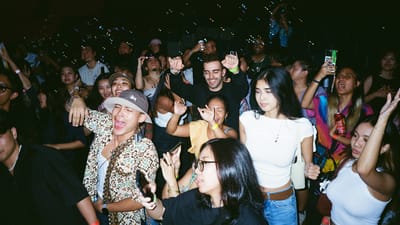

On a Saturday afternoon, on the 38th floor of CapitaGreen in the heart of Singapore’s Central Business District, dozens of entrepreneurs, founders, influencers, and content creators mingle in an Art Deco-inspired cocktail bar and lounge modelled after New York’s vintage jazz clubs—all plum velvet and gilded accents. The bar is part of Centre of the Universe (COTU), one of the city’s hottest new multi-concept food and nightlife establishments. Called The Whisper Room, it’s anything but quiet.
The crowd is unmistakably Gen Z. A sea of young men sporting wolf cuts, broccoli perms, and wide-legged pants, alongside a handful of self-assured young women. They’ve come for Gabe Chia’s first in-person networking event, “Coffee with Gabe”. Gabe, 25, a dropout from the Singapore Management University (SMU), is an internationally known content creator and founder of The Viral Haus—a content agency helping businesses go viral. Gabe scored The Whisper Room for free through one of his contacts. He invited 17 people. Around 200 showed up.
They introduce each other through Instagram handles, not name cards. “What content do you create? What business do you have?” is the usual opener. I meet a poly student who does branding and styling for User Generated Content (UGC) creators; a founder of a 3D-printed, plant-based lamp start-up; and a DJ creating an app to link creators and automate Instagram channels.
As the event winds down, Gabe, muscled and in his trademark black T-shirt, takes the floor. The crowd presses in, eager to capture him on their phones. “A year ago, I was sad. I’d just gone through a breakup. I didn’t want to live anymore. But in the last 10 months, I decided I wanted to take action—I left Singapore, built my personal brand, and put myself out there. It changed my life.”
Later, he posts a version of the speech on LinkedIn; comments roll in: “It’s lit”, “Main character energy”, “Even when it feels delulu—this is how real community gets built.”
My first foray into this community, this hustle-and-hype creator economy which can also feel like a bro-culture-dominated boys’ club, began when a Jom reader tipped us off about some young self-taught barbers creating waves online. At a small Ramadan bazaar in Marsiling this March, I met 17‑year‑olds Osman and Rizki, ITE College West students working under the Good Barber Fades brand. They were reserved at first, but lit up when talk turned to how their barber videos “blew up” on social media, some clips hitting 29,000 likes. “I want to get my name out there—Mothership, all the big platforms,” Osman told me. “I want people not to know me as a barber, but as an influencer. I want to get rich. I want to work for myself, no stress, just be in a position where the money comes in. But you’ve got to start from the bottom. That’s why my handsome boss, Samuel, will help me.”
Enter 21-year-old Samuel Joshiah, founder of Good Barber Fades. Wiry and quietly self-assured, he now juggles several service-based ventures projecting half a million dollars in annual revenue. After National Service, Samuel skipped a costly Australian business degree and poured S$25,000 of savings and family support into a string of businesses, including recruitment and outsourcing firms, eventually making his first S$100,000. Today, his most lucrative play is an outsourcing company linking a network of 300 Filipino remote workers to Singapore SMEs for digital marketing, admin, and customer service at about S$8 an hour. For Samuel, the days are long—his phone doesn’t stop buzzing even at 2am—but the margins are good.
Samuel argues that Singapore’s scripted path delays progress. “By your late 20s, you’re already ‘old,’ and a four-room flat costs nearly a million,” he told me. “If you’re earning S$3,000 a month as a salaried worker, how are you going to afford that? And landed property? That’s only for the very top.” Many of his peers now eye alternatives: entrepreneurship as a fast track to wealth, or moving to cheaper South-east Asian countries where the quality of life is better on S$1,000 a month, and remote work can still fund a house back home—if they return at all. “If so many of us think this way,” Samuel said, “maybe there is something wrong with the system.”
Samuel is part of the Radical Riches community, which has over 20,000 followers. On Instagram, it showcases snappy interviews with successful entrepreneurs breaking down their secrets. At my first Radical Riches event, at a sleek co-working space in River Valley called SQ Collective, the room was packed with mostly male teens and early twenty-somethings. Some are still in secondary school; others are already running side hustles. I heard chatter about lead generation, Shopify hacks, TikTok growth, dreams of building the next Labubu.
That’s where I meet Radical Riches founder Kevin Wee, 31, a public speaker and “edupreneur” who runs multiple businesses under the Radical umbrella, reportedly generating seven-figure annual revenues. Kevin plays the role of older brother and hype man. Tall, intense, fast-talking, he paces the room, hosts with ease, and doles out advice. His core message is simple: traditional school isn’t built for greatness. “Formal education earns you a living. Personal education earns you a fortune,” he said.
That conviction stems from Kevin’s own collapse within the system. Once a high-achieving Raffles Junior College student and competitive athlete with Olympic dreams, he suffered a mental health breakdown at 18 while preparing for A-levels. What followed was a manic episode that culminated in a now-deleted four-hour YouTube video: he drank his own urine, ate dog faeces, and burned his A-level certificate, scrawling “Grades will not define me” across his bedroom wall in red paint.
That breakdown, Kevin said, became the seed for a new mission, to reject rigid definitions of success and build a more empathetic society. Inspired by creators like American YouTuber MrBeast, Kevin launched a media platform, Radical Kindness. His viral videos blend altruism with feel-good spectacle: he’s raised funds for cancer patients and migrant workers, surprised families in need with home makeovers, raced American YouTuber IShowSpeed for S$10,000—pledging to donate the sum to a charity of Speed’s choice if he lost—and handed out envelopes of cash to strangers on the street. He encourages young men to take ownership of their lives, and be “rich with a heart.”
Kevin feels that many express a growing disillusionment with traditional systems, turning instead to embrace the “break the matrix” ideology popularised by controversial misogynist influencer Andrew Tate. Tate sells the fantasy of escaping societal control and achieving wealth through his Hustlers University. The phrase is a reference to “The Matrix”, a 1999 sci-fi film in which humans unknowingly live in a simulated reality. In one scene, Keanu Reeves’s character is offered a blue pill to stay in comforting ignorance or a red pill to see the truth.
Escaping the matrix is a compelling idea. As Kevin put it, “It paints a narrative that governments and institutions are deliberately keeping people poor, enslaved to a system where the expected trajectory is: we are conditioned to study hard, graduate, earn S$3,000 to S$4000 a month, and compete with thousands for the same limited opportunities.”
This sense of entrapment overlaps with anxieties around masculinity. “Now you’re told to be softer, emasculated…It’s part of the narrative that Tate sells—that men are being kept at bay, and you need to take back control of your life,” said Kevin, who believes his message hits home with young men who “want to be rich, known, and influential.”
To him, Singapore’s education system continues to box youth early through grades and rigid stratification. It rewards conformity, not creativity, and sidelines leadership, communication, and problem-solving. “You can’t expect a standardised system to produce exceptional people,” he added. “Look at the top athletes, musicians. They all had personal coaches and mentors, not group classes.” And with knowledge now everywhere—YouTube, the internet, ChatGPT—Kevin argues that self-education offers a faster, cheaper, and more direct path to success.
The hustle-and-grind mindset isn’t unique to Singapore. In the US, youths are skipping college to be TikTok famous, launch start-ups, or sell courses. Their online role models, from Tate to ripped fitness influencer Ashton Hall and UK-based “red pill” YouTuber Hamza Ahmed, sell a potent blend of hustle culture, sculpted alpha masculinity, and curated vulnerability. They offer a comforting script: be strong, reclaim control. They want the old world back, one in which men and women know their place. The same cocktail is also feeding the rise of the “trad wife” aesthetic in the West, and more broadly, a global regression in gender norms, as well as the surge of conservative populism steeped in male machismo, exemplified in the US by Donald Trump’s “Make America Great Again” movement.
Why the appeal? Perhaps because masculinity feels under siege. In Of Boys and Men, Richard Reeves argues that as women soar in education and work, men are falling behind in school, mental health, and meaning. Their struggles go unacknowledged, creating fertile ground for figures who offer purpose, identity, and belonging. Some of these movements sell the idea of brotherhood, community, and empowerment; others veer toward misogyny or incel subcultures, co-opting the red pill metaphor of “The Matrix” to reject feminism and mainstream norms. Political theorist Hannah Arendt saw something similar nearly a century ago. Loneliness and apathy in 1930s Germany left many young men open to Nazi recruitment. It’s a reminder that today’s crisis of disconnected men predates social media.
Singapore’s “manosphere” is softer and less rage-driven, fuelled more by money than anger. Of the five Cs that once defined status here, three—cash, car, and condominium—“seem to be making a comeback amongst those who subscribe to the manosphere,” said Soh Kai Ruo, lecturer in the Department of Communications and New Media at the National University of Singapore (NUS). “It is seen as a sign of success and perhaps those of an eligible bachelor—what it means to be a man.” Empowered by Big Tech’s platform capitalism, young Singaporean men are striving towards these goals by building brands and monetising niche passions, often without formal higher education or start-up capital.
Goldman Sachs estimates the total addressable market of the creator economy to be now worth over US$250bn (S$321.5bn) and growing. Content is serious money. Marketing has evolved. Where search engine optimisation (SEO), e-mail blasts, and glossy ad campaigns once reigned, today’s wins come from raw videos, shot on phones and shoestring budgets, that hook attention in seconds. In this ecosystem, attention is currency. “The greatest real estate you can own,” Kevin likes to say, “is the corner of somebody’s mind. The ROI is infinite. It’s an online résumé, door opener, and filter.” His stripped‑down playbook: be radically different, move fast, stay spontaneous, post every day, and tell stories that connect.
If Kevin is the personal branding evangelist, Gabe is the romantic, posting inspirational reels about chasing dreams and self-discovery. In a hyper self-aware moment, he told me, “I sell a service, yes—but really, I’m selling myself. People buy me, then they buy my service.” To him, a personal brand isn’t just a marketing tool; it’s a lifelong asset. “There’s no other person in this world like you. If people connect with who you are, they’ll stay.”
As a child actor and then film student at the School of the Arts (SOTA), Gabe once dreamed of becoming a Hollywood director. Unable to afford a scholarship to film school, he enrolled in business administration at SMU in 2022 to “land a big boy job in banking or consulting.” But after his five-year relationship ended, he realised something deeper was missing. He stepped away from school and spent a year couch-surfing—often with fellow content creators he met online—in New York, Toronto, Melbourne, and Lisbon, all while building his businesses.
Viral Haus, his content strategy agency, has helped steakhouses, light shops, and urban farms go viral. He also runs Viral College, an education arm where he forms and trains content teams for founders building their personal brand. Combined, the ventures net close to S$100,000 a month, a goal he set for himself after dropping out of university.
Strategic brand management is key to Gabe’s approach. He acknowledges the edge that “pretty privilege” (the social advantages of being conventionally attractive) gives him, and deliberately creates content that transcends local context to reach international audiences and earn in stronger currencies. He’s also highly attuned to the risks of the online attention economy, steering clear of polarising issues like religion or LGBTQ rights to protect his brand and stay focused. While Gabe sells the dream, for other Gen Z founders, it’s all about rapid experimentation: build now, learn later.
Just a few years ago, faceless TikToker Koocester was a Foodpanda rider who had to request free or discounted meals from the platform. Today, he runs a content and branding business with seven-figure annual revenues, rents his own place, and dines out without worrying about the bill—whether it’s at a hawker centre or somewhere more upscale. Koocester left school when he was 19 and, inspired by American TikToker Daniel Mac's viral on-the-street interviews, started talking to supercar owners along Orchard Road.
“Most people want to be millionaires,” he said. “So why not go straight to the millionaires and ask how they did it?” What surprised him: many of them didn’t come from the elite—they just hustled and kept learning. “I learnt more from them than I ever did in school.” He started filming, went viral, and soon brands came knocking. Today, his 12-person team at the Koocester Group handles storytelling and PR campaigns across Singapore, Malaysia, and Indonesia for Netflix, Red Bull, and luxury automakers.
Despite the flashy world he moves in, Koocester keeps a low profile. He won’t share his real name and declined to turn on his camera during interviews. Still, his ambition is unmissable. He’s eager to expand into markets where platforms pay creators directly. “Singapore’s too small,” he said. “Once you’re operating across countries, nine figures isn’t impossible.”
Koocester is just one fish, albeit a big one, in an online sea teeming with them. Take Khai Irfan and Cliff Leck, both 23, who co-founded the Therapin nasal strip brand, which pulled in S$100,000 within seven months of its launch last year. They were partly inspired by the US “Hostage Tape” trend popularised by Ashton Hall’s viral wellness routine. Then there’s Kai Tham, a 20-year-old who put his SMU studies on hold, saying “fuck it, wing it” to build his own clothing line. It’s called Aston Abode, and pulls in five-figure monthly revenues, mainly through intense brand-building on social media. “The algorithm knows us—it shows us what we want. There’s no better time to grow,” he proclaimed.
In some ways then, the platform economy has democratised opportunity. “I come from a not-so-good family. I didn’t know how someone like me would be able to meet someone who owns a big business or corporation,” Koocester said.
But its growth is also a sign of uncertain times, with AI wiping out entry-level roles and tariffs creating economic anxiety. Today, even a degree does not guarantee stability in Singapore’s tightening job market and amid rising living costs. In 2024, just 79.5 percent of fresh graduates from Singapore’s five autonomous universities secured full-time jobs—down from 84.1 percent the year before. Meanwhile, only 46.4 percent of private university graduates found full-time work within six months, a sharp drop from 58.7 percent in 2023. Some send hundreds of applications only to be ghosted; others post raw, vulnerable videos about their struggles. Just search TikTok for their full-blown breakdowns.
Side hustles are a buffer against such uncertainty for 22-year-old Rayyan Matin, a Temasek Polytechnic student specialising in cybersecurity and digital forensics. He runs TwoWheel Freedom, a motorcycle service and care business that also handles distribution. His long-term goal is to build a full-fledged motorcycle workshop and expand into manufacturing his own line of motorcycle care products. A customer who survived five retrenchments in her IT career once told him to specialise in two disciplines. The advice made a deep impact.
“With tech layoffs and the economy the way it is, I need multiple income streams to future-proof myself. But honestly, what does the future even hold? What works now might not work later. It’s scary—especially if you don’t come from money.”
Jobs in the gig and creator economy provide “greater options…beyond the perhaps shrinking traditional job market,” said Tan Ern Ser, NUS sociologist. They’re less stable and less structured, but their promise of higher rewards appeals to those who don’t see much promise in traditional career paths. This is especially true for men, expected to be providers and culturally “more inclined to take risks.”
In Tan’s view, the burgeoning creator economy shows that Singapore’s notion of meritocracy is widening to include multiple pathways, multiple kinds of “merit.” This flexibility opens doors, but it also crowds the room. If gig work outpaces stable jobs, what happens to those who don’t crack the algorithm? “Would young people then wallow in unemployment, attempt to emigrate, or forge new paths?” he wondered.
And what of mental health? In Technofeudalism: What Killed Capitalism, Yanis Varoufakis, economist and Greece’s ex-minister of finance, argued that capitalism has been replaced by a world in which tech giants are modern feudal lords and we, with every click and scroll, labour like serfs to fuel their power. He described a generation trapped in the performance of self, where curating an authentic online identity is now essential. This relentless pressure erodes self-ownership and freedom, turning visibility into invisible labour: “From the moment they take their first steps online…they are taught implicitly to see themselves as a brand, yet one that will be judged according to its perceived authenticity.”
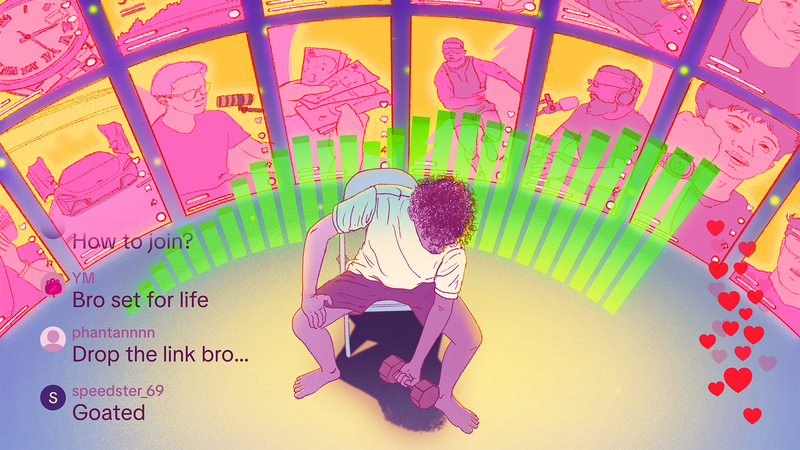
Few know this better than 24-year-old Khairulanwar Bin Razali, whom I first met at Gabe’s event. Blonde-haired and wired with restless energy, he documents 5am gym sessions, Hyrox trainings and ice baths, 19-hour workdays, and even pre-date grooming routines. He runs two ventures: ViralVizions, a TikTok-focused marketing agency, and Okami, an athleisure brand promoting a “take-control-of-your-life” mindset. Across both, he said, monthly revenue has topped S$150,000. Fame has brought clients, credibility, and yes, “free stuff.” But the pressure of being constantly watched, especially as a Muslim influencer navigating hustle culture’s material excesses, is real. Like many young male creators online, Khai is navigating a quiet tug-of-war: how much to share, how much to keep polished, and how to be vulnerable without seeming weak. “As guys, we’re not really taught to talk about mental health,” he said. “I try to share my good days and bad days on social media. But there’s always that pressure—like, will people even want to see the bad?”
Hustle culture normalises, even glorifies, the toxic mix of achievement, overwork, and relentless output. Followers, comments, and likes become proofs of worth, shaping young creators’ sense of self and creating identities that are “performative and externally driven, rather than rooted in internal values,” said Dr Annabelle Chow, principal clinical psychologist at Annabelle Psychology. Over time, this fuels anxiety, depression, and a thinning ability to focus. Quite literally. She noted that a thinning of the prefrontal cortex can lead to reduced attention, impaired memory, and challenges in decision-making and emotional regulation.
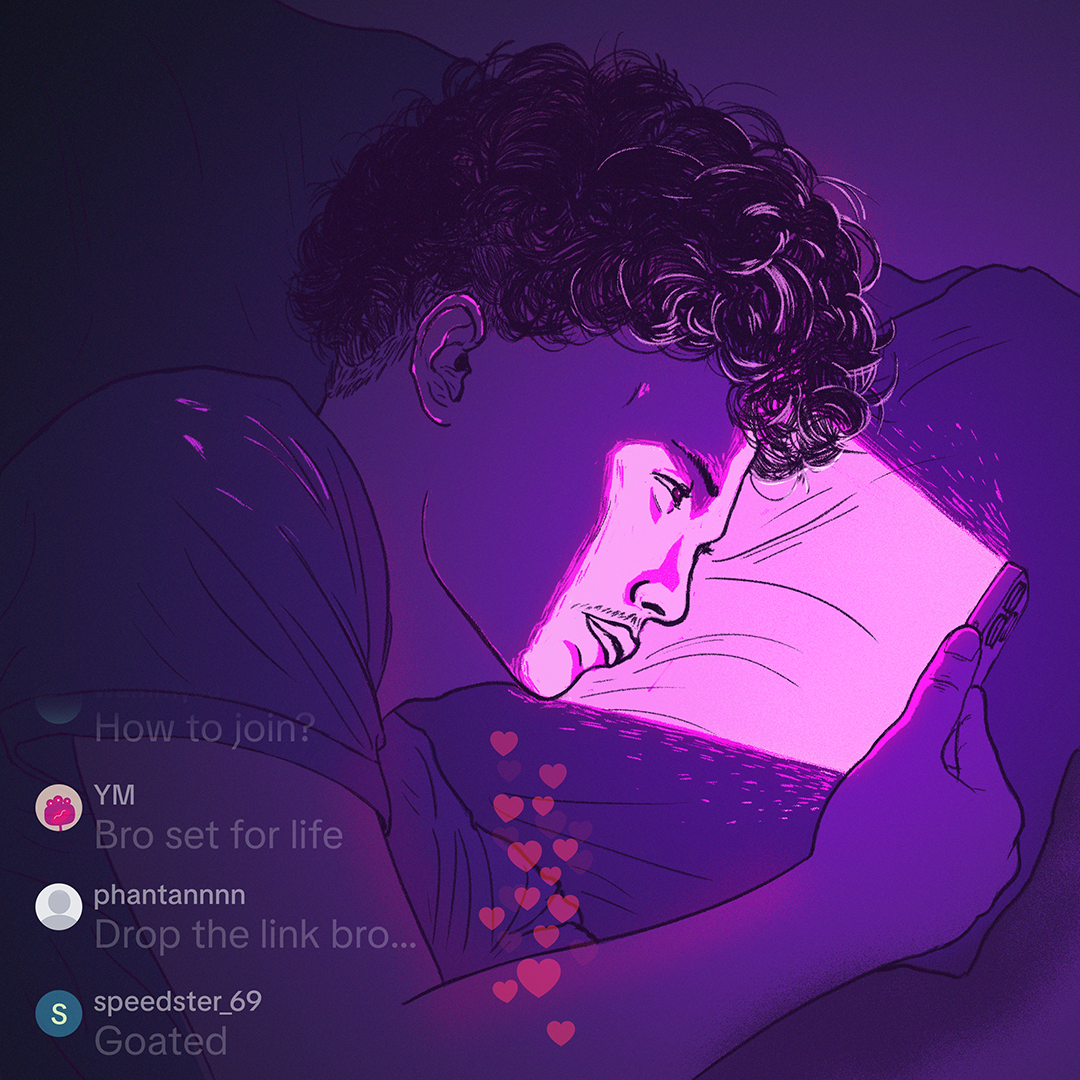
A stable sense of self is key to surviving the psychological demands of the online world, said Dr Chow. That includes normalising failure, talking about burnout, and finding a supportive ecosystem that values more than just output. When navigated healthily, the creator economy can then help build careers offering autonomy, expression, and fulfilment—all vital to mental wellbeing.
As they are today, manosphere communities do offer a sense of brotherhood, but often at the cost of emotional suppression and rigid norms of dominance. This “limits self-exploration and hinders emotional growth” and can also encourage antagonistic views of women (and other men), normalise subtle derogatory behaviour, and promote control in relationships, Dr Chow pointed out. At a larger societal level, and especially among younger age groups enmeshed in social media and digital culture, this is already happening.
Netflix’s “Adolescence” follows 13-year-old Jamie Miller, whose family’s world is upended when he’s arrested for the murder of a female classmate. Though fictional, the story is grounded in broader UK trends of teenage knife crime and consumption of misogynistic content. Closer to home, Singapore police arrested over 460 youths under 19 for sexual offences in 2024, a trend linked to early exposure to online pornography and a lack of impulse control. Many teens today grow up in a digital culture where porn is easily accessible, often degrading, and rarely depicts mutual respect or consent. Yet, few receive real-world guidance on relationships, boundaries, or emotional maturity, said counsellors. In one high-profile case, a group of male students at Singapore Sports School reportedly used AI to generate explicit images of female schoolmates.
Incel rhetoric has also taken root here. This was most alarmingly evident in the recent case of a 14-year-old boy who, according to the Internal Security Department, was radicalised by a “salad bar” of extremist ideologies, including incel culture. Meanwhile, forums like HardwareZone are rife with rants about “stupid feminism rights”, how National Service robs men of their best years, and claims that modern dating is rigged against them. This worldview frames men as victims “owed” sex, and women as manipulative gatekeepers. “Misogynistic comments create an online ecosystem of hatred,” said AWARE’s director of advocacy and research, Sugidha Nithiananthan, “where women and girls feel degraded, objectified, and unsafe.”
Such rampant misogyny may yet be present only at the edges of Singapore’s male hustle culture, but still, it breeds some toxic extremes. One rising trend: looksmaxxing, where influencers push extreme methods—from steroid use to smashing cheekbones with a hammer for a more chiselled jawline—to boost sexual appeal to women. It often overlaps with gymmaxxing (building muscle) and moneymaxxing (chasing wealth), all tied to the idea that a man’s worth lies in how desirable he appears.
When I asked around for an example, every guy pointed me to secondary school dropout Rayston Heem. At just 18, Rayston has become one of Singapore’s most polarising internet personalities. He claims to earn over S$200,000 a month and lives in a S$9,000-a-month penthouse—“pretty cheap”. His Instagram feed, lapped up by around 22,000 followers, is a high-gloss highlight reel: gym thirst traps, supercars, yacht parties, income screenshots. He flexes stays at Sentosa Cove, New York, and Miami; sports Balenciaga and Dior; and shows off a lavish luxury watch collection. One clip features a Cartier ring he bought for Mother’s Day; another, a Mercedes Benz for his father. He posts productivity hacks like plunging his face into ice water, jokingly hashtagging himself the “Asian Ashton Hall.”
Rayston shares his backstory often: he dropped out of a neighbourhood school and describes his 14-year-old self as “skinny, depressed, lost, failing all my classes.” A painful breakup—he was cheated on—sent him into a spiral. He skipped school for six months. Then, he decided to take control. He started hitting the gym six days a week. He got veneers. He locked himself in his room and studied e-commerce obsessively, testing different strategies until he cracked what he calls his “winning formula”: branded dropshipping—selling high-quality, pre-vetted products through polished stores designed to look like legitimate brands, pushed with TikTok-viral and AI-generated content. “It’s like gaming,” he says in one reel. He hired other teens to trim and repost viral edits of his videos, a tactic known as “clipping,” to boost traffic, reach and monetisation.
Rayston claims he paid US$10,000 for a one-hour lesson from controversial hustle bro Luke Belmar, and cites crypto scammer Malone Lam as an inspiration, not for the fraud, but for the “discipline and drive.” He claims to have made over S$600,000 last year. Making money online is “the modern gold rush”, a “cheat code” in this game of life. He’s now selling his blueprint via a coaching platform called eComwarts, aimed at helping others escape the rat race and build six- or seven-figure stores. His first free webinar drew over 700 attendees, mostly men. In one reel, he says: “Nobody told us it was possible in the system we live in. Every teacher just told me to get a stable job. But I watched them drag their feet to work, living paycheck to paycheck. They didn’t drive supercars or look happy. So why was I listening to them?”
It’s tempting to dismiss all this as performative—a virality-maxxing cosplay for the algorithm. Is the lifestyle real, or just convincing enough to sell the illusion, like Indonesia’s Bobby Saputra, the internet’s favourite fictional billionaire? It’s hard to tell. While reporting this story, I encountered a pattern: creators who were open at first, then frustratingly non-committal. Some ghosted. Others cancelled last minute, or didn’t show up for the video calls we’d agreed on. Rayston could never quite commit to a time. In one unsettling moment, a 15-year-old misread my request for his number as a come-on, joking back in a way that felt oddly flirtatious.
Maybe they were busy hustling. Maybe they are still figuring out professional norms. Maybe I just wasn’t part of the inner circle, or the interaction with me wasn’t immediately useful or profitable. Why surrender narrative control to a journalist when you can build your own platform with podcasts, YouTube videos, and a loyal fanbase? Sometimes, I wondered: would I be taken more seriously if I were a man?
Researching this story made me worried about the next generation, especially my own brother. At 16, he’s no longer the cuddly, cheerful kid I grew up with. He speaks in the lexicon of his generation: “bruh,” “cooked,” and “deadass,” and goes to an all-boys school where emotions are often masked by bravado and his peers huddle to vape in the school bathrooms—a culture intersecting with the dangerous Kpod drug-laced vapes recently making headlines. For his birthday, his classmates pooled money to get him a S$600 Apple Watch and a pair of Nike Why So Sad? imitation sneakers. It made me realise just how much the baseline has shifted, not just in spending power, but in what young people see as normal or expected. When he says something hurtful and I call it out, he tells me I’m too sensitive. When I shared parts of this story with him, he got defensive and half-joked that I’d been radicalised…against men.
One Friday night in May, I found myself in a gritty, run-down industrial building in Ubi, at the Modern Wealth Academy for an event called “Entrepreneurship Without Capital: How To Make Your First $10K/Month With No Capital”. Inside, a crowd of mostly young men sat rapt as Kevin, Samuel, and self-made millionaire Edrick Lie, the 30-year-old founder of a sales education company, shared their secrets for success. At one point, Edrick had the room chanting affirmations like, “I need to be the change,” their voices bouncing off the walls.
It felt part motivational seminar, part cult-like initiation ritual—a Singaporean echo of “Fight Club”, the 1999 film starring Brad Pitt and Edward Norton in which disillusioned men form an underground brotherhood to escape modern life’s emptiness through acts of destruction and anarchy. Today, that same quest for liberation often takes the form of chasing money, building muscle, or the seductive pull of status. But sitting among them, I realised it was something more raw, more primal: a generation of young men trying to reclaim power—and their place—at the centre of a changing world.
Toh Ee Ming is a freelance journalist focused on social impact, the environment, travel, and culture. Driven by deep empathy and curiosity, she wanders the world in search of stories about everyday people and communities, aiming to shed light on the experiences that shape our world. This is Ee Ming’s fourth essay for Jom. Read the others here.
Letters in response to this piece can be sent to sudhir@jom.media. All will be considered for publication on our “Letters to the editor” page.