


One plus one equals two (hmm)
Two plus two equals four (are you sure?)
Four plus four equals eight (you got it!)
Doblehin ang eight
Tayo’y mag-otso-otso (otso-otso),
otso-otso (otso-otso)
Otso-otso (otso-otso), otso-otso na
—from “Otso-Otso” (2005) by Bayani Agbayani
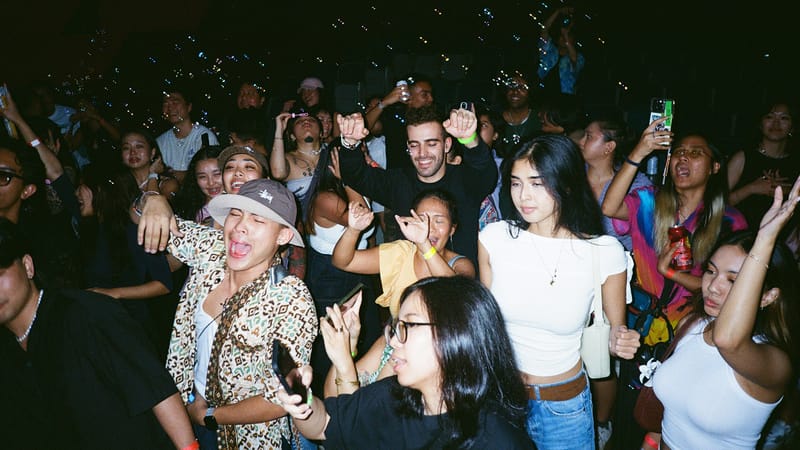
My friends and I find ourselves in a sweaty circle forming at the centre of a tiny dancefloor. The converted cocktail bar is cramped, the floor is slippery, but no one seems to care. Everyone around us, however, seems to know the moves to the song said to send a shimmy through every Filipino. They arch their lower backs and thrust back and forth to the rhythm of otso-otso (otso-otso), otso-otso, while also making way for fellow partygoers entering and exiting a nearby bathroom. Filipino singer Bayani Agbayani’s “Otso-Otso” (eight-eight) conjures childhood nostalgia with its campy mix of 8-bit beats and some squidgy foley of fast-forwarded cassette tape. My favourite part of the song is the bridge. It modifies the chorus: slowing it down, speeding it up, then returning to its original tempo; every acceleration and deceleration sending a frisson of excitement through the already frenetic crowd.
A hopping club late on a Saturday night? Not quite. It’s the middle of a Sunday afternoon, and we are at a Thanksgiving Daytime Party in a bar on Purvis Street, organised by the creative collective Secret Pals. “Just pals, helping pals in secret” goes their tagline, coined by co-founders April Luistro, a graphic designer and creative strategist, and Patrick Gerard Elicaño, a freelance photographer and writer. The latter’s on the deck, spinning a mix of groovy hip hop, the street-style techno beats of budots, and familiar Filipino pop songs. But this party’s also a regional one; it’s a tie-up with OnlyPans Taqueria, a Mexican restaurant based in Manila, and the servers are dishing out tacos in their bright red “Hot Girls Eat Tacos” tees. As I watch everyone dancing around me, I realise I’m standing at the intersection of multiple temporalities as time zones, rest time, circadian rhythms, and music tempo all begin to blend into one.

In music, the mood of a song is significantly influenced by its tempo. This is measured in beats per minute, or bpm. I played the trumpet for my secondary school band, so most of my teenage years were ordered by the cyclical pulse of the metronome: click, clack, clack, clack, click, clack, clack, clack, click. Classical music theory associates different tempos with different moods. There’s adagio, or at ease in Italian, the tempo marking for slower pieces of music. At 55-65 bpm, this pace sits slightly below the typical resting heart rate. Allegro, on the other hand, is lively, bright and fast, and indicates that music should be played at speeds between 120-168 bpm. This is also our heart rate when we’re exercising. Tempo allows us to not only keep time, but also feel time.
Our everyday life is measured by a different kind of click, clack, clack, clack, click: the cyclical loop of Monday, Tuesday, Wednesday, Thursday, and Friday. But unlike a metronome, we can’t slow down or speed up this tempo. The micro and macro rhythms of our everyday life are determined by a range of institutional forces that incarnate in our calendars, schedules, time zones, and alarm clocks. The late Elizabeth Freeman, scholar of literature, gender, and sexuality, calls this chrononormativity, a process where individual bodies are collectively organised towards maximum productivity. Friday is a special day of the week as it marks the end of a productive cycle and ushers in two days of permissible rest and leisure. This permissibility is not enforced through punishment, but an embodied discipline of productivity.
This discipline is frequently imposed on young people in the sandwich class who are also entering the sandwich generation. Business journalist Caroline Binham connected the growing global popularity of daytime partying with the rise of the “discerning clubber”. In her Financial Times article, “Why I’m a convert to daytime clubbing”, she wrote about partygoers in the 18-to-30 crowd who are confronting rising costs of living while also managing caregiving responsibilities—something that’s “hard enough without the hangover, lack of sleep, and the existential sense of regret that traditional clubbing until the early hours tends to engender”. We aren’t just calibrating ourselves to the productivity metronome on weekdays; weekends are now also subject to a careful optimisation of play and rest. Recovering from the week’s tasks becomes necessary to prevent burnout so that the work cycle can begin again, and on time. If you start partying at 3pm and are back home by 10pm, you get to experience the exhilaration of a party and, as a bonus, you also get eight hours of sleep.
Sundays must be handled with even greater care. The sabbath offers a full day of rest, but the timekept working class can’t afford to jeopardise its ability to be productive the next day. Both partygoers and party organisers are governed by this chrononormativity. Secret Pals has thrown Sunday daytime parties for Filipino hospitality workers who may only get a single day off. As partygoers and migrants themselves, Secret Pals takes their role very seriously; they see parties as a means for nurturing connection. They also curate comedy shows, kitchen takeovers, and film screenings, and Filipino expats have repeatedly told them that these events are often their first point of contact with Singaporean cultural life. Their first project was a collaboration with a now-defunct Manila streetwear brand, THE Clothing, that wanted to host a pop-up event in Singapore. The collective’s proximity to fellow Filipinos in the F&B industry means they’re committed to making events enjoyable not just for the people on the dance floor, but also for behind-the-scenes bartenders and kitchen staff. They’ll make sure Sunday parties end before 10pm so that public transport isn’t a worry and rest is a given.
But closing time isn’t the only challenge that Secret Pals must contend with. They’ve started to notice that partygoers now have a specific set of expectations of how parties should go. Luistro attributes this to the rise in recorded DJ sets that are readily accessible online. These sets tend to be intimate, promising partygoers a sweat-slicked night out with a big-name DJ spinning right in front of them. She told me that “sometimes there’s a lot of pressure [from partygoers]…to make sure that the night goes like that”.
Music critics and DJs have raised concerns about a “vibe change” in the global post-pandemic party scene. One of them is Jyoty, a 33-year-old DJ of Punjabi-Dutch descent who’s based in London and whose recorded set went viral in 2019. On TikTok, she lamented the increase in partygoers who are out to “chase short moments” or only “because of FOMO (fear of missing out)”. But it’s not always their fault. Many of these partygoers had never experienced pre-pandemic partying, either because they were underage, or didn’t have the financial or temporal means. But they also didn’t have access to a conventional dancefloor education where, according to Jyoty, “it wasn’t about being seen and seeing, or being able to share that you were there on social media”. It was about having a good time.
What else might explain this shift in party culture? Sociologist and philosopher Jean Baudrillard had a few prescient theories. His 20th-century conceptions of how we produce our realities, such as the simulacrum and hyperreality, still hold sway today. A simulacrum refers to a production of reality that has been reproduced so many times that it eclipses the original experience of that reality. Think about how full-length videos of DJ sets are first uploaded to YouTube. Then, these sets are sliced into shorter clips, featuring only the climactic parts of the set, and uploaded to social media in digestible chunks. And finally, we get the photo receipts offering proof of being there, and the glamorous social and cultural capital that comes with it. Gone are the photos of partygoers bopping right next to the DJ. Now, it’s all about club bathroom selfies or candids at the smoking corner.
Contemporary party culture is less about dancing to music, and more about projecting cool in the transient spaces associated with it. We are collectively producing and pursuing a “perfect party” culture that may not even exist.
The quest for the perfect party straddles both mortal and celebrity realms. The cult TV drama Skins may have attempted authenticity in its gritty portrayal of British teen life. But its simulacrum simulates something else altogether. Ewen Spencer, photographer and filmmaker, shot the young Skins cast for the show’s ad campaign in 2006. Producers dressed up a house in suburban Watford, then parachuted the performers in to reconstruct the scene of a hedonistic house party. Spencer published these images almost two decades later in his 2025 photobook, One Night in Watford, and it’s a heaving, hyperreal representation of what we think the perfect party should be. We see lithe teenage bodies entangled, topless boys draped in feather boas, sweaty girls sporting smudged eyeliner. These conventionally attractive young people, embodying a precise mix of messiness and prettiness, become the aspirational representation of partying, somehow more “real” than the real thing. Could ordinary bodies in a tiny grassroots space come close? Might they be able to discover new music, or genuinely enjoy themselves without judgement?
Baudrillard didn’t think so. In these hyperrealities, “entertainment, information, and communication technologies provide experiences more intense and involving than the scenes of banal everyday life,” he conjectured, and “these models, images, and codes come to control thought and behavior…the camera lens that, like a laser, comes to pierce lived reality in order to put it to death.” Did video kill the “real” party? In this hyperreal world, partying is reduced to its performative components—dressing up, posing for the camera, serving up “main character moments”—rather than making friends and forming communities through shared joy of music and movement. Trying to replicate the perfect party experience is, in Baudrillard’s words, an “anticipated resurrection” that will only lead to rupture and disappointment.
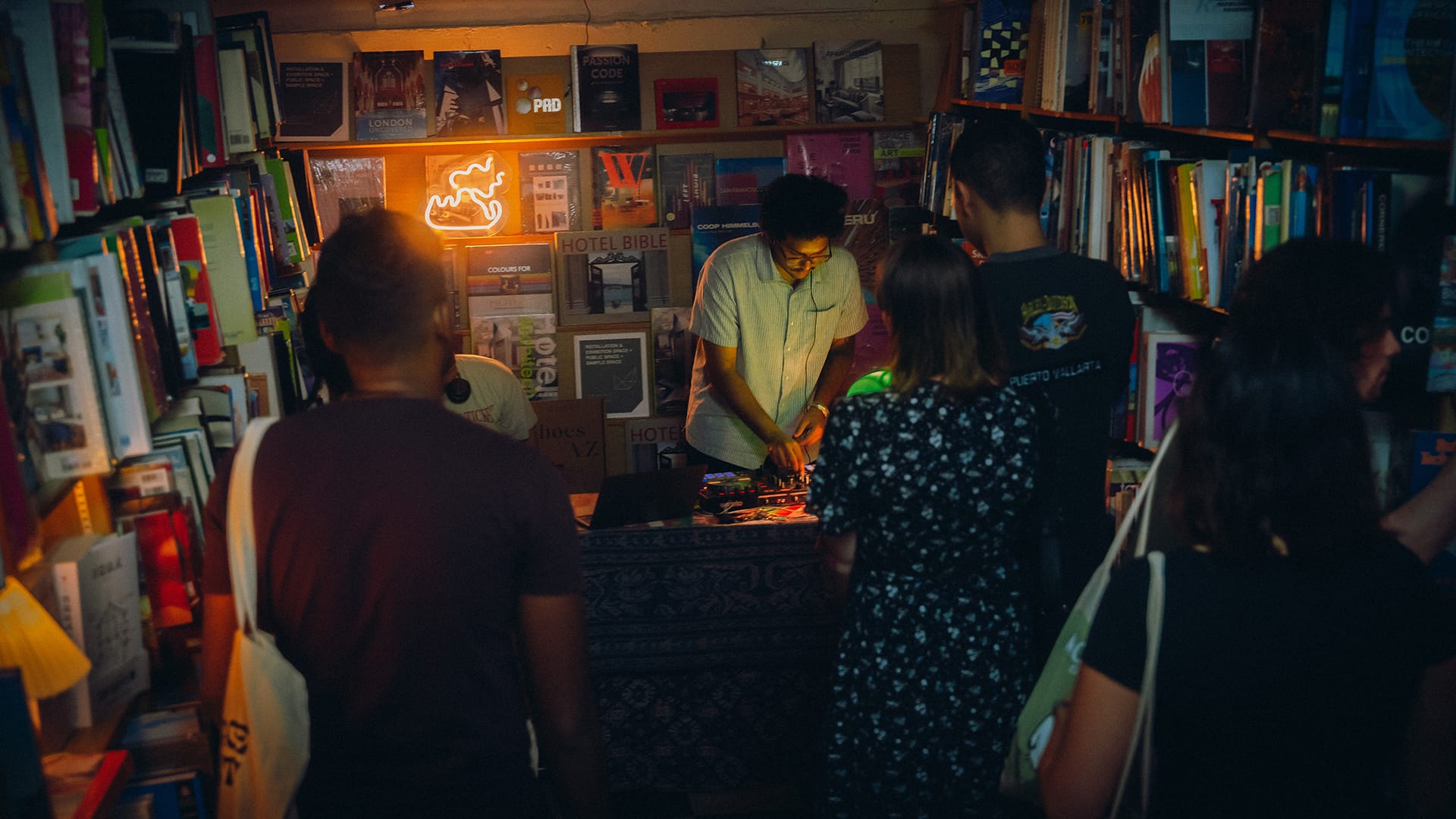
Enter the rebellion. Kopicats, a DJ-events collective, is here to take back the real. Axel Timothy Chee, Claudia Park, and Aaditya Sundar want to set new norms and subvert old ones with their pre-dinner parties. They’re discarding the strobe lights and strident music and, in fact, they’ve ditched the club entirely. Instead, the 20-something trio, who met through mutual friends, brings the party to everyday spaces. Picture this: you’re sipping a cup of kopi while dredging your kaya butter toast through runny soft-boiled eggs at your local kopitiam. One table over, a DJ spins a mix of jazz, indie pop, and mellow hip hop. Kopicats wanted to emulate the intimacy of a dinner party with friends. But “instead of your house, it’s the kopitiam downstairs,” Park told me. Because of this, Kopicats often picks personal venues with a special place in their hearts: the zichar restaurant that’s their go-to for birthday celebrations, or Basheer Graphic Books, the beloved art book store frequented by many in the arts community.
Park is the founding logistics manager and the unofficial big boss of Kopicats. She has both a commanding presence and a casual air. If the collective is her “day” job, she doubles as a filmmaker and production designer for her “real” job. Park was inspired by a random video, fed to her YouTube algorithm, of a DJ dropping “sick ass beats at a barber shop” in Vietnam. “[A] party is like a huge friend hangout,” she enthused, “it feeds our soul to be able to sit down and talk to somebody.” Chee feels the same. He raved about the rave experience and the buoyancy of late night chats after. Forming a heart with his fingers, he went, “friendship, man, friendship.”
The trio is a joyous mix of chaotic energy and clear conviction. Chatting with them over Zoom feels like being part of a video call with a close friend group—with all of its interruptions, affirmations, laughter, distractions, digressions and, of course, plenty of meme references. During the call, Park was sitting in a faux office in an IKEA showroom in Singapore. Chee, who’s studying fashion design in Melbourne, was in his bedroom, its walls decorated with art prints. Sundar didn’t turn on his camera at first. But when he did, his dishevelled hair sent the other two into a mid-interview giggling fit. He’d just woken up in Reading in the UK, where he’s pursuing a degree in agriculture. Despite the early morning, Sundar was passionate and chatty; like Chee, he’s also a resident DJ with the collective, and gives off the kind of contagious-but-chill vibe that might either get a crowd to its feet or in little conversational clusters on a couch.
To savour Kopicats is to suspend contemporary conceptions of partying. What does it mean to slow down the pulse of a party? What if we didn’t need to chug alcohol or jump to the blare of deafening techno beats?
Kopicats encourages us hypercapitalist, hyperproductive, and hyperreal beings to renegotiate our relationship with time. The collective espouses a different kind of romanticisation, of ordinary bodies in ordinary spaces. We don’t need to perform, we just need to be present.
As an ordinary body moving through ordinary space, I’d initially wanted to investigate daytime partying in Singapore, because these parties are what we might call temporally innocuous. Berlin’s iconic club Berghain stays open from Friday night through to Monday morning. You could technically daytime party by visiting Berghain on a Sunday morning. But because it’s a time and place strongly associated with substance use, this wouldn’t fit the definition of temporal innocuousness. Slipping out of the house to hang out with friends at 9pm feels a lot more mischievous than misadventuring with them at 3pm. No one’s stopping you from engaging in vices associated with nightlife during the day. But here, the equatorial daylight, the skin’s stickiness from the sweltering heat, and how visible we become to others sharing these public spaces, all present conditions less conducive for what we do in the shadows.

I was raised in a conservative Malay-Muslim household and had a curfew for most of my life. Until last year, aged 25, I had to be home by midnight, or risk a phone rattling with missed calls from my mother. “Tak balik dik? (Not coming home, sister?),” she’d text. I’d always reply, fiddling with my phone and keeping my composure so I wouldn’t ruin the evening’s vibes with my growing anxiety. I’d sheepishly tell my friends that I had to leave, get a taxi home two hours after curfew, and be greeted at the door by my mother. On top of the lectures and interrogations the morning after, I’d also be ridden with guilt for causing my mother’s lack of sleep—and lack of a “good” daughter. A curfew is set to ensure respectability, because what business does a young woman have, being out after midnight? Daytime parties gave me permission to walk the line. I could experience the delights of new music while still meeting my curfews, maintaining family peace, and marginally complying with the values I was raised in.
“Every time people hear the word ‘party’, they assume that people are going to be very drunk. Everyone’s going to be very dirty, very messy,” Javan Poh, one of 5210PM’s co-founders, told me. “The whole ‘alcohol and partying’, you don’t need to do that all the time. You can still go out and enjoy music sober.” 5210PM is another Singaporean collective that organises parties between—you guessed it—5pm and 10pm.
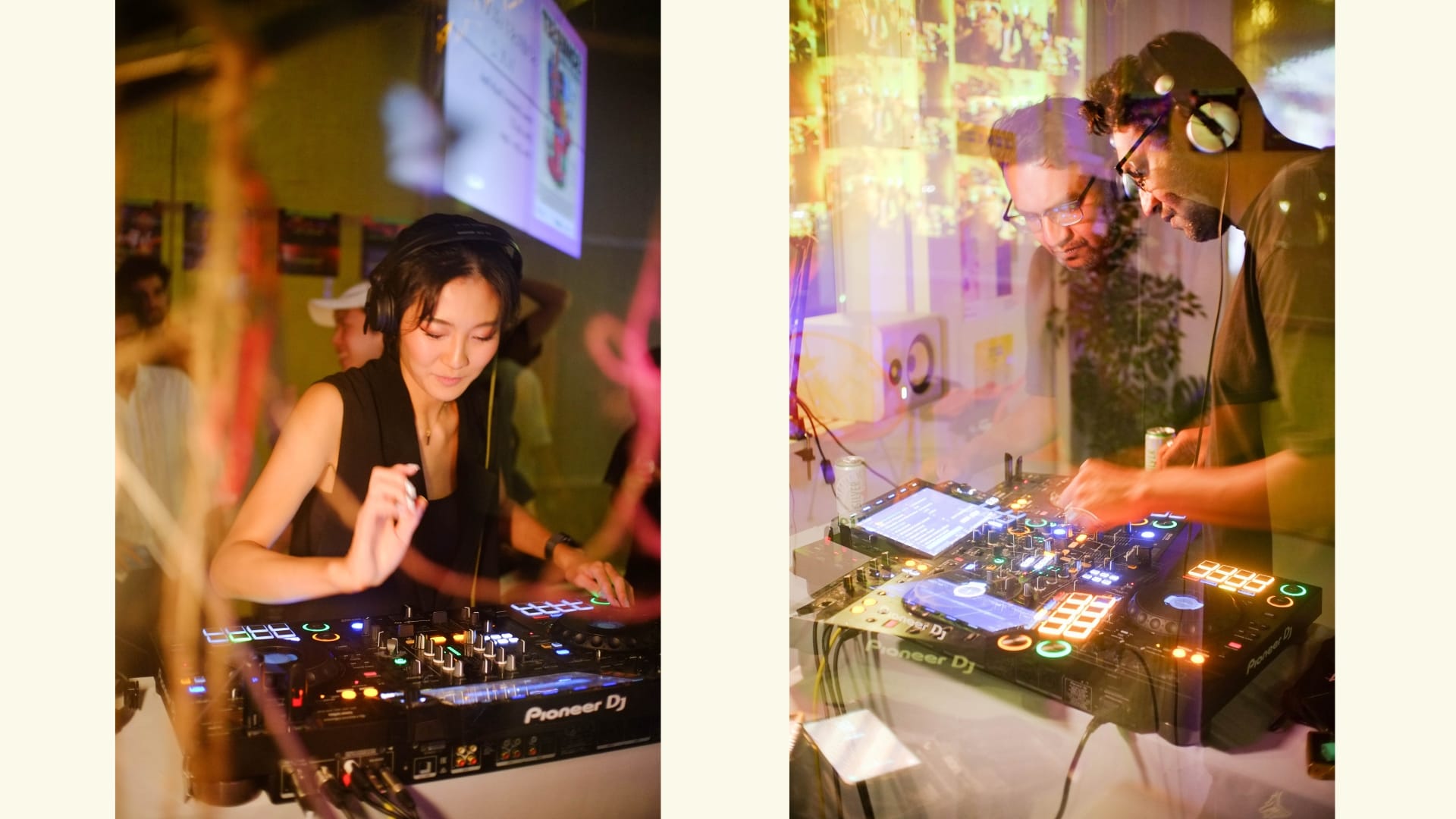
I first met them when they hosted The Party Expo(sure) last year, a series of daytime parties, discussions, and workshops at *SCAPE featuring other local DJs and collectives. The group wants to destigmatise partying in Singapore and its ethos reminds me of makruh (reprehensible), a category in Islamic teaching that falls in-between halal (permissible) and haram (impermissible). According to Afghan Islamic scholar Mohammad Hashim Kamali, also a former law professor in Malaysia, makruh refers to “an act, object, or conduct that should be avoided but whose perpetrator is not liable to punishment and does not incur moral blame either.” Cigarettes are a notable example of the in-betweenness of makruh: it’s permissible for Muslims to smoke because cigarettes aren’t an intoxicant, but also highly discouraged because they’re bad for your health.
Daytime parties are part of this in-between: vices may be present, but don’t have to be partaken of. Chrononormativity is also at work on our behaviours here, and how we regulate ourselves based on the time of day. “Has anyone gone to a 5210PM party wasted?” I asked its co-founders. Not that they could recall: “When you go to a party in a day, people tend to be more controlled.” Sunday evening parties require attendees to renegotiate their party impulses. Under the influence of chrononormativity, they’ll often voluntarily exercise self-restraint around alcohol consumption and be disciplined about departure times, even if all the other conventional elements are still in play: dim lighting, strobe effects, or loud music.
The temporal innocuousness of daytime partying serves a wide range of communities. Geographer Sneha Krishnan found that afternoon clubs could function as an important social site for female university students in Chennai. These women were required to abide by curfews imposed by their hostels—some as early as 4pm for first-year students, and never later than 7pm—and afternoon clubs allowed them to “experience their bodies not as vulnerable but as subversively ‘fun’ and enjoyably capable of taking risks”. Notably, one of Krishnan’s interviewees was a devout Muslim who did not drink or smoke. At afternoon clubs, she relished her anonymity and how she could “dance like a devil” without being ogled, as she often tolerated in other public spaces. And if anything went sideways—some undesired attention, an uncomfortable altercation—home was an easy public transport ride away.
The new politics of partying is about protecting partygoers’ leisure time, but also about providing a variety of options for what is permissible within this protected time. It’s a liminal space: you get to “dance like a devil”, pushing the borders of what is publicly acceptable; you also get the option to snap back into the normativity of everyday life. There’s a term for this in the Philippines. “It’s called bobo, which means ‘dumb fun’,” said Secret Pals’ Elicaño. “We don’t think about things so much and just go enjoy things that you enjoy, knowing that the people on the floor are enjoying it like you.”
These are the moments that party organisers live for, when partygoers and passers-by alike become the producers of their own good time. At a Kopicats party last year, a middle-aged man in a singlet and cap happened to wander by the venue, the zichar restaurant Tong Ah Eating House along Keong Saik Road. He started dancing close to the DJ console, busting out moves reminiscent of the old-school disco days, all twirling wrists and body rolls. Everyone at the party started cheering him on and hyping him up. It’s still one of Chee’s favourite memories. Atiq Iman, a co-founder and DJ with 5210PM, recounted a similar experience. The typically tentative Singaporean partygoers spontaneously formed a soul train on the dance floor, prompting another DJ to burst into tears.
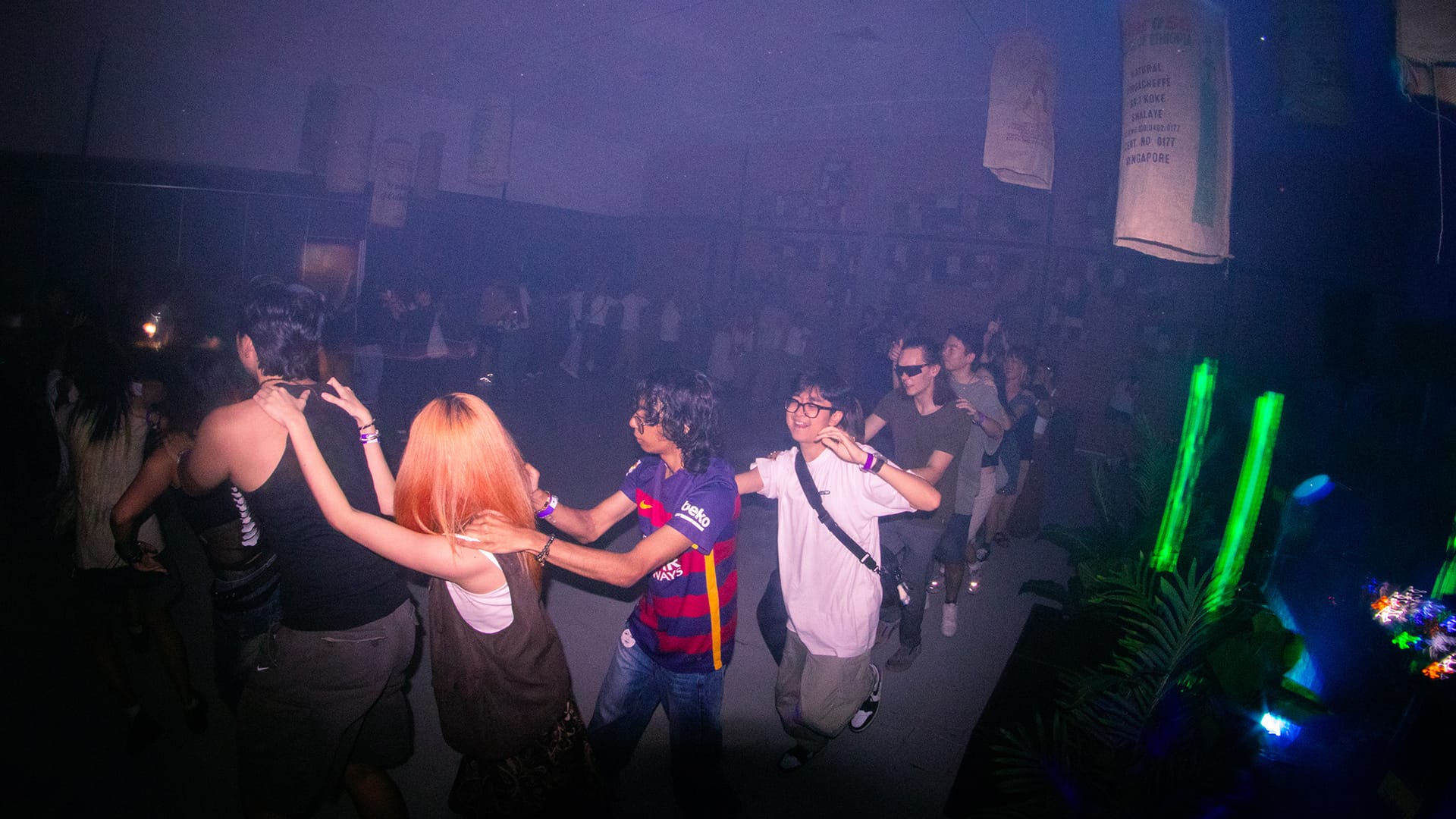
All of these memories have something in common: partygoers were actively making their own cool, not passively waiting for cool things to happen. In the hyperreal dimension of partying, everyone wants to be part of the soul train, but no one wants to be the first to board. We’re cultivating a new dancefloor culture, where partygoers and party organisers are co-producing a collective good time, and sharing in the rhythms of initiating and reciprocating—whether we’re behind the console, cheering from the sidelines, or dancing in the centre of the circle. Maybe it’s okay to have a funeral for the hyperreal party. We’re welcoming the dawn of a new kind of party, where we get to leave our watches and expectations at the door.
My favourite party memory so far has been, incidentally, my first Secret Pals encounter. I’d just caught a film at the indie cinema The Projector and bumped into three of my friends at the Intermission Bar. They were heading to the collective’s Sunday Tambay event in an adjacent theatre. We could hear the strains of an iconic budots song filtering through the walls: Emergency! Paging Dr. Beat! Emergency!
Inside, there were little dancing circles of different friend groups scattered across the room. I overheard a man complaining—“I’m so tired!”—while still working his hips to the music. The crowd burst into a raucous rendition of Mariah Carey’s “All I Want for Christmas is You”, not quite caring that it was early November. The DJ sampled “That’s Not My Name” by The Ting Tings, a song I hadn’t heard since primary school. I felt buoyed by a collective effervescence. The driving bassline vibrating through my body, the thump of my heart in my chest, the shuffle of my feet across the dancefloor.
It was 9.30pm on a Sunday night. Click, clack, clack, click, went the capitalist clock. But for the first time in a long while, I couldn’t hear it. Around me, my friends, their sunglasses on, were swaying their shoulders and pumping their fists up and down. We were finally setting the metronome, I realised, to a beat that’s ours.
Sakinah Safiee is Jom’s head of social media and research.
This piece was first published in Jom’s annual print magazine issue No. 3, released last year.
Letters in response to this piece can be sent to sudhir@jom.media. All will be considered for publication on our “Letters to the editor” page.