
“It was the last thing she was supposed to wear,” recalled Subash Kumar. He had just finished taking a shower when he spotted his grandmother’s batik sarong, along with her towel, hanging on the rack.
“I remember sobbing into it,” he told me.
Subash’s grandmother died in February this year, just a month and a half before we spoke. That sarong would have been the next thing his grandmother had worn—had she taken her next shower. Before she could, she was admitted to the hospital.
Death is fossilised in the sarong, in its folds and wrinkles. The tubular garment, designed to contain and wrap around a torso, will never be filled again by that very body, a cruel reminder of the permanent absence—“an utter impossibility of return”—of the person we love. The postcolonial feminist writer Chimamanda Ngozi Adichie articulates this pain in her memoir Notes on Grief, written after the unexpected death of her father.
But the sarong can nonetheless be a memorial for the body, where spirits and souls take residence. With his hands, Subash gestured to the sarong’s shape by making a circular motion away and then towards each other, then tried to reach for the right words: “You know, it sort of envelops something, which feels very, sort of, almost whole.” This (w)hole, which the baker-poet described as a “house [for] a person’s physical body”, was made complete by his determination to grieve his grandmother viscerally, haptically, to “hold onto a big part of [my grandmother]’s self”.
I refer to objects like these as grief-garments: made from cloth, with material dimensions that capture the immaterial forms of our loved ones’ lingering presences. I have adapted this definition from fashion researchers who have written about the chesty pains of grief, and how they are contained in and embodied by everyday garments.
One of these researchers is Isabel Mundigo-Moore, whose poignant essay, “Material Ambiguities of losing a parent: Time, clothing and grief during terminal illness”, investigates the “emotional possibilities” of anticipatory grief that these garments bring. Karena de Perthuis, another fashion scholar, refers to this sort of material potency as a “haunting” presence in her essay “Darning Mark’s Jumper”. She details her vivid dreams of her late partner Mark cradling her through the sleeves of his jumper, which she had started to wear after his death. Mark’s jumper becomes a portal for his ephemeral physicality, and it is De Perthuis’s grief that makes it a grief-garment. By constantly wearing his jumper, she keeps Mark’s memories and physical imprints close to her.
The jumper, a second skin, becomes evidence of the impossibility of return, but also a site that retains and holds the remnants of his scent and the shape of his arms.
Peter Stallybrass’s grief-garment is his best friend’s jacket. According to the literary theorist, cloth has a magical ability to carry the absent body because it receives. It receives us, our scents, our sweat and the contours of our bodies. “When a person is absent or dies, cloth can absorb their absent presence,” he writes about Allon’s jacket in “Worn Worlds: Clothes, Mourning, and the Life of the Things”.
Stallybrass recounts an experience where he felt inhabited by Allon’s presence after his death: “Anyway, this was the jacket I was wearing when I read my paper on the individual, a paper that was in many ways an attempt to invoke Allon. But at no time in the writing of it did I feel any answering response. Like the paper, Allon was dead. And then, as I began to read, I was inhabited by his presence, taken over. […] He was there in the wrinkles of the elbows, wrinkles that in the technical jargon of sewing are called ‘memory’; he was there in the stains at the very bottom of the jacket; he was there in the smell of the armpits. Above all he was there in the smell.”
Perhaps this makes Subash’s assertion that the batik sarong is his grandmother more plausible. Cloth’s material qualities, including its fibres and the almost invisible gaps between each strand, means that it affords a potent absorption of its wearer’s habits. This process of accumulation has allowed Subash to feel his grandmother’s presence in the garment, even now. The hyphen in grief-garments, to me, indicates reciprocity between the two concepts, attaching the immateriality of grief to the material of cloth.
My grandmother died in October 2023. While tidying up her wardrobe, I noticed a few strands of her grey hair deposited on a purple lambswool cardigan. These hairs, preserved by the cloth fibres, are the only remaining pieces I have of her. On a grey blazer, patches of yellow mould stained the lapels, sleeves, and pockets, showing me where my grandmother’s touch had lingered the longest. Out of curiosity, I sniffed the collar, but hesitated to make anything more of it. I was afraid of the potency of cloth, and grief—that they would bring my grandmother too close, too quickly, when I was not ready to receive her. Anxiously, I searched my memories for confirmation of her smell, and realised that I could no longer remember her scent.
I imagined my grandmother wearing this blazer under her lab coat in the research labs where she spent most of her time as a professor of respiratory infections. I relied on my imagination as a salve for my loss. My grandmother’s death was what convened my ongoing practice, this conjuring of garments as portals for grief.
Holistic deathcare worker Staci Bu Shea writes in Dying Livingly, her recent collection of essays, that to resist the numbness brought about by the alienation and isolation of grieving is to insist on giving grief a voice. To invoke this collective voice, I sought out others who, similarly, processed their grief of losing close kin with clothing. We were a grief circle, connected by the warp and weft of our grief-garments. Subash, already a dear friend, was one of those whose grief-garments I got to meet over Zoom. I was based in the Netherlands at the time, for a postgraduate degree, and he was back home in Singapore. Learning about his grandmother’s sarong allowed us to linger with each other a little longer.
I met other fellow grievers and their grief-garments through an open call on social media, including a white selendang that Cipta Afreen found in their grandmother’s wardrobe at their holiday home in Johor, and a pink tank top that belonged to Teck Lim’s late mother, also when he was packing up her wardrobe.
This white, sheer selendang, a shawl with floral embroidery trimmings, continues to expand the ways Afreen understands and expresses their grief. Rather than treating grief solely as a psychological or emotional state, Afreen wrestles with grief in a material and embodied way. As an artist-practitioner with a background in fashion, their relationship with their grief is rooted in physical objects, including their grandmother’s selendangs and baju kurungs. Afreen reveals that their grief is driven by “a yearning and longing” for something that they wish they had—“five more minutes” with their late grandmother, Mak Tok, who passed away when they were a toddler.
Moments such as this demonstrate what fashion researcher Rosie Findlay calls the power of imagination, which constructs a different reality for us to interact with these garments. In her essay, “Stuff as Dreams are Made On”, Findlay cites political scientist Iris Marion Young, who describes the “open-ended potential” of garments to evoke not just an imagined world, but entire repositories of personal history. The grief-garment becomes a magical portal that reunites us with whomever we wish were here.
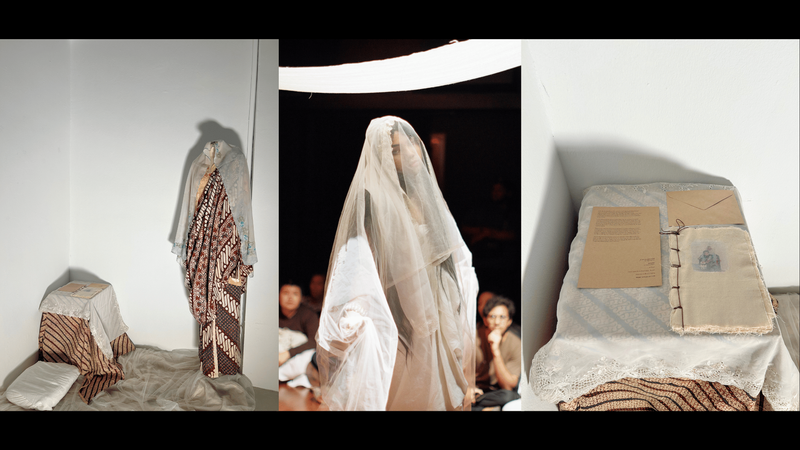
Afreen’s portal took the form of a textile installation, Jarak Antara Kita (Distance Between Us). They dedicated this to Mak Tok. Occupying a corner of the art club senisini’s show&tell exhibition was a mannequin draped in layers of Mak Tok’s kain batik that Afreen had collected over the years. Next to this statuesque figure was a hand-bound fabric zine housing old family photographs, which Afreen had image-transferred onto cotton canvas pages. That zine was nestled atop a small plinth covered in two pieces of fabric: a piece of batik and the diaphanous white selendang.
It was an inviting nook, and Afreen told me that each photograph was a “starter for conversations” they would have liked to have with Mak Tok. “Where did you get this kebaya from when you were holding me when I was still a baby? What are your memories of me?” they asked. They may never receive an answer, but they ask anyway. The point is to reckon with this impossibility, to generate what-ifs that create new memories and imaginations enlarged by existing ones.
The sheer selendang, cascading over their shoulders as they spoke, is not merely a symbol of what they have lost, but also what they have gained from their elders. Inheriting the selendang, and the way it clings to bodily contours with its particular weight and texture, has allowed Afreen, who is non-binary, to proudly embody the femininity that’s always lived in their body, but that may have previously been less visible or accepted by others. “This selendang is an ode to my feminine creative energy,” they said, “as well as my journey in self-reclamation on what it means to be Brown, feminine and queer.”
While grief may have stolen conversations from Afreen, the visual language of the selendang, imbued with the spirit of Mak Tok, supplements their journey of self-reckoning. “When I put on this selendang, I imagine the kind of woman she was. From what I heard, she was very traditional, soft-spoken, the lady of the house, and didn’t really go out. She was full of grace, very intelligent and full of honour. That’s who I imagine myself to be when I put on the selendang. And perhaps, remnants of that are also in me.”
With this in mind, I spoke with Teck, whose mother died earlier this year. He is a freelance photographer and artist who also works with grief in his practice. Before we met, we had already exchanged lengthy emails, which included photos of his mother’s clothing alongside his refreshingly candid reflections on sorting out her wardrobe—a task he’d taken upon himself as her caregiver and “the only freelancer” with some flexibility in the family.
Teck has an ongoing body of work on anticipatory grief, which he calls “funeral portraits”. “How do I photograph death?” he asked, rhetorically. These photographs, which subvert the stylised conventions of obituary and funereal portraiture, were influenced by his grief over various endings in his life. Teck oscillated between emotional registers when he spoke about his mother and the impact she’d had on his art, swinging from tenderness to resignation.
Teck spent the majority of his childhood with his mum. A work-from-home seamstress, she first set up her sewing studio in the living room of their Jurong West HDB flat when they moved in from their Woodlands kampung in 1984. Among her effects, he found many embroidery patterns, drafts, and sketches accumulated from decades of practice. Among these sketches were the patterns she’d used in large-scale sewing projects, such as baju kurungs for her neighbours’ Raya celebrations, or embroidered pillowcases and blankets for Chinese weddings. She also sewed for her family, making entire sets of new clothes for her parents and in-laws for the Lunar New Year. When she became a mother, and then a grandmother, she dressed her children and grandchildren in the clothes she’d made for them. Teck only noticed later that she rarely made clothes for herself.
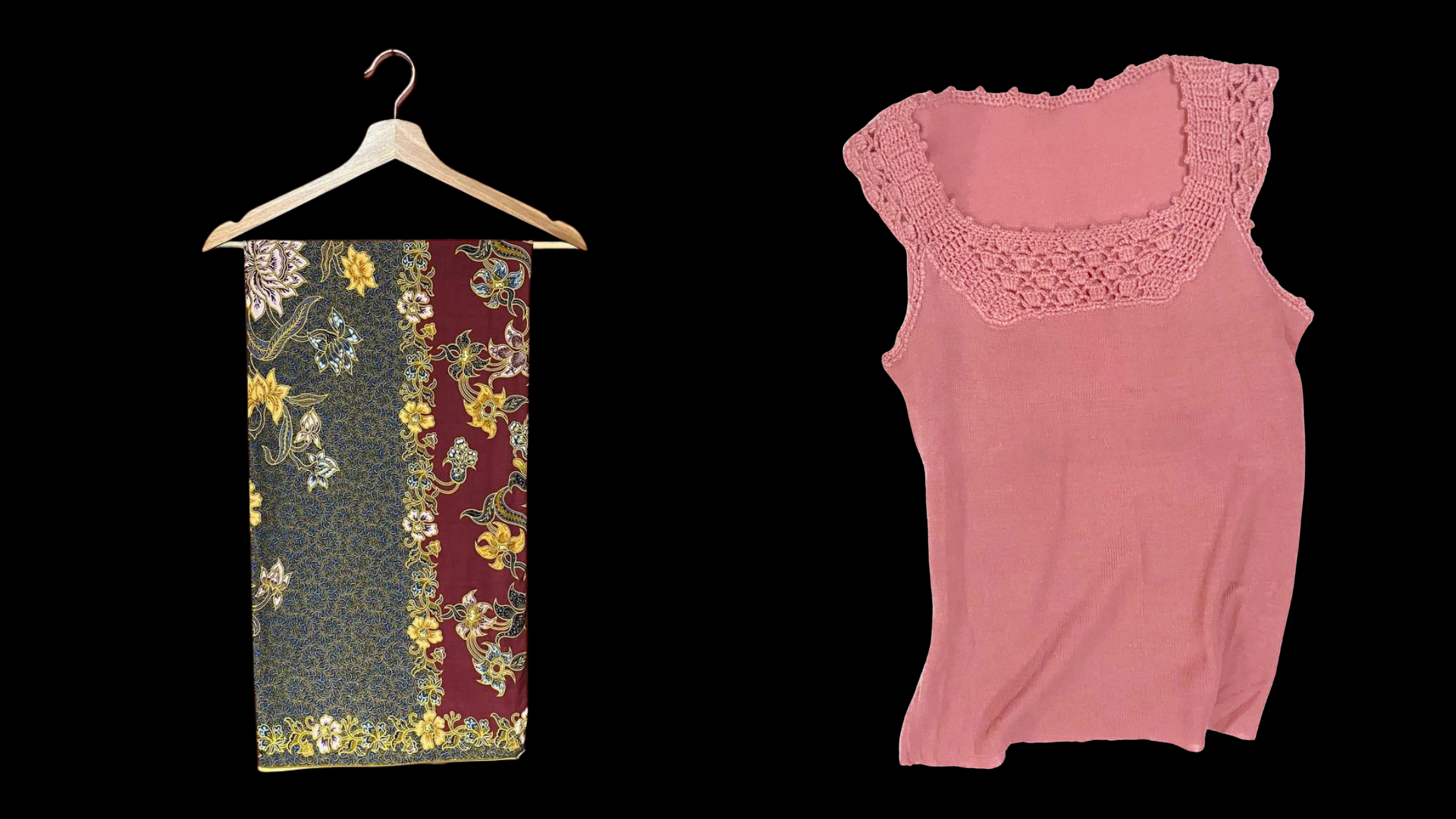
So when Teck began clearing out his mother’s wardrobe shortly after we first got in touch, he picked one garment that stood out: a pink, woven tank top with a crochet panel across the chest. Teck suspects that the chest detail was handmade and embellished by his mother, as she often added a bit of flair to the clothes she bought, personalising them to her taste.
This tank top reminds him of how she used to dress when he was a child, when he’d most craved physical closeness with her. “Too young to remember, yet old enough now to feel the weight of what I missed,” he texted me later on, describing why he was drawn to the tank top. It can be difficult to conceive of this “weight” in a logical sense. How can we materially understand, and decide, why a particular garment contains more energy of the deceased than the rest? Louise Crewe, professor of fashion geography, describes garments as “repositories of accumulated biographies” that capture these stories “between warp and weft, fused into the thread”.
The grief-garment becomes a container of memories for a loved one, allowing us to recall our embodied knowledge of them from the past while also imagining them in the present. The wardrobe becomes a space where multiple temporalities coexist.
Teck often shows his siblings and father any items of interest he’s found in the packing process. His father, who still lives in the house, tends to lament his late wife’s clothes, that she bought “so much” but never wore them. “Wah, so many clothes ah, tell her…” His father would make passing comments as Teck was packing. “And then he would stop there, because, yah…” Teck trailed off, also failing to complete what his father does not say. That she is no longer here.
Teck is still going through his mother’s wardrobe. “It’s going to take a while,” he sighed. Wearable objects can often evoke intense emotional upheaval, considering how closely they stick to our skin, “a border that feels”. Feminist scholar Sara Ahmed, who’s dramatically expanded our conceptual vocabularies in the field of affect and emotion, coined the term “sticky objects” to describe how emotions adhere to things.
Garments are sticky objects, accumulating, sustaining, and preserving fragments of the spirit of the person they once belonged to, the way peeling back a band-aid might lift scab, dust, or hair off our skin.
Inherent in our skin is its ability to restore its original shape after being deformed. Press a finger deep into your arm, and the indentation doesn’t last. This is called skin turgor. In the context of grief-garments and the grieving process, I think of this as object turgor. Subash calls this “the bounce-back”, something he sensed when he first touched his grandmother’s sarong.
During prayers on the 6th, 8th, and 30th day of the Hindu funeral processions for Subash’s grandmother, the funeral undertakers conducted a ritual that involved draping her sarongs on different items: a rock, fruits, vegetables, and grains. Family and friends worshipped this sculpture, now a spiritual representation of her. “I was extremely moved to see my grandmother’s clothes draped on different forms of nature,” Subash told me. “There [was] something very primal about it.”
Grief-garments cannot undo the physical pain brought about by illness; neither can they undo the unimaginable pain of losing a loved one. But the bounce-back proposes a different path. While the ‘living’ body is dead, the ‘dead’ inanimate garment is as alive as the lithe soul it used to contain. As we grieve and summon the spectres of loved ones past, the lines between dimensions are blurred, roles are reversed and, perhaps, theoretical definitions and boundaries might be redefined. When we think of grief-garments as objects with turgor, we gain the liberty to explore how other stimuli and perceptions—auditory, olfactory, somatosensory, even gustatory—can evoke memories and fantastical imaginations of our loved ones.
It took many years for Afreen’s inherited selendang to gain a second life outside the wardrobe. When it is donned and discussed, the grief-garment transforms from a domestic artefact, a private space for bereavement, to a public site that not only memorialises mourning, but displays its ancestral lineage. “Holding onto these garments means so much to me because they are exactly the garments that I once rejected,” Afreen explained. The selendang’s turgor stretches back to their pubescent years, a profound period when they were first reckoning with their gender identity. “I find new sides to the story of how I can possibly carry this grief forward with me,” they said. Perhaps the constant reinterpretation of grief ought to be a ritual in its own right. Intrinsic to fashion is its reinterpretation of the same garments on bodies that might shrink, grow, wrinkle, or deteriorate. Grieving with our loved ones’ garments is what we practice to live with an immense, shapeshifting loss.
Grief-garments accompany us. They are a physical reminder of what is lost, but also permeable sites where we might reconnect with the people we miss dearly. Through our imagination, we conjure immaterial souls malleable enough to slip into the seams of the garments they’ve left us. They stick to us, freighting our fabrics with the traces, scents and stains that tell of a life once lived. These grief-garments become our companions, tethering us back to ourselves after the unmooring of a permanent absence. Our hearts may never bounce back, but grieving with garments might return some of that turgor.
Since the time of writing, I have embarked on a grief ritual of my own. This ritual consists of an almost daily practice of stitching my grandmother’s loose grey hairs onto her purple cardigan. As I sit in silence with my grief-garment, I observe how the hairs bend freely and formlessly, creating a compelling tension between where they want to go and where my stitches land. These stitches will not hold the hairs in place forever; they can’t. Hairs are stubborn and they will move as they wish, wiggling out of their position because—friction. I am okay with this. I want to be haunted by her presence, but not beyond controlling how memories land. My stitches will remain, a reminder that grief never veers too far away from a deep longing for connection, thanks to my companion.
Xingyun Shen is an independent fashion writer and researcher based in Singapore. Her research focuses on the affective dimensions of dress, particularly garments associated with grief, mourning, and memory. She is the co-founder of clothes press, an initiative committed to publishing and circulating observations of everyday wear practices.
Letters in response to this piece can be sent to sudhir@jom.media. All will be considered for publication on our “Letters to the editor” page.