
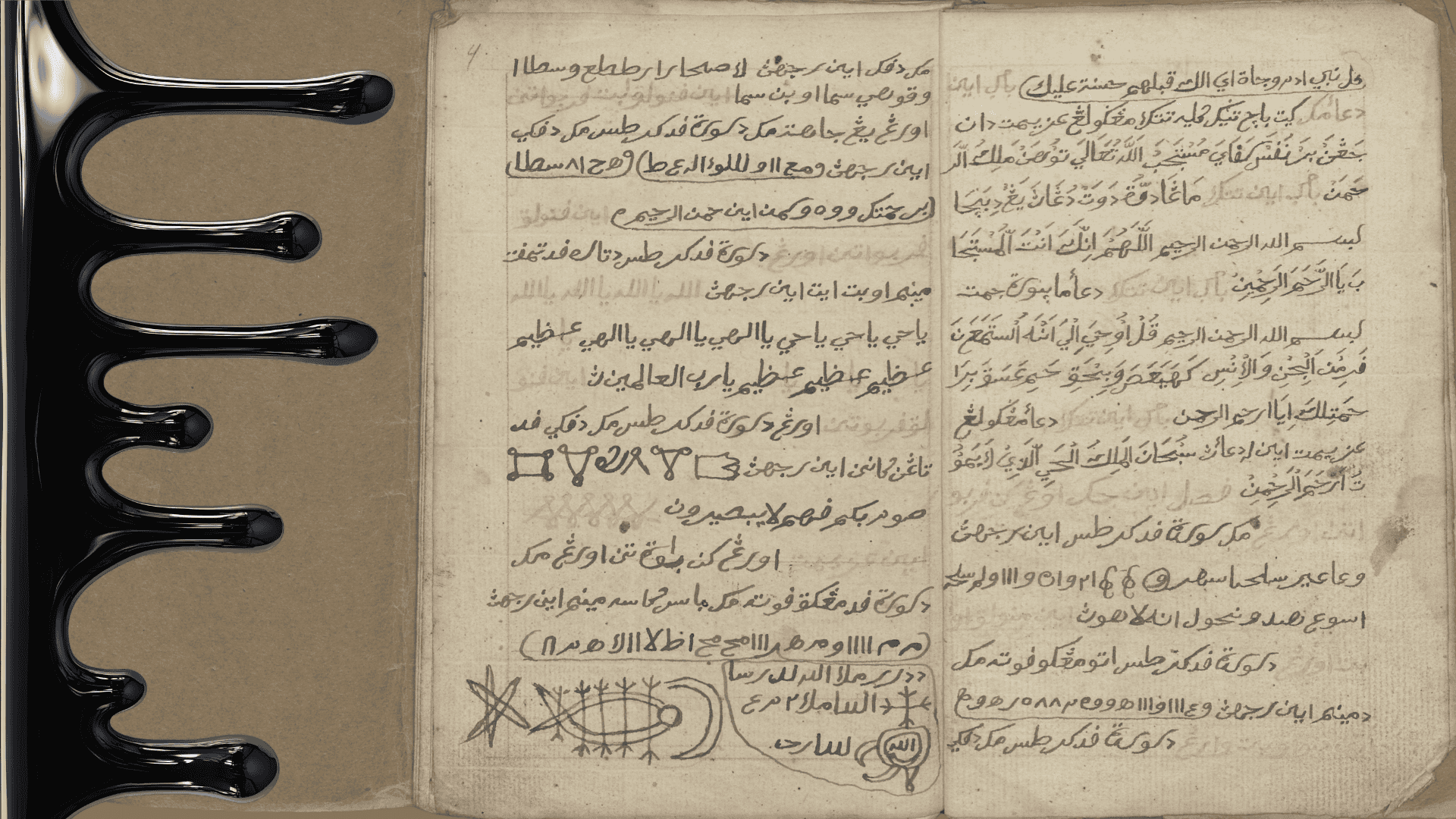
“This is the charm for awakening the desire of a woman. Take a strip of cloth from her skirt, [write the charm], make it into the wick of a lamp and set it alight.”
Excerpt from manuscript Or. 5650 fol. 14v, Leiden University Library
Inserted almost casually between remedies for headaches and treatments for skin diseases, I was struck by how frequently love charms appeared in 18th- and 19th-century Malay medical manuscripts. These were largely focused on changing the behaviour of women for the benefit of the reader, presumably a straight male: how to make a woman obsessed with you, how not to lose an argument to your wife, how to perform better in bed, how to raze the marriage of a rival.
As a woman, my feelings fluctuated between amusement and indignation. I often felt like shouting relationship advice across time to the sad, insecure person who may have tried all these things—and more. “Just talk to her, dude,” I implored. “Find out what she likes or does not like, be caring and nice, listen to what her hopes, dreams, and aspirations are.” Yet, I also see in this imagined male reader of the past a vulnerability I recognise in my female self of the present: the inability to communicate one’s feelings, and the desperate hope for a miracle. For who among us does not wish to be loved?
A charm, known in the Malay-Jawi vernacular as azimat or jimat, can be defined as powerful words, letters, or figures that can effect a desired change by being read, ingested, buried, or worn in specific ways. Charms have always been ubiquitous, known worldwide by different names and associated with diverse religious traditions: biblical verses written on bread in medieval England, and consumed as medicine; an Arabic supplication from 17th-century South Africa for swift memorisation of the Quran traced onto a white bowl, filled with water, then drank from; magical letters to aid fertility in Ottoman Palestine, written on paper and tied around a sacred rock. The categories we now separate as “magic” and “religion” were once inextricable in common heterodoxy in the quest for desired events that transcended ordinary cause and effect.
Magic is the term retroactively applied to such practices. What we now perceive as magic was, in the past, once experienced as simple faith in the possibility of the wondrous, be they people or objects.
Saints and charms were largely interconnected: saints were believed to have the power to mediate between humans and the unseen divine; their relics could confer potency to charms. That faith was also fragile. Belief in transcendent divinity was once espoused by itinerant Sufi Muslim sects who, for centuries, had a global reach. But the 18th century was what religious scholar James Grehan called the “twilight of the saints”, a reference to the waning of such beliefs.
It is in this saintly twilight that a Kitab Tibb, most commonly translated as a book of medicine, was written. The word tibb is derived from the Arabic tabib, meaning doctor. I found it—labelled Malay Manuscript Or. 5650—in the Special Collections of the Leiden University Library. This manuscript is part of a larger corpus of similarly titled documents found across the Malay Archipelago that embrace a much broader view of medicine and doctoring than the mainstream view today. Syaikh Ahmad Al-Fatani, a 19th-century Patani healer, emphasised not just physical wellbeing, but spiritual succour: “Tibb is the knowledge of preserving existing health and returning lost health. It is divided into two parts, the first, beneficial knowledge like akhlaq (good character) and all related to it. The second is all matters related to healing.” Philologist Farouk Yahya, in his analysis of these manuscripts, estimates that only about a third of the Kitab Tibb addresses physical illness, while the rest tackles ways to protect the reader from environmental or interpersonal harm—including love charms.
Or. 5650 was compiled in Banten, West Java by an anonymous scribe, likely at the behest of an unknown Dutch collector. It eventually found its way into the papers of Orientalist scholar Christiaan Snouck Hurgronje, a Dutch anthropologist most well-known for his work advising the Dutch government during the Aceh War, and for being the first non-Muslim European to complete a pilgrimage to Mecca (albeit under the pretence of conversion). Hurgronje was not the only scholar interested in indigenous Malay World ideas of healing; many Kitab Tibb are currently reposited in European libraries. They depict a mode of healing that was both globally networked and deeply localised. Healers learnt from multiple traditions they encountered through trade, while also incorporating local knowledge of plant lore, religion, and kinship.
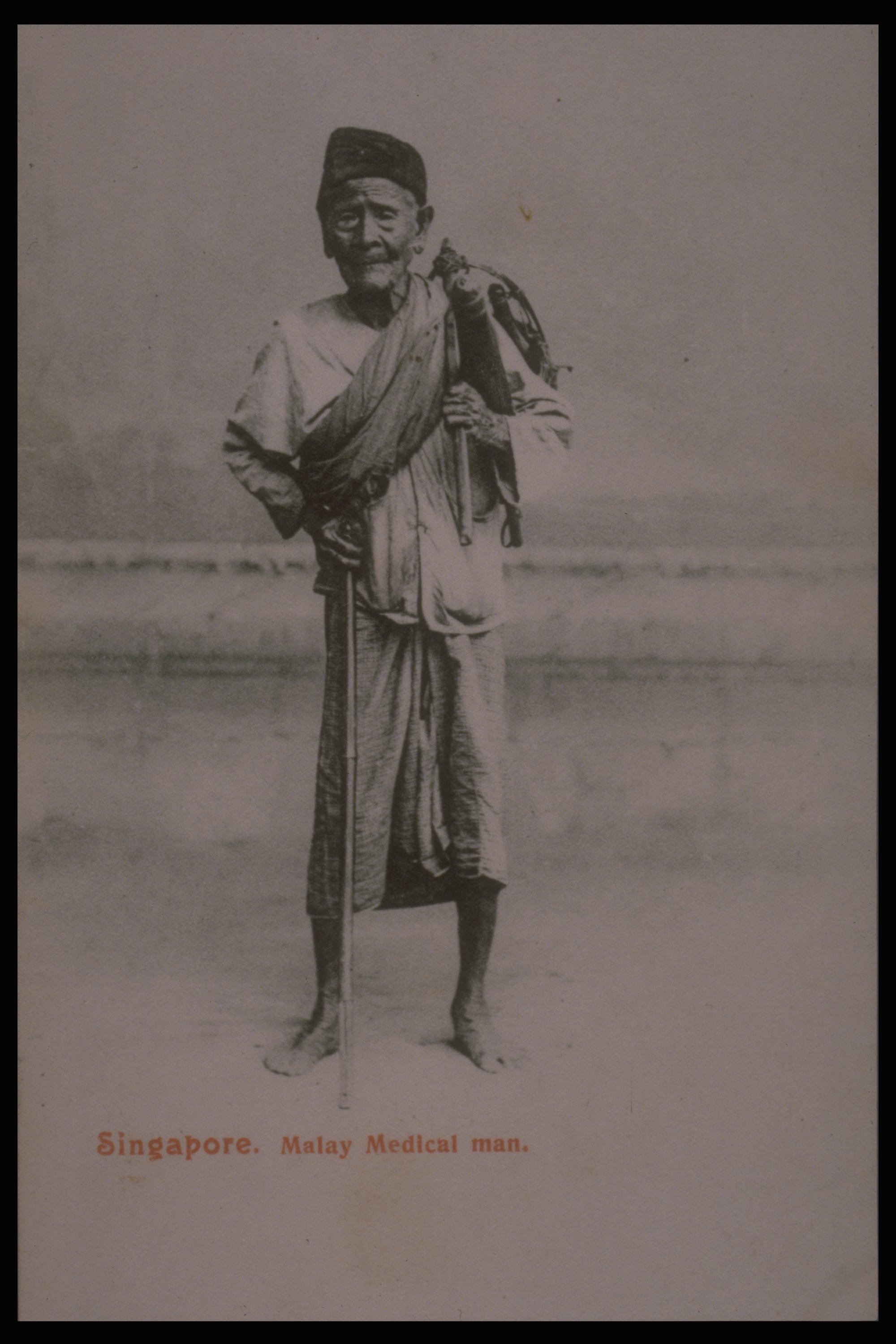
A Straits Settlements postcard captioned “Singapore, Malay Medical Man” reflects the island’s connectedness to this healing network. Here, a barefoot elderly man is carrying what looks like bottles of herbal decoctions in a sarong slung across his shoulder. The postcard provides a rare glimpse into a 19th-century parallel system of Malay heritage healing. This was a system that British colonial officials often dismissed as superstition, even though the popular dependence on such practices allowed them to limit public health spending in the colony.
Contemporaneously, however, physicians and botanists were documenting these practices as a way of understanding local community and ecology. More than a century earlier, at the time of Or. 5650’s creation, residents of Singapore had relied on such knowledge, just as many in Banten did. What little we have studied of 18th-century Singapore indicates that it was inhabited and an active part of an increasingly fractious Johor-Riau Sultanate, with Orang Laut communities plying its waterways and pledging a loose allegiance to the Sultan and his representatives. Both Banten and Johor-Riau were slowly buckling under Dutch imperialist ambitions, culminating in the dissolution of the former in 1803 and the division of the latter in 1824.
We see none of this geopolitical drama in the intimate pages of Or. 5650, where anxieties are much more personal. You’ll find a paragraph about calming an angry wife by writing magic words on a piece of paper and tying it around your waist. Turn a couple of pages, and you’ll find a recipe to make a woman obsessed with you: first, burn a piece of paper with the magic words, then rub the ashes on the kain (skirt) of the object of your desire. Yet another spell can cleave the marriage of a coveted woman. Simply scrawl the requisite words on a shard of pottery and bury it under the steps of the marital home. These charms smoulder with malevolence because they extinguish love in the ardent quest to seize it.
As an ideal, love is a noun when it comes to care beyond the self—and a verb when it comes to actions that decentre the self for the sake of the loved other. By contrast, these charms often frame love within the narrow confines of acquisitive interest and bending a woman to a man’s will.
Here is the very antithesis of love: it is all about the self. This particularly selfish self would, moreover, rejoice if the life of his beloved fell apart—so he could pick up the pieces. Philosopher Lauren Berlant argues against a simplistic view of love as a panacea for all kinds of social frictions and divisions, predicting that we would find it difficult to distinguish between a destructive, narcissistic love that seeks to dominate, and a constructive, self-reflexive love that opens us up to positive transformation. Or. 5650 runs into this exact problem. The text nudges its users towards the “bad” love of narcissism, even though Tibb as a system for healing aspires towards the “good” love of character transformation.
It is tempting, therefore, to disregard these parts of the Kitab Tibb corpus and treat it as amusing ephemera to the “real” content. To many scholars interested in the Kitab Tibb as a medical text today, these are the parts that contain prescriptions for physical illness. However, the manuscript is not just situated in a socio-medical context, but an ecological one. The logics that guide the selection of plants for the healing of our bodies are intrinsically connected to the ecologies we are embedded within.
These logics are part of the “sovereign vernacular” conceptualised by environmental historian Kathleen Gutierrez. She traces how these autonomous, localised insights have found their way into a scientific corpus through the multi-faceted interaction of indigenous healers and natural scientists in the Philippines. These science-tradition interactions were repeated across South-east Asia in studies of “village medicine” and “traditional healing”, ascribing importance only to prescriptions that could be investigated and translated into a linear cause-effect sequence for universalised use. This approach relegates more than 30 percent of these medical manuscripts to charming superstition (pun intended).
Despite my instinctive and modern distaste for some of their content, I have come to wonder—how might we take these charms seriously? And what might they reveal about vernacular understandings of our interconnected, vulnerable, more-than-human bodies? Were their ingredients and methods arbitrary, tossed together in the hopes of some mysterious alchemy of romance and revenge? Or might there be a pattern of preferential use that we can discern from the ways they address these relationship dysfunctions?
“This is a love charm for women. On a piece of white cloth, write her name and that of her mother. Hang the charm on a tall tree with multi-coloured thread.”
Excerpt from manuscript Or. 5650 fol. 7r, Leiden University Library
Vernacular magic is rooted in its local environment. Coloured agate (batu akik pancawarna), with its silicate bands gleaming crimson, turquoise, and indigo, is said to have magical properties that can dispel evil energy. It is a stone local to Banten, found in large quantities close to the historical city in Garut, West Java. Its magical, man-made counterpart, said to increase the potency of the user’s charms, is multi-coloured thread (benang pancawarna). Made by twisting together threads of five colours—red, white, green, yellow and blue—it is a symbolic representation of the stone that mirrors its power in both the natural and cultural worlds.
Likewise, many love charms utilise common local plants whose healing properties are widely known, not just in the Malay tradition, but also in Ayurvedic and Islamic medicine. Camphor (kapur), betel leaves (sireh), yam leaves (daun keladi), Indian taro (birah), and willow-leaf justicia (gandarussa) were all part of the Malay heritage pharmacopoeia, valued for what we now recognise as antioxidant, antiseptic, and anti-inflammatory properties, effective in the poultices for wounds, the treatment of fevers, and in improving the circulation of blood.
But these same plants were rarely ingested in love charms. Instead, they were often inscribed with magical symbols or words and buried, or chewed and spat out. The choice of plant seemed contingent on their natural characteristics. If you wanted a hate charm (azimat pembenci) to repel or ruin your romantic rivals, for example, you might opt for the yam or Indian taro, whose waxy leaves repel water.
For love charms, one might chew a specific variety of betel leaves (sireh bertemu urat) inscribed with a magic formula. The veins of these leaves curve to touch the midrib, creating a delicate oval that resembles a vulva. Nature seemed to signal such use of the leaf through its analogous anatomy, and it is commonly consumed in heritage medicine to treat women’s gynaecological disorders. In a similar vein, men who sought to become more attractive to women were advised to write magic letters on the shell of an egg laid by a black chicken (telur ayam hitam) and bury it near their kitchen. Black cocks were a popular choice for cockfighting as they were believed to be more aggressive, and thus symbolic of masculine prowess. For penis enlargement, consuming red sugarcane at specific times of the day was encouraged. Contemporary scientific studies of the plant indicate that sugarcane can improve blood pressure and encourage its flow, which could very well have a salubrious effect on maintaining an erection. The choice of a red variety, in particular, suggests that a plant’s appearance matters as much as its internal properties.
Charms were, therefore, augmented by the plants and animals that could mimic what the spell-caster craved. Through them, we see a past perspective of how our bodies were mapped in nature, offering signs for what could be used for human socio-sexual welfare.
While nature offers clear visual cues on what plants to use, the human text used in these charms was deliberately opaque. These mostly comprised combinations of Jawi-script letters that make little sense in either Malay or Arabic. A charm’s potency is also its unknowability. It is this incomprehensibility that is often taken as irrationality, interpreted as a blind adherence to ritual practice that carries little meaning. Yet, as linguistic anthropologist Kristina Wirtz reminds us, unintelligible words were not necessarily incomprehensible to those who used them. Rather, they may convey an understanding beyond the lexical, focussing attention on “the phatic functions of rituals”. Here, the phatic refers to a social function of speech that lies beyond the imparting of information. In a paper on ritual in Santeria, a syncretic Afro-Caribbean religion, Wirtz suggests that cryptic text “iconizes the difficulties of communicating with the divine, displays secret or occult knowledge that could not be made transparent,” and marks a process as sacral and potent.
The lexical opacity of love charms attests to how the knotty matters of the heart—a tangle of selfless caring, self-centered acquisitiveness, and selfish desires—are often impossible to articulate.
So, too, are the scattering of symbols in these charms, mysteriously modified from their customary meanings. We find, for instance, altered versions of the magic square, derived from Arabic numerology. This three-by-three arrangement of the numbers one through nine has five in the middle and adds up to 15 in all directions. It represents God at the centre of his creation. Yet, in Or. 5650, we see the magic square invoked for a penis enlargement charm. This seems to border on the profane, more so when we see a flipped “ß”—an incomprehensible symbol—replacing the usual “5” in the centre of magic squares that I have seen in other manuscripts (see extract above).
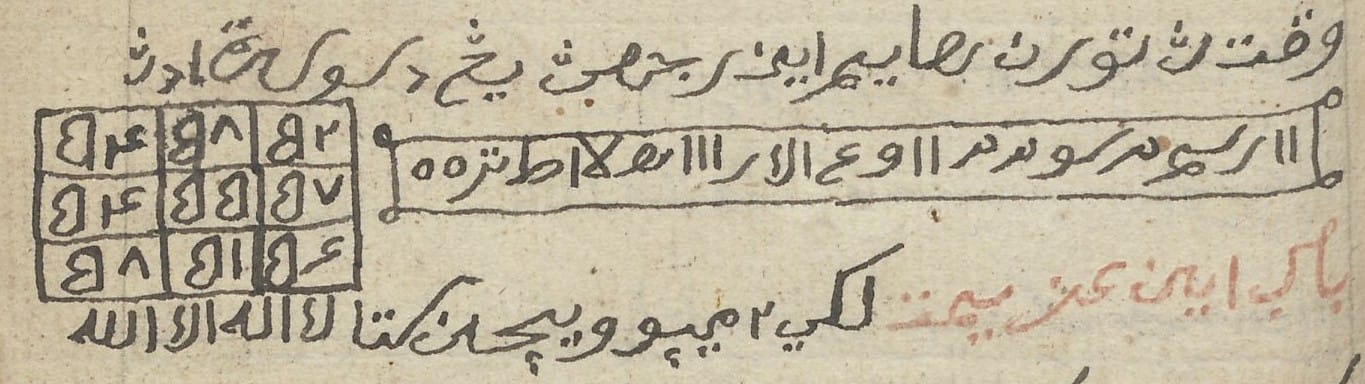
Does this subversion of the magic square indicate that love charms deliberately distort divine will, or perhaps even acknowledge that such practices flirt with the occult? Or could this be interpreted as an attempt to redefine divine authority, a minor assertion of mortal power without claims to immortal infinitude? Either way, both the opacity of the letters and symbols and the ambiguity of the charm-caster’s intentions are a large part of what confers the charms their magic. I wish this person would love me. It’s the thing we know the most about, while also knowing nothing at all.
Most of us would laugh at love charms today; we find amusement in the superstitious foreign country that is our past. We no longer conflate emotional frustration with physical dysfunction. But even in hyper-rational, hyper-pragmatic Singapore, the present, too, glimmers with the longing for miraculous outcomes to secret desires. We seek signs from the natural world—chanting “he loves me, he loves me not” as we pluck the petals of a flower—even though we no longer associate the anatomy of our bodies with the anatomy of plants. We scour the internet for online deals and find on Carousell a love charm that, for S$50, promises to confer on the wearer the beauty of the Prophet Joseph (azimat pengasih Nabi Yusuf). Their ingredients might be of indeterminate origin, but online vendors on Lazada and Shopee promise doorstep delivery for various love charms (pengasih) for anything between 35-188 Malaysian ringgit (S$10.56-56.70). And if that isn’t enough, you could sift through Fiverr for freelancers operating as modern-day magicians, offering a whole range of spell-casting gigs.
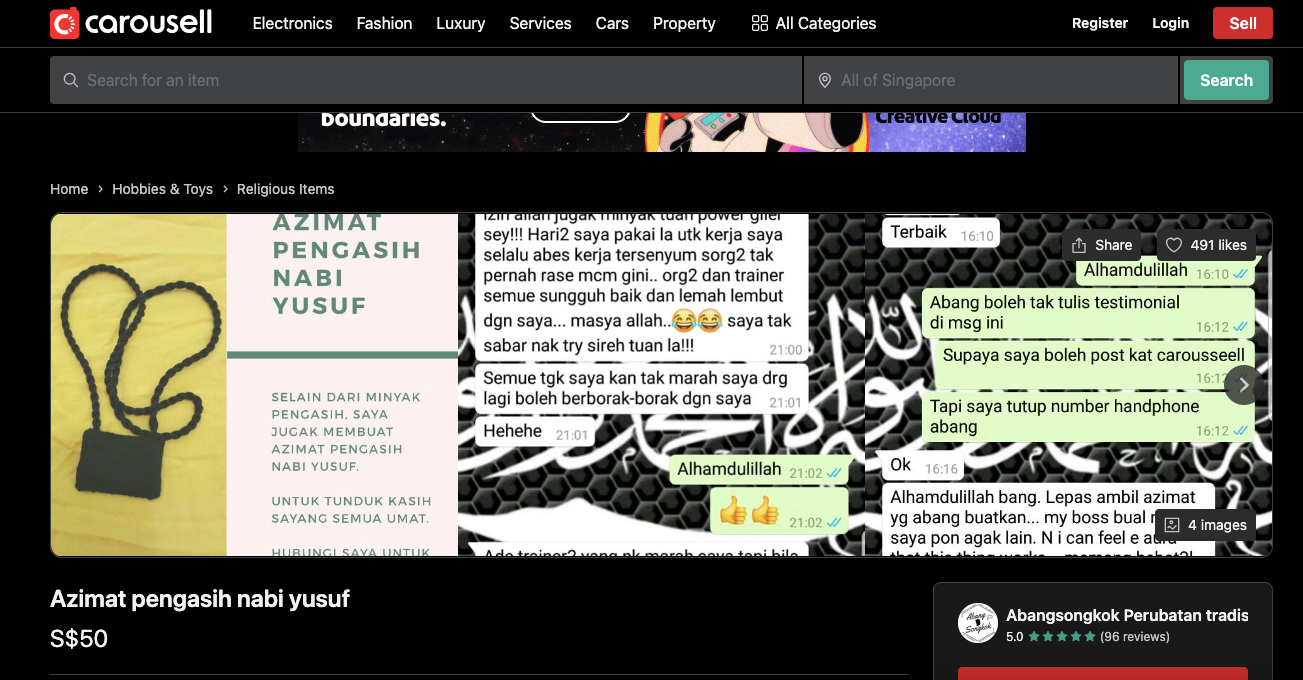
I paid five dollars for a spell once. It promised to fix broken love within a week. It was an experiment, I told myself, when nothing happened. No former flames with second thoughts rang me up. The deal was anonymous; I had no healer to hold accountable, no deity to blame. Perhaps friends would tell me the same thing I had mentally conveyed to the frustrated love seekers of the past: just pick up the phone, and talk to them.
I have come to realise that we seek magic not necessarily to avoid the concrete work of building a relationship, but to take it in a direction we might not yet know how to articulate. The allure of the unknowable persists. You set an incomprehensible act in motion—between cause and effect, between the world you live in and the world you long for—looking for infinity in-between.
Faizah is an assistant professor in the Departments of South-east Asian Studies and Malay Studies at the National University of Singapore. Her research focuses on religion and ecology, environmental justice and indigenous movements in island South-east Asia. Her first monograph, The Camphor Tree and the Elephant: Religion and Ecological Change in Maritime Southeast Asia, was published by University of Washington Press in 2023.
This piece was first published in Jom’s annual print magazine issue No. 3, released last year.
Letters in response to this piece can be sent to sudhir@jom.media. All will be considered for publication.