
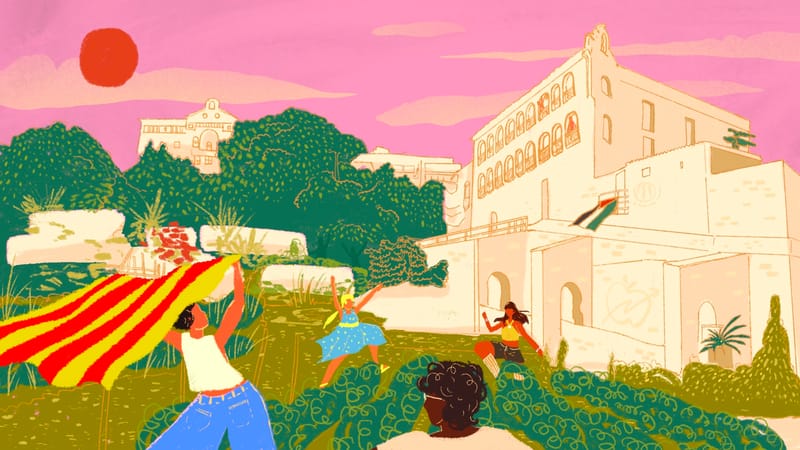
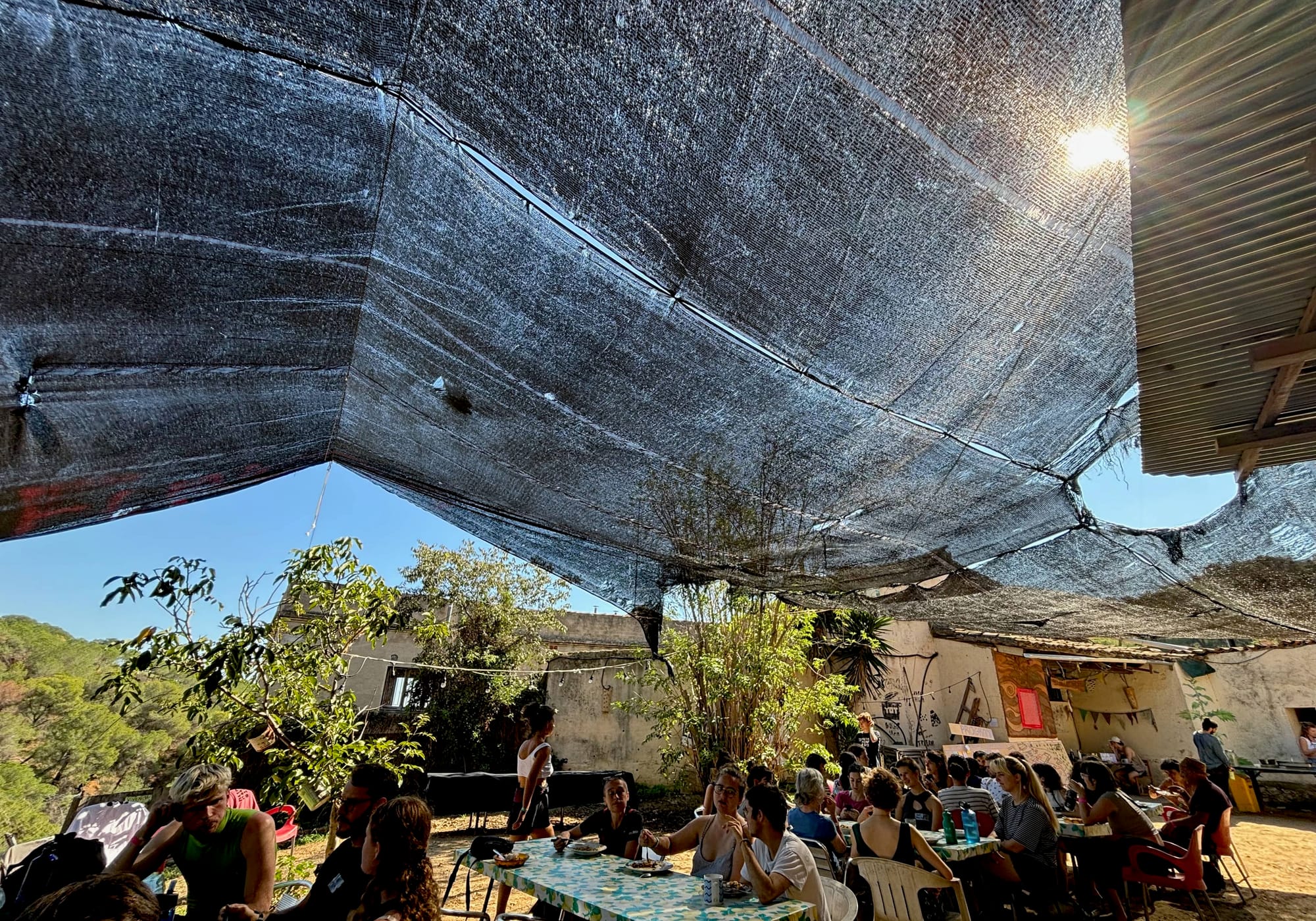
I slowly make my way up the dirt slope at the entrance of Collserola Park. It’s just a short hike from the metro exit, but I can already feel sweat forming on my back. Late September in Barcelona still feels like summer in a year of record high temperatures. Soon, I see my destination: a former masia (Catalan for country house) majestically standing above layers of walls and gardens. This is Can Masdeu, an occupied “social centre” perched on the hills just outside the city. A building has stood here since Roman times, but its current form is the result of 19th-century renovations, when it was likely still the home of the Masdeu family. I arrived a few days ago to start a master’s programme in Political Ecology, Environmental Justice and Degrowth at the Autonomous University of Barcelona, and am here at Can Masdeu to attend a queer ecology and degrowth festival organised by some former students.
As a school of thought, degrowth argues that the multiple social and environmental crises we see today are, at their root, a result of the endless chase for economic growth. Building solar power plants and electric cars won’t reduce greenhouse gas emissions if cryptocurrencies and AI chatbots keep increasing energy use, not to mention the still substantial material footprint of most “green” infrastructure. We need to transition to a post-growth world, where global consumption of materials and energy is capped within ecological limits and equitably distributed, so everyone has access to a decent standard of living. This is feasible with current technology, and will not force a regression to cave-like conditions as critics like to claim. Degrowth calls for a radical abundance of shared commons and public goods, as opposed to the artificial scarcity created and enforced by capitalism. I did wonder though: how can this transition be achieved politically, when rich countries have already gotten used to excessive consumption?
These thoughts entwine with others that emerge after a day of workshops and discussions over a homely vegan lunch. Later, a resident takes us on a tour of the grounds: the sprawling gardens laden with chard, cauliflower, tomatoes and other vegetables peeking from the soil; a stone-and-earth ramp newly built for accessibility; compost toilets that smell better than I expect; an outdoor stage and dining area with amazing views of the surrounding hills. If you wanted to convince someone that using less energy and materials could be a more fulfilling and even attractive way to live, this wouldn’t be a bad place to begin.
The building had been abandoned for more than 50 years when a group of environmental activists occupied it in 2001 to use it for a climate change conference. When the police tried to evict them, they resisted for three days until a judge ruled that “the right to life is above the right to property”. Since then, in addition to being home to a small group of residents, it has hosted events for social and environmental causes, community gardens for residents of the nearby working-class neighbourhood, as well as weekly jornadas d’horts (garden workdays) when anyone can join to volunteer and partake in a communal meal.
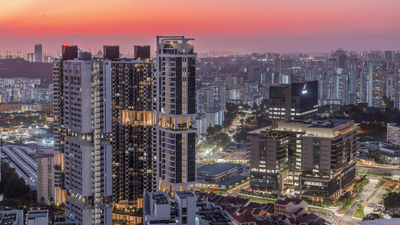
As we are led through the woods to what appears to be the remains of some other long-gone building for the festival’s opening ceremony, I think about the Ground-Up Initiative (GUI) back home. GUI is similar in how its volunteer-run organic farm provides a connection to nature that is impossible for the majority of Singaporeans who live in high-rises. However, its current campaign to raise S$4.5 million for a new home after being evicted from its former Lorong Chencharu site reflects how it is stuck in a larger system that values different things.
It is difficult to imagine something akin to Can Masdeu in Singapore: a space where people make their own decisions, have the freedom to critique both local and global systemic injustices, and can be intimately connected to the land without abusing it or wanting to extract the highest possible monetary value from it. In the months to come, I would return to Can Masdeu again and again, but also discover how these beliefs were not unique to it. In this global city better known for its architecture, beaches, and football club, it is remarkable that they persist against the rising tides of commodification, gentrification and neoliberalisation.
Barcelona may also bring to mind the Catalan independence movement or the Spanish Civil War, made famous by George Orwell’s memoir Homage to Catalonia. Between 1936 and 1937, anarcho-syndicalist trade unions, led by the CNT (Confederació Nacional del Treball), were the most powerful force in the city. Unlike typical unions that mostly concern themselves with improving wages and working conditions, the CNT was also guided by anarchism, a philosophy that people can organise a better society without the tyranny of the state.
It saw the unions as a form of prefiguration: a way to align means and ends by embodying the future they wanted to see in their current practices. Instead of electing representatives to a central committee, union decisions were made with the consensus of all workers at union assemblies. And in between mobilising the masses to strike for better pay, the CNT also organised local mutual aid networks and guided new migrants to find employment and housing. It ran cooperatives that sold groceries at affordable prices while also providing libraries, bars, cafes, and a whole host of cultural activities. All this granted it strong support among the working classes, fed up with the monarchy and the corrupt politicians and oligarchs who controlled the country.
On July 19th 1936, the military of Francisco Franco, the dictator who ruled Spain from 1939 to 1975, staged a right-wing coup in other parts of the country. In Catalunya, the CNT’s armed workers successfully thwarted it. The unions took over, collectivised, and managed hundreds of businesses and utilities. One example was the city’s sole water utility: in the three years that the workers ran it, access to water was expanded and improved based on the principle of prioritising public health. Orwell was impressed by what he saw: “Above all, there was a belief in the revolution and the future, a feeling of having suddenly emerged into an era of equality and freedom. Human beings were trying to behave as human beings and not as cogs in the capitalist machine.”
This period of anarchist self-rule, short-lived as it was, has not been repeated anywhere else in the world. It still inspires anarchists today, who continue their struggle at Can Masdeu and many other squatted social centres in the region.
Franco unleashed horrific repression after winning the war. In what was later called the White Terror, anyone suspected of disloyalty to the state was murdered and buried in mass graves. Political parties, leftist organisations, the free press, and anything to do with the Catalan language and culture were all banned. The total death toll under the Francoist regime is not known due to its destruction of records, but is estimated to range from 60,000 to 400,000. Meanwhile, guerrillas known as the maquis continued to organise against the dictatorship, carrying out sabotage and attacks while taking refuge in forests and mountains.
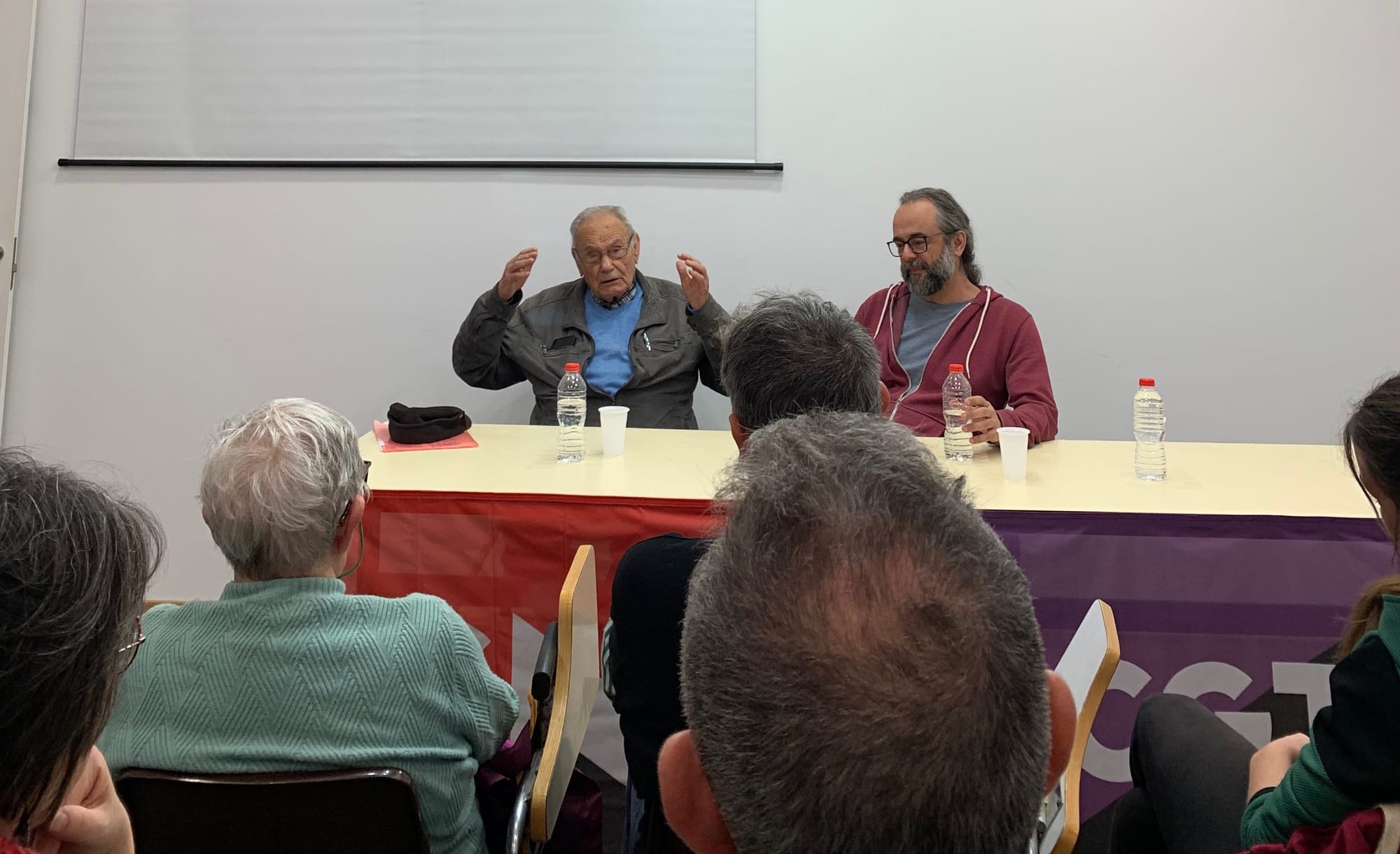
I met one of the last surviving maquis, Joan Busquets, one evening in the historic city of Terrassa. He was giving a talk at the local office of the CGT (Confederació General del Treball), a descendant of the CNT and now one of the largest unions in Spain. Despite his 96 years, Busquets spoke with vigour, occasionally raising both hands for emphasis and keeping the mostly middle-aged audience rapt for more than two hours. I tried to keep up with my rudimentary Catalan. He described smuggling heavy loads of weapons across the mountains, the torture he faced after being arrested, the agony of a broken leg sustained during an escape attempt, his luck at not having been murdered like many of his comrades, and how he still does not consider Spain a legitimate democracy because it has not truly confronted its own dark past.
I thought of Singapore’s former political detainees like Dr Poh Soo Kai, a mere two years younger than Busquets, who was among the 112 trade unionists and Barisan Socialis members arrested under Operation Coldstore, leaving a gaping hole in local leftist politics that remains unfilled. Poh was kept behind bars for 17 years for supposedly being part of a Communist plot to overthrow the government. Filmmaker Tan Pin Pin interviewed Poh and others about their struggles for a more just society in her film To Singapore, With Love, banned from screening in Singapore because it “undermined national security”. Even though there was no military dictatorship or national “pact of forgetting” in Singapore, some narratives are still deliberately silenced and made unknown.
In 1975, after the dictatorship ended following Franco’s death, people could finally speak Catalan and publicly celebrate their long-suppressed culture. Today, all students learn Catalan as the primary language in schools, and a whole host of organisations keep traditions and festivals vibrantly alive. It seems like not a week goes by without some celebration, whether it is the annual festa major of a particular neighbourhood to celebrate specific patron saints, or even specific vegetables such as the calçot, a long onion that is grilled and eaten with a special sauce.
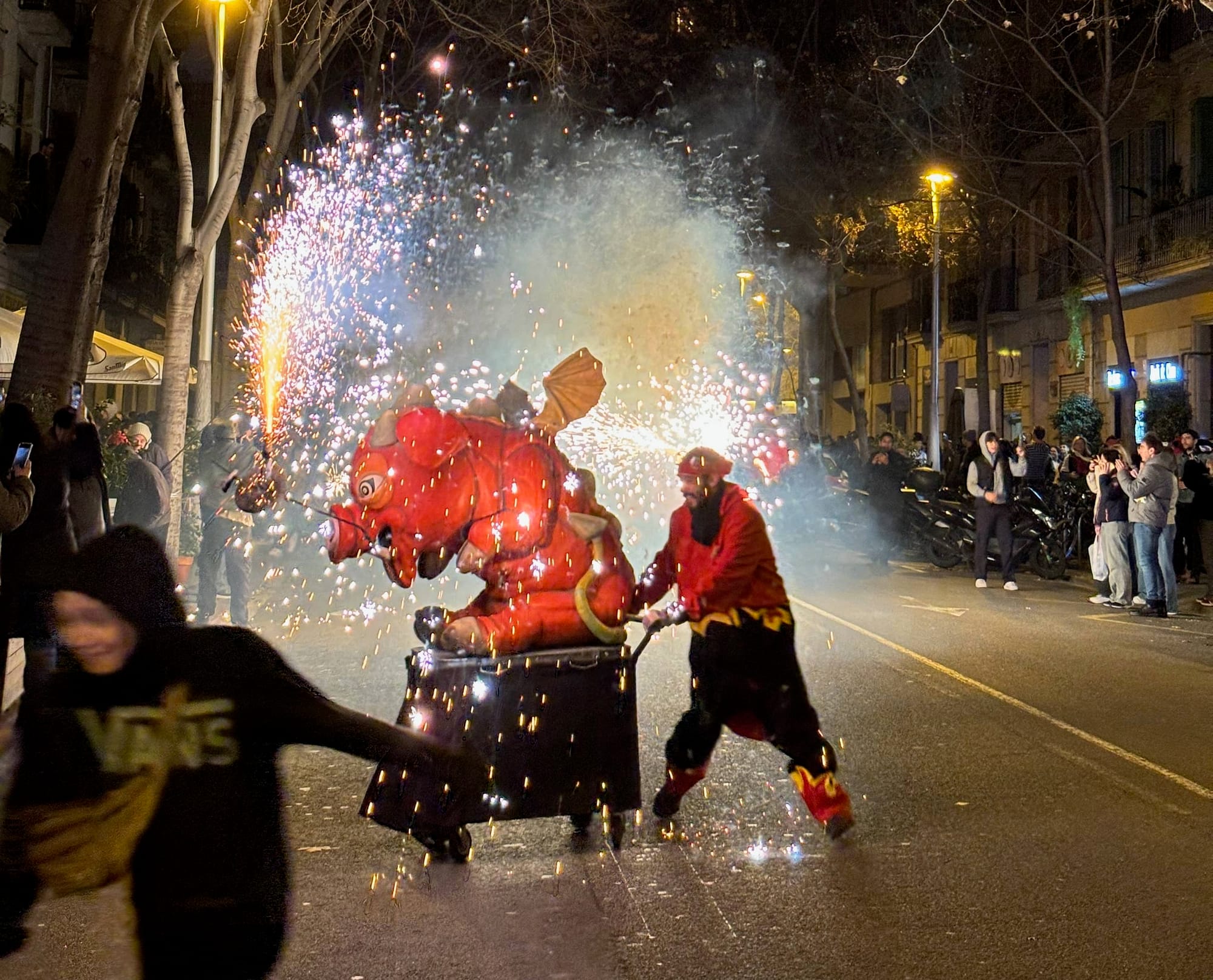
These festivals are often accompanied by the gegants, large costumed figures that are paraded in the streets; the castells, human towers that arrest the gaze; the correfoc, a dangerous night procession of “devils” who set off fireworks and other pyrotechnics that people try to run close to without getting hurt; and the sardana, a circle dance accompanied by an ensemble that features uniquely Catalan instruments. Somehow, the Catalans have revived all these practices and prevented them from being commodified into tourist attractions emptied of meaning. Perhaps being aware of what it was like to lose all this strengthens the desire to value and protect it even more.
But what is most striking about living here is the spirit of activism and community organising that permeates every neighbourhood. There are hundreds of groups that advocate for a wide range of issues from local to global, and many hold regular open assemblies where anyone is welcome to participate. Though it is today a mere shadow of its past glory, the CNT’s anarchist principles are still very much alive, even if these groups may not explicitly call for revolution. Through her own participation with the Castellers de Barcelona human tower team, anthropologist Mariann Vaczi described how the culture of such neighbourhood associations “empowers individuals and groups in their civic, leisure, educational, and political pursuits”, while Nina Kammerer, who carried out fieldwork with the giant puppetry troupe Fal·lera Gironina, argued that it “contributes to creating and recreating a civic society that is at once serious and ludic, cooperative and competitive, and, above all, participatory—just the base needed for an independent democratic state.” Indeed, the practice of cultural traditions has been strongly linked to the desire for Catalan independence.
Although pro-independence signs are still a common sight throughout Catalunya, the vote share of pro-independence parties is no longer the slight majority it was at its peak. Yet, some of these parties prop up Europe’s only left-wing government against a rising tide of far-right nationalism. Perhaps most Catalans want more autonomy and freedom to express their culture, instead of a full rupture from the Spanish state.
It’s important to note too that the solidarity displayed by many of these groups extends beyond national borders. In the face of the ongoing genocide of Palestinians in Gaza, hundreds of protests, boycott campaigns, fundraising events, and more have been held across Catalunya. For example, the Boicot ICL campaign has focused its efforts against the Israeli chemicals company and its potash mines in the county of Bages that contaminate and restrict the area’s water supply. The Barcelona dockworkers union has refused to allow ships carrying weapons to Israel into the port. There are demonstrations and talks too in support of the Kurdish people, the Saharawis, and other indigenous struggles across the world. Of course, this does not excuse the Catalans’ involvement in Spanish colonisation and how much of the city’s early wealth came from the slave trade—although in 2018 the city removed the statue of slave trader Antonio López, the 60m-tall monument to Christopher Columbus still stands.
That is not to say that Singaporeans are less concerned about global issues. Many are horrified by the ongoing genocide in Gaza. Almost 23,000 signed a petition to end diplomatic ties with Israel. But the heavy-handed responses to any form of in-person protest (or even a memorial without any people) mean that they are not able to gather around the issues they care most about. Reviving the much-fussed-about kampung spirit means giving Singaporeans the space and freedom to meet in person and discuss and organise around issues both local and international without fear of reprisal, and not simply launching a crowdfunding website for social workers to raise funds for their clients.
Last year, students occupied my university’s central plaza with tents, flags and banners, demanding that the university cut its ties with Israel. Many of my classmates joined, and at the nightly assemblies we sat and craned our necks to hear volunteers who translated into English updates on negotiations with the administration, happenings at other campuses, logistics to keep the encampment going, and discussions on what to do next. A few days earlier, I had gone with others to harvest chard from L’Ortiga, an agroecological cooperative that had graciously offered them in solidarity with the students. In a makeshift kitchen, we cooked up a nourishing vegan meal accompanying it with rice, lentils, salad and bread, all from donations or food rescue. I recalled 1950s Singapore from historian Loh Kah Seng’s book, Squatters into Citizens, when kampung dwellers helped sustain striking workers with meat, vegetables and eggs from their own farms.
In between, there were also moments of quiet reflection: some classmates set up a sheltered living room where Arabic tea was served while people shared Palestinian stories, discussed forms of resistance, performed music and poetry from the Levant, and even meditated silently to step away from the constant rush of planning and responding to events. A few days later, the university’s legislative body approved a motion for an academic boycott of Israel, joining a growing list of institutions in Spain making similar declarations. This year, students returned with new demands after it was clear that insufficient action had been taken to follow through with those promises. Fully achieving their goals will likely require continued pressure, something for which they seem well-prepared.
At this point, the ever-practical Singaporean, perhaps noting that Singapore is in fact the older democracy by thirteen years, might interject: But a city cannot be run by protesters and activists alone! In fact, it kind of has. Barcelona’s previous mayor, Ada Colau, was a housing rights activist who organised protests and actions against evictions and once lived in a squat herself. Colau co-founded the Plataforma d’Afectats per la Hipoteca, or Platform for People Affected by Mortgages, which became a key group behind the large wave of protests that spread across Spain in 2011 and beyond.
The protesters, colloquially known as the indignados (outraged people), criticised the bailouts given to banks after the financial crisis even as concomitant austerity measures reduced social services and unemployment reached a record high. Riding on the momentum, Colau and other activists formed a new political party, Barcelona En Comú, or Barcelona in Common, with a platform of radical democracy that would defend the city and its public spaces against privatisation. It won resoundingly in the 2015 municipal elections.
After taking over City Hall, they implemented various progressive policies that increased the supply of social housing while targeting large landlords, controlled overtourism by regulating Airbnb and hotel construction, expanded mental health services, pedestrianised the city, foregrounded the needs of women and the LGBTI community, and rolled out a comprehensive climate change plan, all while facing roadblocks from elites used to the old way of doing things, and criticism from former activist partners who expected more radicalism.
In a country where the ruling People’s Action Party has never held less than 89 percent of the seats in Parliament, Singapore’s tiny civil society probably can’t envision such a thing happening even in their wildest dreams. Yes, animal rights activist Louis Ng did spend 10 years as an elected MP asking a record number of questions. But without a position in a ministry, he was unable to do much more than provide suggestions that the government could choose to ignore.
Of course, the Comuns’ win did not come out of thin air, nor was it the success of a few star candidates. This was a product of years of strong grassroots organisations and community initiatives dating back to the CNT’s heyday that created the environment in which activists could thrive. And true to their name, the Comuns have in turn paid back the favour by helping to support the growth of urban commons that demonstrate a third way between the individualist neoliberalism of the free market and the public services of the social democratic state, and that can continue advancing their vision regardless of which party is in power.
One example is Can Batlló, a textile factory built in 1880 by the family also behind the famous Gaudí-designed Casa Batlló, in the working-class neighbourhood of Sants. After Franco’s dictatorship ended, the newly democratic city council announced plans to develop the site for green spaces and public facilities in 1976, but failed to do so thanks to long-running disputes with the industrial owners who wanted to build luxury condos instead. Fed up with being invited to a “participatory process” that was mere tokenism and inspired by the nascent indignados movement across Spain, the Sants neighbourhood association formed a campaign with an ultimatum: if construction did not start by June 11th 2011, they would occupy the site and build the facilities themselves.
A deal was reached to hand over one of the blocks to the group, avoiding the need for a violent eviction. On deadline day, hundreds entered the factory gates to celebrate, and also to start building. Assemblies were held and working groups formed for the big transformation, where everyone from young to old chipped in: architecture students leading the design, gardeners planting an urban farm, artists painting murals, people donating books, furniture and tools. A makeshift kitchen fuelled the volunteers.
Today, Can Batlló continues to be self-run and has expanded to host many spaces and activities, including a library, climbing gym, bike repair shop, carpentry workshop, print studio, childcare centre and even a housing cooperative, with the city providing funding to make the building habitable. To justify extending its lease, the group estimated the monetary value of all the unpaid work carried out by its volunteers between 2012 and 2017 as 4 million euros. Dividing this by the amount that the city had already spent on the project, they found that the social return on investment was at least 500 percent, meaning that the city received more than €5 (S$7.5) in benefits for every euro spent on the project. Convinced, the Colau administration granted it more funding and a 50-year concession of use for the site, allowing the citizens continued autonomy to make long-term plans.
The Italian philosopher Massimo De Angelis prefers to think of the commons as a verb. For him, the process of commoning is a continuous struggle against attempts to enclose, privatise and commodify resources. This implies that there are wins and losses: unfortunately, for every successful example mentioned above there are also many that the state has shut down. In January 2025, the Antiga Massana, a self-managed social centre that provided language classes and other programmes for the immigrant neighbourhood of Raval, was forcibly and violently evicted by police. Its former bright pink walls which declared “ESPAI SOTA CONTROL POPULAR” (space under popular control) have now been whitewashed, and the doors sealed shut, with little trace of what was there before. The city council later announced that this was part of a plan to improve access to the courtyard behind it by partially demolishing the building, as well as expanding the public library next to it. Perhaps a win for urban design and tourism, given their location behind the famous Boqueria market. But what of the people who had relied on the Massana as a space to learn, find community and express themselves?
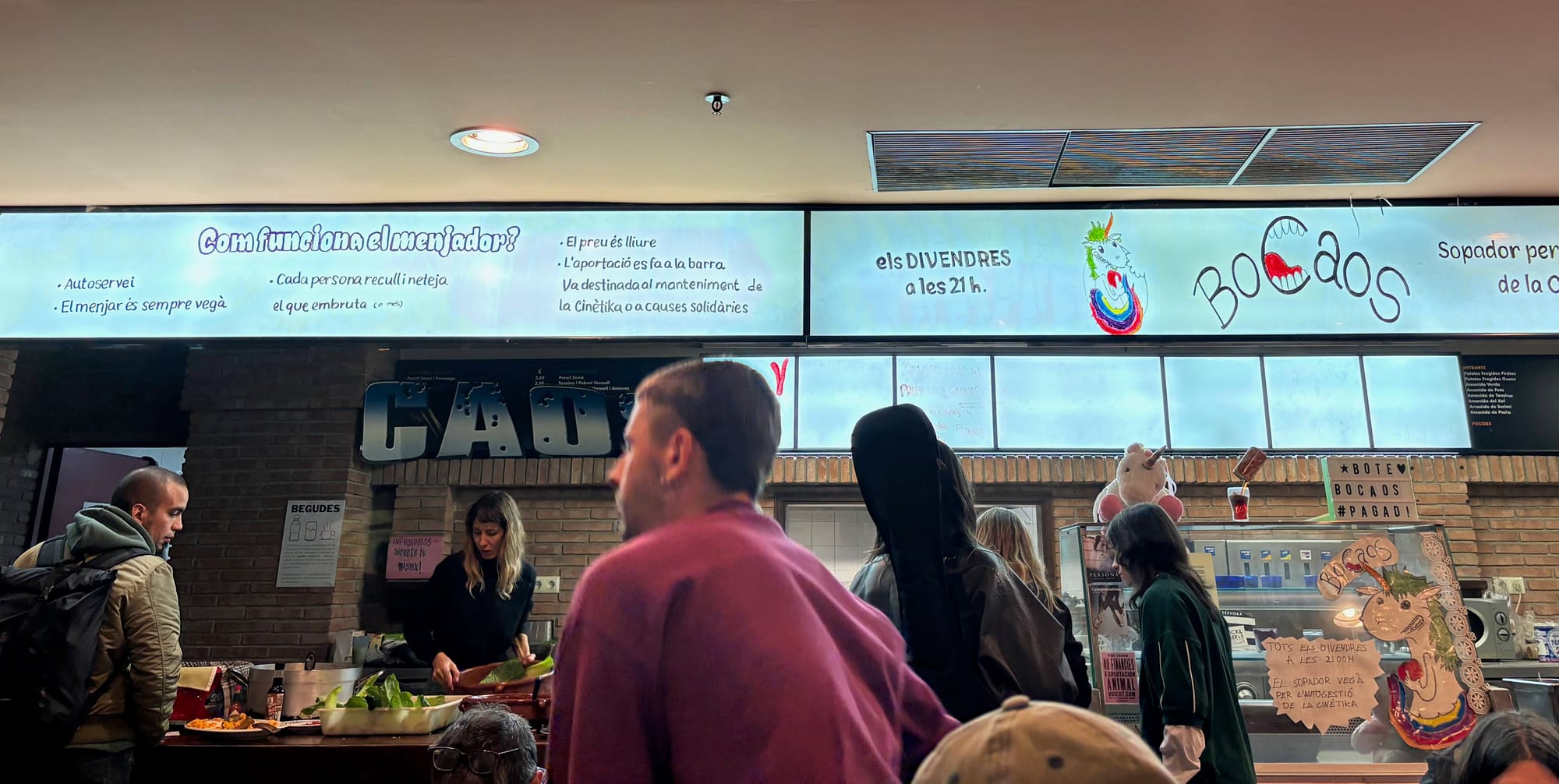
Claiming land in land-scarce cities like Barcelona or Singapore can be a deeply radical act. It declares: here is a space which we can shape to our own desires, where we can decide what happens within it, and not be pressured to make and sell things in order to pay the landlords. In Catalan, the word used to describe this is autogestió, meaning self-management, but also combined with elements of horizontality, autonomy, mutual aid, and a do-it-yourself spirit. In many of these spaces, I had the fortune to listen to invigorating talks, watch films I would otherwise never have known, savour lovingly prepared meals, create and enjoy art and music, and meet people deeply engaged in acts of commoning. Designing and building a space with your own hands gives people a true sense of ownership and agency in a way that government-led “co-creation” exercises cannot.
In Singapore, the popularity of community-funded Casual Poet Library despite the fact that there are already well-run public libraries, shows that the demand for such independent spaces extends across culture and geography. However, the recent closure of The Projector suggests such spaces will struggle to survive if they have to compete with commercial entities for rent. Imagine how many more of them could exist if they were not limited to people who can bear a S$40,000 start-up cost—if, for example, every HDB flat came with common areas that neighbours could turn into repair workshops, tool libraries, community kitchens, or to perform jam sessions, in a process they led instead of being subject to approval by the People’s Association or the Town Council. This is how we can live in a degrowth manner, by spending less individually but enjoying more collectively. For example, a shorter working day could free up time to prepare nutritious meals collectively with others in a shared kitchen, instead of having to order food from Grab.
Eventually, even Colau was unable to stem the global rightward shift, as well as anger over the party’s neutral stance on the independence question. She lost her third bid for mayor in 2023. Nevertheless, her party has left an indelible mark on the city that can be felt not just through the physical and mental health benefits of the car-free superillas, but also through the sense of possibility that ordinary people working together in groups and organisations can push back against capitalist powers to make space for their own needs and desires.
Some years after the Civil War, Orwell reflected on his experiences: “All that the working man demands is… the indispensable minimum without which human life cannot be lived at all. Enough to eat, freedom from the haunting terror of unemployment, the knowledge that your children will get a fair chance, a bath once a day, clean linen reasonably often, a roof that doesn’t leak, and short enough working hours to leave you with a little energy when the day is done…And how easily that minimum could be attained if we chose to set our minds to it for only twenty years!” In simple terms, he describes what degrowth scholars also agree on, with the addition that this is all possible while also stopping ecological breakdown. Sadly enough, more than eighty years later, there is still no place where this is a reality for all of its people. But what I have seen here suggests how it might still happen.
Last year, the CGT, together with other syndicates and organisations, released a proposal for an ecosocial and degrowth transition for Catalunya, while the city of Girona signed a memorandum with the think tank Research & Degrowth to explore post-growth policies. These were the first examples of a trade union and municipal government doing so.
Where does all this leave Singapore, where such ideas are starting to be shared by groups like Post Growth SG and Lepak Conversations, and ever-increasing rents and costs of living have led many to question the government’s continued insistence on the need to prioritise economic growth? Could autogestió in Singapore allow people to live fuller lives while spending less, and offer an escape from the logic of working hard to spend on short bursts of commodified pleasure? In his National Day Rally, PM Wong said that ground-up collective actions happen in other countries because their governments are ineffective, while Singapore is different: no one wants the government to do less. But if the government is genuine in its desire for more people to get involved in shaping Singapore, it has to learn to step back and relinquish its desire for full control.
My time in Barcelona made me realise that the ability to dream and experiment with alternate ways of living and organising is closely related to the freedom of communities to shape their own spaces. In a city that is planned down to every square metre, where landlords optimise land for maximum profits, and even peaceful acts of expression are strongly policed in the name of public order, how can there still be “space for our dreams”, as promised by the government’s Draft Master Plan? What we should perhaps aspire to is a democracy of space: going beyond typical public engagement exercises and enabling more direct forms of decision-making, such as citizens’ assemblies, community land trusts, cooperatives and more. Such processes may seem messier and less efficient, but I believe they are the best way to begin imagining and creating new possibilities and worlds.
See Yong Feng has worked in the fields of architecture and urban planning, and recently returned to Singapore after completing his Master in Political Ecology at the Autonomous University of Barcelona. He is a member of the climate advocacy group SG Climate Rally and the International Degrowth Network.
Letters in response to this piece can be sent to sudhir@jom.media. All will be considered for publication on our “Letters to the editor” page.