

News this week included: NUS among those being blackmailed following data breach; two Singapore residents isolated after Hantavirus exposure; some HDB flats are hotter than the outdoors; tourism receipts blazing new records; plans for a potential government-run dating service (oh, the horror); the implications of falling fresh-grad employment numbers; a new agency to support workers and employers; Indranee’s parenthood reframing, and performance, draws flak; a boost to palliative care; don’t buy contact lenses from unverified online sources; Trump’s war the reason moms can’t have flowers on Mother’s Day; a historic Singapore-New Zealand essential supplies pact; more than a thousand people go missing in Singapore every year; Workers’ Party reprimands Pritam Singh; news about caning for bullying goes global (TLDR: no one approves); jail time for those feeding pigeons, crows, and others (watch out, ah ma!); High Court overturns acquittal of three women who delivered letter to Istana; SG’s press freedom score falls further (yes, possible); bus guitar-hero told to strum from seat; man arrested for church assault; new railway laws ahead of December’s RTS Link launch; Sentosa croc put down; companies can now simultaneously list on SGX and Nasdaq; and SG athletes’ late-career struggles.
Oh, and Jom was mentioned in Parliament a few days ago. If you’re curious why, check out this week’s newsletter.
Below are the issues we explore in depth:
Our picks
Society: Workers’ paradise, according to the PAP-NTUC brotherhood
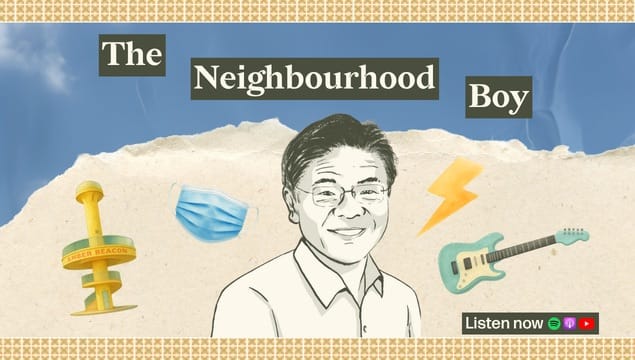
“Majulah NTUC, Majulah PAP, Majulah Singapura!” Lawrence Wong, prime minister, chanted, as he ended another Labour Day rally speech. He was wearing not his party’s trademark white, but a red polo t-shirt bearing the insignia of the National Trade Union Congress (NTUC). Light reflected off his sweat-dappled upper lip, mingling with the tears, at the end of a 48min performance with an emotional denouement. While reading the testimony of a Singaporean who’d been evacuated from the Middle East by the Republic of Singapore Air Force, Wong repeatedly broke down, more intensely than during the pandemic, when we first witnessed his comfort with public vulnerability. Yet again, it seemed genuine and touching, from the neighbourhood boy who’s assumed Singapore’s powerful executive office: a shepherd who cares for, and will take credit for, the wellbeing of every sheep.
That many have focused on the crying reflects the lack of any bold measures to help workers. An extended discussion around the Middle East crisis, oil shocks, and the threat of stagflation concluded with promises that nobody will starve: yes, more VCRs (vouchers, cash, rebates) when they’re needed. It was followed by a 25min elaboration on AI “transformation”—the word “opportunities” featured seven times, “threat” zero—and the supposed benefits of Singapore’s unique tripartism (government, unions, and employers).
Through it all Wong exhibited his signature ability to break down complex issues with nuance, supplementing them with real-life stories: from Yi Tay, the NTU graduate now working on Google’s Gemini, to 62-year-old Yahya Kharthi, who’s worked for SMRT for more than 30 years, and was on the verge of retirement but is now pleased as punch, apparently, because his job is less demanding thanks to—sure enough—automation and robotics. The lesson for humans is clear: aspire to be somebody who can get and keep a job alongside robots.
Wong acknowledged as much: first citing an anecdote about Excel spreadsheets rendering data clerks obsolete in the 1990s, then warning that the impact of AI will be greater. “We may not be able to protect every job. But we will protect every worker. Because in Singapore, every worker matters!” Well, to a point. NTUC is an umbrella group that, instead of acting as a separate power centre as is common elsewhere, has long worked in lockstep with the pro-business agenda of the ruling People’s Action Party (PAP). The PAP’s co-option of the labour movement—Lee Kuan Yew first harnessing its fire and then dousing it—has enabled the creation of a society that privileges capital owners and elite “talent” above all others. It’s no surprise they enjoy a tripartism where workers are defanged and always show up.
With the support of businesses and almost two-thirds of the electorate, why change? PAP fans appreciate the tweaks, such as the new Skills and Workforce Development Agency. And cheer Singapore’s consistently low unemployment rate. Yet, others have become more aware of socio-economic injustices. Jobs, but poor quality; no minimum wage; high income inequality (that sees office cleaners earning under S$20,000 a year); and longer hours worked than in many developed countries. These and other problems have sparked a growing alternative labour movement (see below). Stirring as it may be, and strive as all lefties must for a society more just, the Singaporean worker must also countenance a future where politicians and tech lords rake it in, fortunate workers enjoy plum jobs alongside machines, and others bounce around from one reskilling to another, kept alive on the VCR dripfeed. Oh, and the occasional tear from your empathetic shepherd.
Society: Workers’ paradise, according to WMP-SGCR
Tripartism may be working for the faithful, but not for many others. Dramatic demonstrations of resistance, like the “illegal strike” by bus drivers in 2012, capture the country’s attention. But away from the public’s eye, little perturbations by disparate groups of disgruntled employees have been steadily coalescing into a larger disturbance to the force. Awakened and energised by a new breed of youth activists, and spurred on by the success of 2022’s criticism of Watson’s alleged no-sitting policy, workers are fighting for their rights. Not just those enshrined yet unfulfilled by unscrupulous bosses—but also those that they believe they deserve in a caring, humane society.
Their defiant solidarity was on display at Hong Lim Park last week. Over 1,500 gathered for the fourth edition of the People’s Labour Day rally organised by Workers Make Possible (WMP), an activist group. In substance and form—worker booths festooned with petitions, protest stickers, and poetry; artworks strewn across the lawn; keffiyehs of varying colours and imaginative folds fluttering in the heart of the business district—it was a stark contrast to the predictable triumphalism of the PAP-NTUC bash.
This year's event was jointly organised with SG Climate Rally (SGCR), an eco-socialist collective. Their unified message: people and the planet are being sacrificed for the pursuit of profit. Among other contradictions, they highlight: workers are told to reduce their personal carbon footprint while large MNCs continue polluting with government subsidies and invest in AI-driven data centres that consume vast resources. This year’s demands include an eight-hour workday and a maximum five-day work week for all workers; and the assertion that Singapore’s green transition cannot come at the cost of others—all overseas projects should be done with free, prior, and informed consent of local communities. Their “Labour Day 2026 Campaign Paper”, a blend of analysis and polemic, is worth reading in full. (As is their post-event joint statement.)
Jom reported on five of the 30 groups: Makan Minum Workers, which represents F&B workers; the Interfaith Environment Coalition, consisting of Buddhist, Christian, and Muslim groups; the Urban Birds Initiative SG; the PHV Driver Community, which promotes the welfare of all private hire vehicle drivers of all platforms; and Function 8, co-founded by former political prisoners, which seeks the abolition of the notorious Internal Security Act. (For the second year running, political parties had booths. On show this year were the Progress Singapore Party, Red Dot United's youth wing, and the Singapore Democratic Party.)
Among the speakers on stage were Carmen, the voice behind Confessions of a Grab Driver; and Nasita, a single mother of five, who grew up working in her mum’s satay stall and now, among other things, works with We Support Us, a grassroots network that seeks to enhance mutual aid and community building among rental flat residents. Among the performers were Dakbe Singapore, whose four-person Palestinian Folkloric Dance ended with a giant jam alongside attendees; and Satu Jiwa (One Spirit), a choir that roused the crowd with songs of emancipation.
What began as an inchoate project of some 300 people in 2023 has blossomed into a well-oiled jamboree of over 1,500. It’s appalling, then, that much of society continues to ignore it. Mainstream media journalists were there, but it appears like only Lianhe Zaobao published something. Perhaps ignorance is part of the Faustian pact. The mainstream press, handmaidens of the neoliberal state’s tripartism, surely can’t afford to bite the corporate hands that feed them. Shame. It is not just the tears of Wong that we should watch, but those of the dispossessed and disenfranchised, finding strength in numbers, hands on hearts, bodies swaying, as they sang “We shall overcome”.
Society: State-funded lotteries a lottery for the state?
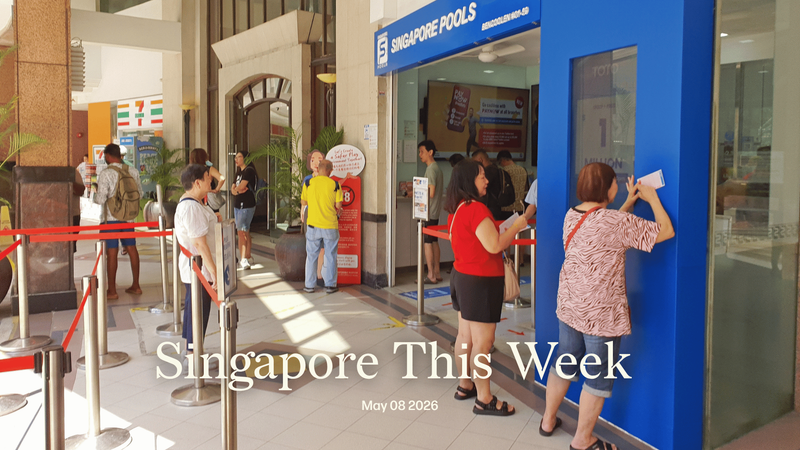
Small slips of paper with red squares of numbers. In each rectangular “board”, you mark six numbers between one to 49. This week, fortune guided one lucky punter’s hand to the tune of nearly S$13m. The probability of hitting the jackpot in Toto is one-in-14 million. Yet, four in 10 Singapore residents aged 18 and above gambled at least once in 2022, with lotteries the most popular form. That year, local punters wagered S$11.4bn—outpacing the A$7.8bn (S$6.5bn) spent in Australia, a country with four times Singapore’s population. Our love for the game is embedded in our history.
In 19th century colonial Singapore, gambling activities oscillated between licit and illicit. Stamford Raffles considered them “absolutely pernicious in every degree”—gambling was a vice of the Chinese; cockfighting of the Malays. He banned gambling with harsh penalties in 1823. But his successors William Farquhar and John Crawfurd quickly realised its revenue-generating potential; gambling houses and cockpits were reopened and became the most lucrative source of government income. In 1826, taxes on gambling earned the administration almost as much as taxes on opium and alcohol combined. Three years later, gambling was again banned, following a rise in the number of men falling into heavy debts to feed their gambling addiction. Many, driven to desperation, “resorted to theft, violence and crime, and when all was lost, suicide”.
But the ban only drove gambling underground. By the late 19th century, the immigrant and Straits Chinese were in love with chap ji kee—Hokkien for “12 Cards”. It was dubbed the “housewives opium”, with nonyas as chief organisers and top patrons. Chap ji kee operated through covert door-to-door collectors, avoiding detection while earning high profits from wealthy patrons. Despite being banned from the outset, it endured until sustained crackdowns in the 1960s-70s finally dismantled the syndicates. Singapore Pools was then incorporated in 1968 because, according to Lee Kuan Yew, “If you do not run [the lotteries] the chap-ji-kee man who has always swindled the people of their money is still there”.
Fast forward to the present day. In 2023-24, punters spent S$12.2bn on lottery tickets and sports betting. Of this, S$9.4bn was returned to prize winners; S$437m went to the Tote Board for community-based projects; and the state kept a cool S$2.3bn in Gambling Duties & Taxes (the rest was spent on operating expenses). In comparison, duties for tobacco and liquor totalled S$1.1bn and S$775.9m respectively. Todd A. Wyett, an American lawyer, argued that “[t]he vehicle of the lottery allows government officials to raise revenue without mentioning the word ‘tax’.” A significant portion of Toto punters are elderly, blue-collar, and low-income workers drawn to the vanishingly thin possibility of a lottery-enabled financial windfall. Indeed, some have argued that state-lotteries are a form of regressive tax for precisely this reason.
Singapore has long lived with the contradiction of condemning gambling while profiting from it. State lotteries soften the discomfort by framing gambling revenue as voluntary and beneficial for society—besides community projects, lottery revenue has funded iconic landmarks like the Indoor Stadium, Esplanade, and Gardens by the Bay. Yet the question lingers beneath the billions collected each year: whose hopes are underwriting these gains?
Society: “A flattering malady”
“From every member, every hair, disease that comes in every joint,
From all thyself, from top to toe, I drive thy malady away.” Rig Veda (1450-1350 BCE)
“The voice is hoarse…the fingers…mere bones…the nose is pointed, the cheeks flushed and prominent, the eyes are sunken…the face is puffy, pale, or livid, the patients…are emaciated and fleshless…” Aretaeus of Cappadocia (100-200 AD)
“The captain of all these men of death”. The Life and Death of Mr. Badman, John Bunyan (1680 AD)
No disease has killed more humans than tuberculosis (TB). Symptoms include a persistent cough, fever, night sweats, weight loss. In the English-speaking world once, TB was called consumption—the very name inspiring dread of a malady that seemingly feasted on its victim for months, sometimes years, before granting death. Incredibly, because the effects of TB could make some patients look ethereal, it was briefly associated in the 19th century with beauty, romance, and an artistic disposition. “Consumption, I’m aware,” wrote Charlotte Bronte, “is a flattering malady.” She died of it, as did her sisters; as did John Keats, Henry David Thoreau, and Frederic Chopin. The germ theory of disease emerged later that century, confirming that tiny, invisible organisms who travel from human to human on cough and spit are responsible for TB’s spread (and much else); finally we had an inkling of how to keep this millennia-old messenger of death at bay. (Much later we’d learn that although Mycobacterium tuberculosis can invade any body part, it usually resides in the host’s lungs, accumulating gradually until, during a period of weakened immunity, it breaks free of the body’s defences.)
Early interventions focused on behaviour. A national pastime among American men, for instance, was chewing and spitting tobacco—on sidewalks and in trams, on walls and on floors. When told that this could spread TB, the men blamed women’s fashion. You see, women’s long, trailing skirts were skimming their righteous spit off the floor, and porting it into homes and communities. Naturally, the solution lay not in refraining from gobbing everywhere, but in asking women to wear shorter skirts. Indeed, many upright patriarchs previously apoplectic at uppity women baring ankles now demanded that women do their civic duty. Women did, unfurling new fashion, and taking to shoes, now visible, in a big way.
Oh, men did their bit too. Beards were wildly popular at the time but within decades—a blink on the geological scale, really—of being told that “the Amazonian jungles of a well-whiskered face” could be teeming with infectious agents (a tenuous link), men embraced the clean-shaven look. King Gillette, a businessman, seized on this cultural moment at the turn of the 19th century to found his eponymous company.
Thanks in part to these changes and other public health interventions (men eventually did stop spitting), TB rates dipped in the first half of the 20th century but a cure arrived only when antibiotics were added to humanity’s medical arsenal during the second world war. Today, the disease afflicts fewer than ten people out of 100,000 in the rich Western world and kills fewer than 1. But it remains deadly in poorer, densely-populated nations, especially among low-wage workers inhabiting cramped, unhygienic dwellings in gigantic urban centres. In 2024, 10.7 million people were diagnosed with TB, and another 1.2 million died—most of them in countries like China, India, Bangladesh, and Indonesia.
In Singapore, where three TB clusters were recently detected, incidence remains low with 27.6 cases per 100,000 in 2024. Still, some are more vulnerable than others—the elderly and the infirm, of course, and migrant workers, the majority of whom are from high-TB burden countries. “The same dense living conditions that predispose them to getting infected by SARS-CoV-2 also put them at risk of acquiring Mycobacterium tuberculosis infections,” wrote local health researchers in 2023. Further, they identified lack of awareness as a problem—many didn’t know that hospitalisation and treatment is free (employers must cover fees for consultation and clinical investigations). This prevents some from approaching medical services, causing delays in diagnosis and treatment. The researchers called for education programmes among migrant worker communities to better disseminate info not just about the disease but also about their health entitlements. Knowing your rights is as important as having them.
Culture: Better in retrospect
Remember a world without notifications? Without the buzz of a phone booting you out of your heart-to-heart with a friend? Without that pesky pop-up puncturing your long read? Gen Zs don’t. But they miss it all the same, the days when we weren’t drowning in a surfeit of information we’ll never process, nor digitally-generated slop designed to entrap us. This is called historical nostalgia, a feeling for a time that pre-dates you. This affection for a low-tech past is fuelling new interest in old-school objects: vinyls, polaroids, cassette tapes, camcorders. While Gen Xers and Ys (Millennials), who lived through this era, are also part of its resurrection, it’s their kids who are sustaining its revival.
One of the great attractions of the analogue era is the gift of deep, uninterrupted attention, what the writer Simone Weil called the “rarest and purest form of generosity”. For 24-year-old Cody Tong, it’s the gentle spiral of the vinyl that reels him in. He’s acquired 180 CDs, 170 LPs, a turntable, amplifier, standing speakers, and a CD player with digital-to-analogue conversion. “It really makes me sit down in front of my system and just enjoy the music,” he told The Straits Times (ST). “I don’t use my phone and I can see the record spinning. It’s quite hypnotic.” He isn’t the only one. Across the border, Chloe Ling lugs her 1970s typewriter to live poetry events in Malaysia. She loves her Olivetti Lettera 35, a gift from her father, an artefact from an ad-free past. “I think perhaps it’s the return to a slower, more intentional way of living,” the 33-year-old told The Star. “No million tabs open, no YouTube in the background, just you, your thoughts and the rhythmic clacking of keys.” ST reported that Amazon Singapore has seen a surge in demand over the past two years for a variety of retro electronics, including film cameras, walkmans, and MP3 players; and thousands have thronged Side A, Singapore’s annual record convention, alongside corresponding spikes in sales at record shops across the island.
This nostalgia for all things tactile isn’t arbitrary. The education researcher Carl Hendrick recently wrote about the cognitive damage the digital age has done to his students, whose “attention had been colonised by a system designed to fracture it”. And it isn’t just the usual culprits of screentime and social media, but a broader “contagion of distraction”. There’s an attentional cost to being on our high-tech devices; a single notification on your neighbour’s screen will have a ripple effect on everyone else around them, “because [our] brains have been conditioned to respond to its form,” one that “commands attention even when the reward is not forthcoming”. This is the “seven-second tax”, a slowdown in cognitive processing we pay that accumulates throughout the day as our phones ping and punt us out of any deep focus or sustained work we may have been doing.
It’s why archivist Jamie Lee, 28, has opted for a “dumb phone”, a Unihertz Jelly Star that lets her make calls and send messages, but little else. “I don’t like how the online experience is directed by tech companies who most often don’t have any kind of humanist goal. They just want to make you addicted to their products so that you can make them as much money as possible,” she told ST. Attention isn’t an individual act, but a collective phenomenon. We don’t just live in an attention economy, we live in an attention ecology, where our attention is always influenced by the attention, and attentiveness, of others. We might want to pay a little more attention to that.
Arts: Passion made possible
We weren’t always such prudes. In fact, much of what we take to be standards of “public decency” were imposed on us only from the mid-19th century. Case in point: Singapore had plenty of public bathing spots from the Singapore River to Telok Blangah, where locals would wash themselves with nary a care, nor clothing, in the island’s various waterways. Our British colonisers were not amused. “The Jury present that the public bathing in the rivulet skirting Orchard Road is a nuisance from persons being allowed to bathe in the view of the public in a state [of] nudity or nearly so,” went a ST report in 1849, “they recommend that means should be taken to prevent this violation of public decency.” The castigation of local bathers cut across racial lines. In 1871, the Straits Times Overland Journal was horrified that many Indians “of both sexes...must be seen here at all hours of the day, in unblushing nakedness, close beside one of our most fashionable thoroughfares”; in 1886, four Chinese were fined 25 cents each for “indecent bathing” opposite the Ladies Lawn Tennis Club.
Nudity and the erotic has long occupied an uneasy place in Singapore, tugged between its desire to be a cultural hub and a desire to censure assumptions of public indecency. Desire itself has been a frequent target of censorship. In 2011, the British artist Simon Fujiwara only discovered belatedly that the Singapore Biennale had scrubbed his installation clean of its subtle undercurrent of erotica, meant to act as a critique of the military dictatorship of Spanish general Francisco Franco. In 2016, the Infocomm Media Development Authority refused to grant artist Ming Poon’s “Undressing Room” a rating at the 2017 Singapore Fringe Festival for “excessive nudity” (a headscratching tautology if there ever was one), essentially banning the work. Members of the public accused this participatory performance—where both performer and audience member consensually undress—as “pornography disguised as art”, when in fact such nonsexual nudity may be found in locker rooms and saunas all across the globe.
But are we finally coming around? Last week, the National Gallery Singapore opened its first-ever R18 show on South-east Asian erotic art. “Passion Is Volcanic: Desire In Southeast Asian Art” prohibits photography and minors, but it’s a start. Adele Tan, the show’s co-curator, told ST: “When we went around the region to borrow artworks, they said, ‘Wow, you are doing this in Singapore? What took you so long?’ Everyone’s ready for us to grow up.” The artworks are sensual and sumptuous. There’s Filipino sculptor Agnes Arellano’s “Haliya Bathing”, where the Bicol goddess of the moon, back arched and a hand on her swollen belly, looks like she’s about to give birth on a bed of crushed marble. And in a gilded copper sculpture dating back to the 14th-15th centuries, two Buddhas, their limbs entwined, share a kiss. They were given to the Asian Civilisations Museum by the Kwan Im Thong Hood Cho Temple. One interpretation of the tantric object: compassion straddled by wisdom, their embrace forming a complementary whole. If even the Buddha can embrace sensuality and sexuality, it’s about time we shed our intimate inhibitions and face our vulnerable, naked selves, just as we are.
Abhishek Mehrotra, Sakinah Safiee, Corrie Tan, and Sudhir Vadaketh wrote this week’s issue.
Letters in response to any blurb can be sent to sudhir@jom.media. All will be considered for publication on our “Letters to the editor” page.
If you enjoy Jom’s work, do get a paid subscription today to support independent journalism in Singapore.