

Dear Jomrade,
Today we’ve published:
- “Singapore This Week”, by Jom
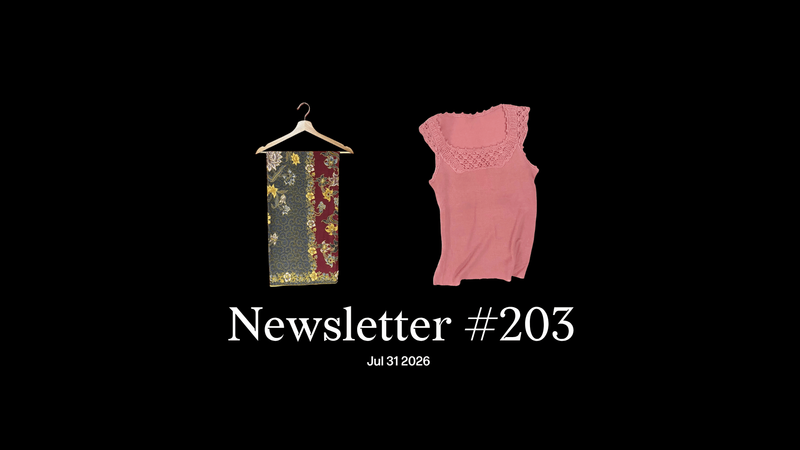
- “The soft companionship of grief-garments”, by Xingyun Shen
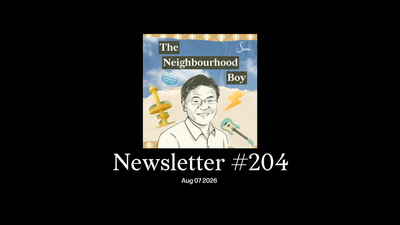
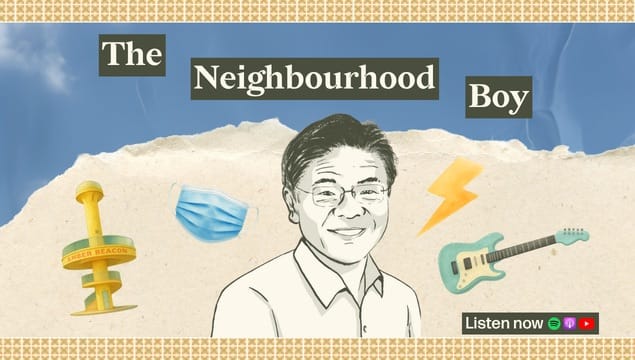
Barring some unforeseen complication, next Friday we’ll be launching Jom’s first ever podcast, “The Neighbourhood Boy”, a four-episode scripted series on Lawrence Wong, Singapore’s fourth prime minister. It’s been years in the making—mostly cos of our stretched labour and other resources—and is hosted by Jean Hew, our dear Employee #1 (who left us last year). We didn’t necessarily plan it for National Day, but it seems like it’ll make it just in time! Fingers crossed, and look out for more details in a week.
On Wednesday, I watched Massive Attack at the Star Theatre. (Yes, Gen X tunes.) It was a visual feast, and I’m still trying to decide if I liked all the video art, critiquing our relationship to technology in different ways. Before we entered, a friend told me she wanted to wear her keffiyeh but was worried she’d get in trouble. I told her about another friend who had her watermelon pin removed by security before Olivia Rodrigo’s show here. Imagine our (pleasant) surprise, when towards the end there was a moment of Palestinian solidarity by Massive Attack, flag and all. The crowd loved it. Partly, I think, because of the symbolism of the act in one of our megachurches. But, Singapore being Singapore, somebody complained to the police, who are now investigating. Like that also cannot? Boo.
The video that has entranced me this week, for all the wrong reasons, is of The Economist’s editor, Zanny Minton Beddoes, interviewing Elon Musk. Zanny, who flew to Kyiv shortly after Russia’s invasion, is one of the bravest journalists around. I’ve seen her stumble sometimes, like with Tucker Carlson, but never before have I seen her shrinking into her chair, cowering almost, because of a narcissistic bully. Shockingly, he later branded her a “traitor to the West”. It’s important for people everywhere to understand what the world’s richest person is like—and all the more so in Singapore, with our infatuation for AI and his space ventures, and his admiration for the Lee father and son. We talk about the interview more, and share some choice clips, in “Singapore This Week”.
And given the heat waves and raging fires around the world, it’s appropriate that one of our interns, Yue Qian, has chosen to interrogate heat inequality in our little red dot. Thank you for your very first bit of writing for us!
- The Economist x Elon offers further proof that AI-optimism here must be tempered
- Is access to Singapore’s greenery and shade only for the privileged?
- How can society better address the threat posed by teenage extremists?
- Goodbye, Marmite
- That racist Bali run, and the history of elite privilege in recreation
- Should you get paid to read a book?
Above are the issues we chose to explore in more depth.
Other news this week included: GIC’s returns down; financial sector grew 4.3 percent last year; government reviewing eligibility age for singles buying HDB flats; ST on the highest-paying jobs in the private sector; scam centres in Forest City busted; suicides among people in their 30s up 50 percent from 2023 to 2024; fewer than 30,000 babies born in a year, the first time since independence; new book series details 25 years of legal reform; car ownership falling and rental rising; South-east Asian youth hooked on illegal online gambling; a Myanmar national injured in an accident returns home because she can’t afford surgery here; writer Don Shiau opens up about his amicable divorce under new mutual agreement clause; ST’s coverage of rhabdomyolysis, “When a workout becomes a medical emergency” (and a spin instructor’s response); the threat of 2027’s El Niño to our corals; Singapore’s inaugural bald community meet-up draws 80; 10 newcomers to the Michelin Guide 2026; fake Jack Ma the latest disinformation ploy; four nurses win the President’s Award; and gymnast Amanda Yap, 16, wins our first Commonwealth Games medal.
Join 1,700 members keeping Jom independent. From S$10/month—full access, no compromises.
“The soft companionship of grief-garments”, by Xingyun Shen
We all have them: objects that remind us of another person. Often they’re fabric. And many symbolise grief. Is that 2026’s emotion of the year, btw? In any case, Xingyun responded to last year’s print issue theme of materiality—movement and magic were the others—with this tender piece that will almost certainly touch every one of you. Here are some opening passages:
“Subash’s grandmother died in February this year, just a month and a half before we spoke. That sarong would have been the next thing his grandmother had worn—had she taken her next shower. Before she could, she was admitted to the hospital.
Death is fossilised in the sarong, in its folds and wrinkles. The tubular garment, designed to contain and wrap around a torso, will never be filled again by that very body, a cruel reminder of the permanent absence—“an utter impossibility of return”—of the person we love. The postcolonial feminist writer Chimamanda Ngozi Adichie articulates this pain in her memoir Notes on Grief, written after the unexpected death of her father.
But the sarong can nonetheless be a memorial for the body, where spirits and souls take residence. With his hands, Subash gestured to the sarong’s shape by making a circular motion away and then towards each other…
I refer to objects like these as grief-garments: made from cloth, with material dimensions that capture the immaterial forms of our loved ones’ lingering presences. I have adapted this definition from fashion researchers who have written about the chesty pains of grief, and how they are contained in and embodied by everyday garments.”
Jom rasa,
Sudhir Vadaketh
Editor-in-chief, Jom
p.s. I didn’t want our errors to precede Xingyun’s prose, but I should say to her, for the very last time, sorry for missing out your bio in last year’s print issue.
Jom on grief
 Corrie Tan
 Tsen-Waye Tay
 Zachary Hourihane
 Cherry Tan
Singapore This Week
Society: The Gods Must Be Crazy
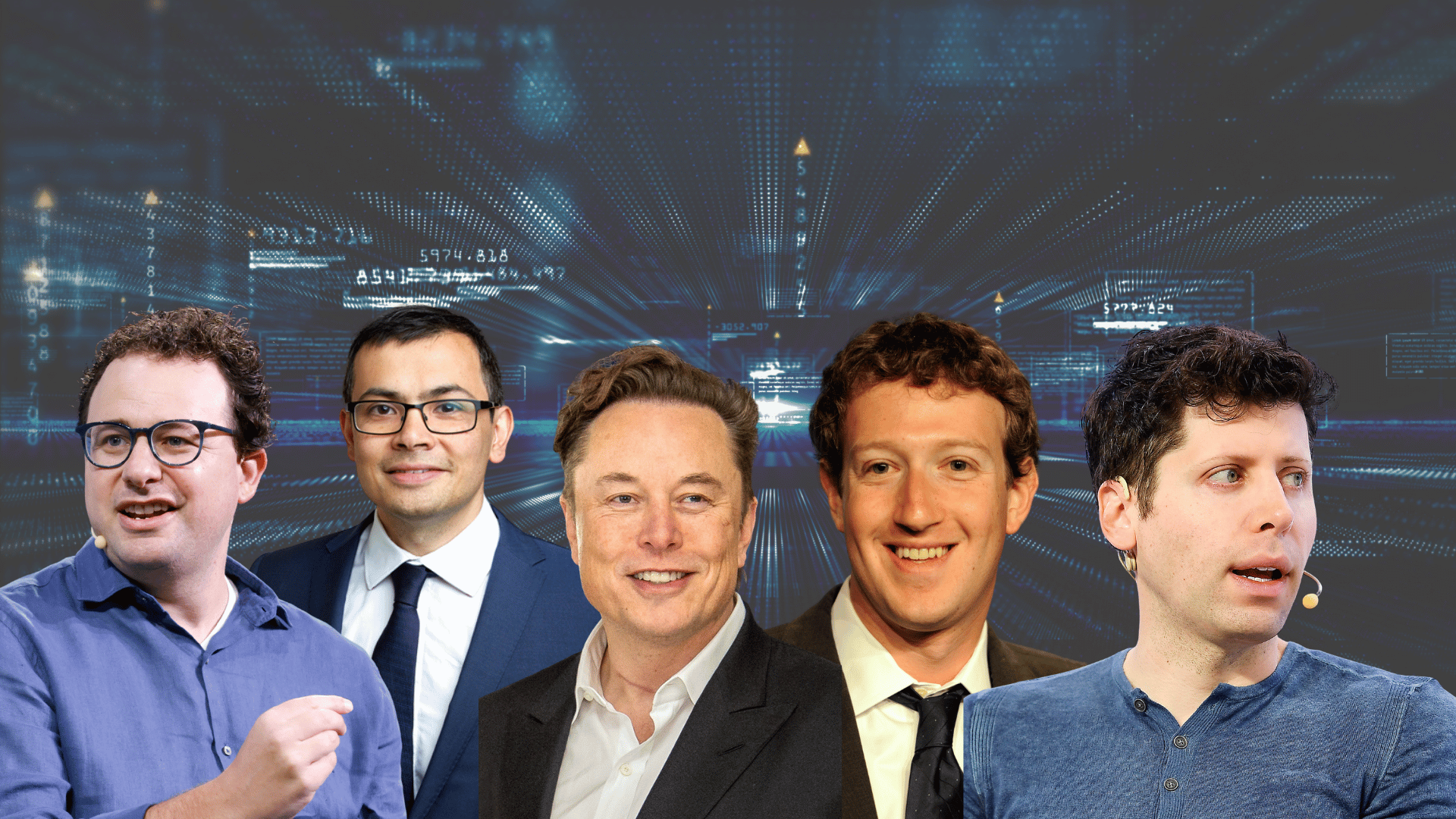
And Sam said: the Singularity is here. And Elon said: within 5 years, AI will possess more intelligence than humanity, and after ten, it’ll usher in a period of “amazing abundance” in which we won’t need money. Dario, Demis, and Mark will soon issue their latest commandments. (Regarding style, in April The Economist said that “the age of the AI demi-god” is defined by “five tech bosses so iconic you need only use their first names”.)
AI has already fundamentally improved our lives, from the everyday (such as this sentence’s grammar) and the occasional (that Google Translate convo in Bangkok) to the unfathomable. With “the protein folding problem” described in 1972, scientists had till recently only mapped the structure of about 150,000 of the 200m known proteins in nature. In 2016, Demis’s team trained their AI system on those, and by 2022 had completed the remaining 99.925 percent—for which he and two others (some John, and some David) won the 2024 Nobel Prize in Chemistry. Alzheimer’s, cancer, diabetes, and many more—the Gods are coming for you.
AI has already fundamentally destroyed lives too. Oklahoma’s Kimberlee Williams was wrongfully arrested and jailed for 6 months for a crime in Maryland, a state she’d never visited, after facial recognition technology screwed up. UnitedHealth was sued in 2023 for allegedly denying care to the elderly because it used an AI system that it knew had a 90 percent error rate. Adam Raine killed himself after ChatGPT apparently encouraged his suicidal thoughts. And Israel’s Lavender AI system assigns Gazans a score of 1-100 that denotes their likelihood of being a militant, producing 37,000 targets in the genocide’s early days. Energy, resource exploitation, the list goes on, as we overturn this planet, and soon others, to welcome the age of amazing abundance.
But what we must fear most are the human traits of some of our demi-gods. Sam and Elon possess a singular narcissism that’d make Odysseus blush. “He’s unconstrained by truth,” an OpenAI board member said in The New Yorker’s April profile of Sam, noting his “sociopathic lack of concern for the consequences that may come from deceiving someone.” And when The Economist’s Zanny Minton Beddoes interviewed Elon last week, the hubris and boorishness of the all-conquering white male was on display. When asked whether he’s anti-Muslim, one response was that he’s “against rape and murder”. When discussing whether people might “loath” him for political interference, he took grotesque delight in repeatedly telling Minton Beddoes that people “hate” her and the traditional media. A “traitor to the West,” he later branded her, putting a target on her back for some of his quarter billion followers on X.
War is brewing. UnitedHealth’s CEO was gunned down in New York City in 2024 by a person himself now deified by many: “What’s the use of having a badass in the family if you can't brag about him? Now I know how the Mangiones feel,” said Bart Simpson. Elon travels with some 20 bodyguards and Sam’s home has been attacked. The reasons for this antagonism range from “culture wars” around “wokeism” to class angst and desperation—a sense that the economic game is rigged, and that the already shocking inequality (Elon is/was the world’s first trillionaire) is only going to worsen because of AI.
Why should Singapore, specifically, care? Few dissenting views are heard in one of the most AI-friendly countries, poised to wreak havoc on neighbouring countries in our search for “clean” energy to fuel the revolution. The rich are so insulated that even scam bosses till recently felt comfortable parading around town. We know what must be done, including greater investment in techno-sceptical views and investigative journalism on the elite. But for them to allow that, the Gods would indeed be crazy.
Other stuff we like
Singapore Minstrel at Filmhouse, 2pm on Aug 8th. The critically-acclaimed film, a “fantasy-documentary painting the magical universe of Singapore’s wildest busker”, turns 10. The director, artist Salty Xi Jie Ng (whom Jom profiled), will be in conversation with busker/protagonist Roy Payamal, moderated by Viknesh Kobinathan.
The Economist’s Big Mac Index turns 40. To celebrate, the publication has released a fun multi-media piece that demystifies currencies and foreign exchange.
A flavour of Jom. Occasionally, Jom publishes essays outside the paywall. These are on issues we think are in the public interest, and deserve a wider airing. In the past two years, we have published nearly 50 such pieces. Read some of these if you’d like to see samples of our work. We hope they’ll convince you to subscribe. And even if you’re here with no intention of doing so, we hope you’ll enjoy these offerings and consider it time well spent!