



Dear Jomrade,
Today we’ve published:
- “Singapore This Week”, by Jom
- “The story behind ‘The Neighbourhood Boy’”, by Jom
Happy National Day! Some of you might be spending the long weekend away. Others, like me, will be attending watch parties on Sunday to cheer; scrutinise politicians’ dressing and their seating arrangements; and, most importantly, engage in some collective self-deprecation about this annual jamboree of militaristic might and “kampung spirit”.
Wherever you are, here’s one request: spend a few minutes learning the meaning of “Majulah Singapura”. Here’s a translation by Alfian Sa’at that I like.
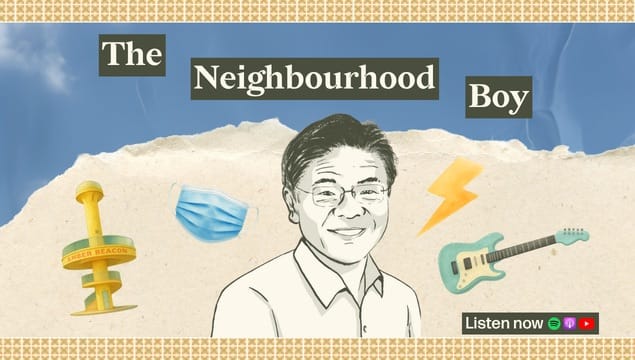
Podcast. It’s here! “The Neighbourhood Boy” is a four-episode series on Lawrence Wong, Singapore’s fourth prime minister. It premiers today, with a new episode every subsequent Friday in August. Listen now on Spotify, Apple Podcasts, YouTube, or wherever you get your podcasts.
We’re eternally grateful to Jean Hew, our Employee #1 and podcast host, who completed this work long after she’d formally left Jom. Thanks also to all our other contributors. Credits and episode transcripts here.
It’s our first podcast, so reply and let me know what you think! We’re building Jom together.
“Letters to the editor”. Thank you, Deepa Ramanathan, for pontificating on the problems with paying people to read (and other incentives to change behaviour); and Michelle Law, for rejecting our “diminishing characterisation of Professor David Baker” in last week’s blurb about AI’s “demi-gods”.
- Do the young wonks in Lawrence’s cabinet reflect a narrow leadership pipeline?
- Have the PAP and WP agreed on the direction of SG’s “future economy”?
- Singapore’s space activity and exploration
- As loansharks bare their fangs, how can we make it easier and safer for lower-income folk to borrow?
- Filmhouse, The Singapore Chinese Orchestra, Wild Rice and other artists engage with National Day
Above are the issues we chose to explore in more depth.
Other news this week included: Parliament debates Gillman Barracks and Maju Forest, which unsurprisingly, “need” to be developed for housing; easier en bloc sales with proposed lowering of consent thresholds; Lee Hsien Yang’s response to Oxley acquisition; Law Ministry to review legal education and considers guide on workplace norms; arrest warrant issue for opposition politician Lim Tean after he fails to surrender for jail term; Woodlands Hospice opens; man wins forced retirement case; immigration backlash forces SG school operator out of Sapporo; the need for better traffic regulations for a super-aged society; Ivan Heng and MINDEF on paying artists fairly; obituary to Andrew Chow, Zouk DJ; ST commentary on why we need mandatory criminal history checks for those working with kids; trans youth harassed at a mamak stall; autonomous wheelchairs at Changi Airport; CNA investigates whether words like “supermum” and “girl boss” are doing women more harm than good; is it true love, or love bombing?; Massive Attack members barred from re-entering Singapore because of pro-Palestine support; student clubs joining Singapore’s anime, comics and games creator scene; ST “full-time report” on week of feats for SG athletes; the Seniors National Games; SG’s dog gym for canine fitness; and venomous blue-necked keelback snake spotted at MacRitchie.
Join 1,700 members keeping Jom independent. From S$10/month—full access, no compromises.
“The story behind ‘The Neighbourhood Boy’”, by Jom
Why did we decide to enter the podcast space? How did we choose the genre and subject? What was the production process like? As part of our commitment to “build in public”, involving you as intimately as we can in Jom’s growth, we decided to publish this today alongside the podcast’s launch. Here are a few opening paragraphs:
“Many of us, including Gen Zs fascinated by nostalgia, know the tactile and aural joy of toying with a knob on a transistor radio, a search amongst the blur of white noise for the crack of a voice or instrument. Digital radio and, later, streaming, reflect the neoliberal order’s insatiable drive to make the ‘production’ and ‘consumption’ of content as frictionless as possible. These democratising technologies permit unique accessibility—a fledgling firm like Jom couldn’t have produced a “radio show” in the old days—but that’s tempered by the realisation of, if not resistance to, their ills, including an addiction to personal devices that dangle autonomy at the risk of isolation, algorithms that favour the superstars and alter the very nature of music (and other content), and the shift of money from artists to tech overlords…
The modern podcast, then, represents a radical evolution from the original radio. It is on demand. It can platform niche personalities and interests—such as the “People Movers” podcast, exclusively about escalators—because the internet has made it easier to connect with one’s tribe. And, in today’s personality-driven era, it offers a deeper intimacy with your host(s): Alie Ward of “Ologies” is just one whose offbeat, personal, and vulnerable style makes it sound like you’re listening to a chum, not some stuffy, self-important presenter.
When Jom launched four years ago, and sought to build a literary long-form publication for Singapore (and perhaps one day South-east Asia), we knew at some point that we would enter the podcast space—the aural equivalent of our text-and-image based storytelling. But what, whom, and how?”
Jom dengar,
Sudhir Vadaketh
Editor-in-chief, Jom
Jom’s storytelling
 Jom
Jom
 Jom
Jom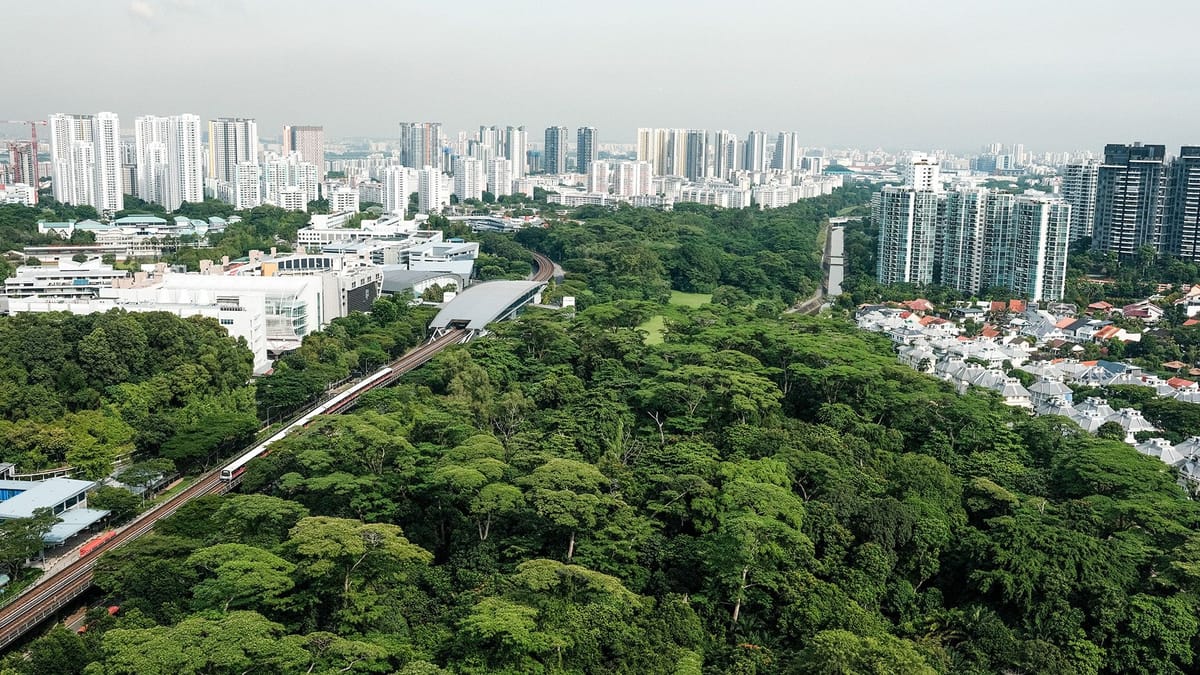
 Jean Hew
 Jom
Jom
Singapore This Week
Politics: Predistribution rather than redistribution

While accepting that Singapore as an “exigency” may have had to focus on growth first and redistribution later—for instance through the so-called VCR (voucher, cash, rebate) system—Kenneth Tiong, Workers’ Party MP, said “over the medium and long-term we should be building an economy where a fair distribution is produced by the growth itself, rather than repaired afterwards out of the proceeds.” He argued for “an economic engine driven by dynamic local companies, healthy domestic demand, and Singaporeans and Singaporean capital venturing abroad”.
This was the core thrust of a WP motion on Singapore’s future economy, which saw 24 MPs speaking for almost nine hours on Wednesday. “We host many large companies, but build few of them,” Tiong said, comparing Singapore’s three Fortune 500 companies (all commodity traders) with South Korea’s 13 and Taiwan’s six (semiconductors and ships). “Theirs were built by their own people, Ours came here, and can as easily go.” Jamus Lim, fellow WP MP, said that the Economic Strategy Review (ESR) “betrays an implicit bias” towards MNCs over SMEs. “We need a conscious shift away from too much fixation with tax competition, an undervalued exchange rate, and the wooing of footloose multinationals.”
To spark local innovation, one recommendation from Tiong was for a “special zone surrounding NTU where the State land is charged at cost-recovery, rather than market scarcity value”. Residential and commercial spaces, co-living, local enterprise and R&D could clump around the university, “zoned for organic messiness”, he suggested (veering close to the mocked Singaporean desire to manufacture creativity). Best of all, “this experiment is reversible,” he said. He also offered “three North Stars for the distributional aspect of growth”, part of a broader lament about insufficient “report cards and targets” with government blueprints.
Other ideas from the party included: changes to land policy to lower costs of housing and other uses; proper paid apprenticeships and other measures to ensure those under 30 transitioning from education or NS to professional life “get a fair start”; and legislating for minimum retrenchment benefits. All in all further evidence that the party has put Raeesahgate behind it, and is flexing its intellectual and policy chops in Parliament.
The PAP responded to all this by…mostly agreeing. “We all want a more inclusive economy. Stronger local companies, good jobs for Singaporeans, and growth that gives our people confidence in the future,” said Edward Chia, PAP MP and businessman. Jeffrey Siow, transport minister, said there was “considerable common ground” between the parties, but perhaps they differed in degree, with the WP believing that the “economic model is imbalanced and needs to be fundamentally reoriented. They have portrayed Singapore as a place where MNCs create wealth, and there’s some Faustian bargain where SMEs are held down…I disagree with this characterisation.” Chia proposed four amendments to WP’s motion to make “clear that these aspirations are aligned” with the ESR, and it passed, with the WP’s members unsurprisingly voting against.
Humour was proffered by Tan See Leng, manpower minister who started his own successful healthcare firm as a 27-year-old doctor (aka the one with the real battle scars). “Rocky [Balboa] is like an entrepreneur…it’s not someone who can just throw punches. But it is that person who can take the punches, get back up and keep moving forward.” The punchline actually came at the beginning: “[WP chief] Mr Pritam Singh is smiling. I presume he would have known who Rocky the character is.”
Other stuff we like
JELLY magazine launch. The first issue explores ideas of power, of the iconic and the everyday, of the violent and meditative nature of beauty.
Commencement address. In her speech to the NUS Class of 2026, filmmaker Tan Pin Pin spoke about the importance of being present, noticing, and remembering in a city where change is incessant.
Cherian George on “a good society”. The media scholar critiques Singapore’s censorship, harassment, and blacklisting of social activists pushing for moral progress in this essay, which elaborates on arguments he made at the “States of Unease” Public Forum 2026.

A flavour of Jom. Occasionally, Jom publishes essays outside the paywall. These are on issues we think are in the public interest, and deserve a wider airing. In the past two years, we have published nearly 50 such pieces. Read some of these if you’d like to see samples of our work. We hope they’ll convince you to subscribe. And even if you’re here with no intention of doing so, we hope you’ll enjoy these offerings and consider it time well spent!