
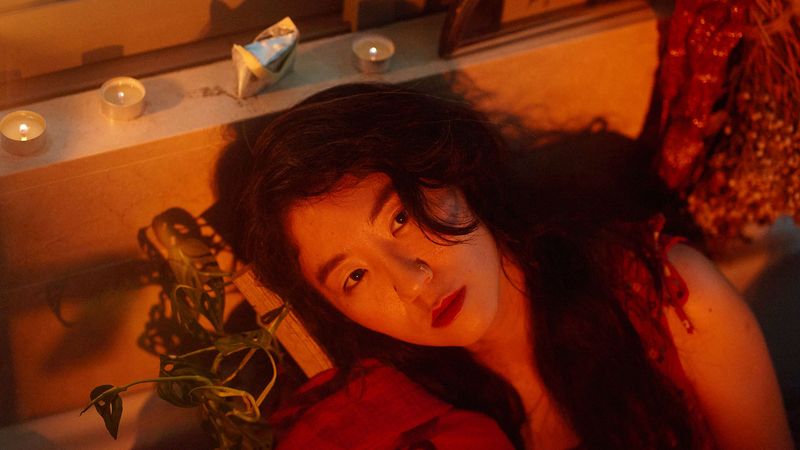
In late May, Sheralynne Dollatella-Wong Jia, a sassy curator and art dealer, went to Gillman Barracks, an arts cluster home to many galleries, to promote the work of Roy Payamal, a pioneering Singaporean busker. Payamal was there for his first-ever painting exhibition. At the door Dollatella-Wong, dressed in bright orange, handed me a business card that listed some of her accomplishments: MA Art Business, e-flux Party Leader, and Dip. NFT Guru L3.
In her hour-long curatorial tour, Dollatella-Wong described to us Payamal’s shift from the organic freedom of the streets to the cloistered gallery space: “Can you enjoy an ephemeral performance the way you enjoy a painting? Must a painting be owned for money to be exchanged?”
Dollatella-Wong WhatsApped us PayNow QR codes. She invited us to tip Payamal for the experience of viewing his paintings the same way we might tip him for a street performance: “Similar to experiencing busking on the streets, no pressure. You can walk away having appreciated it. This is just an experiment.”
I stood in front of a painting I liked, immersed myself in it for a few minutes, and then, for the first time in my life, sent the painter a small tip for that experience. In our hyper-marketised economy, it was a rare moment to contemplate the value of unpriced intangibles: “Didn’t realise there’ll be an atas curator,” one of Payamal’s friends quipped, his wallet a bit lighter.
Sheralynne Dollatella-Wong Jia is a fictitious persona of Salty Xi Jie Ng, a Singaporean practitioner of what’s commonly called “socially engaged art”. This artform relies on collaborative, participatory forms of social interaction in order to engage with community issues. In her work Xi Jie often deploys a different persona to address a specific issue. In this case she used Dollatella-Wong, a curator with exaggerated business savviness, to get us to reassess the way we value art.
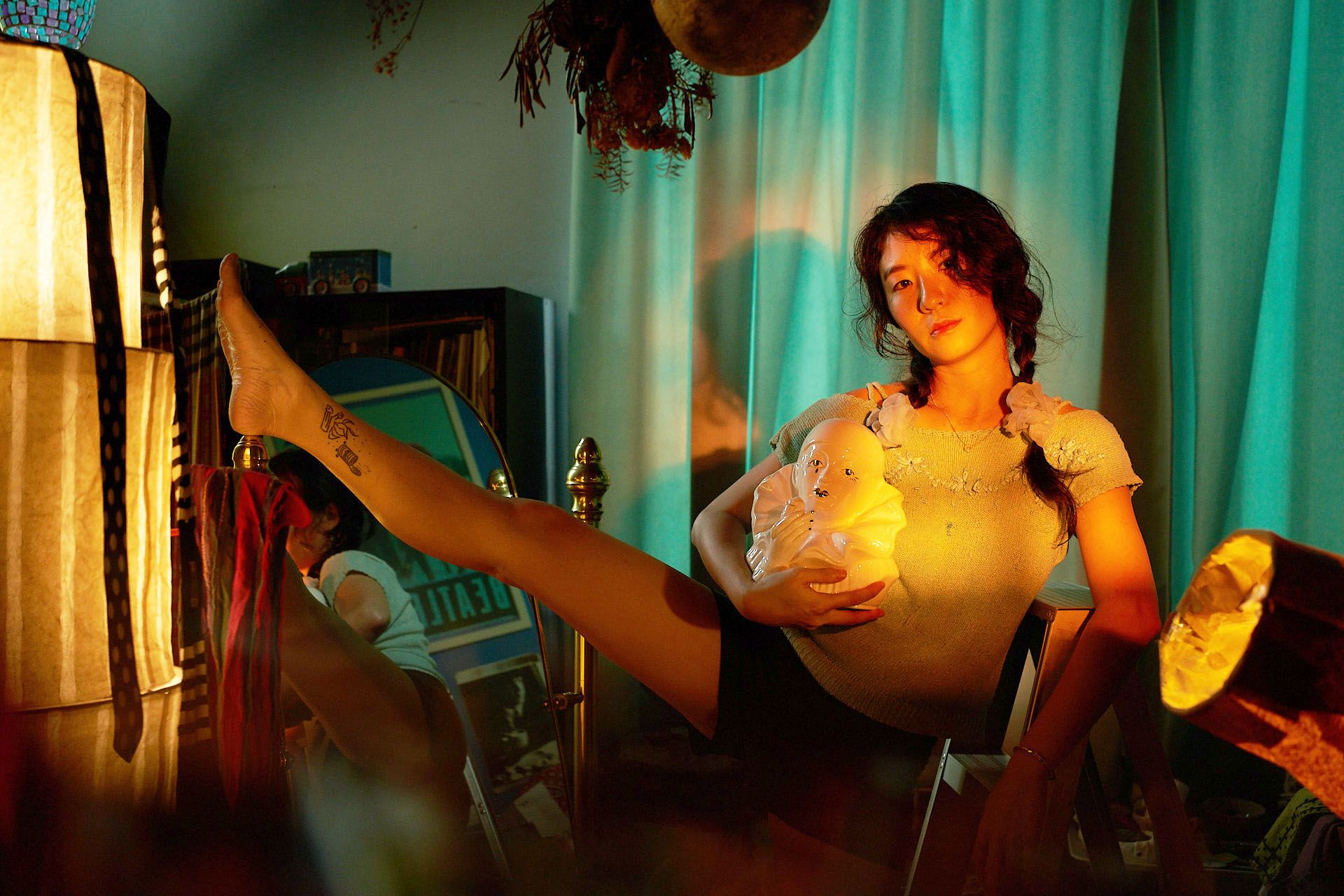
Before our first meeting, I had read about these multiple personas. Xi Jie introduced herself to Arts Equator, a local magazine, as “a grandma who carries hot tea wherever she goes, a non-binary elf existing in mutual support with a community of magical creatures, a melancholic Pierrot clown, a naughty boy pranking his neighbours with glee, a solitary uncle living in a desert under the stars, a crass and bossy auntie who loves sex. I am all of my past lives and present selves.”
I was sceptical, unsure if it was just kitschy artistic branding, or perhaps reflective of a wandering soul, another cosmic traveller trying to find their place in the universe. Would I actually get to know Xi Jie, the person, or was I in for a series of performances?
Xi Jie had suggested the banks of the Upper Seletar Reservoir, “the mystical place of my childhood”, near her family home. We sat on a west-facing concrete bench near the water, an immense expanse ringed in the distance by Mandai’s wilderness. It felt like we were on the edge of a dreamy, green-framed mirror, the setting sun and its reflection gliding elliptically towards each other. To our right macaques were languishing on palm trees. To our left a photographer was scurrying around, nudging newlyweds towards his ideal, doesn’t-look-like-Singapore backdrop.
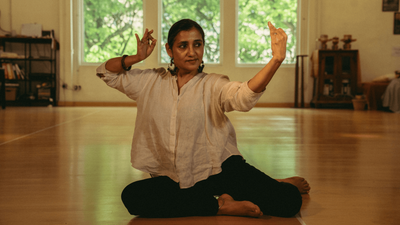
The first thing I noticed about Xi Jie was her gold, Indian nose-ring. Her jet-black hair, revealing the first traces of white, was tied in two pigtail buns. With her petite frame, her penchant for sudden impromptu stretches and splits, and a face that often, cheekily, seems eager to break into a smile, I could see how an elf might be an easy persona to project.
“Old hobo uncles are drawn to me,” Xi Jie said, midway through our conversation. “I think I have an old hobo uncle in me. This is why I love Bob Dylan so much, or Tom Waits and the Beatles.”
Xi Jie explained the tattoo on her inner right ankle, a can of baked beans over a campfire, by playing “Lucky Day” by Waits.
“And when you get blue
And you've lost all your dreams
There's nothin like a campfire
And a can of beans”
The tattoo’s finish had a certain faded rawness, unlike the heavily inked and stylised ones common in Singapore. “My friend did it for me in a tent in Western Massachusetts and we lit the scene with just my iPhone. For three hours he worked hard at this tattoo.”
Had I just met “old hobo uncle”? As our conversation progressed I started to pay less attention to the body in front of me and more to the personas that were manifesting themselves. We all contend with different ones, including our inner child, throughout our lives. With Xi Jie this process appears supercharged, as if a multitude of characters is on standby within her, each emerging at a specific moment to fulfil a need for her and those around. She switches accents seamlessly, which means her voice’s cadence, melody and intensity have a somewhat precocious unpredictability.
After we swapped notes on spirituality, a guru appeared, offering me a “clearing”. What?
“For anything that you might want an energy clearing around. Could be a physical, emotional, mental or spiritual thing. And it just takes one minute.”
I had recently undergone my first colonoscopy, so I pontificated about mortality, and then awaited liberation.
“Thanks for sharing that…there isn’t a clearing for fear of death.”
Xi Jie chuckled, and before I could complain, she had transformed into an animal whisperer, standing up to face the assailants behind me: “The monkeys are getting a bit nearer. So let us get your phone in your pocket.” Xi Jie had earlier told me that the Upper Seletar macaques steal phones just so they can barter them for food, the sort of insight that made me wonder if her practice had crossed the species barrier.
As we walked out of the reservoir, Xi Jie performed a cartwheel, her first since she got diagnosed with Covid-19 weeks prior. Xi Jie dusted off her hands, freshly pressed into the moist rainforest’s earth, and carried on with the nonchalance of somebody who had just snapped their fingers.
I began to wonder if the cartwheel was her way of spinning her own internal Dharmachakra, the “wheel of life”. I began to wonder about which Xi Jie was going to show up for the banana leaf dinner with my wife in 30 minutes.
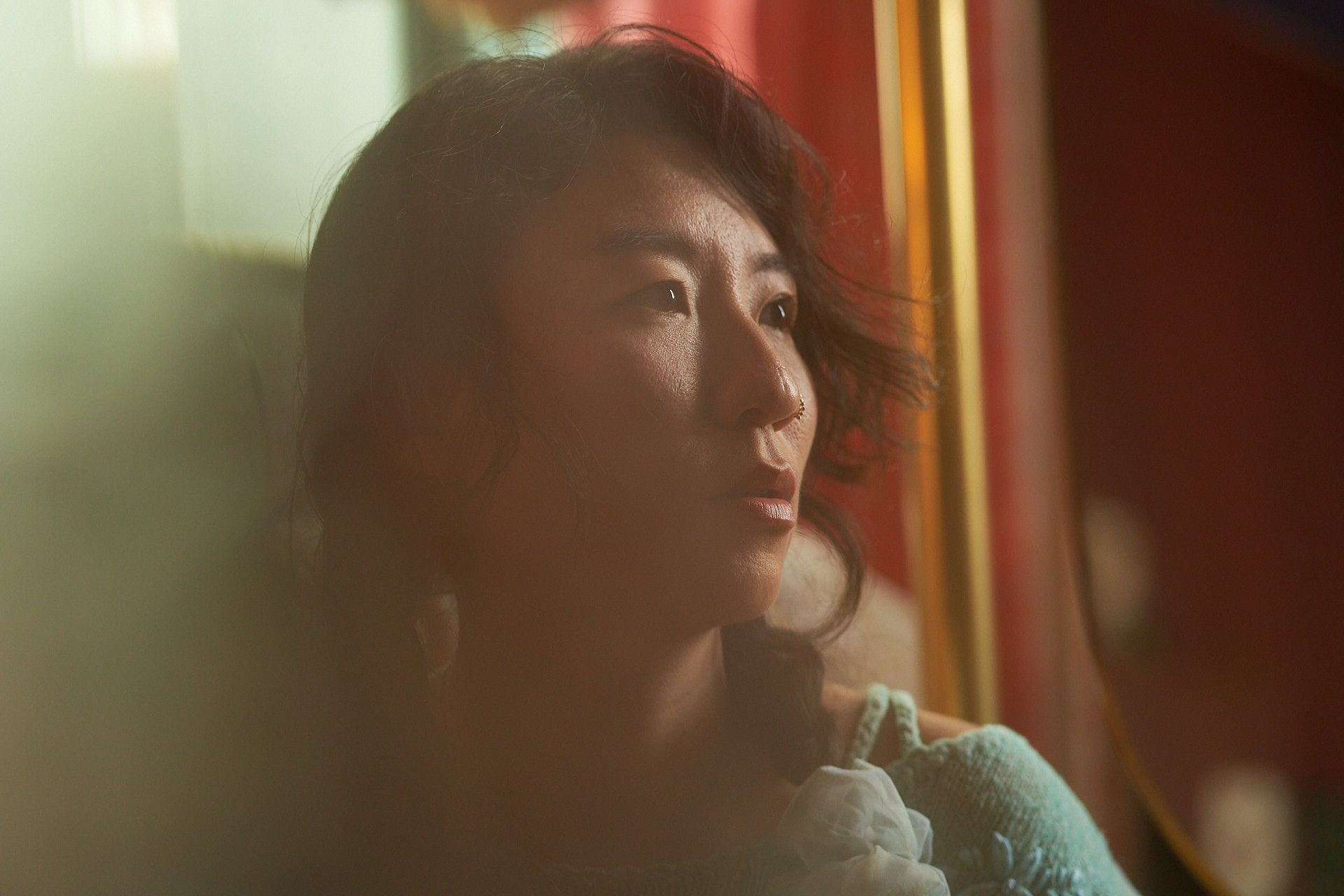
Socially engaged art is, simply, “a social interaction that proclaims itself as art”, writes Pablo Helguera, a New-York-based Mexican artist and professor, in Education for Socially Engaged Art, a definitive text. The artform sits awkwardly between a number of traditional disciplines, including performance, activism and investigative journalism.
Important modern examples include the A-Portable, a mobile gynaecological clinic retrofitted into a shipping container, staffed with physicians and nurses, and then transported on board a ship to countries with restrictive reproductive laws. Run by Women on Waves (WoW), a Dutch pro-choice NGO, A-Portable sometimes lingers miles offshore in international waters, awaiting local women in need of abortion pills, information, and other services. Its distinctive purple-pink-orange logo turns it into a recognisable saviour on the horizon.
“Our goal has always been to stir public debate, and to send the message that abortion is not simply a public health issue—it’s a social justice issue,” Kinja Manders, WoW’s project manager, once said. (Women on Web, a sister organisation that prescribes and mails abortion pills to women in faraway theocracies, has recently spawned an outfit to serve the US.)
While WoW is transparent about its methods and objectives, others engage in subterfuge. In 2003, in order to protest the perceived paucity of cultural policy in Mexico City, Helguera and other artists organised the First Congress of Urban Purification of Mexico City. The satirical project, advertised as an actual conference, drew submissions from as far as Colombia. The team also prepared six scripted papers and hired actors to read them.
One actor presented a fictitious cultural programme from Rudy Giuliani, American politician, who had recently been appointed as a security advisor to the Mexican City government. “This last paper generated a media blitz and outrage over the notion of a US-led cultural policy…which in turn led to a public debate on cultural policy as originally intended,” writes Helguera.
But isn’t WoW just social work, and wasn’t the fake conference just activism? Socially engaged art has pushed the very definition of art, an age-old imponderable, to its limits. Some practitioners eschew the word “art”, preferring “social practice”.
Xi Jie uses “social forms of art” because she says it’s more general: “[The artform] lies between art and life. It’s ontologically hard to define. Part of what it is, is to have a constant debate about what it actually is.”
But whom is it for? Xi Jie illustrated the varying registers of social forms of art by referencing “The Inside Show”, a variety show she made in 2019 with prisoners at the Columbia River Correctional Institution in Portland, Oregon. “We are making it for ourselves, first and foremost, like the guys who are in it, they are the primary audience of the whole thing. And then the next year might be their peers, their family, their friends, people who support them. And then there's, of course, the art world, because inevitably, it is an art project.”
One of Xi Jie’s most ambitious recent works was the Buangkok Mall Life Club (BMLC). From September 2020 to January 2021, she transformed a retail unit in Buangkok Square into an art space that allowed her collaborators, including Buangkok residents and her creative team, to interrogate notions of commerce, materialism and mall life.
The project’s centrepiece was the Buangkok Exchange Department, a 600-square-foot barter shop offering one-for-one exchanges regardless of presumed item value. One patron swapped a brand-new vacuum cleaner for a ceramic piggy bank. Other circulating goods included a black sofa, a rice cooker, a “Flashlight Earpick”, and Jacky the Singapore Airlines teddy bear.
”How do we ascribe value to things? What are our object desires? What do the objects we let go and take in reflect about self, the collective, and material culture?” Xi Jie asked on BMLC’s Instagram account.
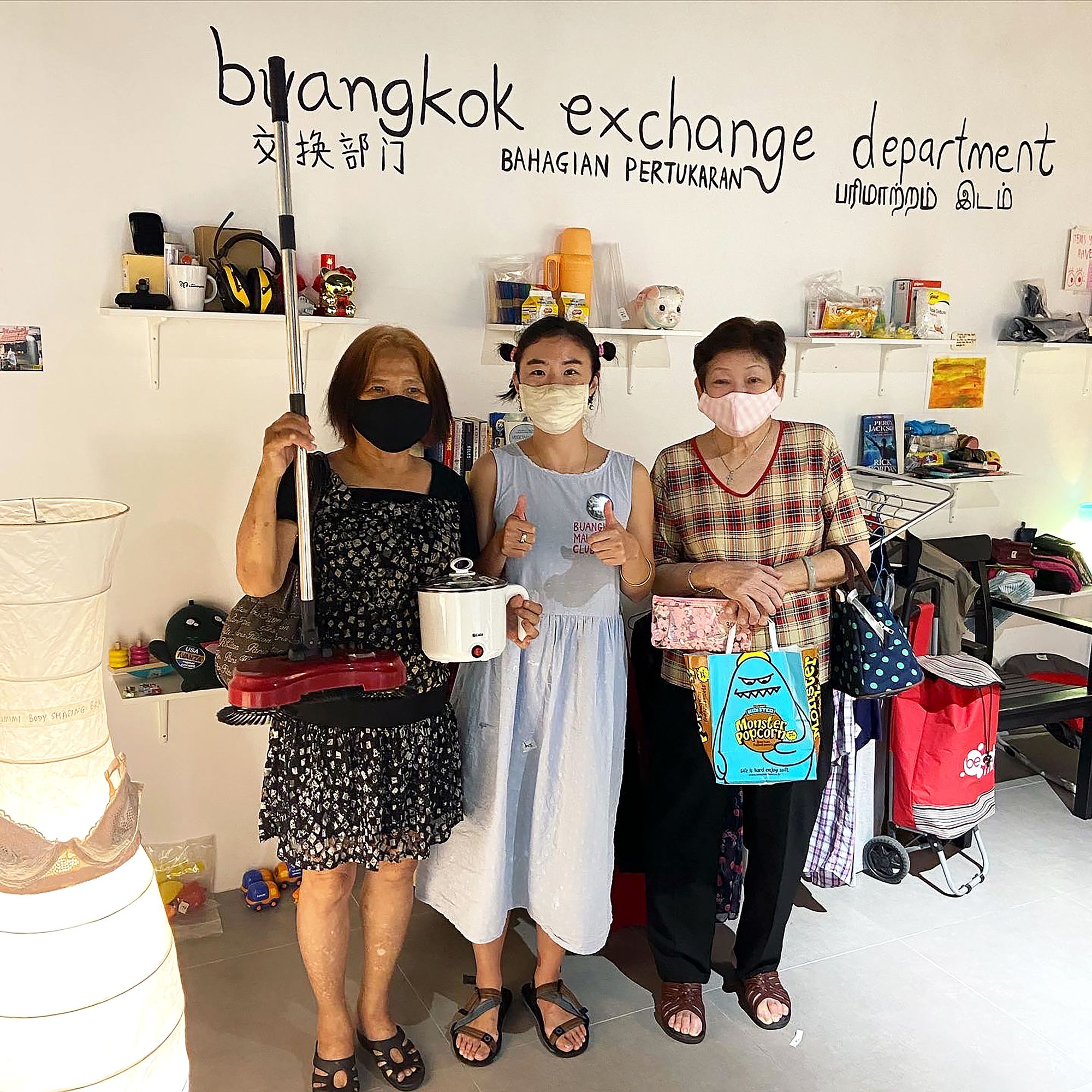
A key element is Xi Jie herself—the artist as architect, instigator and lubricant of deep social interactions. At BMLC she deployed a 老板 (boss) persona. Dressed in a powder blue dress with the words “Buangkok Mall Life Club” written in thick red ink over her left chest area, 老板 motored around the space, chatting with customers, recommending items, discussing their lives and the stories behind objects, and meticulously recording them in a ledger.
“I do feel partly that the space is held up by my performative charisma as a shopkeeper,” Xi Jie told Jill Tan, an artist and anthropologist who documented her own BMLC experience.
According to Tan, BMLC had, over three months, created for its regulars a mall experience—visiting, hanging out, exchanging goods without money—that provided “an emphatic alternative to life in a neighbourhood mall.”
Put another way, Xi Jie and her collaborators had collectively reimagined a key locus of Singaporean life—the shopping mall—through their shared, direct experience of a semi-fictionalised alternative. Though social practitioners rely on documentation, including her Instagram and Tan’s essay, the essence of their practice is the actual lived experience, in which the presumed audience are actually collaborators.
This stands in contrast to most other art forms, in which creators produce something tangible that others later appreciate—and which the market finds easier to price.
Xi Jie had created a wonderful shared space at BMLC, but how should her “audience”, which includes her direct collaborators and those of us who enjoyed it on Instagram, pay her for that experience? BMLC was possible only because of support from Singapore’s National Arts Council (NAC) and the Housing Development Board (HDB).
All this is the backdrop for why Xi Jie, despite her upper-middle-class upbringing, constantly feels like she is teetering on the edge of financial precarity. It is the source of some tension with her parents.
Xi Jie’s mum grew up in poor circumstances in Johor Bahru and Singapore. Xi Jie’s paternal grandfather moved from Malaysia to Singapore with his parents in the mid 1900s.
A teenager then, he later got into the construction industry at a propitious time, coinciding with newly independent Singapore’s phase of rapid urbanisation. He progressed quickly from labourer to contractor.
“That’s where all this came from,” Xi Jie said, gesturing up at the semi-detached house’s three storeys that rise above the dining room we were in. Conscious of her privilege, Xi Jie says she has grown more aware of the archetype of artists as “poor, romantic, sensitive beings” who fight for freedom.
“Many of us unconsciously keep ourselves in that space,” she said. “It can be hard to generate financial exchange from what we love doing, in a world that does not support it very well.”
Like other artists in (costly) Singapore, Xi Jie seeks an equilibrium: “It's about finding the spot where you can honour your gifts as a creative being while having enough monetary resources to live according to your values.” Her mum and dad, echoing sentiments heard around pragmatic Asian households, occasionally wonder if she’d be better off in a more regular job.
Despite this slight tension today, Xi Jie recognises their support throughout her upbringing. Her dad drove her from Upper Thomson to Victoria Junior College (VJC) every morning for two years. Xi Jie chose VJC because it was the only one then that offered theatre studies.
Her instructor, John Lofthouse, had a Beatles CD in his office: “I don't know if I even asked him because we had that kind of relationship. I just took it home and played it on my CD player. And I remember distinctly feeling that my life changed in that moment.”
She bought CDs of Bob Dylan, Johnny Cash, and Simon and Garfunkel on eBay. She read about Woodstock and broader American music history, and soon became “obsessed with 60s’ American counterculture…and I didn’t have any friends I could talk to about it.”
At VJC, Xi Jie started signing off greeting cards to her parents as “your difficult child”, creating a sort of shared awareness about the unconventional path she foresaw. She thought she might want to work as a music journalist.
In 2009, before her final year at the Wee Kim Wee School of Communication and Information at the Nanyang Technological University, 22-old Xi Jie did a photojournalism internship at The New Paper, a tabloid one year younger than her. “I was traipsing around Singapore with like, over 15 kilograms of gear, taxiing everywhere, and taking pictures of celebrities, food, crime.”
Xi Jie appreciated the exposure she got, and the technical skills she picked up, including photo documentation techniques that serve her practice today. But the conceptual demands of a tabloid grated against her artistic and personal sensibilities.
On one occasion her editor sent her to photograph guys wearing thongs at the beach. She saw one but couldn’t bring herself to photograph him. At the 2009 AWARE saga, a senior photographer snuck in Xi Jie: “I was there photographing, you didn't pee for nine hours.” An editor later pored over their photographs. Incentivised by a system and readership that crave sensationalism, they searched for unflattering photos of the much-ridiculed “new” AWARE board. They picked one, blew it up, and put it on the front page.
The internship had served its purpose: “That world was harsh and fast and fascinating, and not my world.”
Xi Jie’s disillusionment with mainstream journalism coincided with her flourishing interest in different art forms and their respective local artists. In 2011, she started seeing Payamal, and became more familiar with Singapore’s buskers, who, caught between a fussy state and an uncharitable public, somehow eke out an existence. In 2015, she released “Singapore Minstrel”, a documentary film about Payamal, “the wildest busker of a country ranked the world's most emotionless society.” Tender, whimsical, and tragic in equal measure, it was screened at several international film festivals, winning some awards.
A year later, Xi Jie won an NAC scholarship to pursue an MFA in Art and Social Practice at Portland State University. Her fascination with social forms of art, she believes, was fed by a lifetime of curation and programming in small settings, from co-organising themed school parties to volunteering herself as the family archivist and historian. Leading up to her MFA she engaged in various relevant projects, including giving facials to migrant workers in Little India on their day off.
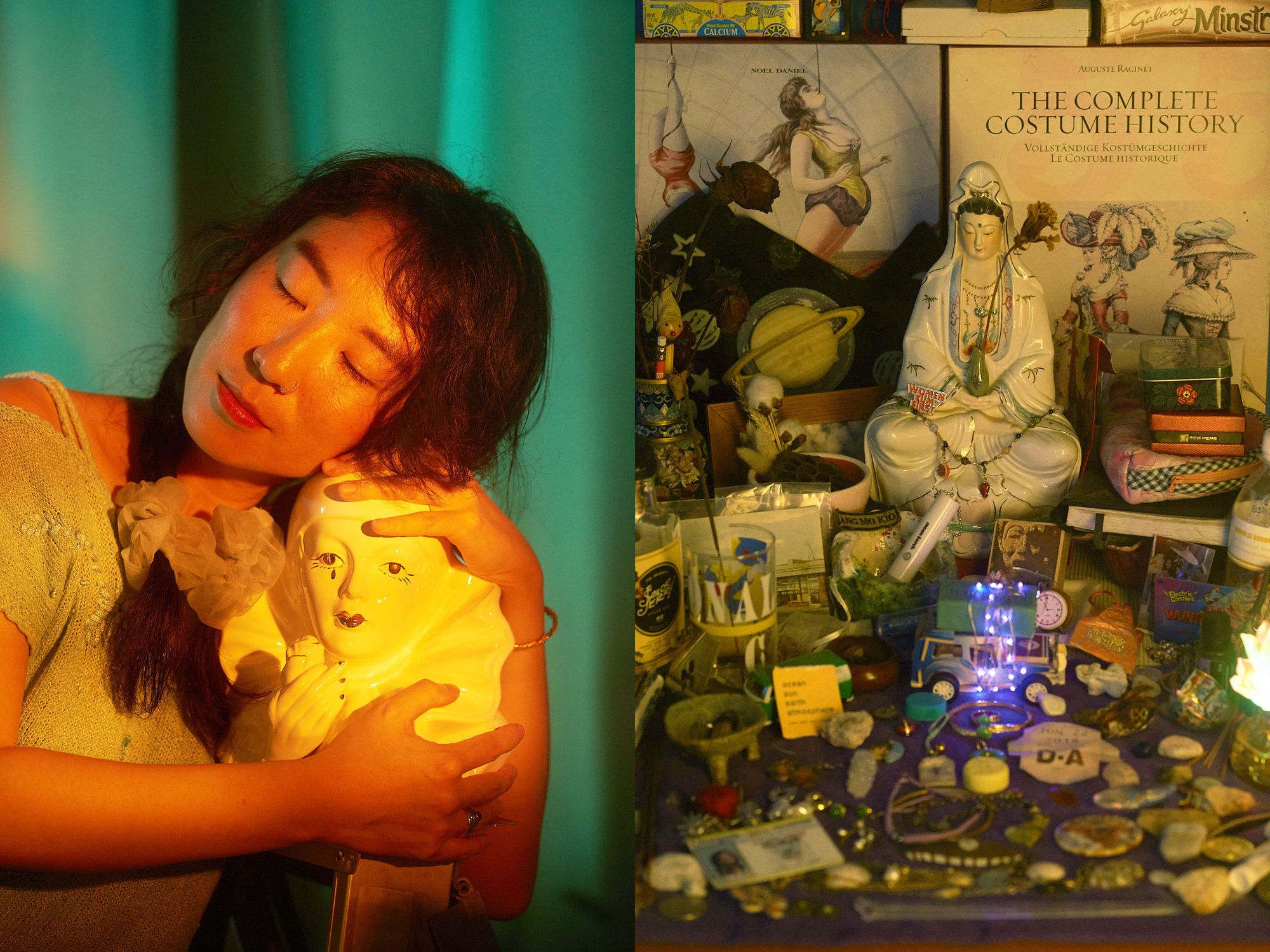
In Portland, she found family in the Shangri-La, an old motel that had been converted into a multi-apartment complex, “like a home for eccentric people in a neighbourhood that is being rapidly gentrified.” It was the first time she had her own proper place outside her family home in Upper Thomson.
“I really believe in the concept of ‘chosen family’, what I also call ‘cosmic family’. I think biological family is really important…but we need to think more expansively about the notion of family, and what different people can give to us.”
Xi Jie was in an artist’s residency in Dartmouth, Massachusetts when Covid struck. Afraid of pandemic uncertainties in the US, she rushed back to Singapore in March 2020. Though circumstance yanked Xi Jie away from her cosmic family there, it allowed her to spend a precious last few months with the biological family member she is closest to, her paternal grandmother.
Xi Jie grew up in the three-story, three-generational household that her grandfather, the contractor, had built. As Xi Jie’s parents were out working during the day, “Mama”, his wife, was her main caregiver: “When she went on holiday I would…I would…I would be devastated,” Xi Jie tells me, the only time I’ve heard her fumble her way to words. “She was my security blanket.”
Over the past few years, Mama became a key collaborator. She was a lead in Xi Jie’s bunion2bunion project, a celebration of an oft-disdained body part. Mama even travelled to Portland in 2017 to perform on stage with Xi Jie in a piece entitled, “I got my bunions from you.”
In December 2020, as the BMLC project was coming to a triumphant end, Mama passed away. Xi Jie had to skip BMLC’s final weekend.
Worse, Xi Jie learned that while Mama was lying in an intensive care unit, she had been converted to Christianity, after a lifetime guided by Chinese folk spirituality. This “really painful” discovery sparked the creation of Xi Jie’s Bai Bai Research Group, which examines Chinese ancestor worship and, more broadly, Taoism. Xi Jie has improved her Hokkien, which she now uses to communicate with the owner of a Chinese religious goods shop, which sells, among other things, the paper money and goods burnt for those in the afterlife.
“I was at her deathbed crying and saying, ‘I will burn all these things for you forever.’ And I really feel that,” she said. “I’m not wanting to be the bearer of tradition in the sense of like, practising or passing it down as it has been, but actively, imaginatively thinking about how to reinvent these rituals, and I’d like to do it in collaboration with people of my generation.”
Xi Jie has turned Mama’s passing into a journey of self-discovery that might resonate with young Singaporeans, especially those eager to understand the cultural and social costs of our rapid economic development.
Among other drastic changes in the 1960s-90s was the prioritisation of English and Mandarin over Malay and Chinese dialects. This often led to the perverse situation where Malay- or dialect-speaking grandparents could no longer communicate easily with their English-speaking grandchildren. A Western form of modernity also saw Christianity gain in prominence, often at the expense of traditional religious practices.
Xi Jie, through her use of Hokkien and her work at the Bai Bai research group, is offering Singaporeans a portal to our past. More powerfully, perhaps, she is offering a method to others eager to reinvent their own rituals, to create their own portals to the past, to grasp and feel for something missing from our textbooks.
Over the coming years and decades, will Singaporean society cherish the work of Xi Jie and other social practitioners? It is easy to feel pessimistic about their prospects. We are often inclined to celebrate the spectacular, the glamorous, the art that travels to the most decorated stages or that dazzles in galleries, and whose value lures patrons seeking trophies for their living room.
In 2021, Xi Jie had a residency at the Singapore Art Museum, arguably her biggest institutional opportunity thus far. Still, she says that compared to the US, in Singapore there’s more “siloing of social forms of art.” Compared to other artforms, it’s not as well-embraced “within the contemporary art discourse and lineage.” Many in the industry, she says, tend to regard it as simplistic art, which is just about doing good: “And I think there’s so much more to it.” As a result, Xi Jie says that she sometimes feels a bit alone here.
It nevertheless seems clear why socially engaged art is going to be of immense value to Singapore at this juncture of its development. Many have long dispensed with the fatuous belief that art is a privilege of the rich (“Poetry is a luxury we cannot afford,” Lee Kuan Yew once said). Individuals are increasingly seeking inspiration through art, in their quest to find meaning and belonging in their lives. Many are eager to engage in more participatory forms, to be part of shared experiences among an increasingly diverse population. In her short but prolific career, Xi Jie’s practice has already created the space for thousands of Singaporeans to explore ideas around the body, ageing, commerce, materialism, love and sex.
Xi Jie believes that it is difficult to assess the impact of social forms of art: “How do you meaningfully reflect in a report a little cellular change in someone because they walked into this shared experience with other people? You can’t.” More important than external validators, she says, is the experience.
I asked Dana Lam, a 69-year-old writer-artist, about her experience working with Xi Jie on The Grandma Reporter, a collaborative publication about “senior women’s culture” around the world. Xi Jie founded it in 2016 in Portland as “a way to gently excavate the complex inner worlds of elder women in a world that often renders them invisible, infantilised, or patronised.” For the Singapore edition, published in July 2021, Xi Jie convinced Lam to write about erotica.
“How on earth did we end up talking about sex? With this young girl,” Lam wonders in admiration. “For someone [young] to be so deeply interested in exploring the older person's mindscape and experience also astounds me. I mean, lots of people love their grandparents, but to be so steeped in it, so truly, honestly interested in that experience. It’s unusual, isn’t it?”
Lam believes the reason Xi Jie can undertake such varying projects is her “enviable ability to enter communities and interact, and be very comfortable, and so comfortable as to allow other people to be comfortable.”
This description reminded me of something David Whyte, Irish poet and philosopher, recently said, after having spent months alone in the Galapagos: “And I began to realise that the only places where things were actually real was at this frontier between what you think is you and what you think is not you…it’s astonishing how much time human beings spend away from that frontier, abstracting themselves out of their bodies, out of their direct experience, and out of a deeper, broader, and wider possible future that’s waiting for them if they hold the conversation at that frontier level.”
In a sense Xi Jie, in whichever persona she embodies, gently lures her collaborators’ inner selves to this frontier, to this place that is so alien to all of us numbed by the relentless cacophony of modern life. The Grandma Reporter had shifted Lam’s consciousness into a space where she could contemplate sex and other issues that the senior Singaporean woman isn’t often given a chance to; just like Sheralynne Dollatella-Wong Jia had shifted my market-based consciousness into a space where I could better perceive the little pleasures all around, ones we often take for granted.
Xi Jie momentarily frees us from the identity straitjackets that we are socialised to wear, as we stumble through life. It is a gift, one that society should surely find a way to support.
“Art-making is giving me a way to live my life. And yet, right now, something about it needs to change. I have just exhausted myself. And it has not compensated me with the earthly resources that I deem necessary.”
“You mean money?” I asked.
“Or if people can think of other ways to give me resources, like food vouchers or rent, right, like a space. It doesn't have to be money.”
To be fair, in this drastically unequal country where some already depend on free kitchens and mutual aid, many would scoff at the notion that Xi Jie is in a precarious position.
Even as she understandably aspires towards financial independence, one wonders if she may simply grow even more comfortable with the contradictions, tensions, burdens and precarities that she experiences.
After an interview, I dropped Xi Jie off for an appointment near her house. She had packed a foldable bicycle in the trunk.
“Wah, struggling artist can afford Brompton ah?” I joked, as I pulled out the Rolls Royce of foldables.
Xi Jie laughed, telling me that she owns a cheap bicycle but that her father had bought the Brompton, which he owns but insists she uses.
He has always wanted the best things for her, she said.
Perhaps the most tragic sequence in “Singapore Minstrel” shows the evisceration of undesirable buskers from Orchard Road, Singapore’s main shopping stretch. The capitalist and artistic overlords, their identities cloaked by voice-overs and buffers, boot out Payamal and Mashruddin Saharuddin, an eloquent Malay saxophonist who has played at “your Shangri-Las, your Hiltons, your Hyatts”.
Xi Jie’s documentary hints at the fact that Mashruddin, blind and with his eyelids permanently closed, might have failed a beauty test.
“Orchard Road is very particular about the look and the finish and the whole attire, not just the performance itself,” a bureaucrat says moments before, in one of many chilling, late-stage-capitalism lines. Singapore, one realises, has managed to co-opt even busking, that most liberated of forms, into its aesthetic and commercial hierarchies.
The next scene shows Payamal subverting these sensibilities by standing in his underwear outside Takashimaya, a mall on Orchard Road. He then slowly dresses himself in three black garbage bags, eventually looking like a swimmer in a bodysuit and cap.
He spray paints his outfit and then perches himself on a grey garbage can, from where he can alternate between observing Orchard Road’s pedestrians below—a voyeur somehow part of the morass—and then looking up, aloof, away from it all.
One imagines Xi Jie, at that moment behind the camera, observing two worlds colliding. The developed city responsible for her birth privilege makes for an unsettling canvas for her then-partner and chosen tribe.
In the following scene, one listens to Payamal’s increasingly depressive musings about his inability to get through to people on Orchard Road, about the fact that Singapore often prioritises “Louis Vuitton with shopfronts already conceptualised in France”, over local artists. In a rare moment of self doubt, Payamal admits that he regrets even having tried.
“Nothing can grow on this soil,” he says.
Well, one might protest, Salty Xi Jie Ng did.
Sudhir Vadaketh is Jom’s editor-in-chief. Additional research and contributions by Charmaine Poh, Jean Hew, and Tsen-Waye Tay.
Letters in response to this piece can be sent to sudhir@jom.media. All will be considered for publication on our “Letters to the editor” page.