

It looked like a LEGO mouse: a small white box that could fit in your palm, and a registered jack dangling from it like a tail. There were several of them available for loan across the busy newsroom where I began my media career. You’d plug one end of the jack into your landline telephone, and another into your audio recorder and ta-da! A low-tech recording system—low-tech, at least, compared to what we have now. But in the 2000s, this was magic. Well, if it worked. I remember the first time this tech failed me. A half-hour phone interview with a hard-to-schedule international artist late at night. I was alone in a silent office. After, I pressed “play” on my voice recorder, which played back 30 minutes of soft, clean static. The only other record I had of our conversation were a few scribbled lines in my notebook which, shamefaced, I showed my editor the next day as proof that the interview had happened.
Tech’s fallibility unmoored me. As a failsafe, I taught myself to transcribe phone interviews as they took place. The pace of an unhurried conversation in English tends to hover around 150 words per minute, or wpm. My typing speed averages 105 wpm, which means that, at full concentration, I can retain about 70 percent of any interview. When I became a journalist, tech’s exponential development had only just begun. Then, I owned a Sony Ericsson flip phone that could store contacts and a couple of MP3 files. Now, I have an on-demand research assistant named Claude, and AI extensions that automatically transcribe and summarise my Zoom interviews and save them in a tidy index that is invisible but also lives on an energy-hungry data server, probably somewhere in Malaysia.
When you put an audio recorder and a notebook on the table, they become a moat between you and your interviewee. The conversation can be convivial, even confessional, but the chasm is always there. There is some small part of our attention that will continue to snag on these explicit tools of documentation, no matter the camaraderie you’ve cultivated, or how forthcoming your subject. They’ll glance at your equipment and say, “Okay, but this part is off the record.” There’s a brief performance of reassurance as you pause the recording, as you put down the pen. When you leave a smartphone on the table—the device that implicitly records everything, that knows our every fingerprint and keystroke, that we hold more than we do our children or lovers, that doubles as password vault and intimate archive, that records the flick of our eyes and the creases on our faces—sometimes your interviewee forgets what’s on, and what’s off. And sometimes you forget too.
Ben Lerner’s slim new novel, Transcription, begins with the panic of forgetting, then becomes about the burden of remembering. It begins with a protagonist accidentally drowning his smartphone in a clogged bathroom sink. He happens to be a writer, about to conduct the interview of his life—and now he has nothing to record it with. He’s returned to his alma mater, Brown University, to profile his former professor and mentor, Thomas, an ancient German philosopher king whose name seems to be cited in the same rarefied parentheses as Freud and Adorno. Our unnamed narrator silently agitates over his smartphone, rendered dumb but pretending otherwise. In the meantime, the nonagenarian pours him wine and potters around the house, dallying on the brink of death while also dispensing casual but crucial nuggets of information about his early life and intellectual maturation. These all go unrecorded in any place but the writer’s memory which—by some sorcery, we are now reading. I wonder: why didn’t he just bring a notebook, or admit technological failure? (Later, after the interview is published posthumously, another character will ask him exactly the same thing.)
Transcription is about what we long to remember but also what we wilfully forget; it’s about what is seared into our memory and what our bodies erase for us, whether from trauma, or sheer length of time. It is about those whose professions depend on reconstructing memory, how we want to represent these recollections to the world, but also what we cannot admit to ourselves. This slender volume manages to be a novella about the current technological era, about the post-truth era, and also about the post-pandemic era, all by deconstructing how a shared story is told.
Much of our current technological alarm concerns the outsourcing of our cognitive functions: that we now rely on brain prosthetics, not just bodily ones; that the tools we made to extend our intellectual capacities are starting to look more like crutches that quietly corrode our capacity for critical thought. Lerner gestures towards this fatalism, and initially his protagonist seems liberated from the all-consuming churn of tech when he unintentionally tumbles off the grid. “I was experiencing a withdrawal indistinguishable from mild intoxication, the landscape made strange, the stones stonier, by my being suddenly offline,” he writes, “more aware of silicates glittering in the asphalt, the little plumes of vapor that were my breath, the articulation of branches and their shadows on the sidewalk...”
But this romanticising of a prelapsarian past is temporary. It isn’t just our devices we’ve been relying on to remember. We’ve also been depending on each other, the most fallible devices of all. Whose account takes precedence? Whose revisionist retellings might usurp what was once gospel? Who owns a story? Who gets to interpret it? That is the impossibility of the writer’s task—whether you call yourself a journalist, a critic, a poet, or a playwright—and also the beauty of it. Roland Barthes, in his 1966 treatise Criticism and Truth, marvels at the act. “For to write is already to organize the world, it is already to think,” he declares. “It is thus useless...to ask the Other to re-write himself if he has not decided to rethink himself.” A character, a subject, an interviewee: a writer desires to know a person enough to create an image of the person that we, or they, might recognise as their own. But do we know anyone at all, or are we just making them up as we go along?
Our anonymous protagonist learns this the hard way, not just from his clumsy conversation with Thomas, but also in the (clumsier) friendships and romances from his undergraduate past. His girlfriend (now wife) appears to desert him for a smouldering Spaniard; he later realises her best friend has been lying to him about that relationship, deploying jealousy and grief as a pretext for cultivating their own romantic intimacy. These reconstructions recur, in different forms and different bodies, across the three-part novel. The middle chapter acts as a hinge, a sliver of a scene that segues between the accounts of Thomas by “a son by spirit” and “a son by blood”. The novel challenges the fabrications of the former but doesn’t spare the memories of the latter. Every narrator, it seems, is unreliable. And so are their fathers. In his final days, Thomas confuses the two men and his memories of each of them, to the dismay of them both. Here, Lerner alludes to the unheimlich, the Freudian uncanny, that eerie sense of déjà-vu when the familiar (and the familial) returns in a different skin.
There’s also something prodigal about me, the reader. I’m not just a writer-journalist (like the narrator), or an academic (like Thomas, but barely). I also went to Brown, about a decade after Lerner. I find myself misremembering my own undergraduate life through Lerner’s succulent prose: the heavyset iron gates I’d walked through for my graduation ceremony; the street names that conjure a flicker of a conscious memory; wondering which Thai place on the campus artery the narrator had visited, confusing it with the Vietnamese place I’d frequented; the anticlimactic spectacle of “WaterFire” on the sleepy city’s rivers, low flames trapped in steel braziers like my own fading impressions of that brief but bright period of my life.
Uncannier still are the protagonist’s references to his late friend, Arjun, doomed to haunt everyone’s memories with the eternal bloom of youth, who died after falling from a window in Saint Petersburg (perhaps while studying abroad, it’s unclear). At Brown, I was an academic peer counsellor to a bright young man named Arun, who died after falling from a Tsinghua University rooftop. What a difference a “j” makes. I feel like Thomas’s biological son, Max, who reads the interview with the false son only to encounter fragments of other histories stitched and spliced into the story of the father he thought he knew.
Max isn’t just jealous of the writer’s relationship with his father; he seems to smart at the effortless intimacy between his own daughter, Emmie, and her grandfather. “She would sit on his knee...and he would tell her long stories in German that must have been utterly incomprehensible to her, and yet she was rapt,” Max muses. “They loved each other.” Intimacy doesn’t require words. It has, as literary theorist Lauren Berlant concluded, “the quality of both eloquence and brevity”. A hand on a knee might be enough. Or even the briefest of glances. These days, we might be less intimate with others as we are with our machines, who scan our irises, whose screens are smudged with our fingerprints. If, as Berlant puts it, “intimacy also involves an aspiration for a narrative about something shared, a story about both oneself and others that will turn out in a particular way”—then our stories are also dictated by the machines we so consistently, and constantly, share them with.
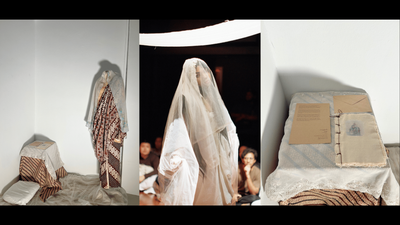
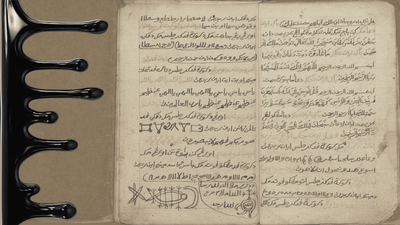
bani haykal, a Singaporean artist and musician, has long been fascinated by our fraught relationships with machines. Just before the pandemic, he gave a public lecture titled “sifrmu: intimate machines”. He began with our Anglophone understandings of intimacy: revealing what is “innermost”, “essential to”, or “indicative of one’s deepest nature” to another (Oxford English Dictionary, American Heritage Dictionary). Then, he turned to consider intimacy in Malay. “When someone says ‘mesranya tu dua ekor’ or ‘those two people are very mesra’, mesra denotes a couple of things,” he told us. “1. It is suggested that the two individuals are very close to one another; 2. Usually in the context of how it’s said, this example is riddled with moral judgment.” Later, I asked another native speaker of Malay if she understood mesra as synonymous with “intimacy”. She paused and wrinkled her nose. That has a really derogatory meaning.
But bani didn’t stop there. Mesra, he told us, suggests other kinds of interminglings between bodies. To absorb (menyerap), to blend (bersebati), to appropriate (sebati). To be in relationship with another, he concluded, is to necessarily be transformed by them, “a kind of memory making process where bodies lock into one [another]”. I’m a long-distance runner, and I once acquired the dreaded plantar fasciitis or “runner’s heel”. I couldn’t bear weight on my foot and the injury knocked me out for months. My physiotherapist had me wear orthotics, but cautioned me against using them long-term. Your heel will never heal if you do that. It’ll always be reliant on them; your weakened joints will mould themselves around the ankle guard, the insoles, the orthotics. When we absorb, or are absorbed into the life of someone, we become the prosthetic that is eventually accommodated by the body, so much so that the body cannot distinguish between the two.
Amanda Petrusich, the New Yorker music critic, lost her husband to two swift and sudden seizures. He was alive, and then he was dead. She set out to interrogate her crushing grief so that she might recover from it. As part of her journey, she spoke with Katherine Shear, the founder of Columbia University’s Center for Prolonged Grief. “Our closest relationships, especially when we’re living together—in particular, when we’re living together—have an impact on our immune system, our cardiovascular system, our sleep, our eating, probably the whole body,” Shear told her. It’s why we have the widowhood effect, where a surviving spouse often dies shortly after. A life is made sense of with others.
To tell the story of a person’s absence in the presence of all who were transformed by that person is, then, to create a fiction. There are no non-fictions between us, no matter the fidelity of the audio or video recorder. You may tell one version of it to yourself, while your best friend may recall another. Your lover may leave you, having co-written a chapter with you, and then you may find that their annotations, footnotes, and 10th-year-anniversary preface tells another tale of your time together.
Lerner’s nameless narrator admits he’d never been drawn to “unspoiled” landscapes and vistas. But he has an epiphany after wandering through an exhibition of glass flowers as a young man. It is in these tracts of evocative description that we remember Lerner is first a poet who can detonate an emotion in the shortest of sentences. “I would see cracks in the rock face as penciled, as a history of small decisions, and then experience the view as beautiful,” he writes. “I could will myself to see the rose and pink of a sunset as applied in touches or stains and then revert back to seeing it as natural; and so on...Eventually I’d call this ‘fiction.’” What, then, is the natural, non-fictive state of things, if nature is itself constantly intervening in and growing into other bits of nature?
Barthes poses a provocative question in the guise of a playful one in Criticism and Truth—about the “history of small decisions” that constitute the record of history in the Middle Ages. Where does “interpretation” begin in the making of history? With the scriptor, the one who copies without adding anything? Or the compilator, who does not add anything of their own? Perhaps the commentator, who furnishes the copied text with some context to make it intelligible? Certainly the auctor (the Latin root for “author”), who offers their own ideas, but always cross-references their views? You can almost see Barthes rubbing his hands with glee. It’s the compilator! He exclaims: “it is not necessary to add something of oneself to a text in order to ‘distort’ it: it suffices to quote it...to break it up: a new intelligibility is born immediately...” Within this paradigm, our conflicted narrator has not sinned. We are always already interpreting our histories. Yet the hierarchy of the scriptor, commentator, compilator, and auctor remains, just as journalists and biographers are now credentialled with the legitimacy to represent another.
The tiniest person attempting to assert her autonomy in Transcription is Emmie, Max’s young daughter. Her entire identity—all her conversations, her emotions, her decisions—is retold through her father’s propulsive voice and anxious gaze. Emmie is in the grip of ARFID, Avoidant/Restrictive Food Intake Disorder. Her parents beg her to have a bite of anything: a spoonful of peanut butter, a sip of soda, a square of chocolate. ARFID isn’t caused by anxieties over body image, but can arise from sensory aversions to the texture of food, or simply a lack of interest in eating—but really, as in the novel, sometimes no one knows. The winsome, waiflike Emmie floats through her father’s tell-all, subsisting on barely anything at all, unreadable in intention and unpredictable in action.
The solution that Lerner arrives at for Emmie’s food crisis is the perfect bookend to the novel’s tech crisis. She discovers unboxing videos on YouTube, and while watching them realises that she can keep some food down. She’s fascinated by the unboxing of “squishies”, squeezable foam toys often in the shape of food. Her parents are disconcerted but desperate enough that they encourage it. Perhaps a facsimile of food might lead to the actual consumption of food. Max tells the narrator, or perhaps he tells us: “It’s like the device takes you out of the real world, shields you from all the pressures and information, but then it administers this series of subtle sensory inputs and muffled shocks, these mild effects, as compensation for the unmanageable reality it’s made disappear. Which...maybe just is pornography, reducing all the complexity and messiness of an intimate encounter and offering a safer, addictive, milder, repeatable version of satisfaction in its stead”.
Safer, addictive, milder, repeatable. I thumb through all the videos I’ve taken on my phone, realising that every visual transcript I’ve kept is really a translation of experience. We see the clean external record of a scene or a situation, and none of the wonky plumbing beneath. You can place your camera, or your phone, wherever you like: but like you, it only gets one vantage point at a time, one side of the story.
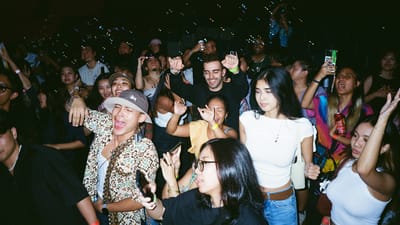
In June, I travelled to a music festival in Finnish lapland during the summer solstice, when the sun doesn’t set for several weeks. I wanted to remember a rare moment: the midnight sky striated pink and gold, everyone light-stunned and aglow, the thump of the bass through my feet and my bones. I recorded a one-minute video of a former lover and I dancing together on a sun-drenched hilltop, a farewell rave before we parted ways. We’re a little drunk and a little euphoric, grinning at each other as we bop to the beats. We also know the phone is looking at us, and like Lot’s wife, like Orpheus, we look back. We sometimes sway out of frame, but we always come back. Off the record, on the record. When we rewatch these intimate moments, what is it that we crave? The proof of the fact? The performance of the truth? The moment you had to leave—so that the record of it could stay?
Corrie Tan is Jom’s arts editor.
Letters in response to this piece can be sent to arts@jom.media. All will be considered for publication on our “Letters to the editor” page.
If you enjoy Jom’s work, do get a paid subscription today to support independent journalism in Singapore.