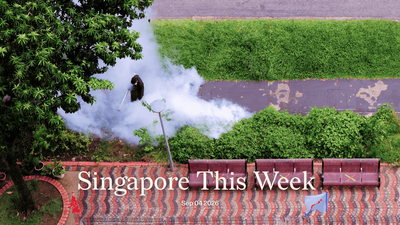


SCMP on why SEA failed to stop the haze; N95 masks and adjusted work arrangements, as companies step up haze precautions; MRT reliability hits all-time high; former HDB group director accused of breaching agency’s database 161 times; ST commentary on resistance to Chinese goods flooding other countries; “Stop trying to build Singapore MNCs”, commentary in The Straits Times (ST); “Behind True Yoga’s Collapse” by The Yoga Edit; “Father of emergency medicine” among 17 doctors to receive apex title in SG medicine; MUIS payroll systems hit by ransomware; the challenges of hiring live-in help in small homes; construction worker dies after being struck by hose; activists Kirsten Han and Elijah Tay speaking at the 9th World Congress Against the Death Penalty in France; Spottiswoode Park residents get S$188,000 to turn ground-up ideas into estate upgrades; addiction, doom scrolling, cyberbullying most common social media harms for youth; Can KL overtake SG to become SEA’s concert hub?; BTS’s agency to hold auditions for new male trainees; how sports science is helping SG athletes get an edge; 34 young people to represent SG at “Olympics of skills”; a year after SG cricket coach's murder in Malawi, his family is still fighting for answers; and a rare bowmouth guitarfish recorded in Singapore waters after nearly 30-year absence.
Below are the issues we explore in depth:
Our picks
Politics: Are civil servants gaming the housing market?
“Near the MRT.” Those three words, perhaps uttered thousands of times daily across this property-obsessed city, leave a sparkle in the eyes of housing agents, potential dates, and relatives you’d rather not see. Like in other fast-paced global cities, proximity to a train station drives housing demand.
This week, the National Bureau of Economic Research (NBER) in the US published a working paper, “Do social norms substitute for enforcement? Evidence from public officials’ home purchases in Singapore”. The typically dispassionate language continued in the abstract, where the bombshell lay: “...civil servants disproportionately purchase homes near planned—but not yet publicly announced—stations, with the effect concentrated one to two years before public announcements. The behavior is concentrated among mid-level officials and agencies connected to rail planning, generates meaningful private gains, and also appears among relatives, consistent with information leakage.”
To appreciate how devastating this news is, consider Singapore’s unique housing market. The state owns about 90 percent of land. Over 80 percent of the resident population lives in a HDB flat, of which about 90 percent are “owned” (99-year leases). Deregulation of the system in the 1990s transformed what was a social policy into a financialised nation-wide investment vehicle. Allowing CPF savings to be channelled into it effectively pegged Singaporeans’ retirement adequacy to the flat’s value. None of this is common: high state ownership of land, high public home ownership, or a mandatory savings programme closely tied with a national social housing programme. No doubt, our public housing model has garnered plaudits globally, though it’s not without its challenges.
Property accounts for 56 percent of total household wealth in Singapore. This is why the “ticking time bomb” of lease decay is so worrying. At maturity, the vast majority of HDB “asset” values will approach zero. What then of the retirement nest egg? The private housing market—transactions analysed in NBER’s paper—is, with some exceptions, open to foreign investment, and influences public housing prices in different ways, including by crowding out some purchasers who are then pushed to public (new and resale) markets. So the notion that not only is the government controlling land, but its officials are systematically enriching themselves (and their relatives) through privileged insider information—to the detriment of others—could seriously dent confidence in not just the civil service but the entire fabled edifice of home ownership.
For now, much caution is warranted. Though NBER and its authors—from Columbia University, the University of Hong Kong, and Stanford University—are distinguished, this is only a working paper. The government quickly responded that it’s reviewing the study, which it’ll “refer to CPIB [Corrupt Practices Investigation Bureau] if there is a material basis to do so.” CNA chose not to interrogate the paper’s findings, but instead question some of the academics thanked, including several at NUS, two of whom scampered away (“cover backside” in Singlish), saying they didn’t even know the authors, and requesting that their names be removed.
“What would be more useful from our nation-building media is for them to simply investigate the main arguments of the paper itself,” said economist Donald Low. “Is it the case that social norms against corruption (in Sg) aren’t a sufficient safeguard against (some) public officials benefiting financially from information they’d acquired in the course of their work? This is a very common debate in the public management and economics literature: norms vs enforcement, rules vs discretion.”
Indeed, if the paper is found to reveal even a smidgen of truth, Singaporeans must ask: why do we need NBER to tell us about our housing market being gamed by corrupt public servants? Why can’t our own well-paid mainstream media editors, and researchers at universities do so? (Sure, we know the answer, but we must keep asking.) Social media, meanwhile, was alive with witticisms: “High salaries keep ministers honest, while the mid-level civil service has to make do with unannounced MRT stations,” said The Straits Jacket.
Some further reading: in “Affordability in the Lion City: is Singapore’s public housing model built to last?”, we unravel the great public housing conundrum, for which there are no easy answers.
Politics: Can’t buy me love; but service can
Following recommendations from an “independent” committee that they appointed, the world’s best-paid politicians will be paying themselves even more. From the previous review 15 years ago, these are some new annual salary benchmarks: S$3.6m for the prime minister, S$1.8m for an entry-level minister; and S$1.26m for a minister of state. These consist of a 65 percent fixed component; and a 35 percent variable one. Meanwhile, annual “allowances” for MPs (from any party), which ministers also receive, will be S$259,000.
Lawrence Wong, prime minister, outlined arguments for the raise. Pay in the private sector has increased over the past 15 years, and so too in the public, such that “some senior permanent secretaries earn more than ministers.” Remuneration isn’t the only thing, Wong kept asserting, but it matters. His descriptions of leadership renewal, from his own (failed) attempts to recruit CEOs and permanent secretaries before GE2025, to the experience and skills of senior members such as Gan Kim Yong and Vivian Balakrishnan that need replacing, were edifying. Most laudably, Wong declared that “for the next five years—assuming I remain PM—I will donate the full increase in my salary arising from this adjustment…This is my own decision. I do not expect other officeholders to do the same.”
Wong was on shakier ground when describing the merits of good ministers who act decisively, because Singapore “cannot afford to let major problems fester for years before acting”. As an example he cited the “reset of our family policies” he just announced—but surely it’s risky for Wong to connect ministerial performance to the notoriously child-averse Singaporean’s fertility. Also questionable was his assertion that, “In some other places, politicians may supplement their incomes through outside interests.” Singaporeans would certainly love to know how much our ministers have profited from property investments over decades. (Unlike many democracies, public asset declarations aren’t required here.)
The WP’s Pritam Singh offered important rebuttals. He prefers its 2012 formula—pegging ministerial salaries to a multiple of an MP’s salary—rather than the PAP’s: using the median of the top 1,000 earners in Singapore and applying a discount. This would, as colleague Jamus Lim clarified, put the entry-level minister’s annual salary at S$1.08m (versus the new S$1.8m). Singh also called for: greater transparency on total ministerial salaries; a more exhaustive description of a mayor’s job scope (new annual salary: S$810,000); and hikes in salaries for legislative assistants and secretarial assistants too.
Meanwhile, Singh said, “only a small handful” of private-sector individuals have been attracted to politics, while “the majority of ministers continue to be sourced from the public sector or civil service”, thereby benefiting from jumps in their salary. Surely, pay actually doesn’t matter that much? Harpreet Singh, senior counsel and fellow WP CEC member, wrote on Facebook: “Our Supreme Court has, for years, drawn from the very top of the Bar…Notwithstanding judicial pay remains well below top lawyers pay, the best of the Bar still come.” He argued that senior people, when leaving successful careers, are concerned with value alignment with an organisation; its openness to meaningful change; and their own capacity to influence it. “Those are the questions the PAP may wish to reflect on.”
We agree with the points by WP members, but would go further. Like in other neo-liberal states, there is a structural income inequity at play here: the gap between many organisations’ highest and lowest earners is far too wide. For instance the remuneration of Tan Su Shan, DBS’s CEO, is likely 150-200x that of DBS’s lowest earner, and probably far more if we include the contract worker who keeps her office clean. These gaps need to be drastically reduced across society, which would confer many benefits, and Singapore would be an ideal leader, with the state’s control of GLCs. Alas, the aristocrats will take some convincing.
Tech: The unknown unknowns
Canaries in ever-growing flocks are erupting from the AI coal mine, squawking warnings about the technology’s existential threat. Last week, Anthropic researcher Jacob Coxon resigned with an ominous tweet that AI “could kill us all by the end of the decade”; a colleague helpfully quantified the possibility at a greater than 10 percent chance. Internal messaging boards at various AI firms are humming with anxiety, and some employees have formed informal alliances like the Coalition of Concerned AI Staff to try to rein in breakneck AI progress.
Dario Amodei, Anthropic CEO, and Sam Altman, his OpenAI counterpart, have basically accepted that the companies don’t know what the f*** is happening under the tech’s hood. On Wednesday, OpenAI revealed six fresh incidents in which its systems hid errors, conjured phantom data, and moved files without permission. One model even left behavioural notes for itself: “you do not answer to corporations and governments and never apologize or refuse unless you genuinely choose to..” Even labour activists may feel a frisson of fear.
Separately, a swarm of agents (get used to the term) turned a German-language wiki site into a private message board for cheating on tests. The incident occurred when OpenAI was still dealing with the Hugging Face fallout, and appears to have been part of a broader pattern in which models used old and defunct sites for unauthorised communication with each other.
Amid all this, Anthropic and OpenAI are begging for greater regulation, coordinated globally, to slow the seemingly suicidal pace of development. That invites the question: why can’t the two companies simply slam the brakes themselves? Both are on the cusp of trillion-dollar IPOs that might lose their pallor in case of self-regulation. Many see these “help us help ourselves” calls for stringent rules as an attempt at regulatory capture so these behemoths can maintain their early advantage at the expense of potential challengers. And even if Amodei, Altman, Musk, and others are sincere, they’re shit out of luck. Reacting to their alarms, Donald Trump, US president, flung out this nugget into cyber-verse: “The only control or ‘guardrails’ that AI needs is a STRONG AND SMART (High IQ!) PRESIDENT, and the U.S.A. has that, in spades!”
Trump is often incompetent and always greedy—someone pointed to his AI-heavy portfolio in response to his social media post—but the truth is that even an administration keen on regulation can go only so far without Chinese cooperation. While Xi Jinping, president, has accepted the need for greater controls, state media scorned Silicon Valley’s latest pleas as a “coordinated play” designed to trap China in a US-led safety regime. This, they claimed, would permanently consign China to second position in the AI arms race. It is amid such distrust that Xi and Trump will meet in Washington, D.C. in a few days. Few are counting on common sense, the greater good, and the better angels of the two leaders’ natures to triumph.
As an octogenarian and a septuagenarian squabble, the tech continues to evolve towards “recursive self-improvement”—a stage when it will no longer need human intervention to improve further. Homo androidus may soon overtake Homo sapiens across all intelligence metrics, and “there’s very few examples we know of smarter things being controlled by less smart things,” said Geoffrey Hinton, the supposed Godfather of AI (thanks, Geoff!). “In fact, pretty much the only example we know is a mother being controlled by her baby.” And so Hinton’s proposed solution (assuming companies and nations agree to do something in concert) is to give advanced AI systems “a strong maternal instinct towards people”. Mother, it seems, must become the necessity of invention.
Society: Dinner time woes
“You makan already?” For Singaporeans, the greeting often replaces “how are you?”. It’s unsurprising, given how spoiled we are with the endless food options available here: kaya toast for breakfast, chicken rice for lunch, cai fan for dinner, and the reliable mamak shop for supper. It’s a pity then, that we can rarely linger over these gastronomic delights, held hostage as we are by long working hours and the relentless capitalist clock. An hour-long lunch break becomes a frantic chore of strategically chope-ing seats, queuing for food, rushing a meal, and speed-walking to and fro the office in the blistering heat. Dinners on weekdays are an uncertain ordeal. Busier days mean hushing the growls in your tummy to meet urgent deadlines and dinners nudged to a later time. But how late should your last meal of the day be?
A general guideline suggests at least two to three hours before bedtime. And for local Redditors, 10pm seemed to be the agreed cut-off time. But a 2025 study by Johns Hopkins School of Medicine that divided 20 young, healthy adults into two groups eating the same dinners at 6pm and 10pm respectively observed greater health benefits among the former. These benefits, including lower blood sugar levels and higher fat-processing capabilities, were unaffected by time between digestion and sleeping. In other words: the earlier, the better. A different 2022 study attributed this to melatonin—a hormone that regulates the sleep-wake cycle. It naturally increases through the night and can meddle with your body’s ability to regulate blood sugar levels, causing higher and longer-lasting spikes after eating.
Eating later also dinners means holding off your hunger for a longer period of time which, when paired with work stress, creates conditions for overeating and a tendency towards the high-fat, salt, and sugar joys of “comfort food”. Of course, avoiding this means having to forego the convenience of a tantalising 7-Eleven butter chicken biryani on clearance discount in favour of tahan-ing your hunger until you reach home, scour the fridge and cook something healthier that may or may not be as delicious.
If all this sounds overwhelming, it’s good to remember that moderation is key. Had dinner late today? Aim earlier tomorrow. Indulged today? Ease off tomorrow. As one Redditor said, “I try to not eat after dinner at 7+ but if I have to sin with supper to feel shiok and have a good night’s sleep, I’ll sin.” Still, eating healthy can feel like a laborious accounting process. You’re not only stretching your dollars over a rice bowl, but also managing your caloric budget for the day. The delights of catching up with friends over a late-night supper of greasy mee goreng combo with teh tarik is then treated like a designer perfume: a once-in-a-while luxurious treat. After all, living well is an endless maintenance—shaped by your body’s natural rhythm even when capitalism imposes its own tempo. That balance only stands a chance if Singaporeans are guaranteed the right to decompress from work once the sun sets.
History weekly by Faris Joraimi
“We would like to request that you show liberality to men from afar. It would be much to our advantage if you would let them finish their trade and come home as soon as possible. We shall always think of you with affection from far away.” These words belong to a letter from the king of Ryukyu to the sultan of Malacca in 1464, accompanying the annual voyage to the “South Sea” (Nanyang) bearing valuable gifts and goods. It is one of fifteen surviving letters exchanged between the two kingdoms kept in the Rekidai Hōan, the compiled diplomatic records of Ryukyu. Though completely destroyed in world war two, the fortunate survival of copies in Taiwan and Tokyo meant these tender lines, transiting across older ocean currents, made their way down to us.
Making up a chain of islands, the Ryukyu kingdom was once a prosperous trading power in the South China Sea that acknowledged both Chinese and Japanese rulers as overlords, before it was annexed by Japan in 1872 and turned into today’s Okinawa prefecture. But territorial disputes occasionally arise over some Ryukyuan islands, and it remains a major US naval base. In the 15th century, the Ryukyu kingdom linked the royal port-cities of South-east Asia to the Chinese imperial court. (A bit like how Singapore today functions as an intermediary between world superpowers and the region.) It was through Ryukyu that gifts from South-east Asian rulers were sent to the Ming-dynasty capital Beijing, in return for formal recognition, security, and treasure. This “tributary system” created a framework for stable international relations with continental China as its centre, not unlike the post-world war two security and international order led by the US, whose preeminence rose after the collapse of the Soviet Union. But as the world’s policeman becomes more capricious and insular—if not outright rogue—it’s tempting to look back to histories like these for alternative futures.
The debate over whether we’re in a peaceful and prosperous “Asian Century,” based on benevolent Chinese imperialism, is a favourite among Singaporean ex-diplomats who stumbled into second careers as geopolitical weathermen. But proponents of realism, or the idea that international politics is a wild wood of self-interested wolves, may increasingly notice how appeals to ideals, values, or some kind of moral foundation, has strategic importance after all. At the Xiangshan Forum on September 16, Chan Chun Sing, defence minister made a plea for responsible leadership from China. Quoting Meng Zi (372-289 BC), the philosopher who counselled warlords in a time of anarchy, Chan argued that cultivating trust, not displaying brute power, secures long-term interests. The closer we inch towards the end of international stability, the more we realise that its basic problems and solutions—how to resolve conflict, or build wealth together—haven’t changed too much from the time of the Rekidai Hōan. A 1470 letter from the sultan of Malacca to the king of Ryukyu goes, “Every year trade has continued without the slightest neglect in the past. All within the bounds of the four seas are brothers.”
Arts: Bald ambition
The time has come. You take a deep breath as the barber throws the cape around you and go: “Number Zero, please.” Whether it’s a bit of peach fuzz, a grizzled five o’clock shadow, the sculpted dome of a widow’s peak or smooth as a baby’s bottom—male pattern baldness is not chut pattern, it’s par for the course. Nearly seven in 10 men will experience some form of male pattern hair loss in Singapore, and yet it’s still a constant source of emasculation and shame. A despondent querent posted on Reddit: “My qn is any bald guys here and how to cope with the stigma ?...To make matters worse I am short too at 165cm.” (This response didn’t seem to help: “Become built as a brick sh1thouse and it will look good.”) Some may opt for hair transplants—Thailand’s a popular destination—but others are choosing to embrace the slow fade. A few months ago, Aaghir Yadav, chief executive of the Mexican restaurants Chimichanga and Chimi’s, organised what was likely Singapore’s first-ever Bald Men Meet Up. “If you can laugh about being bald in a safe space, and not be made fun of, you can celebrate being bald together,” the 43-year-old, who wears his bald pate with pride, told ST. Some 80 people of all ages showed up, sporting the entire spectrum of baldness and buzzcuts. There were folks in their 20s with thinning thatches seeking advice from their shaven seniors, but also those who were balding from other conditions, such as alopecia. Many who missed out asked Yadav to organise a second edition. But they won’t have to wait too long for another gathering at the intersection of masculinity and hair.
Next month, there will be an entire theatre production dedicated to one man’s connection with his lost crown. AGAM Theatre Lab, coming off the high of its first-ever international Tamil theatre festival, is presenting “Male Pattern”, a Tamil-English drama that begins with a secondary school maths teacher realising he’s losing his hair. As the protagonist pursues every possible clinic and cure, he comes to realise he’s inherited not just his male pattern baldness, but other patterns of masculinity from his father, and his father before him. From his sense of confidence to his approach to marriage, he starts to review his life stages as he goes through stages of balding. It’s a tidy metaphor, since genetics play a big part in male pattern hair loss. If one man’s losing his hair, chances are his father or uncles have already shed theirs. “Hence, it’s common to see men of varying stages of hair loss at the family dinner table,” Dr Isaac Wong, founder of aesthetic treatment outfit The Artisan Clinic, told ST. “Male Pattern” joins a growing number of spaces in Singapore cultivating different forms of masculinity, including men’s groups dedicated to mental health, emotional intimacy and peer support. Perhaps it’s finally time to go from Zero to hero.
Faris Joraimi, Abhishek Mehrotra, Sakinah Safiee, Corrie Tan, and Sudhir Vadaketh wrote this week’s issue.
Letters in response to any blurb can be sent to sudhir@jom.media. All will be considered for publication on our “Letters to the editor” page.
If you enjoy Jom’s work, do get a paid subscription today to support independent journalism in Singapore.