
Dear Jomrade,
Today we’ve published:
- “Singapore This Week”, by Jom
- “Dreaming in the shadow of the CBD: raves and raving in Singapore”, by Clarissa Ng
As the world’s elite petrolheads jet in to hobnob with ministers at the race track, and dine on quintessentially Singaporean fare like caviar, they’ll be greeted by a changing city-state. The occasional exhaust flames from their beloved cars will almost certainly be overshadowed by the raging fires nearby, guaranteeing a skyline more reminiscent of some post-apocalyptic dawn, ala “Blade Runner”. Climate activists can be forgiven for feeling a bit of schadenfreude when high-consuming individuals, watching one of the world’s most pollutive sports, are smacked in the face by noxious vapours from our burning earth.
I hope they all stay safe, have a fab time here—and also think a bit harder about the impact of our collective actions on our planet.
Much less visible, but also of concern to plutocrats who regard us as a bastion to preserve their capital, were the suggestions this week of wealth taxes, including on inherited property—raised not in the swamps of Hong Lim by irascible, envious leftie nutjobs, but in Parliament by young PAP MPs. Following years of clamouring by commentators and opposition politicians, it’s gratifying to see the mainstreaming of this conversation. It’s our lead blurb in “Singapore This Week”.
And finally, this week is the third anniversary of Hamas’s October 7th war crimes, which precipitated Israel’s ongoing genocide in Gaza, for which Singaporeans bear moral responsibility. Just days after we published “In solidarity with our activists”, came the news of a PhD student allegedly deported simply for taking photographs of Singaporeans delivering letters in 2024 to the Ministry of Home Affairs. Their account on Instagram is heartbreaking and searing, combining their love for many aspects of Singapore with the seemingly appalling treatment by our police, including having their passport and phone confiscated for close to two years. It’s all very ICE-ish, and offers us, in this week, another moment to think about how and why we welcome some people into our society, but not others.
- Some 18 years after estate duties were abolished, is it time for SG to introduce an inheritance tax?
- Parley round-up: AVs, data centres, saving local F&B, support for firms, and charities
- This year’s Nobel in Physics reveals how we observe space from far below the South Pole
- The intricacies of workplace bullying, featuring SAP Asia
- As pilgrimages to Kusu Island dwindle, what are we losing?
Above are the issues we chose to explore in more depth.
Other news this week included: SG to join agreement on neutrality of the Panama Canal; AI adoption rises as digital economy grows to over S$144bn; SG does not require frontier AI developers to give model access; fresh grads, retrenched workers struggling to find job in tightening labour market; ST commentary on losing a job at 40; MOM weighs “action” against firms that can afford retrenchment benefits but refuse to pay; seven workplace deaths in a month in construction/transport sectors; a national serviceman died yesterday; eight public servants referred to police in relation to the NBER paper on property purchases near MRTs; third Singaporean on US’s “worst of worst” criminal list for coercing women into prostitution; the troubling, ICE-like case of a PhD student deported for taking photographs of a peaceful assembly; Shanmugam disagrees with High Court’s supposed leniency towards youth involved in scams, so new legislation imminent; CNA commentary on commuter fatigue from North-South Corridor construction; SCMP commentary on Singaporeans going “car-lite”; polyclinic priority queues and trained staff proposed for people with intellectual disabilities; sugar down but calories and sodium up, says the National Nutrition Survey; one in four office workers at risk of sleep apnoea; Healthier SG to offer bone density and other muscular tests for women; eight public libraries to open earlier; Crystal Jade in trouble; farewell, OldTown White Coffee; as recyclers scour garbage bins for cans, the government reminds us it’s illegal; and a farm stay in Changi Village for sale.
Join 1,700 members keeping Jom independent. From S$10/month—full access, no compromises.
“Dreaming in the shadow of the CBD: raves and raving in Singapore”, by Clarissa Ng
I love this piece partly because it reminds me of my youth, but mostly because it’s written by Clarissa, an NUS law student who interned at Jom this past summer. She’s not our youngest-ever writer—that’d be teenager Aryan, on living with epilepsy—but is our first intern to publish an essay, after spending a long, concerted time working on a draft, through multiple revisions, till it met our standards. Here’s her opening:
“Early in my raving days, I used to go alone. Clubs like Zouk, Drip, and Marquee were more often the spots of choice for my friends then. As hard as I tried to cajole them into coming with me, they weren’t into ‘underground’ electronic music. My first visit to Boat Quay’s Headquarters—better known and loved as HQ—was spent walking haplessly up and down the cigarette-littered brick street, checking and re-checking Google Maps for some kind of guidance. I eventually trailed a group of intimidating-looking people to the spot: an unmarked black doorway leading to a flight of grey stairs in between a sports bar and a Chinese restaurant. The poster by the door read, ‘This must be the place’. As a fledgling raver, fresh out of the painful conformity of Junior College and completely new to the scene, I remember feeling a certain anxiety and also a sense of adventure, a conspiratorial feeling like I was finally being let in on a secret I’d spent the larger part of my life searching for, as someone who felt like I never fully fit in.”
Thank you, Clarissa, for the hard work. (But still much easier than a law internship right?)
Jom joget,
Sudhir Vadaketh
Editor-in-chief, Jom
Jom on catharsis
 Jom
Jom
 Sakinah Safiee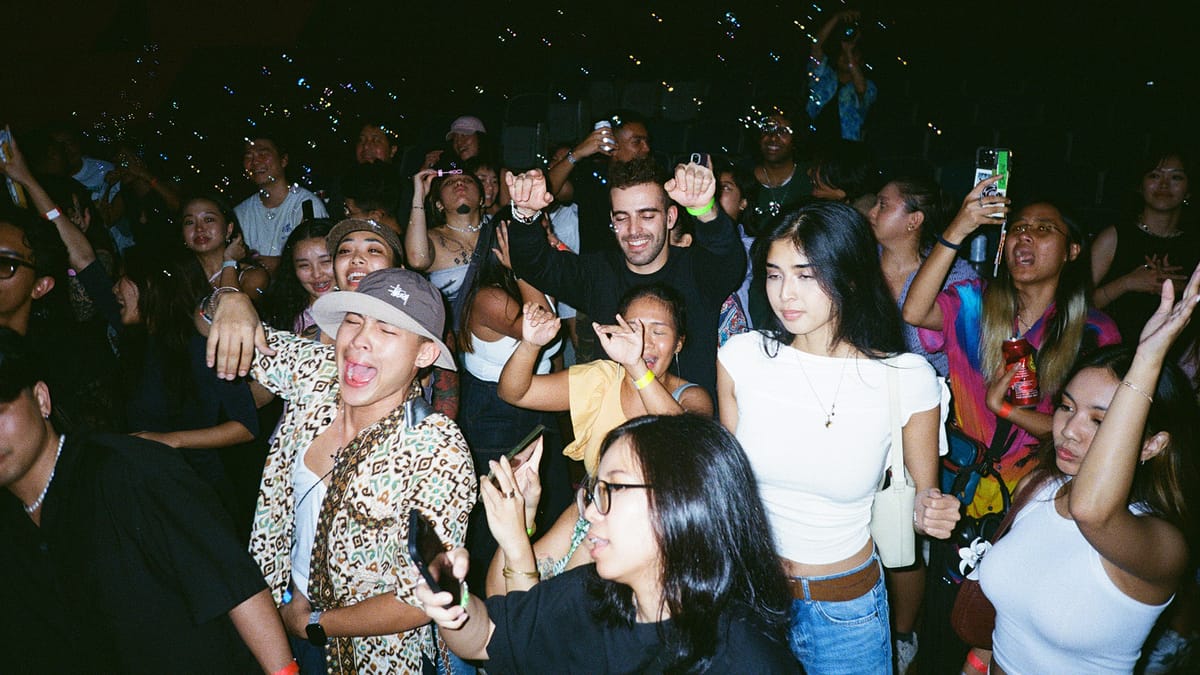
 Xingyun Shen
 Jean Hew
Singapore This Week
Science: Turning ice into a space telescope
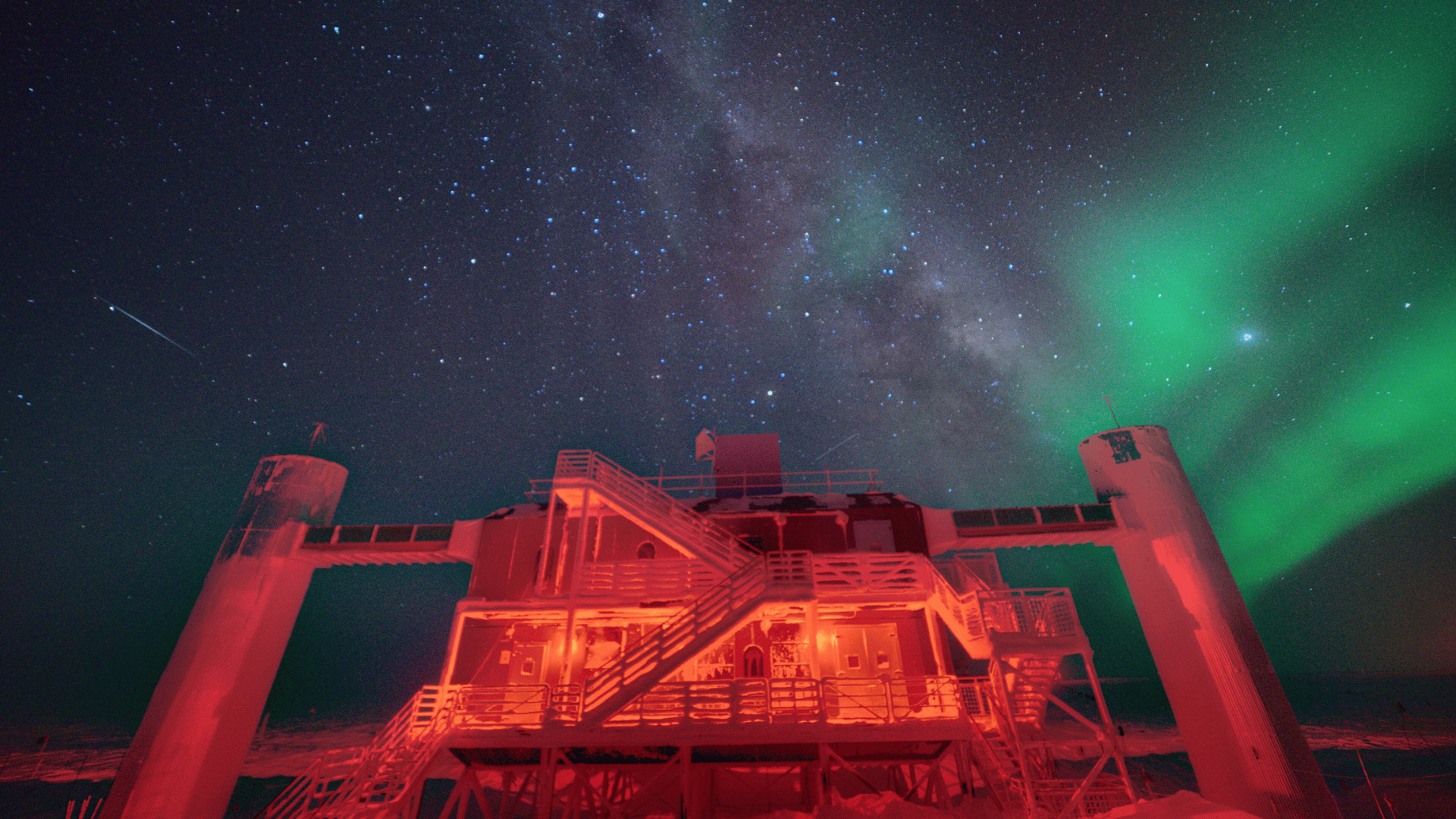
Among the inviolable laws of physics is the Law of Conservation of Energy, stating that energy can neither be created nor destroyed. But physicists in the early 20th century were driven to distraction when experiments involving a type of radioactivity, beta decay, indicated that part of its energy was simply disappearing. Some, like Niels Bohr, felt that the law broke down at the subatomic level; others, like Wolfgang Pauli proposed a “desperate” hypothesis: the reaction was producing a third, invisible particle carrying the missing energy. Another physicist, Enrico Fermi, christened this ghost particle “neutrino”—the little neutral one. Experiments in the 1950s confirmed the ghost was real. Just about. Neutrinos are nearly weightless, which allows them to streak through space at nearly light speed; they carry no electrical charge, so magnetic fields don’t knock them off course; and they interact so weakly with matter that they can pass through entire planets unimpeded. Trillions upon trillions pass through Earth, and all of us, daily.
Very occasionally, an infinitesimally tiny probability materialises and a neutrino slams into another atom. The collision creates a slightly less tiny particle which, in the right medium, say ice or water, hurtles along producing a faint blue trail of blue light. That trail holds clues to some of the most tantalising mysteries of the universe, including the origins of cosmic rays and the workings of supermassive black holes. For the longest time, scientists puzzled over how to capture large numbers of collisions and then capture the information (aka light) from those collisions in high fidelity. One of the early solutions mooted was light sensors placed deep within the ocean but that posed problems because of currents and potential interference from marine bioluminescence (although such set-ups do exist, notably in the Mediterranean Sea and Russia’s Lake Baikal). In the late 1980s, a Belgian-American physicist, Francis Halzen, alit on a different idea. How about drilling holes deep, deep into the Antarctic near the South Pole, lowering sensors through ice melted with hot water, and then letting it freeze around them? Ice from depths of around 1.5km is clear and quiet, allowing light from neutrino collisions to be captured with relatively little interference. In theory, the idea was sound. But the logistics were absurd. The rarity of neutrino collisions meant that a cubic kilometer of ice, enough to fill a million swimming pools, would have to be turned into an observatory to capture a meaningful number of collisions.
But after some smaller-scale experiments, Halzen convinced enough people at the American National Science Foundation (NSF) to fund the larger enterprise; by 2010, a quarter-century after the idea first popped into his head, Halzen had his IceCube Neutrino Observatory, equipped with some 5,500 optical sensors that could capture light from numerous neutrino collisions, each pushing further our understanding of the universe’s magnificent workings. In 2017, IceCube detected a neutrino that had travelled some four billion years (for context, the Earth is around 4.6bn years old) from the direction of a galaxy powered by a supermassive black hole. It was the first strong evidence linking a high-energy neutrino—lower energy ones are produced regularly within our solar system—to a known cosmic source. A similar discovery followed in 2022. This week, Halzen was awarded the Nobel Prize in Physics, the first solo winner in over three decades.
Neutrinos, cosmic rays, black holes. Why should they matter? Some of the most advanced tools at our disposal today are based on a deep understanding of fundamental science. The inventors of quantum mechanics could hardly have foreseen semiconductors; Einstein likely wasn’t thinking of GPS when dreaming up his theories of relativity; and scientists playing around with magnets weren’t envisioning MRI machines. IceCube may or may not birth similar material gains, but pursuits powered by curiosity—be it Halzen doggedly trying to study neutrinos or you relentlessly trying to figure out where socks disappear—are quintessentially human.
Other stuff we like
“A very safe place.” The New Yorker has just published a haunting short story by writer Rachel Heng, of The Great Reclamation fame. A Singaporean child’s regular, rules-bound life is upturned by the shock arrival of a stranger—but also by the surprising generosity of his parents.
Catch IDENTITÉ at Rasa Space. A monthly Singapore-based independent live music series connecting music, community, and youth culture with contemporary independent creative practice. This month’s lineup features local producers Young S.E, Cravism, and Fauxe. Happening next Fri, Oct 16, at 7:30pm, S$30 entry.
A flavour of Jom. Occasionally, Jom publishes essays outside the paywall. These are on issues we think are in the public interest, and deserve a wider airing. In the past two years, we have published nearly 50 such pieces. Read some of these if you’d like to see samples of our work. We hope they’ll convince you to subscribe. And even if you’re here with no intention of doing so, we hope you’ll enjoy these offerings and consider it time well spent!