
Early in my raving days, I used to go alone. Clubs like Zouk, Drip, and Marquee were more often the spots of choice for my friends then. As hard as I tried to cajole them into coming with me, they weren’t into “underground” electronic music. My first visit to Boat Quay’s Headquarters—better known and loved as HQ—was spent walking haplessly up and down the cigarette-littered brick street, checking and re-checking Google Maps for some kind of guidance. I eventually trailed a group of intimidating-looking people to the spot: an unmarked black doorway leading to a flight of grey stairs in between a sports bar and a Chinese restaurant. The poster by the door read, “This must be the place”. As a fledgling raver, fresh out of the painful conformity of Junior College and completely new to the scene, I remember feeling a certain anxiety and also a sense of adventure, a conspiratorial feeling like I was finally being let in on a secret I’d spent the larger part of my life searching for, as someone who felt like I never fully fit in.
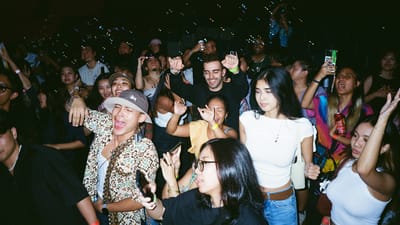
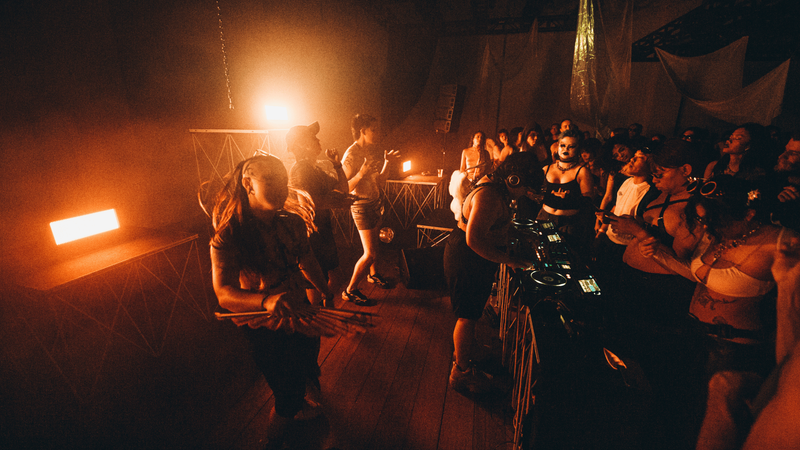
It was completely dark save for the red lasers piercing the space from the projector over the DJ booth, which lay inside a forbidding black cage. I have difficulty recalling what else that first time was like. My first memory of HQ is now a palimpsest, merged with every other memory of every other ecstatic night spent there, alone, with friends, too drunk, completely sober, lost in the music, or not really feeling it. What remains constant across all these memories though, is the dark roiling mass of bodies, their freedom and abandon, and how the sound consumes and dissolves you the moment you step into the room. No matter the music, the room has a way of drawing you in and making you a part of itself.
Countless raves by countless collectives have populated that narrow, red-lit, graffiti-laden room. HQ was a second home: where to go when bored on a Wednesday night, where to go after drinks on a weekend when the night was far too young, where the music was always solid and the faces always familiar.
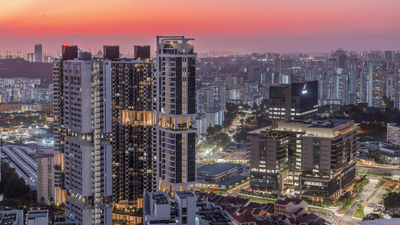
Many a night were spent on the second floor balcony with friends, most of us in some outrageous outfit or another, chatting and resting our feet, sore from dancing. A four-on-the-floor beat thrummed through the floor, just barely shaking the tables outside. It smelled of humid night air and cigarette smoke and somebody’s spilled drink. The skyscrapers of the CBD loomed large over the river—Maybank, Standard Chartered, DBS, some others I can’t conjure up in my memory. These monoliths dwarfed the tiny red room behind me, and all the strange, wonderful people in it. There was an unpleasant feeling of sublimity; an infinitely stretching smallness in the face of this overweening skyline.
This sanctuary, sitting steadfastly in the reified heart of Singaporean neoliberal “success”, closed earlier this year. It leaves in its wake the bittersweetness of memory, and a poignant hope. The freedom and safe haven it once provided to all those ill-fitted to the well-oiled machine that is Singapore reminds me that it is always possible, despite everything, to dream of alternate, freer, futures in the shadow of the present.
Raves began in the late 1980s and early 1990s as illegal and grassroots-organised parties, held in the countryside or in abandoned warehouses. In contrast with club culture, raves did not concern themselves with the hierarchies of financial resources or status. For instance, if “opening” a table at a club allows one to avoid the squeeze and sweat of the crowd—akin to living in a gated community, a status symbol—raves offer no such option. The dance floor is the dance floor, no matter how deep your pockets. The rave is, aspirationally, an egalitarian space where everybody is equal and everybody is welcome, one in the love for the music.
Music lies at the core of the rave. Whereas clubbing may be seen as a primarily social event, perhaps to pick up a partner or display one’s wealth, raves are centred around music—and the community, which has a shared, deep, authentic love for it. An exploration of what raves are thus cannot gloss over an exploration of their sound.
The music commonly played at raves include house and techno—the most popular genres generally—as well as trance, jungle, gabber, and others. Most, if not all, originated from marginalised communities. House was pioneered by queer black and brown communities in Chicago, notably Frankie Knuckles, co-founder of The Warehouse, a black gay club from which house gets its name. Techno was the afrofuturist brainchild of black youth communities in Detroit, pioneered by legendary collectives like Underground Resistance, and associated figures like Jeff “the Wizard” Mills (whom some of us had the privilege of watching recently in Singapore). As for the genres across the Atlantic, jungle grew out of immigrant Jamaican soundsystem culture in the UK, and gabber originated from working-class youth in the Netherlands. The music was an answer to all manner of communal pain: racism, homophobia, transphobia, economic disenfranchisement, and the like.
In Singapore, older ravers attest to a thriving underground scene, held in industrial areas like Tanjong Pagar and other unconventional venues, playing genres like trance, techno, and bass. Like today, it comprised independent organisers, separate from large mainstream clubs, bringing fellow music lovers together. One of the long-standing purveyors of rave music was HQ, co-founded in 2016 by the late Eileen Chan, also known by her DJ name Cats on Crack, and Clement Chin. As chronicled in Resident Advisor’s tribute following her passing in 2022, she was one of those responsible for building up the local rave scene, both inviting regional talents as well as international DJs like Peggy Gou and Amelie Lens to Singapore.
Some recent raves in Singapore have been centred around newer, internet-based genres like hyperpop, sextrance, and broadly speaking, underground internet music, by artists like SOPHIE, Charli XCX, 2hollis, DJ G2G, and beansclub, to name a few. Music from the Global South has also seen a surge in popularity here, with genres like budots from the Philippines (pioneered by DJ Love), baile funk from Brazil’s favelas, and gqom from South Africa.
The existence of the rave has always been political; as a safe space for the marginalised and the othered, and as a rebellion against bourgeois expectations of propriety, “respectability”, and economic productivity. In recent years, the concept of the “rave” has been used relatively loosely, following its increasing virality as a social media phenomenon. In Singapore the aesthetic has famously been co-opted by the matcha pilates wellness ideology and Beans and Beats, a coffee roaster and music collective. While there is certainly a place and demographic for sober daytime parties, the association with, and sometimes overt marketing, of these events as “raves” drew rejection from the local rave community. The reason is relatively straightforward: they adopt the trappings of the rave, but strip it of its transgressive, liberatory heart. (The late-stage capitalist caricature was only brightened when Beans and Beats’s founder later revealed his evangelical intentions.)
In “Baroque Starbursts”, cultural theorist Mark Fisher describes how the raves of the 1990s threatened the Thatcherite neoliberal cultural order. Fisher argued that raves, in recalling the collective ecstasy and “decadent” leisure of pre-industrial society’s festivals, presented an alternative to the dominant capitalist mode of being. The common people in pre-capitalist Northern European society, he said, enjoyed much free time and many public holidays, with at least one third of the year set aside for leisure. Capitalism’s ascendancy strangled this unproductive leisure culture. The propagation of “a dismal cult of work”, Fisher said, “extolled the virtue of hard work while condemning any use of time not devoted to capital accumulation as profligate and morally degenerate.”
The rave thus threatens this “rational”, productivity-and-capital-maximising way of life by reintroducing the decadent, the excessive, and the wasteful. Raving is associated with all kinds of unproductive excess: intoxication, bright flashing lights, loud music, ostentatious dress, inhumanly long waking hours. It is, in the terminology of French philosopher Georges Bataille, a sovereign activity—an unapologetic and joyous waste of time, resources, and energy—for no economic end but enjoyment itself, something sacrilegious to a strictly utilitarian and productive way of life. (Dynamics only too familiar to Singaporeans—both in personal and political life—thus sharpening the significance of raving for many here.)
Fisher argues that the rave imagines a world in which modern technology (which made the rave possible) is used to generate more leisure time for all; where people are not perpetually subjugated to the “dismal cult of work”, where pleasure is not “[distributed] in small separate doses”. The rave asks, “Why should rave ever end? Why should there be any miserable Monday mornings for anyone?”
Fisher concludes his discussion of the liberatory potential of raves by quoting literary theorist Fredric Jameson’s Valences of the Dialectic: “‘From time to time...like a diseased eyeball in which disturbing flashes of light are perceived or like those baroque sunbursts in which rays of [sic] from another world suddenly break into this one, we are reminded that Utopia exists and that other systems, other spaces are still possible.’...So it is perhaps better to see the other possibilities that these baroque sunbursts illuminate not as some distant Utopia, but as a carnival that is achingly proximate, a spectre haunting even—especially—the most miserably de-socialised spaces.” [Emphases added.]
Much of the theorising and exposition about raves and their nature is situated in a completely different space and time. America and Europe, the late 80s to early 2000s. But what of Singapore in the 2020s?
I think it is appropriate to begin with what the local rave scene has achieved (and it is an admirable amount, especially given draconian nightlife laws and licensing woes). Given the internal diversity of the rave scene in Singapore—each collective has its own ethos, aesthetic vision, and genre—I will discuss these questions in relation to the particular collectives closest to my heart.
Queer rave collectives such as Ringtone, Bussy Temple, and Hyperfocus have created safe spaces for all manner of queer expression and art. I remember my first ever rave being a Ringtone party held at Epiphyte Bar in 2023. Having come from a conservative social milieu where I had stifled myself in fear of judgment and ridicule, stepping into that bar and seeing partygoers in their rave regalia, freely giving themselves over to the music, was life-changing. I credit these collectives with the destruction of the panoptic voice in my head surveilling and limiting my horizons of being in the world. These spaces are queer joy, as well as queer angst, manifest. The music is both catharsis and celebration.
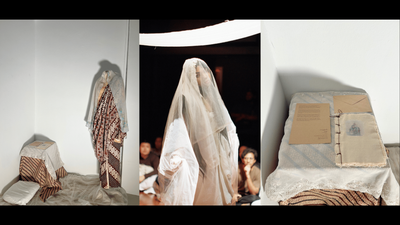
Beyond a safe space, collective Bussy Temple also constructs a relentlessly utopian vision of possible queer futures. Its raves are not just raves, but manifestoes centering around themes of fluidity, transformation, community, and reflection. Each iteration is an exercise in world-building, with the space itself being transformed with elaborate lighting and set pieces, and often featuring performances which further explore the themes of each rave. Examples of such performance art include live bondage rituals and ethereal vocal accompaniments to DJ sets. Written passages also are posted on Bussy Temple’s social media page which further expand on the ideas and themes of each party. The collective is currently presenting its work at Padimai Art & Tech Studio at Singapore Art Museum (SAM) for the exhibition “Islands in the Net: Southeast Asian Futures in the Age of AI”, and reimagined the space as a rave in September, very much in keeping with its ethos of metamorphosis and the queering of place to make space for the rave.
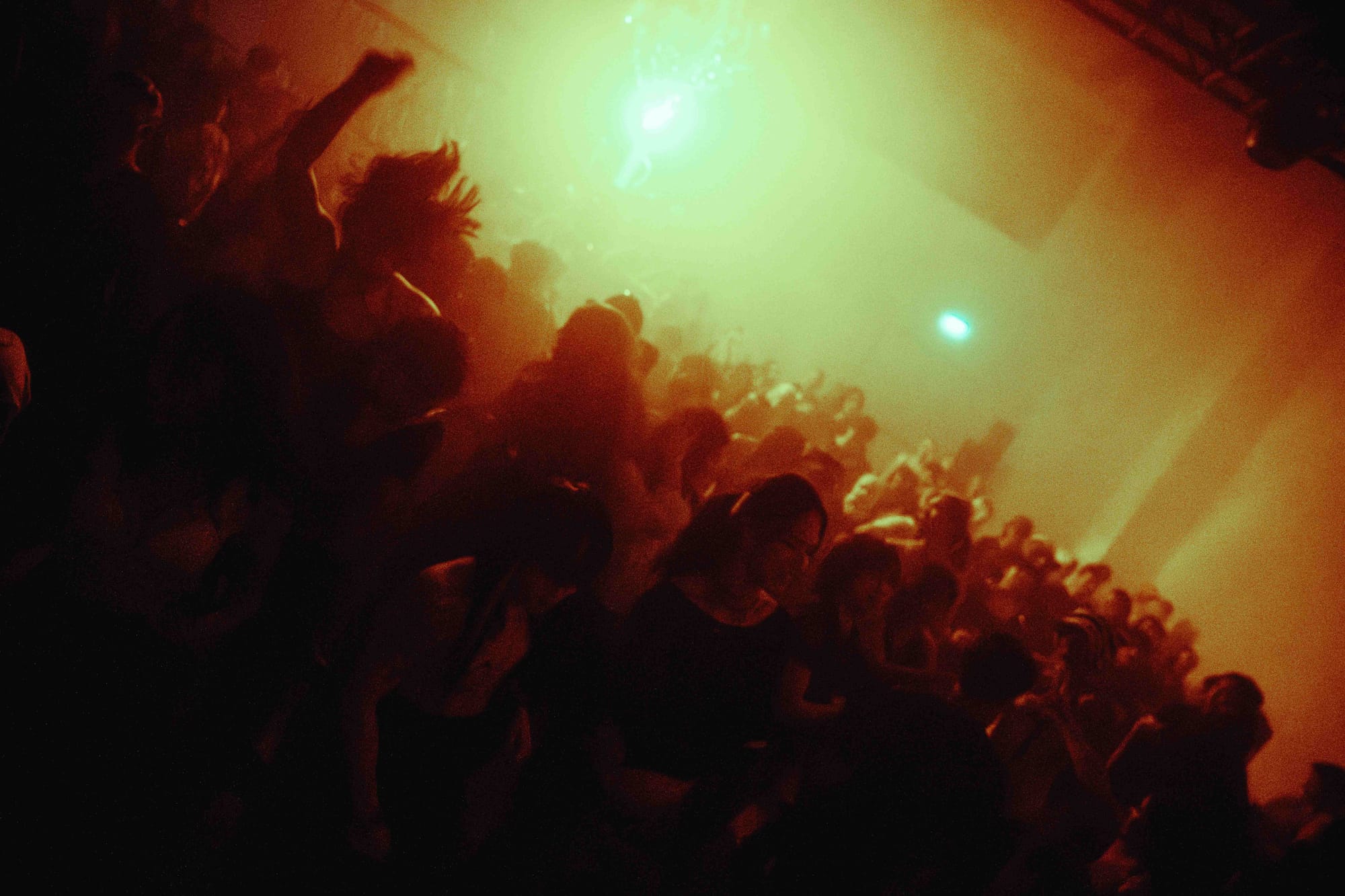
Speaking of place/space, Bussy Temple raves always feature the Sanctuary—a space away from the ecstatic chaos of the dancefloor, where ravegoers can rest, chat, and make friends. Community building features prominently in the collective’s practices, which have previously included a community dialogue on future directions for the collective and other queer raves in Singapore, as well as a pre-rave tea ceremony and performance lecture. Bussy Temple’s unabashed queerness, in combination with its focus on community building and progressive politics, presents, in my view, the most promising instance of the rave as a site for positive civic and socio-political action. It is not only a negative rebellion against conservative repression, but also a positive, community-driven project to create a freer and more just version of the world.
An excerpt from the collective’s manifesto puts it best: “Our unapologetic impurities become our catalyst: towards new embodied vocabularies, towards liberation, towards new possibilities. It is our utopia in action, an open-source code for collective world-building. …Queer kin to queer kin, we sprout networks of interconnected being, building up our care practices in the smallest - then largest - of ways. Bussy Temple is a reminder that none of us exist in isolation. We feel safer to exist when we are held by one another.”
Bussy Temple has successfully created a sanctuary for the queer, the othered, and the “weird” in Singapore. There is no other place where I have seen such an unleashing of creative, unapologetically queer energy, which has been held and uplifted so strongly by the space and community itself. I think it is a testament to the collective’s work that I, a generally self-conscious person, felt safe enough from judgment to don a full face of corpse paint and blackout sclera contacts to their recent rave at T:Works. Never in my life did I imagine there would be a place for me to outwardly embody my inner monstrous feminine, a concept near and dear to my heart for a plethora of personal reasons.
Besides Bussy Temple, collectives Ringtone and Hyperfocus also have donated proceeds of their events to humanitarian aid organisations operating in Gaza. Community tickets are also a common feature of these raves, where members of the community who have difficulty affording tickets can get free or discounted entry. These initiatives reflect a concrete commitment to the progressive politics associated with the rave, and not just in espousing those values, but acting on them as well, even in the face of the financial difficulties that plague all of nightlife.
Hyperfocus is one of the collectives at the forefront of the underground sonic movement. In the organisers’ own words, “[T]he whole idea behind Hyperfocus was to highlight music and artists that we felt fell out of the radar of the Singapore club scene….we wanted to introduce more forward thinking club sounds that incorporate everything from global to very experimental music, bridging everything we love together.” There are few other parties in Singapore at which you get to hear everything from queer latin club icon DJ G2G’s relentless sound to the nostalgic camp of Skrillex and Marshmello, to internet-pilled underground music like Esdeekid and Crystal Castles. Collectives like this carve out a niche within a niche, nodding to the globalised, eclectic, and hyper-specific (hyper-focused, one could say) tastes of the internet generation. When I heard Skrillex’s “Scary Monsters and Nice Sprites” played at HQ’s second floor, usually reserved for house music, amidst a crowd of equally amused chronically online people, I felt a particular wellspring of joy—a kind of magical understanding and appreciation between the organisers and the crowd in their love for the music, informed by a shared, very online cultural milieu.
The survival of these smaller collectives thus far is also testament to the fact that despite the pullulation of large, commercialised parties under the name “rave”, the rave has not been entirely co-opted by capital or mass culture. The tension between pushing the envelope in terms of genre and sound, and appealing to a large enough audience to keep the raves sustainable is an inevitable quandary the organisers have faced, especially in light of high venue costs.
Raves in Singapore must, to a certain extent, capitulate to state regulations on venue and alcohol licensing, and as such also to the commercial logic which is structurally embedded in such regulations. Legal venues are not free, and in fact usually very expensive to rent. Non-club venues also face the financial challenges of paying for liquor and entertainment licensing, sourcing and setting up sound and light equipment, crowd control, and more.
Recall the free parties of Anglo-European rave mythos: illegal, underground, spread by word of mouth, often held at abandoned warehouses and rural areas, far from state surveillance. These are simply not possible at scale in our dense, urban city.
Singapore law imposes hefty fines for unlicensed events under the Public Entertainments Act (up to S$20,000 for organisers), and there is a right to arrest anyone reasonably suspected of organising an unlicensed event. Noise complaints also invariably draw police intervention. Ravegoers are often part of communities already vulnerable to policing, and participation in illegal raves may expose them to further legal liability beyond mere participation. A tension thus emerges between the desire to create a liberatory space genuinely free from the constraints of tightly-regulated Singapore, and the need to protect the very communities these raves are meant to serve.
Collectives have thus understandably erred on the side of caution; warehouse raves are entirely licensed and legal, and unconventional venues have been generally avoided for fear of noise complaints and police raids. One such free party-adjacent experiment at which I was in attendance was Bussy Temple’s Amorphous rave. It was held at a studio on the ground floor of a HDB estate housing low-income communities. Eventually, after several noise complaints, the police raided and shut down the party prematurely, leaving residents, ravers, and the organisers alike shaken. Three-way tensions were palpable: for instance, ravers questioned the problematic choice of venue, specifically rental housing populated by many elderly people. Bussy Temple adapted to the feedback, thereafter choosing spaces like art galleries and theatre spaces. It was a striking example of how the impromptu, illegal texture of raves as seen overseas rubs up uncomfortably against Singapore-specific constraints; social, spatial, and legal.
The acquiescence to regulation, in my view, was ultimately a necessary decision that puts the concept of the “rave” in Singapore in an odd liminal space; transgressive, yet within the limits of the law; anti-establishment, but not to the extent of attracting state reprisal. This is the uncomfortable space that all movements at the margins in Singapore find themselves in, be it art, activism, or raves. It feels as if the spectre of a different kind of world must remain a spectre, just barely visible, in the overweening shadow of the present.
A kind of pessimism pervades the zeitgeist; a resignation to this being “just how things are”. I sense it in the nihilistic hedonism of some ravers (including myself). We are all fucked, declared the poster hanging behind the DJ booth on the second floor of HQ. In this climate, the rave becomes, more than anything, a site of escapism (HQ is now named Exit Reality, a rather on-the-nose rebrand). But that escape is painfully ephemeral. The music stops at three or four a.m. The sun always rises, the buses always start running again, the joggers emerge from their slumber to start the day like urban cockerels. The suspended reality of the rave dissolves in the cruel inevitability of morning.
And yet, in spite of this, I hold on to the hope that the rave can continue to be not merely a fleeting safe haven, but a site for communities to gather and connections to form, which will persist off of the dancefloor and in the daylight. The rave unleashes our collective frustrations and holds space for our collective dreams, but what we do in the waking hours is what will make the difference in the long term. Activism, volunteering, and mutual care and support within the community are necessary parts of the rave’s liberatory machinery. The dreams we see need not forever be relegated only to the wee hours of the night. With our collective efforts, we may live to see them blossom into reality, like rays of light from another world of our own imagining.
Clarissa is a law student and avid music and book enjoyer. She interests herself with subculture, the Internet, and intermittently, theory.
Letters in response to this piece can be sent to sudhir@jom.media. All will be considered for publication on our “Letters to the editor” page.
If you enjoy Jom’s work, do get a paid subscription today to support independent journalism in Singapore.