

News this week included: SG to join agreement on neutrality of the Panama Canal; AI adoption rises as digital economy grows to over S$144bn; SG does not require frontier AI developers to give model access; fresh grads, retrenched workers struggling to find job in tightening labour market; ST commentary on losing a job at 40; MOM weighs “action” against firms that can afford retrenchment benefits but refuse to pay; seven workplace deaths in a month in construction/transport sectors; a national serviceman died yesterday; eight public servants referred to police in relation to the NBER paper on property purchases near MRTs; third Singaporean on US’s “worst of worst” criminal list for coercing women into prostitution; the troubling, ICE-like case of a PhD student deported for taking photographs of a peaceful assembly; Shanmugam disagrees with High Court’s supposed leniency towards youth involved in scams, so new legislation imminent; CNA commentary on commuter fatigue from North-South Corridor construction; SCMP commentary on Singaporeans going “car-lite”; polyclinic priority queues and trained staff proposed for people with intellectual disabilities; sugar down but calories and sodium up, says the National Nutrition Survey; one in four office workers at risk of sleep apnoea; Healthier SG to offer bone density and other muscular tests for women; eight public libraries to open earlier; Crystal Jade in trouble; farewell, OldTown White Coffee; as recyclers scour garbage bins for cans, the government reminds us it’s illegal; and a farm stay in Changi Village for sale.
Below are the issues we explore in depth:
Politics: Tax the rich, by the PAP’s young guns
When you make money from a property investment, how much should you credit your financial nous versus factors beyond your control? An individual’s response to that can reveal their broader ideological stance. Lefties, for instance, would point to numerous actors—from the roadsweeper and police officer keeping your streets sanitised to dock workers and others far away keeping the economy humming—as important contributors whose rewards aren’t commensurate, particularly in red-hot property markets that attract global investment. The property gains, in other words, are mostly privatised by those with the means to invest.
Governments have long used tax policy to mitigate this. Singapore’s property taxes have become increasingly progressive in recent years, but much more can be done. “Tax policy allows us to shape society according to the values that we want to nurture. This should become increasingly important as a policy goal,” said Shawn Loh, MP with the ruling People’s Action Party (PAP), during this week’s debate in Parliament over the Finance (Income Taxes) Bill. This was a prelude to encouraging philanthropic giving, corporate volunteerism, and reducing wealth inequality across generations. “This will get worse, and more entrenched, as wealth gets passed down from generation to generation.”
Given that much local wealth is stored in property and its appreciation is due to “the nation’s collective success”, Loh said, the increase “should be shared with those that have less”. He said the government should be willing to: increase taxes further, especially for “higher-value properties that are for investment”. His colleague Elysa Chen suggested similar measures, and criticised “hoarding” by pointing to a High Court case last year involving a woman with 25 properties. Singapore should make it “less attractive to hoard homes, and correspondingly more attractive” to invest in private enterprises, Chen said.
Loh also called for inherited wealth to be taxed, suggesting that it could apply to perhaps the top one percent of properties, and that the tax could be deferred till the property gain is realised. This specific proposal would debunk the usual (defensive and mostly self-interested) arguments against inheritance taxes: that they might result in “leakage” as footloose capital flees; and that they might unintentionally hurt the middle class, less accustomed to using innovative tax structures to preserve wealth, more.
In 2007 Warren Buffet called dynastic wealth “the enemy of meritocracy”. Last year The Economist warned that the “return of the inheritocracy”, in which inheriting is becoming nearly as important as working, was dangerous for capitalism and society. From California’s proposed billionaire tax to Zohran Mamdani’s pied-à-terre tax—on secondary homes worth over US$5m (S$6.4m)—politicians everywhere are responding.
Singapore’s property woes are arguably worsened by our unique housing market, in which the state owns about 90 percent of the land. Property investors range from those who buy freehold land to those—the vast majority—who can afford only “subsidised” government housing with 99-year leases. In other words, the former hold assets which will presumably keep growing perpetually, while the latter are effective “renters”, whose HDB homes will (mostly) approach zero value at maturity. This is at the heart of worries about intergenerational wealth inequality.
To address it, Jom would go much further than Chen and Loh. Why not an inheritance tax on, say, the top 10 percent of properties? Still, perhaps baby steps are needed for a society so indoctrinated in the virtues of upward mobility through property. The PAP abolished estate duties in 2008, and that it now speaks openly about an inheritance tax—arguably a more precise instrument—is surely testament to long-standing calls from The Workers’ Party. The one-and-a-half party system working well?
Some further reading: “Should Singapore tax the wealthy more?”, a 2014 essay for the Institute of Policy Studies by Jom’s editor-in-chief
Politics: Parley round-up
A busy week saw a range of other issues discussed. “Will there still be enough trips for our drivers to earn a decent living?” asked PAP MP Yeo Wan Ling, given the advance of autonomous vehicles (AVs), in relation to the Land Transport and Related Matters Bill, which among other things proposes extending the existing regulatory sandbox for AVs till December 2028.
A Digital Infrastructure Bill, meanwhile, introduces new licensing regimes for major data centres and cloud service providers, to boost their security and resilience while (purportedly) mitigating environmental harm. The regime’s impact on competitiveness was of interest to MPs across the aisle, along with concerns about electricity and water demand. Dennis Tan from the Workers’ Party (WP) questioned the exemptions for data centres operated by government agencies and statutory boards; while his colleague He Ting Ru said the global data-centre “arms race compromises our ability to meet our climate targets.” In a speech filled with references that’ll please the eco-conscious, she asked why local data centre operators, unlike say those in the EU, won’t be required to publicly report environmental data. “Just like we mandate listed companies and large non-listed companies to publicly report carbon emissions, requiring disclosures such as water consumption, energy needs and noise pollution should be considered.”
In an Adjournment Motion on the food and beverage (F&B) sector, the WP’s Jamus Lim, known for sharing his home-cooking exploits on social media, warned that “chain concepts from foreign shores, especially China, have barged into the local market”. We cannot allow the local F&B scene, he said, to be “a guinea pig for the market-share aspirations of such foreign chain restaurants, lest we inadvertently surrender a core part of our intangible cultural heritage.”
The economist explained why notions around productivity gains with tradeable services like finance do not easily apply to non-tradeable ones, like F&B. Among his numerous suggestions were allowances, amid foreign-recruitment caps, for operators to hire Malaysians, “who clearly share our hawker culture”, as stall assistants; and ways to reduce rentals, including valuation discounts on land intended for hawker centres, and caps on annual rental increases. Low Yen Ling, senior minister of state for energy and trade and industry, refuted these, warning against market distortions. Given the obvious problems our hawkers are facing, we agree with Lim that more protectionism is warranted.
SMEs are certainly getting help. In the aforementioned finance bill, Singapore raised the Corporate Income Tax rebate, for firms with at least one local employee, to 50 percent, with a minimum of S$2,000 and capped at S$40,000. “This floor effectively gives S$2,000 to each unprofitable company,” said the PAP’s Shawn Loh. He prefers if only profitable firms get it. But if support is extended to all, then “it would be better to tie it to jobs, such as time-limited wage subsidies for hiring, especially hiring those who are long-term unemployed.”
The WP’s Lim, citing SMEs who are “struggling mightily to make ends meet”, questioned whether “S$2,000 is a sufficient lifeline for lossmaking firms, one that is broadly proportional to the extent of support received by profitable firms.” In a society that still valorises business interests, often at the expense of workers’, Singaporeans must ponder these allocations of limited taxpayer dollars. Should loss-making firms even be getting any support? And if so, is S$2,000 sufficient?
Finally, with regards to charities, Lim made a compelling argument about the difficulties many have in attaining the cherished Institutions of a Public Character (IPC) status. We agree that Singapore should “consider expanding the scope of tax-deductibility, to include non-IPC charities that have a demonstrable record of sound operations and clear contributions to Singaporean society as a whole.”
Science: Turning ice into a space telescope
Among the inviolable laws of physics is the Law of Conservation of Energy, stating that energy can neither be created nor destroyed. But physicists in the early 20th century were driven to distraction when experiments involving a type of radioactivity, beta decay, indicated that part of its energy was simply disappearing. Some, like Niels Bohr, felt that the law broke down at the subatomic level; others, like Wolfgang Pauli proposed a “desperate” hypothesis: the reaction was producing a third, invisible particle carrying the missing energy. Another physicist, Enrico Fermi, christened this ghost particle “neutrino”—the little neutral one. Experiments in the 1950s confirmed the ghost was real. Just about. Neutrinos are nearly weightless, which allows them to streak through space at nearly light speed; they carry no electrical charge, so magnetic fields don’t knock them off course; and they interact so weakly with matter that they can pass through entire planets unimpeded. Trillions upon trillions pass through Earth, and all of us, daily.
Very occasionally, an infinitesimally tiny probability materialises and a neutrino slams into another atom. The collision creates a slightly less tiny particle which, in the right medium, say ice or water, hurtles along producing a faint blue trail of blue light. That trail holds clues to some of the most tantalising mysteries of the universe, including the origins of cosmic rays and the workings of supermassive black holes. For the longest time, scientists puzzled over how to capture large numbers of collisions and then capture the information (aka light) from those collisions in high fidelity. One of the early solutions mooted was light sensors placed deep within the ocean but that posed problems because of currents and potential interference from marine bioluminescence (although such set-ups do exist, notably in the Mediterranean Sea and Russia’s Lake Baikal). In the late 1980s, a Belgian-American physicist, Francis Halzen, alit on a different idea. How about drilling holes deep, deep into the Antarctic near the South Pole, lowering sensors through ice melted with hot water, and then letting it freeze around them? Ice from depths of around 1.5km is clear and quiet, allowing light from neutrino collisions to be captured with relatively little interference. In theory, the idea was sound. But the logistics were absurd. The rarity of neutrino collisions meant that a cubic kilometer of ice, enough to fill a million swimming pools, would have to be turned into an observatory to capture a meaningful number of collisions.
But after some smaller-scale experiments, Halzen convinced enough people at the American National Science Foundation (NSF) to fund the larger enterprise; by 2010, a quarter-century after the idea first popped into his head, Halzen had his IceCube Neutrino Observatory, equipped with some 5,500 optical sensors that could capture light from numerous neutrino collisions, each pushing further our understanding of the universe’s magnificent workings. In 2017, IceCube detected a neutrino that had travelled some four billion years (for context, the Earth is around 4.6bn years old) from the direction of a galaxy powered by a supermassive black hole. It was the first strong evidence linking a high-energy neutrino—lower energy ones are produced regularly within our solar system—to a known cosmic source. A similar discovery followed in 2022. This week, Halzen was awarded the Nobel Prize in Physics, the first solo winner in over three decades.
Neutrinos, cosmic rays, black holes. Why should they matter? Some of the most advanced tools at our disposal today are based on a deep understanding of fundamental science. The inventors of quantum mechanics could hardly have foreseen semiconductors; Einstein likely wasn’t thinking of GPS when dreaming up his theories of relativity; and scientists playing around with magnets weren’t envisioning MRI machines. IceCube may or may not birth similar material gains, but pursuits powered by curiosity—be it Halzen doggedly trying to study neutrinos or you relentlessly trying to figure out where socks disappear—are quintessentially human.
Society: Office politics
Besides learning the difference between dressing smart and business casual, a fresh-eyed graduate has to also contemplate the art of wayang, angkat bola (boot-licking), “act blur, live longer”, and “cover backside”. From ensuring your competence is visible while avoiding being scapegoated to canvassing senior management support for pet projects, performing well at work demands careful relationship management. The issue is so tricky that “r/askSingapore”, a Reddit forum, has several threads featuring people asking for advice on how to deal with workplace politics. Many are unsure if what they’re experiencing is “regular” politics or actual bullying.
A recent legal case between Prashant Mudgal, a senior employee in the sales department, and his former company, SAP Asia, depicts the gnarliness of discord and disagreement in the workplace. In 2018, Mudgal’s relationship with a colleague deteriorated to the point that he publicly questioned her ability to back up her team and also accused her of unfairly maligning another colleague over e-mail. Deeming that his criticism had crossed over from professional to personal, senior management demanded Mudgal apologise. He refused.
In response, SAP Asia management placed him on a Performance Improvement Plan (PIP) that required him to improve his communication and interactions with other teams. PIPs enacted even in good faith cause reputational damage, often rendering a worker’s continued employment untenable at the firm. Little wonder that some call it “paid-interview period”—a time when you’re drawing a salary from your current employer while looking for a new one. In Mudgal’s case, internal e-mails showed the outcome was predetermined, with management having decided to sack him anyway. While the court dismissed Mudgal’s allegations that the company had conspired to sack him unfairly—he was described by the judge as the “author of his own misfortunes that culminated in the termination of his employment”—it held that SAP breached the implicit trust and confidence by running a sham PIP.
Its specifics aside, the SAP Asia mess elicits larger questions about handling office disagreement and discord. Too often, there’s a preference for artificial harmony (or pointless PIPs)—alignment created by suppressed disagreement, which is treated as friction that slows productivity. The direct and rigorous debate needed gives way to paper trails of e-mail threads and formal documents that deliver bad news without confrontation.
The root cause for such uncertainty and anxiety is the lack of safe spaces for employees to speak out and address tensions. To shift this, Crystal Lim-Lange, CEO of consultancy Forest Wolf, whose viral video explained why Singaporeans don’t speak out, emphasised fixing psychological safety at work—bosses need to reward employees for speaking up, even when they’re challenging a person or process. At the very least, no one should face reprisal for voicing their views. Otherwise, we reinforce the message that Singapore is “not a society that is ready for [an] open and constructive challenge”.
Arts: Lonely island
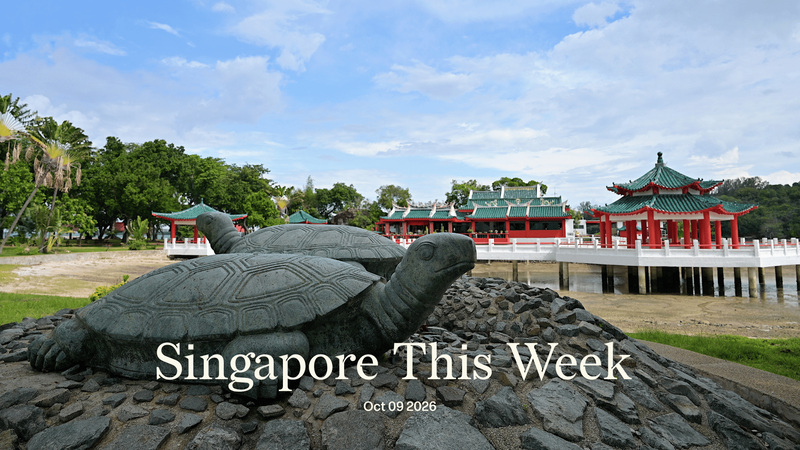
There are many stories about the island’s murky origins, but they’ve always had three anchors: the raging sea, the rescuer turtle that turns itself into a refuge, and the resulting lifelong friendship between two men: one Chinese, and the other, Malay. The island, now known as a safe haven, becomes host to several shrines—and to generations of seafarers and islanders who honour the debt to the universe their grateful ancestors longed to repay. Here are all the ingredients for a peaceful life in the Malay archipelago: the multicultural ties of kinship, the syncretic practices of faith, the respect for an untameable sea and the creatures who share it.
But not so much today. Devotees used to descend by the thousands on Kusu Island each year to pay their respects at the red-edged Tua Pek Kong Temple and the yellow-gilded Keramat Kusu: the two sacred spaces that embody its twin spiritual lineages, Chinese and Malay. The month-long pilgrimage season used to see dozens of vendors jostling for spots to sell drinks, snacks, and souvenirs; this year, there will only be four stalls. About 30,000 visited in 2019; visitorship nearly halved by last year, to 15,500. Seet Seng Huat, the 78-year-old custodian who’s cared for the temple for three decades, lamented a lack of cultural memory across generations of Singaporeans. “[The younger generation] don’t know the significance of the pilgrimage, and the older generation have also not managed to convince them to come along or learn more about it,” he told CNA. “The Kusu pilgrimage is actually very meaningful. It’s been passed down for so many generations, and has been taking place even before we were born.”
Our veneration of these tutelary gods tethers us to the broader folk practices of the region. In the Straits Settlements of Singapore, Penang, and Malacca, you’ll see both roadside shrines and grand temples erected to folk gods who observe Islamic customs—no pork offerings here—Chinese deities donning songkoks and sarongs, and even the Hindu god Ganesha worshipped alongside them. Ho Yong Min of The Urbanist Singapore, which leads heritage walks and experiences, was concerned that the pilgrimage might eventually become a sanitised tourist event, stripped of its deeper meaning. “What’s at risk is the legend as something believed and enacted, kept alive by people choosing to go every year and be part of it.”
There is, however, a musical group that’s been persistent both in its commitment to traditional origins, and also our archipelagic porosities. The Siong Leng Musical Association, founded in 1941, performs nanyin concerts at the Tua Pek Kong Temple each year. This intimate form of Southern Chinese music pares the orchestra down to its chamber parts and relies on an unusual ensemble: the paiban, a set of bamboo clappers to keep time, rarely seen in other Sinophone musical forms; the pipa, a plucked-string instrument resembling a lute, played sideways instead of upright; the three-stringed sanxian with a slender neck; the dongxiao, a vertical flute; and the erxian, a two-stringed fiddle. Nanyin also depends on delay, where instruments often don’t start and stop in unison, but rather enter into a conversation of melodic arrivals and departures, of anticipation and suspension. Siong Leng has been distinctly syncretic in its approach to repertoire, frequently incorporating the intricate rhythms of the tabla, the brassy harmonies of Asli music, and even Javanese dance. You can see them in action on November 7th, from 5pm at the temple—where you might also want to thank a turtle, touch a tree, then tread the 152 steps to the keramat and tithe what you can to the gods who came before, so we might protect the generations who will come after.
Some further reading: In this essay, doctoral researcher Soh Chuah Meng Esmond explores the expansive cosmologies of keramat and datuk worship in the Singaporean Chinese community; and in this one, musicologist Tan Shzr Ee offers an introduction to the history and accommodating musical arrangements of nanyin.
Abhishek Mehrotra, Sakinah Safiee, Corrie Tan, and Sudhir Vadaketh wrote this week’s issue.
Letters in response to any blurb can be sent to sudhir@jom.media. All will be considered for publication on our “Letters to the editor” page.
If you enjoy Jom’s work, do get a paid subscription today to support independent journalism in Singapore.