
News this week included: Trump warns the UN he’ll “annihilate” Iran; The Straits Times (ST) on Trump and Xi; Malaysiakini on the legality of Najib’s controversial house arrest; Red Dot United marks sixth anniversary with 50-candidate ambition; SG backs calls for greater frontier AI regulation; SCMP on why AI giants are using SG as a test-bed; Nvidia’s latest AI chips in SG’s public safety robots; Waymo’s driverless cars here from 2028; SIA crowned world’s best airline; ST on “money trauma” in SG; former Sembcorp Marine CEO acquitted in Brazil “carwash” corruption case; vessels collide in SG waters; Chan Chun Sing on RSIS’s 30th anniversary; Tommy Koh on SG’s foreign policy “realism”; police investigating workplace complaints at LawSoc; HDB converts some Tengah housing land to park after consultations; solar investments saved SG S$123.8m in higher fossil fuel import costs, says Finland-based centre; Shell Singapore fined for Pulau Bukom oil leaks; Tuas sorting facility boosts SG’s recycling effort; new MSF unit to faster identify child abuse (and a ST commentary on using big data for this); two arrested after Italian probe into Telegram child abuse network; more young Singaporeans seeking longevity treatments; two-year-old one of 400 globally with rare genetic disease; mid-market gyms feel the heat in SG’s golden age of fitness; CNA commentary on technology turning us into “hasty readers”; Joo Chiat’s car-free street party on Oct 3rd; ST’s “haze season” skincare guide; and horrific animal abandonment stories: 71 cats in a flat, and 23 rabbits in the wild.
Below are the issues we explore in depth:
Society: This caffeinated life
“I need my caffeine fix.” The phrase is uttered so casually, and so often, that we barely register what it implies: a craving for a stimulant that has become part of everyday life. Among young people, caffeine has increasingly been used to boost attention, fight fatigue, and improve performance. Now, the practice of “caffeine stacking”—combining several caffeinated drinks—has prompted a warning from the Consumer Association of Singapore (CASE). It’s cautioned teenagers against mixing naturally caffeinated beverages such as matcha and coffee with energy drinks, after tests found that some common concoctions could easily exceed the recommended daily limit of 100mg of caffeine for those aged 12-18 years.
Four mixes—each containing matcha and one energy drink—exceeded the recommended daily limit, while the strongest “stacks”—espresso combined with Monster and Red Bull—contained nearly three times as much. Excessive caffeine consumption can cause headaches, rapid heart rate, anxiety, tremors and insomnia. Melvin Yong, CASE president, urged youths and parents to check caffeine information on labels where available, to keep track of intake throughout the day, and to avoid caffeine late in the day, which might disrupt sleep. For better concentration and performance, CASE instead recommended prioritising quality sleep, balanced meals, and sufficient hydration.
It may be time for Singapore to require clearer disclosure of caffeine content, much as it does for sugar levels under the Nutri-Grade system. Last year, Yong, who’s also an MP with the ruling People’s Action Party, asked whether the Ministry of Health (MOH) was studying the UK government’s proposed ban on sales of high-caffeine energy drinks to under-16s. MOH replied that there was no recognised health-based guidance for caffeine intake, nor any international standard governing how much caffeine may be added to food. It added that the ministry and the Health Promotion Board would continue to monitor overseas developments, while encouraging Singaporeans “to adopt healthier diets overall”.
The UK has since confirmed its ban will take effect next April. Spain has announced a similar move, following countries like Poland and Romania, which have prohibited sales to minors for several years. Data from the European Food Safety Authority indicates that adolescents are the age group with the highest consumption of energy drinks, with some classified as high chronic consumers. There’s no product-specific legislation at the EU level, although high-caffeine warning labels are mandatory. Close to home, Australia and New Zealand require “formulated caffeinated beverages” to declare the average caffeine quantity in milligrams both per serving and per 100ml. They must also state that the product contains caffeine and warn that it isn’t recommended for children, pregnant or breastfeeding women, or caffeine-sensitive people.
Against this backdrop, placing the onus squarely on young people (and their parents) to police their own caffeine intake seems inadequate, particularly in a culture where academic and professional achievement already exacts a heavy toll, contributing to chronic stress and lost sleep. It is also oddly hands-off for a traditionally paternalistic government.
There is nothing new about caffeine use. Wild coffee plants originated in Ethiopia, its precious “bean” found in the centre of a cherry-like fruit. Before it became a beverage of choice, the fruit was used in a number of preparations, including mixed with animal fat to make a protein-rich bar. Yemeni sufis were believed to be the first dedicated drinkers of the rich, aromatic liquid; its psychoactive effects especially useful during long, night prayers.
From social ritual to a seemingly “natural” means of extending the productive day. But regulation isn’t the only answer. It’s also worth asking why so many young people feel they need excessive levels of caffeine to function. When exhaustion sets in, the healthier response should be the simplest one: to feel able to stop and sleep.
Society: The messenger
Among the billions of celestial objects floating around in the cosmos of the human body are molecules called messenger ribonucleic acid (mRNA). Within each cell, the single-stranded mRNA carries instructions from the double-stranded DNA to the part of the cell that makes proteins—like a temporary biological manual. Already in the 1970s, scientists were experimenting with ways to deliver new mRNA into human cells to better understand the body at a molecular level. Within a decade, they’d understood how to synthesise mRNA in labs too.
Some other smart people then realised that this synthetic mRNA could be used to prod the body into producing essential proteins that it lacked or proteins that could train the immune system to recognise and destroy pathogens. But among the myriad obstacles separating theory from practice was the fact that synthesised mRNA is notoriously unstable, unable to keep itself together long enough to enter cells and impart instructions. A tantalising treatment modality remained frustratingly out of reach.
Later tech advances helped a new generation figure out how to place mRNA within lipid nanoparticles (LNPs)—tiny packages made from fat-like molecules that protect fragile cargo much like helmets do skulls—so it wouldn’t degrade as quickly. By 2015, companies like Moderna had raised around US$1bn (S$1.26bn) from investors hoping for big paydays from mRNA-based approaches that could turn the body itself into a miniature drug factory and pharmacy. That grand vision proved exceptionally hard to realise.
Moderna and others increasingly focused on vaccines—seen by some as disappointingly unambitious until we were all slammed by the pandemic of a lifetime. The decades of research allowed mRNA firms to design a vaccine in days, with clinical testing beginning as many countries went into lockdown. The recipe was deceptively simple: inject mRNAs, housed within LNPs, with instructions for cells to create a version of the coronavirus’s “spike protein”, which the immune system would learn to recognise as foreign, to be dealt with sternly. There were side-effects, including rare tragic ones, but there is little doubt that the mRNA vaccine’s success during the pandemic is one of pharmacology’s crowning 21st century achievements.
It also unleashed fresh enthusiasm and funding for mRNA tech, and just last month Moderna announced stunning topline results from a Phase III trial involving 1,100-odd melanoma patients. Those who received a personalised mRNA vaccine in combination with an established treatment had a significantly lower risk of the cancer returning or spreading compared with those on the treatment alone.
Amidst all the jubilation and optimism, Singapore has announced plans to develop and manufacture mRNA vaccines which could be modified and scaled in the event of another, unknown pandemic, termed Disease X. “It [mRNA] offers the most flexible platform and fastest to market, fastest to develop, fastest to produce. And with AI technology, I think you can reiterate the solutions much faster,” said Ong Ye Kung, health minister.
Given the current gloomy AI zeitgeist, perhaps it’s a good time to be reminded of its immense potential. With mRNA specifically, AI could speed up vaccine design, allowing researchers to power through iterations, and helping them figure out how to keep mRNA stable for longer. Knowledge would compound, and millions could benefit (even though equitable access would still have to be figured out). As our ancestors with fire, we are dealing with something that could elevate life or end it. The agency, for now, still rests with us.
Sports: The choir-girl’s chops
“Barbaric” and “human cockfighting”. That’s what John McCain, US senator, called mixed martial arts (MMA) in 1996. The very first Ultimate Fighting Championship (UFC) in 1993 featured just three rules: no biting, no eye gouging, and no groin shots. Promoters sold it as a real-life version of “Mortal Kombat” and “Street Fighter”. By 2007, with the sport having adopted more rules and gained broader societal acceptance, McCain changed his mind. New York state became the last US state to legalise it in 2016. And in the decade since, MMA has risen in tandem with the MAGA movement. The parallels between a muscular, carnal, testosterone-charged, battle between two humans, and a president that seeks to impose a “might makes right” international order, are painfully obvious. In June this year, UFC Freedom 250 was held on the White House’s south lawn.
Yet this image of MMA—sweat-and-blood soaked men with black eyes, toothless grins, and too many tattoos—is but one. Alongside are mellower versions. MMA’s core building block is Brazilian jiu-jitsu, a century-old sport that combines grappling, ground fighting, and submission holds. (MMA adds on striking elements, from boxing, Muay Thai, and elsewhere.) Over the past two decades jiu-jitsu has grown exponentially around the world, championed by celebrities like Anthony Bourdain. Around Singapore today, there are adherents young to old. Focus, stress-relief, discipline, and strength-training are just some of its stated virtues. MMA itself also grew. Some milestones include the Evolve MMA gym opening in 2009; ONE Championship’s first local event in 2011; and UFC’s in 2014.
But for Singaporeans in competitive jiu-jitsu and MMA, the journey has been mixed, as May Ooi, a national swimmer-turned-MMA fighter, asserted at Jomfest earlier this year. On the one hand, like other smaller sports, the road to a medal is relatively easier than in fiercely competitive ones, like swimming. On the other hand, medals don’t necessarily translate into funding and support, like they do in sports with fully-fledged National Sports Associations.
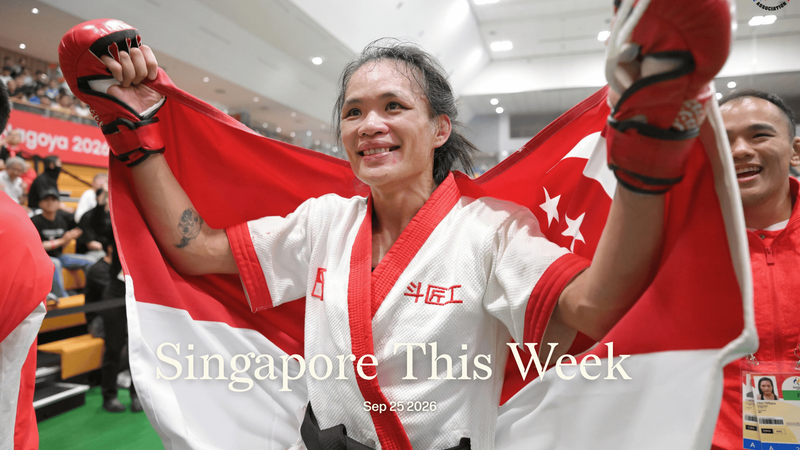
All this is why Tiffany Teo’s MMA gold medal (Singapore’s first in the tournament) on the sport’s debut at the ongoing Asian Games, is so important. “A bigger goal of mine [than the medal] is to grow the sport of MMA in Singapore,” she said. Teo’s childhood, as narrated to The Straits Times (ST), is one many Singaporeans might relate to. “[N]ever into sports growing up”, Teo chose the choir in primary and secondary schools, “because it was the most chill CCA [co-curricular activity] and I could sit in an air-conditioned room.” At 17, she took up taekwondo to keep fit. Muay Thai and MMA followed. There’ve been many ups-and-downs in her 10-year career in the sport, including a loss in a 2018 title fight that the referee had to stop in the fourth round. “I got beat up on international TV. My face was bruised up. My ear blew up after the fight, and I needed surgery.” She avoided her family for a week—not wanting them to see her injured—after what she calls the defining point of her career.
Over the decades Teo’s taken breaks, moved in and out of One Championship’s embrace, and contemplated retiring. During this “dark period” she, along with husband and coach Sim Kai Xiong, co-founded Homeground MMA in Clarke Quay (“🧒 FREE Kids trial class”). And a series of events led to her competing in the Asian Mixed Martial Arts Championships in May in Tashkent, Uzbekistan, where she lost the final to local Khilola Sobirova. Earlier this week, she gained revenge in an overtime victory in Nagoya, Japan, and was later seen crying, then on the shoulders of her hubby, then giving interviews in her blood-stained uniform, then on the podium with her spectacles back on, looking every part the geeky kid. A Singaporean choir girl whupping an Uzbek from the Eurasian steppe? Not the sports story we thought we’d be writing.
History weekly by Faris Joraimi
The zapin is a performance practice popular across our region, from Singapore and the western Malay Peninsula, to the east coast of Sumatra, Brunei, coastal Borneo, and far out in the isles of eastern Indonesia. No high-profile custody battle has broken out over it yet, in a region notorious for trite debates over ownership of shared history. Yet we just as often come together. As the annual haze crisis reignited tension between countries in the region (with annoyance mostly directed at Indonesia), a recent joint nomination submitted by Brunei, Malaysia, Singapore, and Indonesia will inscribe zapin on UNESCO’s intangible cultural heritage list. In recent decades, zapin’s been kept alive by regional practitioners; in Singapore, it’s taught in CCAs while traditional dance groups have experimented with new choreography.
Like most other genres of Malay dance now called “traditional”, though, zapin was more of a recreational practice rather than a formal genre. It has roots in the music and dance of the south Arabian diaspora in South-east Asia: traders, diplomats, scholars, and saints who married locals and settled in the region. Some of them founded important ruling dynasties and became Malay kings in the sultanates of Perlis, Siak, and Pontianak, among others. An Arabic word, zafn (z-f-n: to gambol) is the origin of Malay zapin. According to Anis Mohd. Nor, a Malaysian scholar of dance, practitioners would say they “main zapin” (play zapin), hence it was something undertaken leisurely, like a game or pastime. It is by playing that the stranger becomes a friend, just like people did at the gatherings that must have transpired over centuries between Arab strangers and their local hosts.
From the precious little I’ve seen and experienced, though, I wonder if there’s still actual playing left in traditional Malay dance. There are masculine men and coy women, smiling to each other very politely. Their footwork is polished and rehearsed. Where’s the easy charm of dancing like in the black-and-white Malayan and Indonesian films of the mid-last century: “Tiga Dara” (1956; dir. Usmar Ismail) for instance, or “Masyarakat Pincang” (1958; dir. Phani Majumdar)? The ST report on this UNESCO nomination asserted rather prudishly that zapin is “associated with budaya (culture), nilai (values) and adab (etiquette)”. These are words my Mother Tongue teachers would use. It is culture by instruction, not play.
For listening, at least, the music of zapin still captivates. The zapin songs of Malaysian singer S. M. Salim and Indonesian singer Iyeth Bustami, are already undisputed classics on the radio and karaoke machine alike. As the plucked gambus produces a filigree of sound, accompanied by the interlocking pattern of the marwas drums, there is still something of the Arabian mariner’s playful song, as he rode the monsoon winds to the Malay world.
Arts: Flipping the script
Flip through any playscript and you’ll often see long chunks of dialogue punctuated by stage directions; conversations between characters and descriptions of their actions that give directors and actors a sense of what to say, and what to do. For two shows opening here this week, however, their scripts are an open invitation to anyone who might dare to tackle them: written without a fixed cast size, without characters or stage directions, but with lyrical episodes that flit between prose and verse, between third person and first. One of the plays is from the 1990s, just as contemporary Singaporean theatre was coming into its own. And another has been on a five-year journey to its very first staging.
Kuo Pao Kun’s “Descendants of the Eunuch Admiral” is one of the late dramatist’s most beloved texts. It follows an unnamed narrator—inspired by the admiral-diplomat Zheng He and his travels through South-east Asia—as he muses over everything from castration and eunuchhood to the sumptuous markets and thrilling bazaars he encounters. “Descendants” was a vehicle for Kuo to think through his notion of Singaporeans as “cultural orphans”, an immigrant society castrated from its cultures and nations of origin, inheriting only fragments of what came before. It’s this “wandering and searching state of mind” that the play also inherits; though its first director, Ong Keng Sen, had a different view. “Being cultural orphans means we could inherit everything and, in a sense, create from a fantasy rather than creating from a rooted reality. That was liberating,” he told ST. He pushed the ensemble he assembled to their physical limits, including a 7.5-minute scene where actress Janice Koh delivered a monologue while spinning 300 times on the spot. Director Jeff Chen’s take, 20 years later, had his cast inflating phallic balloon sculptures and parading in feather boas. It’s this expansive canvas that seduced zone 境, a brand-new cross-disciplinary performing group, that’s putting on what it calls a “psycho-spiritual reimagination” of Kuo’s seminal play. Young theatremaker Ang Kia Yee has zoomed in on the figure of the workhorse, coloured by contemporary Singaporean anxieties around trading freedom for security, pleasure for compliance. She’s also amputated some of Kuo’s text and inserted some of her own, and invited a dancer, an actor and an electronic musician into this new reading of the work.
Michelle Tan’s “The Radicalisation of Mrs. Mary Lim-Rodrigues” poses similar questions about individual liberties and institutional loyalties, but this time in a secondary school, where a brilliant student is failed again, again and again—effectively orphaned by the very system that makes grand promises to support every child that passes through its gates. Except those who don’t conform, that is. Tan, herself an educator of 14 years, wanted to know what it would take to nudge the needle. “What does it take to change a system? And before that, what does it take to change a person?” she told ST. She first started work on the play in 2021, and knew she wanted it to be an open-ended creature that could be performed by any number of people. A first reading had just two; its current incarnation at Wild Rice, helmed by Edith Podesta, features a starry ensemble of nine, headlined by Koh (again!) as the titular school principal who’s transformed in the wake of a tragedy.
Both zone 境’s “Descendants” and Tan’s “Radicalisation” were beneficiaries of years-long incubation processes, with numerous work-in-progress presentations to audience members willing to take a risk on experimental work. If we want to encounter more risky art that dares to redefine the boundaries of performance, we might want to offer them the luxury of longer runways of development. Building a home for art takes time, especially homes in which many configurations of voices are welcome.
Faris Joraimi, Abhishek Mehrotra, Corrie Tan, Tsen-Waye Tay, and Sudhir Vadaketh wrote this week’s issue.
Letters in response to any blurb can be sent to sudhir@jom.media. All will be considered for publication on our “Letters to the editor” page.
If you enjoy Jom’s work, do get a paid subscription today to support independent journalism in Singapore.