
It’s hard for South-east Asians to talk about food without our familiar sibling rivalry and low-stakes nationalism creeping in. Who has the better nasi lemak? Who invented rendang? Where did Batik originate? In mid-2025, that discourse took a bittersweet turn.
Affan Kurniawan was a 21-year-old Gojek rider in Jakarta, and his household’s main breadwinner, supporting his parents and two siblings. His simple dream was to save enough for land and a house in their hometown. Like so many young workers, he endured brutal conditions in the city to make that future possible. But he never got the chance. During a rally over low wages and politicians’ expenses, he was going about his delivery work when an armoured police vehicle ploughed into him.
Affan’s death injected new urgency into an already simmering movement protesting state apathy and corruption. Even more people poured into the streets across Indonesian cities. Soon after, something unexpected began circulating online. An X user suggested that people across South-east Asia could take advantage of the regional compatibility of delivery apps like Gojek and Grab to order food for the riders and protestors on the ground, faraway across the archipelago.
The platforms allowed users to message the riders directly. You could see their names and faces. A university student in Singapore, who might have never considered themselves an activist, could send a hot meal to a rider they would never meet, in a city they had never visited. They could send words of encouragement like “stay safe” or “from SG with love”. There was no need for grand speeches or political manifestos. Here was a tangible, intimate, and personal form of cross-border solidarity that extended beyond moral support: protecting the livelihood of riders, and feeding the protestors themselves. Those who could afford it also tipped generously, knowing that tips went directly and fully to the riders.
Across South-east Asia, people began posting screenshots of their orders placed from hundreds of kilometers away. The hashtag #SEAblings emerged alongside them: a shorthand for South-east Asian siblings showing up for one another. Because that’s what siblings do. We bicker over small things, but we stand up for each other when it matters.
In recent years, this kind of solidarity has been building across borders, coordinated through social media platforms once dismissed as trivial distractions. This is where the story of Gen Z social media resistance—their evolving political identity, and what they reveal about the future of civic life at home—really begins.
Last year will go down in history as the year when, for the first time, a prime minister was elected through Discord (in Nepal), an online messaging platform previously used primarily by the gaming community.
Clearly, those who claimed “the revolution will not be televised” had no idea what the social media age would bring. Today, anyone with access to a screen can witness revolution, often edited to trending audio clips, layered with brainrot slang, and stitched with fandom references bewildering to some of an older vintage. Even if you’ve never been on TikTok, you’ve probably seen the widespread news coverage of Gen Z protests.
These protests began as isolated uprisings, such as the one in Bangladesh in 2024, where Gen Z-led protests against the job quota system built up to a full-fledged uprising that ousted the then-prime minister. By 2025, they had spread globally and gained a distinct Gen Z identity. Some protestors explicitly said they were inspired by what other Gen Z movements were doing abroad. In Nepal, a nationwide social media ban in response to rising anti-corruption sentiments online inspired protests that eventually led to the resignation of the prime minister and other notable government officials. At the time of writing, Gen Zs have taken to the streets in a similar fashion in Peru, Mexico, Morocco, Madagascar, and Bulgaria.
This wave washed closer to home too. In the Philippines, the youth protested against corruption following the flood control project controversy. In Indonesia, protests against the Subianto administration and its policies exploded nationwide. The government suspended TikTok’s license until the platform handed over the data of individuals who livestreamed the protests.
Whether we like it or not, TikTok, and to a lesser extent, Instagram Reels and YouTube Shorts, has become a geopolitical force. Gen Z, the first digitally-native generation, has finally aged into the voting bracket. Naturally, we’re bringing our unique brand of civic energy along with us. Sure, we use TikTok to lip sync and dance to trending songs, but we also use it to organise, mobilise, and occasionally take down governments.
The language of these uprisings is telling. They’re not called “youth” or “student” protests— terms with decades of precedent. They’re called Gen Z Protests, a label that marks not only age, but a shared identity that transcends national borders and social structures. This, in itself, is unusual. Previous monikers like Boomers or Millennials gained currency after distinctive cultural patterns had already emerged. With Gen Z, generational identity has become an active, present-tense lens through which culture is understood.
The generational label, once used in more familial or demographic contexts, has become something else entirely. Today, it functions as a sociocultural identity, reinforced and amplified by social media. A 19-year-old in Kathmandu and a 19-year-old in Jalan Besar likely have wildly different lived experiences, native languages, and material realities. Yet, both are steeped in a shared media ecosystem unconstrained by geography, and speak a recognisable digital dialect.
It’s no secret that Gen Z has a bad rep. It is caricatured as undisciplined, entitled, and lazy. These surface-level jokes obscure a more complicated reality. We are, statistically and subjectively, a generation shaped by contradiction.
We are the most educated generation to date, raised on the promise of a stable, meritocratic economy—only to come of age amid a global pandemic, rising inequality, unaffordable housing, and increasingly fragile social and political institutions. Some of us are thriving in new sectors like tech and creative industries, while others face the distinct possibility that they may never own a home. Despite decades of material progress, we are the generation that has been hit hardest by the global mental health crisis. The list goes on.
These pressures not only shape our opportunities, but also how we cope with them. We are hyper-literate yet brainrotted. (I may or may not have called a member of Parliament a “corporate baddie” to their face once.) We blend earnest discourse with coded satire, often in defiance of the proprieties of formal political or corporate settings. Memes, silly images, and audio clips are catharsis as much as comedy in a world that often feels dire and unresponsive.
Which brings us to the universal and enduring symbol of these protests: the Straw Hats’ Jolly Roger flag.
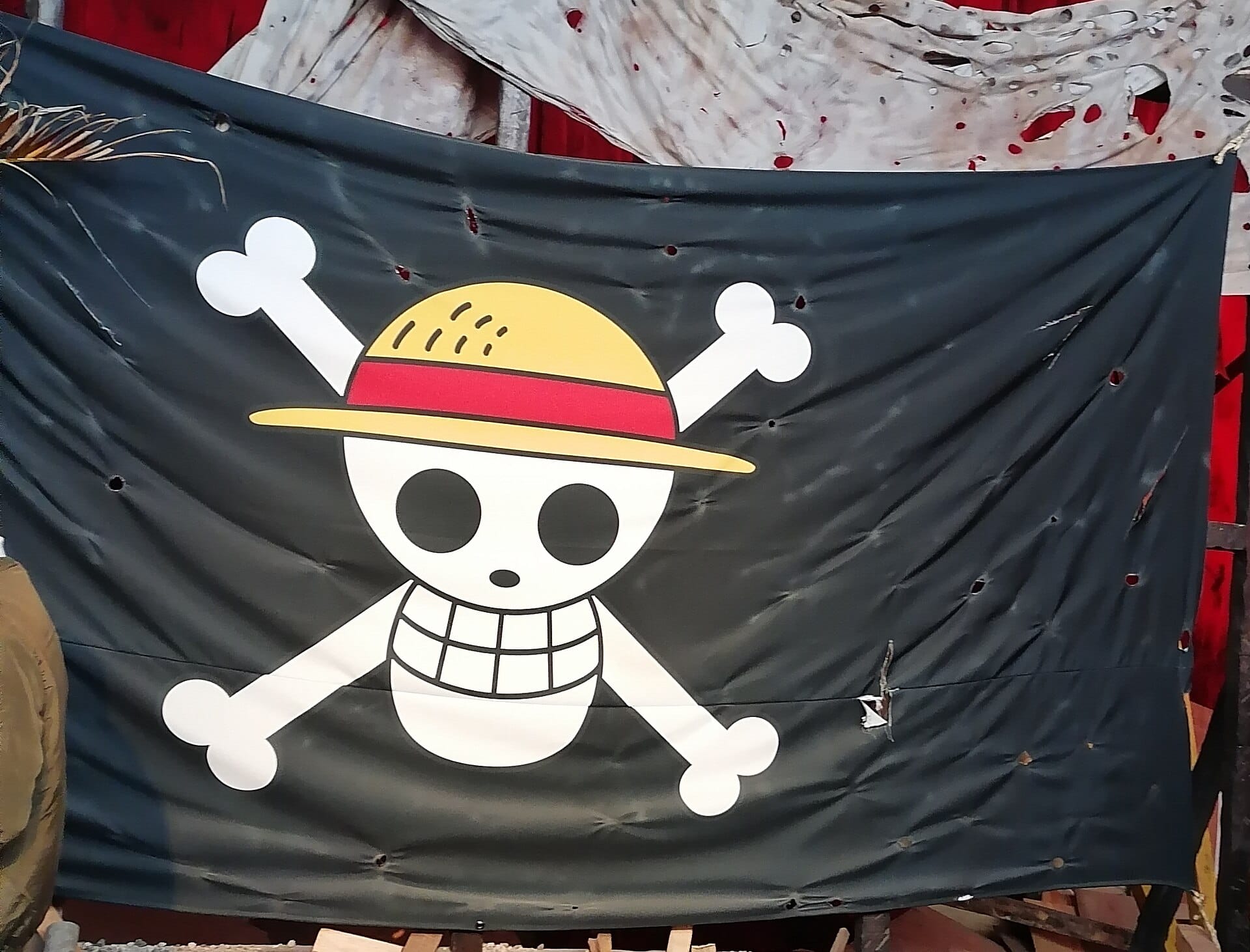
The skull-and-straw-hat emblem originates from “One Piece”, a manga and anime franchise, where it represents a pirate crew fighting for oppressed peoples. Originally tied to themes of freedom, loyalty, and anti-authoritarianism in the series, it has become the most recognisable and universal symbol of the 2025 movements. Some countries even put their own local twist on it: in Madagascar, protestors replaced the straw hat with a satroka hat, a traditional garment of the Betsileo ethnic group.
The same digital infrastructure that spreads the meaningless yet ubiquitously-funny “6-7” meme to tweens worldwide also spreads these more potent symbols, protest techniques, and ideas. Culture diffuses at a speed that older movements simply did not have. “Old-school” organising tactics such as “cold-calling”, pamphlets, and word of mouth required many volunteers to spread the message, which even then, remained limited to immediate social or geographic circles. Today, a TikTok filmed by a teen in a rural bedroom can garner millions of views within hours.
Social media’s virality and addictiveness is no accident. Tech companies have been building towards this moment for decades. In the 1990s and early 2000s, the World Wide Web gave anyone and everyone the ability to play games, exchange files, and talk to strangers across the world without institutional gatekeepers. These early peer-to-peer networks collapsed geography in a revolutionary way. Early social media extended this logic, allowing users to find communities organised around interests or identities rather than physical proximity.
Yet, there is a crucial difference between then and now. In the internet’s earlier eras, users actively sought out their communities. You searched for forums, joined groups, and followed pages. Agency rested largely with the individual. Current social media platforms flip this relationship.
TikTok’s algorithm, for instance, dictates how information travels, amplifies, and mutates online. When you open the app, you don’t see posts from your friends. You see the For You Page (FYP), which delivers recommended content based on your prior interactions, watch time, and engagement patterns. Videos are tagged with keywords, and those that perform well in small niche communities are pushed outward to increasingly larger audiences. If those videos perform well with a more general audience, the algorithm starts pushing out similar content, turning a trickle of interest into a full-fledged wave of public attention.

Once you interact with a particular type of content—by watching the video to the end, liking, commenting, sharing with a friend—the app responds by feeding you more of the same. Ultimately, these platforms just want one thing: for you to stay on them as long as possible.
(That’s a quick explainer. If you’d like to go deeper, I’d recommend Algospeak by Adam Aleskic.)
Crucially, virality no longer depends on status, in-person networks, or even intentionality. Anyone who touches on the right idea at the right time can be catapulted into millions of feeds. Gone is the 2010s era of posting for people you already know.
Another way to ponder this seismic shift is by contrasting it with classical diffusion theory (see chart), whereby ideas spread slowly through an adoption curve. Early adopters pass something on to their immediate social circles, momentum builds gradually, and only after a tipping point does wider uptake occur. Social media compresses this entire process. Platforms like TikTok collapse the distance between early adopters and mass audiences, allowing ideas to jump quickly from niche to mainstream if they satisfy the algorithm’s engagement criteria . Terms undergo a Darwinian “survival of the fittest”, where the most engaging slang and ideas achieve global reach in a short time, while others fall into irrelevance and obsolescence just as quickly. What looks chaotic and inscrutable from the outside is in fact, a highly efficient engine for mass cultural transmission.
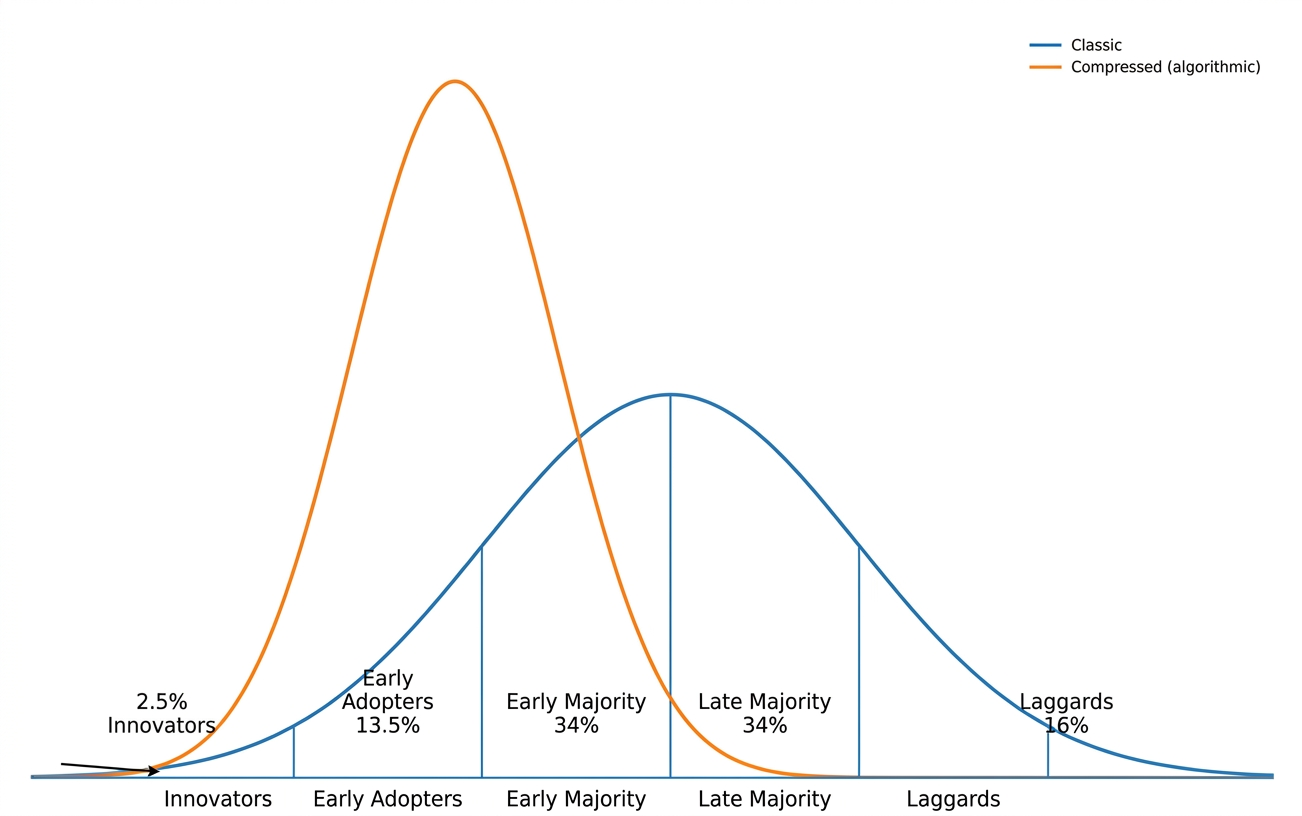
The Rogers Diffusion curve in classical diffusion theory (blue) is compressed (orange) by platforms such as TikTok, causing ideas to blow up and/or die out much faster than before.
Here’s the other kicker: you don’t need to be on TikTok for this to matter to you. Even if only a portion of the population is on the app, once narratives gain enough momentum there, it inevitably spills outward into WhatsApp chats, mainstream news, and dinner-table conversations. Opting out of TikTok doesn’t mean opting out of this new style of politics.
We’ve seen this dynamic play out linguistically: after the “side-eye” meme exploded on TikTok, Google searches for the term spiked more than tenfold and stayed elevated long after the trend’s peak. People who had never touched the app nor had any idea where the phrase originated were suddenly using it in daily life. Similarly, political discourse and culture established and incubated on social media do not stay there.
This style of organisation is markedly distinct from mobilisation through traditional social structures. Information historically flowed in two primary ways: top-down, through institutions such as governments and large corporations that controlled the media; or horizontally, through existing social ties such as those with friends, family, classmates, and colleagues.
Early digitally-organised movements were still reliant on these vertical structures. Hong Kong’s Umbrella Movement (2014) was, in many ways, an early prototype of the digitally-amplified protest. Yet, it still relied on recognisable networks such as student and civic groups on college campuses. But recognisable structures and leaders later proved to be a vulnerability. Prominent organisers were identified and jailed, and with their removal, much of the movement’s momentum dissipated. Social media, used as a tool to conceal identities, spread information, and mobilise quickly, amplified the movement, but had limited reach outside of existing activist circles.
Similarly, the Arab Spring (2010-2012) has also been mythologised as a “social media revolution”. It unfolded in an ecosystem where “activist and broadcast media complemented each other, allowing the coverage of areas that would have been unfeasible to reach, without losing the power of diffusion held by the established media”. This dynamic made it possible for everyday citizens to document events and push back against institutional narratives without fully displacing the gatekeeping role and reach of institutional media. The political outcomes of these uprisings were mixed and remain contested even today.
Gen Z’s style is different. The emphasis on shared ideas, rather than existing relationships, to foster community produces the first defining feature of Gen Z political organising: horizontality. Unlike previous movements that had recognisable leaders, organisers, or activist circles, Gen Z protests are born from content rather than command. The algorithm flattens everything from geography and hierarchy to political context.
While some of the content originates in traditional, “institutional” media, they are not necessarily encountered there. Surveys suggest that social media is rapidly overtaking TV and new sites as the primary news source. They reach the youth as clipped, captioned snippets on TikTok rather than the front page.
A damning expose about the embezzlement of government funds goes viral. Someone remixes a nepo baby rant, and it becomes a rallying cry against inequality and corruption that was even blasted at an EDM festival. The hashtag #SEAblings helped organise regional efforts to support protestors and food delivery drivers in Indonesia. What begins as individual frustration quickly builds into collective momentum.
These algorithm-driven movements spread contagiously, without central figures, hierarchical structures, or intermediaries. Much like actual viruses, viral content spreads exponentially and there is rarely a clear “patient zero” we can identify. Even if we could, “controlling” that creator would do little to stop what has already spread. Once you reach a critical mass of people posting, stitching, remixing, the movement becomes self-sustaining. In such an environment, traditional leadership is neither necessary nor natural. In stark contrast, modern governments operate vertically through command structures, where legitimacy is tied to institutional authority.
When these orthogonal systems collide, things can spiral.
Feeling destabilised by a movement with no identifiable leader, governments often reach for outdated tools that are almost always counterproductive. For instance, they might ban social media, as with TikTok in Nepal after anti-corruption sentiment exploded on the platform. Censorship could also take the form of certain political keywords, such as protest, being allegedly filtered or downranked on the platform algorithm. Platform restrictions are another tool, such as when livestream functions were disabled in Indonesia after protests first broke out. Perhaps the most draconian action might be blackouts, like when mobile internet services were shut down in Bangladesh amid Gen Z protests.
These actions assume that digital mobilisation works like past organising: cut off communication and the movement dissolves. But TikTok movements have no leaders who can be arrested, offices that can be raided, or websites that can be shut down. In fact, digital suppression can turn online outrage into fury on the streets.
All these dynamics were in play during the Nepal protests. What began as generalised frustration about corruption, unemployment, and economic stagnation gained traction through short-form videos. I still remember seeing, on my own FYP in Singapore, an image of a minister’s son posing beside a Christmas tree of Louis Vuitton, Cartier, and Gucci bags, in a country where many young people are struggling to secure basic economic stability.

For many, the government’s subsequent TikTok ban proved that the state feared transparency and had no genuine commitment to solving problems. Some Gen Z protestors with prior experience tried to set the tone for the protests: non-violent and non-partisan. Early on, water, food, and medical tents were set up, and protestors were all “seated, singing old Nepali songs”. Soon, eyewitness accounts reported the arrival of protestors on motorbikes who pushed toward restricted government zones and set fire to vehicles. A protest that began peacefully was quickly co-opted by smaller, more radical groups. To protestors, outsiders, and the state, it was near impossible to distinguish between the peaceable and the violent groups.
The police, fearing that the entire Gen Z contingent was violent, retaliated with tear gas, water cannons, and shots of their own. Violence quickly escalated, and within 48 hours of the start of the protest, the parliament building was set on fire and dozens of protestors were killed. The finance minister was chased through and attacked on the street. In global media coverage, Nepal was celebrated for a “successful” and highly efficient government overthrow. The country elected its first female head of government (on an interim basis) on an online messaging platform. Most recently, in March, the four-year old Rastriya Swatantra Party (RSP), led by an ex-rapper, won the election in a landslide.
Yet, many early protestors later said that they had not intended, nor desired a complete government overthrow—and it goes without saying: neither did the state. Within the movement, the views were far from unified. Allegations of external influence, alongside controversy around emerging figures reflected deeper fractures over representation and direction.
TikTok-based mobilisation comes with a paradox. The horizontality that gives these moments scale also deprives them of coherence. This leaves them susceptible to co-option by a vocal minority, who could end up pushing ideologies or violent means that do not represent the beliefs of the majority.
These movements are also extremely effective at opposing something—corruption, inequality, police violence—but less effective at articulating what comes after. Once power is toppled, they often scatter. Momentum dissipates. The very architecture that makes them possible also constrains their longevity.
In Nepal, there was no clear, collectively agreed-upon agenda for the next steps. The lack of cohesion meant that those protestors who were originally invited as advisors to the new government eventually found themselves sidelined again. Whether the protest will ultimately engender better conditions for young Nepalis remains to be seen. Similar examples have appeared elsewhere, with varying levels of success.
In Singapore, the stakes are different, and thankfully, much lower. We benefit from stable institutions and relative material wealth, so our struggles are rarely existential. But our digital environment is identical to that of our peers abroad.
We face our own pressures—housing anxieties, rising costs, civic opacity—and we voice these frustrations through the same infrastructures: TikTok rants, Telegram channels, Reddit threads. These conversations already shape our elections. During GE2025, commentary and analysis in the form of short-form videos and longform podcasts frequently hit hundreds of thousands of views, often reaching audiences traditional media struggle to access.
Yet our political system, much like others around the world, still functions vertically. This is where tensions surface. Guitar covers or “get ready with me” videos may humanise politicians, but these gestures are often aesthetic. They rarely engage in the hard discourse circulating horizontally about public housing, public transport, workers’ rights—conversations often wrapped in memes and slang but rooted in very real concerns. When such content is dismissed as “just kids joking around”, because it defies the proprieties of traditional political discourse, we risk trivialising genuine sentiment.
We are accustomed to traditional channels to raise concerns, such as Meet-the-People Sessions in void decks, house visits, and formal letters. You dress down, show up at the void deck in slippers and an army tee, and still expect to be taken seriously. It should be the same on social media. Dressed-down language should not mean diminished legitimacy. Parody videos of politicians’ “humble background” stories are satire, yes, but they also reveal deeper feelings about inequality and the perception that some leaders are out of touch.
Our official channels still treat social media like state media. On Facebook, our political figures post long, curated speeches or share photo ops with followers who have already chosen to see their content. Viewers can then interact with their content through liking or commenting, but rarely through creating content of their own, keeping the conversation relatively top-down. Your Facebook feed consists mostly of your friends or family and pages you follow, and is thus more constrained to your existing physical and social circles.
But modern social media is a public square, not a bulletin board. This is also why TikTok is not just a “new Facebook”. The app’s FYP connects you far outside your network. Politicians now compete in the same attention economy as absurdist memes, fan edits, and layperson commentary. (Search Jo Teo on Google and see who pops up. Then do the same on TikTok.) Authority in the “real world” such as titles, office-holding, or prestige, does not automatically translate into authority online.
This is the reality political institutions must adapt to. Traditional methods of top-down control are not just ineffective, they can be actively counterproductive in this new TikTok age of politics.
When policymakers worry about social media activism, the fear they articulate is usually dramatic: unrest, instability, riots like those we’ve seen overseas. The more immediate threat here, however, is something quieter: the evaporation of the middle ground.
Polarisation has always been part of politics. The difference now is that new social media algorithms amplify the extremes. Our social media landscape is not just reflecting existing political division; it is actively shaping it by rewarding the most emotionally charged content.
In the newspaper world, you could disagree with a headline, but you were at least looking at the same front page as the person you disagreed with. Today, algorithms reward provocation. Content that provokes strong emotions is most effective at holding your attention and keeping you scrolling. This is why “rage bait” is Oxford English Dictionary’s Word of the Year in 2025. What’s more, the longer you stay, the more of the same content you are shown and the further you are pushed into an ideological bubble. As a result, two people can live on the same street yet inhabit entirely different political realities, each meticulously curated by their personal feed.
There is something genuinely democratic about this shift. Marginal stories can break through without institutional permission, allowing voices once excluded from mainstream media to reach mass audiences. But the same flattening that enables this also sidelines editorial standards and mechanisms of accountability. Viral falsehoods and inflammatory rhetoric are no longer filtered through shared norms of verification. At its worst, this dynamic spills beyond the screen into physical and political violence (for example, the January 6th attack on the US Capitol). Consuming politics primarily through short-form video is not inherently corrosive, but it is undeniably a double-edged sword.
In this climate, opinions calcify before they can be contextualised. We see miniature versions of this every day: anonymous accounts attacking content creators; pile-ons over minor political statements, and the automatic assumption that critique equals disloyalty or opposition.
I’ve personally experienced the ugliness of this—threats, harassment, dogpiling. I am labelled an “oppie dog” the moment I call for greater transparency, even though I make it a point to avoid naming specific political parties or making any personal attacks in my videos. Viewers proudly comment that they’ve lodged police reports over my educational content. After one particularly scathing commentary, I received a mysterious platform ban.
Polarisation in Singapore will not look like burning barricades. It will look like mutual incomprehension and parallel realities curated by personalised feeds. It will look like a generation fluent in mobilising outrage but never taught how to build consensus. In a society that prides itself on social cohesion, this is a structural vulnerability we cannot ignore.
This isn’t all doom and gloom. The very architecture that enables polarisation also enables community. If we approach digital public spaces as civic infrastructure rather than hazards to be controlled, we can strengthen our democratic culture. This requires commitment on both sides.
For leaders, it means entering the digital public square with humility and reciprocity. Not just to perform relatability, but to engage seriously with the discourse that already exists, even when presented in unfamiliar vernacular. It means responding to concerns raised in TikTok comments with the same respect as concerns raised at MPSs. It also means modelling disagreement without contempt, and setting the tone for political discourse that is robust but not dehumanising.
For citizens, the challenge is to harness this horizontal capacity not only for moments of protest or anger, but also for sustained civic building. If we can channel the global lessons without replicating the volatility, we have a chance to build a political culture that is accessible, participatory, and stable.
We can start small, with local issues that matter to us: school stress, rental conditions, neighbourhood safety. From there we can build up, and organise around climate justice, mental health advocacy, migrant rights, economic equity, among others. When we build communities and habits of constructive discourse around “small” concerns, we build a system that is resilient when larger, potentially more destabilising issues arise. We have the safety of observing the recent protests around the world from a distance, and should use this privilege to design and build a uniquely-Singaporean model of digital-era democracy.
No matter what kinds of controls or bans are introduced—whether aimed at combating misinformation, protecting youth mental health, or, in less generous interpretations, suppressing dissent—social media is here to stay. And so is its political dimension.
Jo Teo (not the MP, yet) is a theoretical physicist who brings a quantitative lens to their witty TikTok political commentaries, most notably on GE2025. As an incoming Schwarzman Scholar at Tsinghua University, they hope to explore how social media is reshaping politics.
Letters in response to this piece can be sent to sudhir@jom.media. All will be considered for publication on our “Letters to the editor” page.