
Fresh off the stonking victory by the ruling People’s Action Party (PAP) at the 2025 general election (GE), Lawrence Wong, prime minister, has, as expected, reshuffled his cabinet. But how significant are the changes? And what do they tell us about the manner in which Wong will govern?
Our assessment is that Wong has shown himself to be a meticulous tinkerer, rather than a reformer, who’s rewarded electoral performance, while distributing power so as to foster teamwork between strong-headed individuals and ministries. He’s also cannily left himself latitude to test out new cabinet members before confirming them.
Perhaps most intriguingly, we also see the emergence of Wong the electoral strategist. His picks suggest that he’s already plotting an eastern defence, to try and neuter the inevitable ambition of the Workers’ Party (WP) at the next GE. Finally, the main disappointment is the paucity of women and ethnic minorities at the top.
Let’s start with the tinkering. No surprise that Lee Hsien Loong and Gan Kim Yong have retained their respective positions as senior minister and deputy prime minister (and minister for trade and industry). They’ve in some way mentored Wong over the past decade—Lee through the party ranks and Gan most notably during the Covid-19 pandemic—and will continue as a supporting cast. The former will be in a sort of emeritus professorial role, à la Gandalf the Grey, dispensing “wisdoms” as (we hope) the last of the Lees in politics.
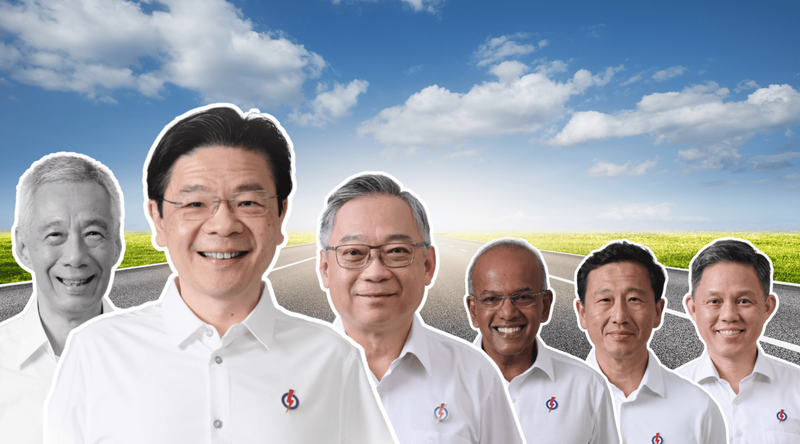
That Lee will be far from operational duties was reinforced by his absence from Wednesday’s cabinet announcement. Wong was flanked by Gan and three coordinating ministers, Chan Chun Sing, K Shanmugam and Ong Ye Kung. “So that's four senior leaders in my cabinet. They are part of the core team to assist me, to advise me, and also to provide guidance and mentorship to the new and younger ministers.” In his absence, Wong said, Gan will be acting prime minister, and in both their absences, he’ll appoint one of the three.
Chan and Ong were erstwhile rivals for the top job. Like Barack Obama’s appointment of Hillary Clinton as state secretary, and countless other efforts to co-opt political rivals throughout history, Wong is smart to keep them close but in their lanes. The “task force man” Gan will one day get his long-awaited retirement, and so Wong has positioned both Chan and Ong for ascension to deputy, no doubt dependent on their performance and loyalty. Chan will also serve as Singapore’s new minister for defence, a role for which the major-general, with his drill-sergeant utterances, seems tailor-made. Ong will also continue as minister for health.
Perhaps no other individual’s future role was as closely watched as K Shanmugam’s, who’s served as both law and home affairs minister since 2015. This dual role meant that he oversaw everybody from the Attorney-General’s Chambers to the Internal Security Department and the Singapore Police Force. Wong has, thankfully, bifurcated it, appointing Edwin Tong, part of the same fourth-generation (4G) of PAP leaders, as the new law minister.
Shanmugam keeps the home affairs portfolio and also takes over from (the retired) Teo Chee Hean as the coordinating minister for national security. Whereas Teo had to “coordinate” with former defence minister Ng Eng Hen and Shanmugam himself—fellow PAP seniors—the latter now has to perform this role with Chan and possibly other 4G leaders. Get along, work as a team, seems to be the message. It’s a similar story with the other two coordinating minister roles: Chan for public services and Ong for social policies. This cabinet sees powerful ministers with possibly overlapping lines and responsibilities, a nod also to the need to break through functional silos in an increasingly complex world. (When Tharman Shanmugaratnam was coordinating minister for social policies, Wong said, “we put in place many inter-agency processes to review and to improve social policies.”)
Shanmugam bulls felt like he might one day make deputy prime minister; bears thought he might be altogether dropped from the cabinet. Many liberals will be disappointed that the fearsome Shanmugam will still be around, but not all. “If I were putting a cabinet together, I would want someone like that [Shanmugam] to be in my cabinet. No question about it,” an opposition politician told Jom last year. “Because there’s a mean nasty world out there, and you need someone who is able to deal effectively without emotion with the kinds of threats that are out there.”
Singaporean conservatives may not mind that he’s no longer the law minister. After FICA, POFMA, the Maintenance of Racial Harmony Bill, and countless other legislative tweaks, they might conclude that his job here is done.
Before GE 2025, Jom and other analysts were relishing the prospect of Shanmugam sparring with Harpreet Singh, fellow senior counsel and WP candidate, in Singapore’s next Parliament. “Absolute balderdash,” Shanmugam had said on an episode of “Yah Lah But”, in response to Singh’s commentaries about the Ridout Road saga. But Singh and his teammates in Punggol GRC lost the election.
Still, with Tong taking over as law minister, there’s another delicious rivalry in the offing. Hopefully Pritam Singh, WP chief, and Tong reprise their fiery, memorable exchanges from the Committee of Privileges hearing on RaeesahGate. “I’m sorry Mr Tong, you’re a good lawyer, but I’m a good listener,” just one of many highlights. Indeed, several analysts speculated that Tong’s selection then was preparation for this upcoming role.
There’s little else remarkable about the new cabinet, and perhaps that’s how most Singaporeans prefer it: same same but different. Josephine Teo, much maligned, retains her portfolio after her team won over 75 percent of the vote at GE 2025 (albeit against mediocre neophytes). Jeffrey Siow and David Neo are the two newbies who have skyrocketed their way in: acting minister for transport and acting minister for culture, community and youth, respectively. “MP Jeffrey Siow being considered for new Cabinet line-up,” headlined a piece from The Straits Times a few days ago. But that should have been a foregone conclusion. As soon as Siow, then second permanent secretary at the ministry of manpower, threw his hat in the ring, we knew he’d be destined for great things. Among other reasons is the obvious practical one: there’s no way the PAP would make him experience a wage drop.
The last new addition to the cabinet is Faishal Ibrahim, the new acting minister-in-charge of Muslim affairs. Masagos Zulkifli, who previously helmed the position, was unpopular in the community even before the Calvin Cheng saga and his team’s narrow GE 2025 victory over the WP in Tampines GRC. All this rendered his position “untenable”, said Walid Abdullah, associate professor at NTU. “I am glad that PM Wong picked up on this. Prof Faishal is quite liked by many Malays/Muslims, so he is the obvious choice in some ways…PM Wong’s decision will definitely earn some goodwill from many in the community. There is a pipeline of younger office holders as well (Zhulkarnain Rahim, Rahayu Mahzam, and Dr Syed Harun), all of whom are really promising.” (Disclosure: Walid’s an endorser of Jom.)
If Faishal doesn’t perform, then, there are others ready to take his place. Indeed, perhaps it’s no coincidence that Wong appointed the three new cabinet members—Faishal, Neo and Siow—as acting ministers, not full. Prove yourselves.
Elections have consequences, Walid also said. In the aftermath of GE 2025, perhaps many younger Singaporeans will realise that their vote can affect not just electoral outcomes, but the appointments of public office holders (POHs). Wong has promoted Sun Xueling and Baey Yam Keng—to senior minister of state for transport and national development, and minister of state for transport and culture, community and youth—almost certainly because of their impressive performances in Punggol GRC and Tampines GRC, respectively. Janil Puthucheary, by contrast, remains as a senior minister of state, seeing a number of more junior members of Parliament (MPs), such as Neo and Siow, fly past him into cabinet—presumably for his relatively poorer performance on the ground in Punggol GRC. (The Malaysia-born paediatrician, who memorably declined to perform National Service when he migrated, now has a taste of a very Singaporean armed forces ritual: hentak kaki.)
Electorally, Wong also appears to be looking ahead to the next GE when, as Jom has argued, we can reasonably expect to see more ambition from the WP, including a Pritam Singh-led team outside Aljunied GRC. But Wong appears to be barricading him by promoting numerous PAP leaders in the adjoining areas, little chieftains to hold the fort: Sun in Punggol GRC; Baey and Neo in Tampines GRC (who’ll join existing POHs Masagos and Koh Poh Khoon); and Dinesh Vasu Dash in East Coast GRC (who’ll join existing POHs Tan Kiat How and Tong). Additionally, he’s also promoted Desmond Choo of adjacent Tampines Changkat SMC. The long-term electioneering has probably begun—indeed, from Nomination Day, when Wong sent some favoured picks to the east.
Every time Singh looks out from Aljunied, he’ll see POHs galore. Will he risk sending out an all-star team like his predecessor Low Thia Khiang did in 2011 (to capture Aljunied from another POH-studded PAP team led by George Yeo)? Will Singaporean voters at the next GE be susceptible to the PAP’s pretence that POHs are invaluable?
The main cabinet disappointment has to do with diversity. There’s just one Indian (Shanmugam), two Malays (Faishal and Masagos), and no Eurasians in the 18-person cabinet. If we include the half-Chinese, mixed-race duo of Vivian Balakrishnan and Indranee Rajah, then we have a respectable 28 percent of the cabinet as ethnic minorities, broadly mirroring their share in the broader population.
But no new women either, and here the problem is far deeper. In an age when many developed democracies have much more equitable gender representation in high office, Singapore’s three female ministers (Grace Fu, Indranee, and Teo) comprise just 17 percent of the cabinet. Anthea Ong, a former nominated member of Parliament, asked why Sun Xueling did not make the cut, both on merit as minister of state and her electoral performance, while two male newbies just sauntered right in.
Surely deep-seated gender inequity isn’t Wong’s problem to fix overnight through cabinet picks. But the structural forces that favour Chinese men as they ascend through antiquated “meritocratic” hierarchies—and lead to them comprising a whopping 67 percent of the new cabinet—are certainly ones he must interrogate. That is, if he truly wants to take Singapore “forward”.
For now, as we await the swearing in of a new cabinet, and wonder if any will come Bible in hand, we should simply be grateful for the small blessings in life: Jesus had only three wise men; Larry has five.
Sudhir Vadaketh is Jom’s editor-in-chief. Letters in response to this piece can be sent to sudhir@jom.media. All will be considered for publication on our “Letters to the editor” page. Read Sudhir’s other essays for Jom here.